Questions

5 Marks Questions

🎯

Test yourself on this topic

6 questions · timed · auto-graded

Question 15 Marks
A start-up company invested ₹ 3,00,000 in shares for 5 years. The value of this investment was ₹ 3,50,000 at the end of second year, ₹ 3,80,000 at the end of third year and on maturity, the final value stood at ₹ 4,50,000. Calculate the Compound Annual Growth Rate (CAGR) on the investment. [Given that $\left.(1.5)^{\frac{1}{5}}=1.084\right]$
Answer
Given that,
Beginning Value $=$ BV $=300000$
Ending Value $=$ EV $=450000$
Number of Years = $n =5$
$
\therefore C A G R=\left(\frac{E V}{B V}\right)^{\frac{1}{n}}-1
$
$
=\left(\frac{450000}{3000000}\right)^{\frac{1}{5}}-1
$
$
=\left(\frac{3}{2}\right)^{\frac{1}{5}}-1
$
$
=(1.5)^{\frac{1}{5}}-1
$
$
=1.084-1
$
$
=0.084
$
CAGR% $=0.084 \times 100=8.4 \%$
Hence the compound Annual Growth Rate (CAGR) on the investment is $8.4 \%$.
View full question & answer
Question 25 Marks
Two cards are drawn successively without replacement from a well-shuffled deck of 52 cards. Compute the variance of the number of aces.
Answer
Let $A _{ i }$ denote the event of getting an ace in $i ^{\text {th }}$ draw, where $i =1,2$.
Further, let X be a random variable denoting the number of aces in two draws. Then, X can take values $0,1,2$. Then, we have, $P ( X =0)=$ Probability of getting no ace in two successive draws
$
\Rightarrow P(X=0)=P\left(\overline{A_1} \cap \overline{A_2}\right)=P\left(\overline{A_1}\right) P\left(\overline{A_2} / \overline{A_1}\right)=\frac{48}{52} \times \frac{47}{51}=\frac{564}{663}
$
$P ( X =1)=$ Probability of getting an ace in one of the two draws
$\Rightarrow P ( X =1)=P\left(\left(A_1 \cap \overline{A_2}\right) \cup\left(\overline{A_1} \cap A_2\right)\right)$
$\Rightarrow P ( X =1)=P\left(A_1 \cap \overline{A_2}\right)+P\left(\overline{A_1} \cap A_2\right)$
$\Rightarrow P ( X =1)=P\left(A_1\right) P\left(\overline{A_2} / A_1\right)+P\left(\overline{A_1}\right) P\left(A_2 / \overline{A_1}\right)=\frac{4}{52} \times \frac{48}{51}+\frac{48}{52} \times \frac{4}{51}=\frac{96}{663}$
$P ( X =2)=$ Probability of getting an ace in each draw
$
\Rightarrow P(X=2)=P\left(A_1 \cap A_2\right)=P\left(A_1\right) P\left(A_2 / A_1\right)=\frac{4}{52} \times \frac{3}{51}=\frac{3}{663}
$
Therefore, the probability distribution of X is as follows:
X012
P(X)$\frac{564}{663}$$\frac{96}{663}$$\frac{3}{663}$
$\begin{array}{l}\therefore \Sigma p_i x_i=0 \times \frac{564}{663}+1 \times \frac{96}{663}+2 \times \frac{3}{663}=\frac{102}{663} \\ \text { and, } \Sigma p_i x_i^2=\frac{564}{663} \times 0+\frac{96}{663} \times 1+\frac{3}{663} \times 4=\frac{108}{663} \\ \text { Hence, } \operatorname{Var}( X )=\Sigma p_i x_i^2-\left(\Sigma p_i x_i\right)^2=\frac{108}{663}-\left(\frac{102}{663}\right)^2=\frac{108 \times 663-(102)^2}{(663)^2}=\frac{61200}{663 \times 663}=\frac{400}{2873}\end{array}$
View full question & answer
Question 35 Marks
A class XII has 20 students whose marks (out of 30) are 14, 17, 25, 14, 21, 17, 17, 19, 18, 26, 18, 17, 17, 26, 19, 21, 21, 25, 14 and 19. If random variable X denotes the marks of a selected student given that the probability of each student to be selected is equally likely.
a. Prepare the probability distribution of the random variable X.
b. Find mean, variance and standard deviation of X.
Answer
a. Let us prepare the following frequency table:
Marks obtained14171819212526
No. of students3523322
Total number of students $=20$
Given that $X =$ marks of a selected student.
So, $P ( X =14)=\frac{3}{20}$;
$P ( X =17)=\frac{5}{20}=\frac{1}{4}$;
$P(X=18)=\frac{2}{20}=\frac{1}{10}$;
$P(X=19)=\frac{3}{20}$;
$P ( X =21)=\frac{3}{20}$;
$P ( X =25)=\frac{2}{20}=\frac{1}{10}$;
$P(X=26)=\frac{2}{20}=\frac{1}{10}$
Hence, the required probability distribution is
X14171819212526
P(X)$\frac{3}{20}$$\frac{1}{4}$$\frac{1}{10}$$\frac{3}{20}$$\frac{3}{20}$$\frac{1}{10}$$\frac{1}{10}$
b. To calculate mean, variance and standard deviation, we construct the following table:
x1pi$p _{ i } x _{ i }$$p_i x_i^2$
14$\frac{3}{20}$$\frac{42}{20}$$\frac{147}{5}$
17$\frac{1}{4}$$\frac{17}{4}$$\frac{289}{4}$
18$\frac{1}{10}$$\frac{18}{10}$$\frac{165}{5}$
19$\frac{3}{20}$$\frac{57}{20}$$\frac{1083}{20}$
21$\frac{3}{20}$$\frac{63}{20}$$\frac{1323}{20}$
25$\frac{1}{10}$$\frac{25}{10}$$\frac{125}{2}$
26$\frac{1}{10}$$\frac{26}{10}$$\frac{338}{5}$
Total$\frac{385}{20}$$\frac{7689}{20}$
$\therefore$ Mean $\mu=\Sigma p_i x_i=\frac{385}{20}=\frac{77}{4}=19.25$
Variance $\sigma^2=\Sigma p_i x_i^2-\mu^2=\frac{7689}{20}-\left(\frac{77}{4}\right)^2=\frac{7689}{20}-\frac{5929}{16}$
$\begin{array}{l}=\frac{30756-29645}{80}=\frac{1111}{80}=13.89 \\
\text { Standard deviation } \sigma=\sqrt{\text { Variance }}=\sqrt{13.89}=3.73\end{array}$
View full question & answer
Question 45 Marks
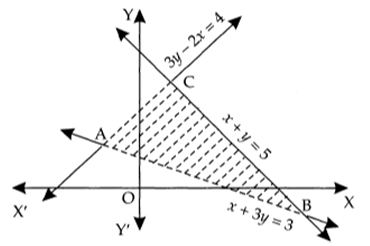
Solve the following system of inequalities graphically:
3y - 2x < 4, x + 3y > 3 and x + y ≤ 5.
View full question & answer
Question 55 Marks
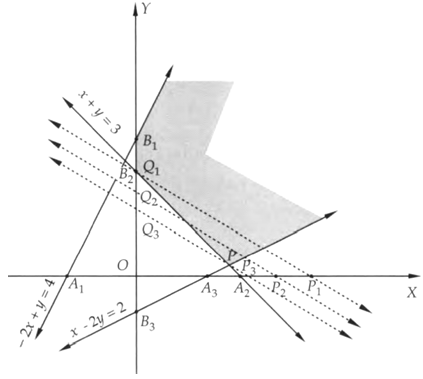
Solve the following LPP graphically:
$
\text { Minimize } Z=3 x+5 y
$
Subject to
$
\begin{array}{l}
-2 x+y \leq 4 \\
x+y \geq 3 \\
x-2 y \leq 2 \\
x, y \geq 0
\end{array}
$
View full question & answer
Question 65 Marks
Solve the following LPP graphically:
Maximize $Z=5 x+3 y$
Subject to $3 x+5 y \leq 15$
$5 x+2 y \leq 10$
and, $x, y \geq 0$
Answer
Converting the given inequations into equations, we obtain the following equations:
$3 x+5 y=15,5 x+2 y=10, x=0$ and $y=0$
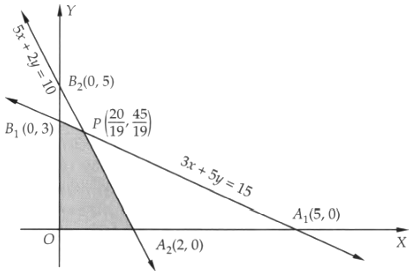
Region represented by $3 x+5 y \leq 15$: The line $3 x+5 y=15$ meets the coordinate axes at $A_1(5,0)$ and $B_1(0,3)$ respectively. Join these points to obtain the line $3 x+5 y=15$. Clearly, $(0,0)$ satisfies the inequation $3 x+5 y \leq 15$. So, the region containing the origin represents the solution set of the inequation $3 x+5 y<15$.
Region Represented by $5 x+2 y \leq 10$: The line $5 x+2 y=10$ meets the coordinate axes at $A_2(2,0)$ and $B_2(0,5)$ respectively. Join these points to obtain the graph of the line $5 x+2 y=10$. Clearly, $(0,0)$ satisfies the inequation $5 x+2 y \leq 10$. So, the region containing the origin represents the solution set of this inequation.
Region represented by $x \geq 0$ and $y \geq 0$: Since every point in the first quadrant satisfies these inequations. So, the first quadrant is the region represented by the inequations $x \geq 0$ and $y \geq 0$. The shaded region $OA _2 PB_1$ in figure represents the common region of the above inequations. This region is the feasible region of the given LPP.
The coordinates of the vertices (comer-points) of the shaded feasible region are $O (0,0), A _2(2,0), P \left(\frac{20}{19}, \frac{45}{19}\right)$ and $B _1(0,3)$.
Image
These points have been obtained by solving the equations of the corresponding intersecting lines, simultaneously. The values of the objective function at these points are given in the following table:
Point (x,y)Value of the objective function Z=5x+3y
O(0,0)$Z=5 \times 0+3 \times 0=0$
$A _2(2,0)$$Z=5 \times 2+3 \times 0=10$
$P\left(\frac{20}{19}, \frac{45}{19}\right)$$Z=5 \times \frac{20}{19}+3 \times \frac{45}{19}=\frac{235}{19}$
$B _1(0,3)$$Z=5 \times 0+3 \times 3=9$
  Clearly, Z is maximum at $P \left(\frac{20}{19}, \frac{45}{19}\right)$. Hence, $x =\frac{20}{19}, y =\frac{45}{19}$ is the optimal solution of the given LPP and the optimal value of Z is $\frac{235}{19}$.
View full question & answer
5 Marks Questions - Applied Maths STD 12 Science Questions - Vidyadip