Questions

MCQ

🎯

Test yourself on this topic

18 questions · timed · auto-graded

MCQ 11 Mark
The best-fitted trend line is one for which sum of squares of residuals or errors is:
  • A
    Maximum
  • Minimum
  • C
    Positive
  • D
    Negative
Answer
Correct option: B.
Minimum
(b) Minimum
Explanation
The line is termed as the line of best fir from which the sum of squares of distances from the points is minimized.
View full question & answer
MCQ 21 Mark
$\int \frac{(\log x)^5}{x}$ is equal to
  • A
    $\frac{\log x^6}{6}+C$
  • B
    $\frac{(\log x)^6}{3 x^2}+C$
  • $\frac{(\log x)^6}{6}+C$
  • D
    $\frac{\log x^6}{3 x^2}+C$
Answer
Correct option: C.
$\frac{(\log x)^6}{6}+C$
(c) $\frac{(\log x)^6}{6}+C$
Explanation
Put $\log x = t \Rightarrow \frac{1}{x} dx = dt$
$
\therefore \int \frac{(\log x)^5}{x} d x=\int t^5 d t=\frac{t^6}{6}+C=\frac{(\log x)^6}{6}+C
$
View full question & answer
MCQ 31 Mark
A simple random sample consists of four observations 1, 3, 5, 7. What is the point estimate of population standard deviation?
  • A
    3.1
  • B
    2.3
  • C
    2.87
  • 2.58
Answer
Correct option: D.
2.58
(d) 2.58
View full question & answer
MCQ 41 Mark
How many of the following points satisfy the inequality 2x - 3y > - 5?
(1, 1), (-1, 1), (1, -1 ), (-1, - 1), (- 2, 1), (2, -1 ), (-1, 2) and (-2, -1).
  • 5
  • B
    3
  • C
    4
  • D
    6
Answer
Correct option: A.
5
(a) 5
Explanation:
(1, 1), (1, -1), (-1 , -1), (2, -1) and (-2, -1) satisfy the inequality 2x - 3y > - 5.
View full question & answer
MCQ 51 Mark
Comer points of the feasible region for an LPP are : (0, 2), (3, 0), (6, 0), (6, 8) and (0, 5). Let z = 4x + 6y be the objective function. Then, Max. z - Min. z =
  • A
    48
  • B
    42
  • 60
  • D
    18
Answer
Correct option: C.
60
(c) 60
Explanation:
Here the objective function is given by:
F = 4x + 6y
Corner pointsZ=4x+6y
(0,2)12 (Min.)
(3,0)12 (Min.)
(6,0)24
(6,8)72 (Max.)
(0,5)30
Maximum of F - Minimum of F = 72 - 12 = 60
View full question & answer
MCQ 61 Mark
A man can row a boat in still water at 15 km/hr and speed of water current is 5 km/hr. The distance covered by the boat downstream in 24 minutes is
  • A
    4 km
  • B
    6 km
  • 8 km
  • D
    16 km
Answer
Correct option: C.
8 km
(c) 8 km
Explanation:
The speed of boat in still water = 15 km/hr
Speed of water current = 5 km/hr
$\therefore$ Speed in down stream $=15+5=20 km / hr$
Time given $=24 min=\frac{24}{60} hr =\frac{2}{5} hr$
$\therefore$ Distance travelled $=$ speed $\times$ times
$=20 \times \frac{2}{5}=8 km$
View full question & answer
MCQ 71 Mark
If $\frac{|x-2|}{x-2} \geq 0$, then
  • A
    $x \in(-\infty, 2)$
  • B
    $x \in[2, \infty)$
  • $x \in(2, \infty)$
  • D
    $x \in(-\infty, 2]$
Answer
Correct option: C.
$x \in(2, \infty)$
(c) $x \in(2, \infty)$
Since $\frac{|x-2|}{x-2} \geq 0$, for $|x-2| \geq 0$, and $x-2 \neq 0$ solution set $(2, \infty)$
View full question & answer
MCQ 81 Mark
If x is the least non-negative integer satisfying 218 $\equiv x(\bmod 7)$, then $x^2+1$ is equal to
  • A
    50
  • B
    1
  • 2
  • D
    5
Answer
Correct option: C.
2
(c) 2
Explanation:
From the definition: $a \equiv b$ (mod m)
a is said to be congruent to b modulo m, if m divides (a - b) or (a - b) is divisble by m.
$
\begin{array}{l}
\Rightarrow 218 \equiv x(\bmod 7) \\
\Rightarrow \frac{(218-x)}{7}
\end{array}
$
for this to be hold true, $x$ must be 1 .
$
\Rightarrow x^2+1=1^2+1=2
$
View full question & answer
MCQ 91 Mark
The trace of the matrix $A =\left[\begin{array}{rrr}1 & -5 & 7 \\ 0 & 7 & 9 \\ 11 & 8 & 9\end{array}\right]$ is
  • 17
  • B
    25
  • C
    3
  • D
    12
Answer
Correct option: A.
17
(a) 17
Explanation
As the trace of a matrix is the sum of on – diagonal elements,
So, 1 + 7 + 9 = 17
Trace = 17
View full question & answer
MCQ 101 Mark
Two pipes A and B can fill a cistern in 10 minutes and 15 minutes respectively. Both the pipes are opened together, but after 3 minutes pipe B in turned off. How much time will the cistern take to be full?
  • 8 minutes
  • B
    6 minutes
  • C
    11 minutes
  • D
    12 minutes
Answer
Correct option: A.
8 minutes
(a) 8 minutes
Explanation
In one min, (A + B) fill the cistern
$
=\frac{1}{10}+\frac{1}{15}=\frac{1}{6} \text { th }
$
In 3 mins. $( A + B )$ fill the cistern
$
=\frac{3}{6}=\frac{1}{2} \text { th }
$
Remaining part $=1-\frac{1}{2}=\frac{1}{2}$
$\because \frac{1}{10}$ th part in filled by A in one min.
$\therefore \frac{1}{2}$ nd part is filled by A in $10 \times \frac{1}{2}=5 min$
Total time $=3+5=8 min$
View full question & answer
MCQ 111 Mark
The order of the differential equation of all circles of given radius a is
  • A
    1
  • B
    4
  • C
    3
  • 2
Answer
Correct option: D.
2
(d) 2
Explanation
Equation of all the circles of radius a is
(x - h)2 + (y - k)2 = a2
where h, k are arbitrary constants.
So, the order of differential equation is 2.
View full question & answer
MCQ 121 Mark
If X has a Poisson distribution such that P(X = 1) = P(X = 2) and e-2 = 0.1353, then P(X = 4) is
  • A
    0.0213
  • 0.0902
  • C
    0.9098
  • D
    0.9787
Answer
Correct option: B.
0.0902
(b) 0.0902
Explanation:
Given $P ( X =1)= P ( X =2)$
$
\begin{array}{l}
\Rightarrow \lambda e^{-\lambda}=\frac{\lambda^2 e^{-\lambda}}{2!} \\
\Rightarrow \lambda^2-2 \lambda=0 \Rightarrow \lambda=0,2 \\
\Rightarrow \lambda=2
\end{array}
$
Now, $P ( X =4)=\frac{2^4 \cdot e^{-2}}{4!}=\frac{16 \times 0.1353}{24}=0.0902$
View full question & answer
MCQ 131 Mark
In a series of three trials, the probability of two successes is 9 times the probability of three successes. Then, the probability of success in each trial is
  • A
    $\frac{1}{3}$
  • B
    $\frac{3}{4}$
  • C
    $\frac{1}{2}$
  • $\frac{1}{4}$
Answer
Correct option: D.
$\frac{1}{4}$
(d) $\frac{1}{4}$
Explanation
Given $n =3$ and $P ( X =2)=9 P ( X =3)$.
$
\begin{array}{l}
\text { So, }{ }^3 C_2 p^2 \cdot q=9 \times{ }^3 C_3 \cdot p^3 \\
\Rightarrow 3 p^2 q=9 p^3 \Rightarrow 3 p^2(q-3 p)=0 \\
\Rightarrow q=3 p \\
\because p+q=1 \Rightarrow p+3 p=1 \Rightarrow p \frac{1}{4}
\end{array}
$
View full question & answer
MCQ 141 Mark
If $S =\left[\begin{array}{ll}a & b \\ c & d\end{array}\right]$, then $\operatorname{adj} A$ is
  • $\left[\begin{array}{rr}d & -b \\ -c & a\end{array}\right]$
  • B
    $\left[\begin{array}{ll}d & c \\ b & a\end{array}\right]$
  • C
    $\left[\begin{array}{rr}-d & -b \\ -c & a\end{array}\right]$
  • D
    $\left[\begin{array}{ll}d & b \\ c & a\end{array}\right]$
Answer
Correct option: A.
$\left[\begin{array}{rr}d & -b \\ -c & a\end{array}\right]$
(a) $\left[\begin{array}{rr}d & -b \\ -c & a\end{array}\right]$
Explanation
$S =\left[\begin{array}{ll}a & b \\ c & d\end{array}\right]$
$\begin{array}{l} M _{11}= d \Rightarrow A _{11}= d \\ M _{12}= c \Rightarrow A _{12}=- c \\ M _{21}= b \Rightarrow A _{21}=- b \\ M _{22}= a \Rightarrow A _{22}= a \\ \Rightarrow \operatorname{Adj}( A )=\left[\begin{array}{rr}d & -b \\ -c & a\end{array}\right]\end{array}$
View full question & answer
MCQ 151 Mark
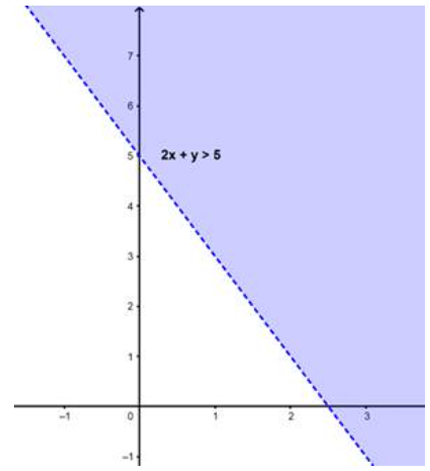
The solution set of the inequation 2 x + y > 5 is
  • A
    whole xy-plane the points lying on the line 2x + y = 5
  • open half-plane not containing the origin
  • C
    whole xy-plane except the points lying on the line 2x + y = 5
  • D
    half plane that contains the origin
Answer
Correct option: B.
open half-plane not containing the origin
(b) open half-plane not containing the origin
Explanation
Given inequation is 2x + y > 5
Now, we convert the inequation into an intercept line equation form, we can clearly see the intercepts of the inequation on x-axis and y-axis.
2x + y > 5
[dividing the whole inequation by 5]
$\begin{array}{l}\frac{2 x}{5}+\frac{y}{5}>\frac{5}{5} \\ \frac{x}{\frac{5}{2}}+\frac{y}{5}>1 \\ \frac{x}{2.5}+\frac{y}{5}>1\end{array}$
Therefore, from the above inequation, we can say that 2.5 and 5 are the intercepts of the x-axis and y-axis respectively. Now by plotting these on the graph, we can clearly see the graph of the inequation.
Image
From the graph, it is clear that the solution set of the inequation.
2x + y > 5 is the open half-plane not containing the origin.
View full question & answer
MCQ 161 Mark
The value of a machine purchased two years ago depreciates at the annual rate of 10%. If its present value is ₹97,200, then its value after 3 years is
  • A
    ₹ 80,859 approx
  • ₹ 70,859 approx
  • C
    ₹ 88,509 approx
  • D
    ₹ 71,859 approx
Answer
Correct option: B.
₹ 70,859 approx
(b) ₹ 70,859 approx
Explanation
Given, P = ₹ 97,200, i = 10% p.a.
$
\Rightarrow i=\frac{10}{100}=0.1
$
So, value after 3 years
$
=97,200 \times(1-0.1)^3
$
$=97,200 \times 0.729$
= ₹ 70,858.80
= ₹ 70,859 (approx.)
View full question & answer
MCQ 171 Mark
A statement made about a population parameter for testing purpose is called
  • A
    statistic
  • B
    level of significance
  • hypothesis
  • D
    parameter
Answer
Correct option: C.
hypothesis
(c) hypothesis
Explanation:
hypothesis
View full question & answer
MCQ 181 Mark
If $A=\left[\begin{array}{rr}2 & 3 \\ 5 & -2\end{array}\right]$ be such that $A^{-1}=k A$, then $k$ equals
  • A
    19
  • $\frac{1}{19}$
  • C
    $-\frac{1}{19}$
  • D
    -19
Answer
Correct option: B.
$\frac{1}{19}$
(b) $\frac{1}{19}$
Explanation:
A $=\left[\begin{array}{ll}2 & 3 \\ 5 & -2\end{array}\right]$
Using adjoint matrix
$
\begin{array}{l}
A^{-1}=\frac{-1}{19}\left[\begin{array}{ll}
-2 & -3 \\
-5 & 2
\end{array}\right] \\
A^{-1}=\frac{1}{19}\left[\begin{array}{cc}
2 & 3 \\
5 & -2
\end{array}\right]=\frac{1}{19} A \\
k=\frac{1}{19}
\end{array}
$
View full question & answer
MCQ - Applied Maths STD 12 Science Questions - Vidyadip