Questions

2 Marks Questions

🎯

Test yourself on this topic

7 questions · timed · auto-graded

Question 22 Marks
If the cash equivalent of the perpetuity of ₹$ 1,200$ payable at the end of each quarter is ₹$ 96,000$, find the rate of interest convertible quarterly.
Answer
Let the rate of interest be $\mathrm{r} \%$ converted quarterly. Then, $\mathrm{i}=\frac{r}{400}$
It is given that the present value of a perpetuity of ₹1,200 payable at the end of each quarter is ₹96,000
i.e., $\mathrm{P}=$ ₹ $96,000, \mathrm{R}=$ ₹ $1,200$ and $\mathrm{i}=\frac{r}{400}$
$\therefore \mathrm{P}=\frac{R}{i} \Rightarrow 96,000=\frac{1,200}{\frac{r}{400}} \Rightarrow 96,000=\frac{1,200 \times 400}{r} \Rightarrow \mathrm{r}=\frac{1,200 \times 400}{96,000}=5$
Hence, the rate of interest is $5 \%$ convertible quarterly.
View full question & answer
Question 32 Marks
An asset costs ₹$ 4,50,000$ with an estimated useful life of 5 years and a scrap value of ₹$ 1,00,000$. Using linear depreciation method, find the annual depreciation of the asset and construct a yearly depreciation schedule.
View full question & answer
Question 42 Marks
Evaluate: $\int_{1}^{2}\left(4 x^{3}-5 x^{2}+6 x+9\right) d x$
Answer
$\int_{1}^{2}\left(4 x^{3}-5 x^{2}+6 x+9\right) d x=\left[4 \cdot \frac{x^{4}}{4}-5 \cdot \frac{x^{3}}{3}+6 \cdot \frac{x^{2}}{2}+9 x\right]_{1}^{2}$
$=\left[x^{4}-\frac{5}{3} x^{3}+3 x^{2}+9 x\right]_{1}^{2}=\left(16-\frac{40}{3}+12+18\right)-\left(1-\frac{5}{3}+3+9\right)$
$=46-\frac{40}{3}-13+\frac{5}{3}=33-\frac{35}{3}=\frac{64}{3}$.
View full question & answer
Question 52 Marks
The effective annual rate of interest corresponding to normal rate of $6 \%$ p.a. payable half yearly is ____________.
Answer
Let principal be ₹ 100
Rate $=3 \%$ half yearly
$\therefore$ Interest for 1 st half year $=\frac{100 \times 3 \times 1}{100} =$ ₹ $3$
Interest for 2nd half year $=\frac{103 \times 3 \times 1}{100} =$ ₹ $3.09$
$\therefore$ Total yearly interest $=$ ₹ $6.09$
Let effective rate of interest be r%
$\therefore 6.09=\frac{100 \times r \times 1}{100} \Rightarrow \mathrm{r}=6.09 \%$
Using formula $\left(1+\frac{3}{100}\right)^{2}-1=(1.03)^{2}-1$
$=1.0609-1=0.0609$
$\therefore$ Effective rate % $=6.09 \%$
View full question & answer
Question 62 Marks
A man borrows ₹ $3,00,000$ at $6 \%$ per annum compound interest and promises to pay off the debt in 20 annual instalments beginning at the end of the first year. Find the amount of annual instalment. [Given: $(1.06)^{-20}=$ 0.312]
Answer
Here, $\mathrm{V} =$ ₹ $3,00,000, \mathrm{r}=6 \%$ and $\mathrm{n}=20$
We know $\mathrm{V}=\frac{A}{r}\left[1-(1+\mathrm{r})^{-\mathrm{n}}\right]$
Thus 3,00,000 $=\frac{A}{0.06}\left[1-(1+0.06)^{-20}\right]$
$\Rightarrow A=\frac{300000 \times 0.06}{\left[1-(1+0.06)^{-20}\right]}$
$\Rightarrow \mathrm{A}=\frac{18000}{\left[1-(1.06)^{-20}\right]}$
$\Rightarrow \mathrm{A}$= ₹ $26,162.79$
hence, the amount of annual instalment is ₹ $26,162.79$
View full question & answer
Question 72 Marks
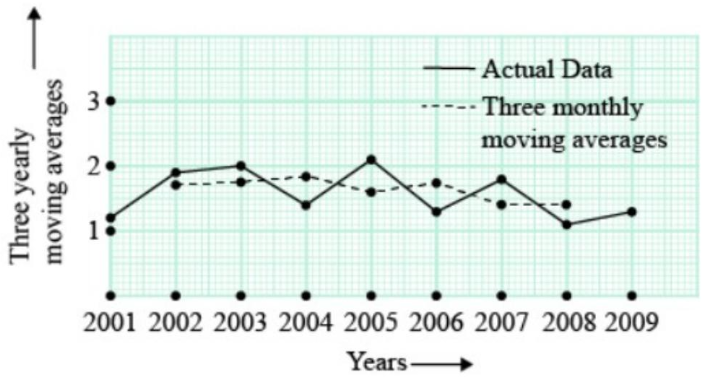
The following table shows the annual rainfall (in mm) recorded for Cherrapunji, Meghalaya:
YearRainfall (in mm)
20011.2
20021.9
20032
20041.4
20052.1
20061.3
20071.8
20081.1
20091.3

Determine the trend of rainfall by 3-year moving average.
View full question & answer
2 Marks Questions - Applied Maths STD 12 Science Questions - Vidyadip