Questions

5 Marks Questions

🎯

Test yourself on this topic

6 questions · timed · auto-graded

Question 15 Marks
A person amortizes a loan of ₹ 1500000 for renovation of his house by 8 years mortgage at the rate of $12 \%$ p.a. compounded monthly. Find
i. the equated monthly installment
ii. the principal outstanding at the beginning of 40th month.
iii. the interest paid in $40^{\text {th }}$ payment.
$
\text { [Given } \left.(1.01)^{96}=2.5993,(1.01)^{57}=1.7633\right]
$
Answer
Given, $\mathrm{P}=$ ₹ $1500000, \mathrm{i}=\frac{12}{12 \times 100}=\frac{1}{100}=0.01$
and $\mathrm{n}=8 \times 12=96$
$\begin{array}{l}\text { i. } EMI =\frac{1500000 \times 0.01 \times(1.01)^{96}}{(1.01)^{96}-1} \\ =\frac{1500000 \times 0.01 \times 2.5993}{2.5993-1} \\ =\frac{1500000 \times 0.01 \times 2.5993}{1.5993}\end{array}$
= ₹ 24379.10
ii. Principal outstanding at the beginning of $40^{\text {th }}$ month
$\begin{array}{l}=\frac{E M I\left[(1+i)^{96-40+1}-1\right]}{i(1+i)^{96-40+1}} \\ =\frac{24379.10 \times\left[(1.01)^{57}-1\right]}{0.01(1.01)^{57}} \\ =\frac{24379.10 \times(1.7633-1)}{0.01 \times 1.7633} \\ =\frac{24379.10 \times 0.7633}{0.017633}\end{array}$
= ₹ 1,055,326.20
iii. Interest paid in $40^{\text {th }}$ payment
$
\begin{aligned}
& =\frac{E M I\left[(1+i)^{96-40+1}-1\right]}{(1+i)^{96-40+1}} \\
& =\frac{24379.10\left[(1.01)^{57}-1\right]}{(1.01)^{57}}
\end{aligned}
$
$
\begin{aligned}
& =\frac{24379.10 \times 0.7633}{1.7633} \\
& \end{aligned}$
= ₹ 10553.26
View full question & answer
Question 25 Marks
Let X denote the number of hours a person watches television during a randomly selected day. The probability that X can take the values $\mathrm{x}_{\mathrm{i}}$ has the following form, where k is some unknown constant.
$\mathrm{P}\left(\mathrm{X}=\mathrm{x}_{\mathrm{i}}\right)= \begin{cases}0.2, & \text { if } x_{i}=0 \\ k x_{i}, & \text { if } x_{i}=1 \text { or } 2 \\ k\left(5-x_{i}\right), & \text { if } x_{i}=3 \\ 0, & \text { otherwise }\end{cases}$
a. Find the value of $k$.
b. What is the probability that the person watches two hours of television on a selected day?
c. What is the probability that the person watches at least two hours of television on a selected day?
d. What is the probability that the person watches at most two hours of television on a selected day?
e. Calculate mathematical expectation.
f. Find the variance and standard deviation of random variable X.
Answer
From the given information, we find that the probability distribution of X is
X0123
P(X)0.2k2k2k
a.We know that $\sum p_{i}=1$
$
\begin{aligned}
& \Rightarrow 0.2+\mathrm{k}+2 \mathrm{k}+2 \mathrm{k}=1 \\
& \Rightarrow 5 \mathrm{k}=0.8 \Rightarrow \mathrm{k}=\frac{4}{25}
\end{aligned}
$
b. Probability that the person watches two hours of television
$=\mathrm{P}(\mathrm{X}=2)=2 \mathrm{k}=2 \times \frac{4}{25}=\frac{8}{25}$
c. P (the person watches at least two hours of television)
$=\mathrm{P}(\mathrm{X} \geq 2)=\mathrm{P}(\mathrm{X}=2)+\mathrm{P}(\mathrm{X}=3)$
$=2 \mathrm{k}+2 \mathrm{k}=4 \mathrm{k}$
$=4 \times \frac{4}{25}=\frac{16}{25}$
d. P (the person watches at most two hours of television)
$=\mathrm{P}(\mathrm{X} \leq 2)=\mathrm{P}(\mathrm{X}=0)+\mathrm{P}(\mathrm{X}=1)+\mathrm{P}(\mathrm{X}=2)$
$=0.2+\mathrm{k}+2 \mathrm{k}$
$=0.2+3 \mathrm{k}=\frac{1}{5}+\frac{12}{25}=\frac{17}{25}$
e. We construct the following table:
$x _{ i }$$p _{ i }$$p _{ i } x _{ i }$$P _{ i } x _{ i }{ }^2$
00.200
2$\frac{4}{25}$$\frac{4}{25}$$\frac{4}{25}$
1$\frac{8}{25}$$\frac{16}{25}$$\frac{32}{25}$
3$\frac{8}{25}$$\frac{24}{25}$$\frac{72}{25}$
Total$\frac{44}{25}$$\frac{108}{25}$
$
\mathrm{E}(\mathrm{X})=\Sigma p_{i} x_{i}=\frac{44}{25}=1.76
$
f. Variance $\sigma^{2}=\Sigma p_{i} x_{i}^{2}-\left(\Sigma p_{i} x_{i}\right)^{2}$
$=\frac{108}{25}-\left(\frac{44}{25}\right)^{2}=\frac{108}{25}-\frac{1936}{625}=\frac{764}{625}=1.22$
and standard deviation $\sigma=\sqrt{\text { Variance }}=\sqrt{1.22}=1.1$
View full question & answer
Question 35 Marks
A die is tossed twice. Success is defined as getting an odd number on a random toss. Find the mean and variance of the number of successes.
Answer
Let $x$ be the random variable denoting the number of times an odd number (the number of successes) when a die is tossed twice. Then $x$ takes the values $0,1,2$
Let $\mathrm{P}(\mathrm{X}=0)$ be probability of getting no odd number (both times showing even).
$\therefore \mathrm{P}(\mathrm{X}=0)=\frac{3}{6} \times \frac{3}{6}=\frac{1}{4}$
Let $\mathrm{P}(\mathrm{X}=1)$ be probability of getting odd number once.
$\therefore \mathrm{P}(\mathrm{X}=1)={ }^{2} \mathrm{C}_{1} \frac{3}{6} \times \frac{3}{6}=\frac{6}{6} \times \frac{3}{6}=\frac{1}{2}$
Let $\mathrm{P}(\mathrm{X}=2)$ be probability of getting odd number twice.
$\therefore \mathrm{P}(\mathrm{X}=2)=\frac{3}{6} \times \frac{3}{6}=\frac{1}{4}$
Thus the probability distribution of X is given by
$X=x: x=0, x=1, x=2$
$\mathrm{P}(\mathrm{X}=\mathrm{x}) \frac{1}{4} \frac{1}{2} \frac{1}{4}$
We know that mean $\mathrm{E}(\mathrm{X})=\sum \mathrm{x}_{\mathrm{i}} \mathrm{p}_{\mathrm{i}}=0 \times \frac{1}{4}+1 \times \frac{1}{2}+2 \times \frac{1}{4}$
$\therefore \mathrm{E}(\mathrm{X})=0+\frac{1}{2}+\frac{1}{2}=1$
Thus mean $\mathrm{E}(\mathrm{X})=1$
We know that $\operatorname{var}(\mathrm{X})=\mathrm{E}\left(\mathrm{X}^{2}\right)-[\mathrm{E}(\mathrm{X})]^{2}$
$\mathrm{E}\left(\mathrm{X}^{2}\right)=\sum x_{i}^{2} \mathrm{p}_{\mathrm{i}}=0 \times \frac{1}{4}+1^{2} \times \frac{1}{2}+2^{2} \times \frac{1}{4}$
$\therefore \mathrm{E}\left(\mathrm{X}^{2}\right)=0+\frac{1}{2}+4 \times \frac{1}{4}=\frac{3}{2}$
Thus $\operatorname{var}(\mathrm{X})=\frac{3}{2}-[1]^{2}=\frac{3}{2}-1=\frac{1}{2}$
Hence mean is 1 and variance is $\frac{1}{2}$
View full question & answer
Question 45 Marks
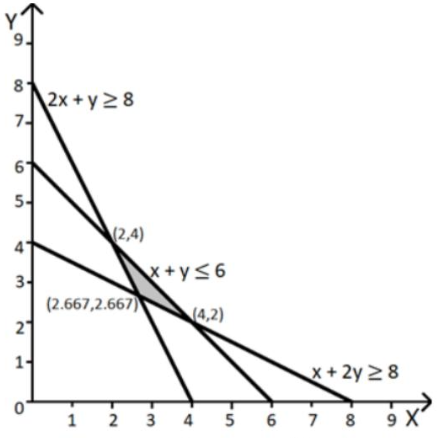
Solve the system of inequations graphically: $2 x+y \geq 8, x+2 y \geq 8, x+y \leq 6$
View full question & answer
Question 55 Marks
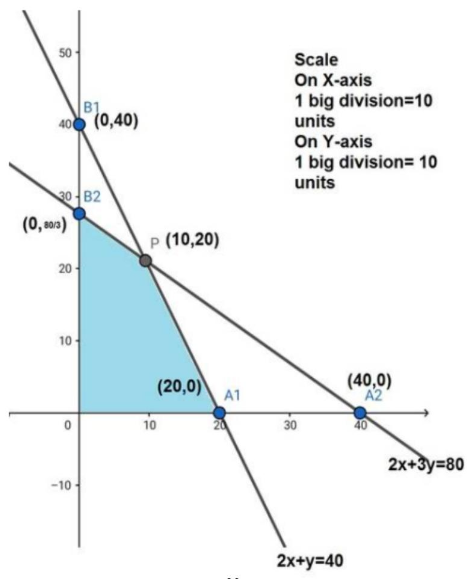
A small manufacturer has employed 5 skilled men and 10 semi-skilled men and makes an article in two qualities deluxe model and an ordinary model. The making of a deluxe model requires 2 hrs. work by a skilled man and 2 hrs. work by a semi-skilled man. The ordinary model requires 1 hr by a skilled man and 3 hrs. by a semi-skilled man. By union rules no man may work more than 8 hrs per day. The manufacturers clear profit on deluxe model is ₹15 and on an ordinary model is ₹10. How many of each type should be made in order to maximize his total daily profit.
View full question & answer
Question 65 Marks
A dietician wishes to mix two types of food in such a way that the vitamin contents of the mixture contain at least 8 units of vitamin A and 10 units of vitamin C. Food $\mathbf{I}$ contains 2 units$/ \mathrm{kg}$ of vitamin A and 1 unit/kg of vitamin C while food $\mathbf{l l}$ contains 1 unit/kg of vitamin A and 2 units/kg of vitamin C. It costs ₹5.00 per kg to purchase food I and ₹7.00 per kg to produce food II. Determine the minimum cost to such a mixture. Formulate the above as an LPP and solve it.
Answer
Let the dietician mix x kg of food $\mathbf{I}$ with y kg of food II. Then, the mathematical model of the LPP is as follows:
Minimize $Z=5 x+7 y$
Subject to $2 x+y \geq 8$
$x+2 y \geq 10$
and, $\mathrm{x}, \mathrm{y} \geq 0$
To solve this LPP graphically, we first convert the inequations into equations to obtain the following lines.
$2 \mathrm{x}+\mathrm{y}=8, \mathrm{x}+2 \mathrm{y}=10, \mathrm{x}=0, \mathrm{y}=0$
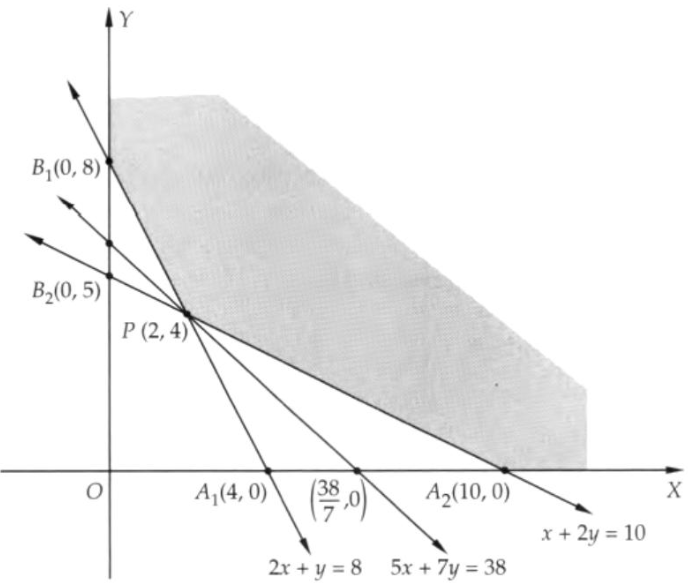
The line $2 x+y=8$ meets the coordinate axes at $A_{1}(4,0)$ and $B_{1}(0,8)$. Join these points to obtain the line represented by $2 x+y=$ 8. The region not containing the origin is represented by $2 x+y \geq 8$.
The line $x+2 y=10$ meets the coordinate axes at $A_{2}(10,0)$ and $B_{2}(0,5)$. Join these points to obtain the line represented by $x+2 y$ $=10$. Clearly, $\mathrm{O}(0,0)$ does not satisfy the inequation $x+2 y \geq 10$. So, the region not containing the origin is represented by this inequation.
Clearly, $\mathrm{x} \geq 0$ and, $\mathrm{y} \geq 0$ represent the first quadrant.
Thus, the shaded region in figure is the feasible region of the LPP. The coordinates of the comer-points of this region are $\mathrm{A}_{2}(10$, $0), \mathrm{P}(2,4)$ and $\mathrm{B}_{1}(0,8)$.
Image
The point $P(2,4)$ is obtained by solving $2 x+y=8$ and $x+2 y=10$ simultaneously.
The values of the objective function $Z=5 x+7 y$ at the corner points of the feasible region are given in the following table:
Point (x, y)Value of the objective function $\mathbf{Z}=\mathbf{5 x}+\mathbf{7 y}$
$\mathrm{A}_{2}(10,0)$$\mathrm{Z}=5 \times 10+7 \times 0=50$
$\mathrm{P}(2,4)$$\mathrm{Z}=5 \times 2+7 \times 4=38$
$\mathrm{~B}_{1}(0,8)$$\mathrm{Z}=5 \times 0+7 \times 8=56$
Clearly, Z is minimum at $\mathrm{x}=2$ and $\mathrm{y}=4$. The minimum value of Z is 38 . We observe that open half-plane represented by $5 \mathrm{x}+7 \mathrm{y}$ $<38$ does not have points in common with the feasible region. So, Z has a minimum value equal to 38 at $\mathrm{x}=2$ and $\mathrm{y}=4$. Hence, the optimal mixing strategy for the dietician will be to mix 2 kg of food $\mathbf{I}$ and 4 kg of food II. In this case, his cost will be minimum and the minimum cost will be ₹ 38.00
View full question & answer
5 Marks Questions - Applied Maths STD 12 Science Questions - Vidyadip