MCQ 11 Mark
For predicting the straight line trend in the sales of scooters (in thousands) on the basis of 6 consecutive years data, the company makes use of 4-year moving averages method. If the sales of scooters for respective years are $\mathrm{a}, \mathrm{b}, \mathrm{c}, \mathrm{d}$, e and f respectively, then which of the following average will not be computed?
- A
$\frac{a+c+d+e}{4}$
- B
$\frac{c+d+e+f}{4}$
- C
$\frac{b+c+d+e}{4}$
- D
$\frac{a+b+c+d}{4}$
Answer(A) $\frac{a+c+d+e}{4}$
Explanation: $\frac{a+c+d+e}{4}$
View full question & answer→MCQ 21 Mark
$\int \mathrm{e}^{\mathrm{x}}\left\{\mathrm{f}(\mathrm{x})+\mathrm{f}^{\prime}(\mathrm{x})\right\} \mathrm{dx}=$
- A
$2 e^{x} f(x)+C$
- B
$e^{x}-f(x)+C$
- C
$e^{x} f(x)+C$
- D
$e^{x}+f(x)+C$
Answer(C) $e^{x} f(x)+C$
Explanation: $\int \mathrm{e}^{\mathrm{x}}\left\{\mathrm{f}(\mathrm{x})+\mathrm{f}^{\prime}(\mathrm{x})\right\} \mathrm{dx}=\mathrm{e}^{\mathrm{x}} \mathrm{f}(\mathrm{x})+\mathrm{C}$
$\mathrm{t}=\mathrm{e}^{\mathrm{x}} \mathrm{f}(\mathrm{x})$
$\frac{d t}{d x}=e^{x} \cdot \frac{d}{d x}(f(x))+f(x) \frac{d}{d x}\left(e^{x}\right)$
$=\mathrm{e}^{\mathrm{x}} \mathrm{f}^{\prime}(\mathrm{x})+\mathrm{f}(\mathrm{x}) \cdot \mathrm{e}^{\mathrm{x}}$
$d t=e^{x}\left(f^{\prime}(x)+f(x)\right) d x$
$\int \mathrm{e}^{\mathrm{x}}\left\{\mathrm{f}(\mathrm{x})+\mathrm{f}^{\prime}(\mathrm{x})\right\} \mathrm{dx}=\int \mathrm{dt}=\mathrm{t}+\mathrm{C}$
$=\mathrm{e}^{\mathrm{x}} \mathrm{f}(\mathrm{x})+\mathrm{C}$
View full question & answer→MCQ 31 Mark
For testing the significance of difference between the means of two independent samples, the degree of freedom (v) is taken as:
- A
$n_{1}-n_{2}+2$
- B
$n_{1}-n_{2}-2$
- C
$n_{1}+n_{2}-1$
- D
$n_{1}+n_{2}-2$
Answer(D) $n_{1}+n_{2}-2$
Explanation: $\mathrm{n}_{1}+\mathrm{n}_{2}-2$
View full question & answer→MCQ 41 Mark
The corner points of the feasible region determined by the following system of linear inequalities:
$2 \mathrm{x}+\mathrm{y} \leq 10, \mathrm{x}+3 \mathrm{y} \leq 15, \mathrm{x}, \mathrm{y} \geq 0$ are $(0,0),(5,0),(3,4)$ and $(0,5)$.
Let $\mathrm{Z}=\mathrm{px}+\mathrm{qy}$, where $\mathrm{p}, \mathrm{q}>0$.
Condition on $p$ and $q$ so that the maximum of $Z$ occurs at both $(3,4)$ and $(0,5)$ is
- A
$p=3 q$
- B
$q=3 p$
- C
$p=q$
- D
$p=2 q$
Answer(B) $q=3 p$
Explanation:Given the vertices of the feasible region are:
Q(0, 0)
$\mathrm{A}(5,0)$
B(3, 4)
C$(0,5)$
Also given the objective function is $\mathrm{Z}=\mathrm{px}+\mathrm{qy}$
Now substituting $\mathrm{O}, \mathrm{A}, \mathrm{B}$ and C in Z| Z at O(0, 0) | Z = P(0) + q(0) = 0 |
| Z at A(5, 0) | Z = p(5) + q(0) = 5p + 0 = 5p |
| Z at B(3, 4) | Z = p(3) + q(4) = 3p + 4q |
| Z at C(0,5) | Z = p(0) + q(5) = 0 + 5q |
As per the condition on $p$ and $q$ so that the maximum of $Z$ occurs at both $(3,4)$ and $(0,5)$
Then we can equate Z values at B and C, this gives
$3 p+4 q=5 q$
$3 p=5 q-4 q$
$3 \mathrm{p}=\mathrm{q}$ View full question & answer→MCQ 51 Mark
If the objective function for an L.P.P. is $Z=3 x-4 y$ and the comer points for the bounded feasible region are (0,$0),(5,0),(6,5),(6,8),(4,10)$ and $(0,8)$, then the maximum of $Z$ occurs at
- A
$(5,0)$
- B
$(4,10)$
- C
$(6,5)$
- D
$(6,8)$
Answer(A) $(5,0)$
Explanation: $(5,0)$
View full question & answer→MCQ 61 Mark
In a kilometer race, A beats B by 50 meters or 10 seconds. The time taken by A to complete the race is:
Answer(A) 190 seconds
Explanation: In a 1000 m race
$50 \mathrm{~m}=10 \mathrm{sec}$
$1 \mathrm{~m}=\frac{10}{50}$
1000 m of race will take $=\frac{10}{50} \times 1000=200 \mathrm{sec}$
$\therefore$ Time taken by 'A' to complete $1000 \mathrm{~m}=(200-10)=190 \mathrm{sec}$
View full question & answer→MCQ 71 Mark
- A
$|x| \geq 5$
- B
$|x|>5$
- C
$|x|<5$
- D
$|x| \leq 5$
Answer(A) $|x| \geq 5$
Explanation: The given figure is highlighted between $-\infty$ to 5 and 5 to $\infty$
So, $x \in(-\infty, 5][5, \infty)$
$\Rightarrow \mathrm{x} \leq-5$ and $\mathrm{x} \geq 5$
$\Rightarrow|x| \geq 5$
View full question & answer→MCQ 81 Mark
If $100 \equiv \mathrm{x}(\bmod 7)$, then the least positive value of x is:
Answer(A) 2
Explanation: $100 \equiv \mathrm{x}(\bmod 7) \Rightarrow 100-\mathrm{x}$ is divisible by 7
Putting $x=1,2,3, \ldots$
For $\mathrm{x}=1$, 100 -1 $=99$ which is not divisible by 7
For $x=2,100-2=98$ which is divisible by 7 .
Hence, the least positive value of x is 2 .
View full question & answer→MCQ 91 Mark
The number of arbitrary constants in the particular solution of a differential equation of third order is:
Answer(A) 0
Explanation: 0, because the particular solution is free from arbitrary constants.
View full question & answer→MCQ 101 Mark
A man rows d km upstream and back again in t hours. If he can row in still water at $\mathrm{u} \mathrm{km} / \mathrm{hr}$ and the rate of stream is $v \mathrm{~km} / \mathrm{hr}$, then $\mathrm{t}=$
Answer(C) $\frac{2 u d}{u^{2}-v^{2}}$
Explanation: upstream speed $=(\mathrm{u}-\mathrm{v}) \mathrm{km} / \mathrm{hr}$
downstream speed $=(u-v) k m / h r$
$\mathrm{t}_{\text {downstream }}=\frac{d}{u+v}$
$\mathrm{t}_{\text {upstream }}=\frac{d}{u-v}$
$\mathrm{t}=\mathrm{t}_{\text {downstream }}+\mathrm{t}_{\text {upstream }}$
$\mathrm{t}=\frac{d}{u+v}+\frac{d}{u-v}$
$\mathrm{t}=\frac{(u-v) d+(u+v) d}{\left(u^{2}-v^{2}\right)}$
$\mathrm{t}=\frac{d[u-v+u+v]}{\left(u^{2}-v^{2}\right)}$
$\mathrm{t}=\frac{2 u d}{u^{2}-v^{2}}$
View full question & answer→MCQ 111 Mark
Integrating factor of the differential equation $\frac{d y}{d x}+y=\frac{x^{3}+y}{x}$ is
Answer(B) $\frac{e^{x}}{x}$
Explanation: $\frac{d y}{d x}+\left(1-\frac{1}{x}\right) \mathrm{y}=\mathrm{x}^{2}$, which is linear in y.
I.F. $=e^{\int\left(1-\frac{1}{x}\right) d x}=e^{x-\log x}=\frac{e^{x}}{e^{\log x}}=\frac{e^{x}}{x}$
View full question & answer→MCQ 121 Mark
A box contains 20 identical balls of which 10 balls are white and 10 balls are red. The balls are drawn at random from the box one at a time with replacement. The probability that a white ball is drawn for the 4th time on the 7th draw is
- A
$\frac{1}{2}$
- B
$\frac{27}{32}$
- C
$\frac{5}{64}$
- D
$\frac{5}{32}$
Answer(D) $\frac{5}{32}$
Explanation: $\frac{5}{32}$
View full question & answer→MCQ 131 Mark
If $X$ follows a binomial distribution with parameters $n=8$ and $p=\frac{1}{2}$, then $P(|X-4| \leq 2)$ equals
- A
$\frac{117}{128}$
- B
$\frac{118}{128}$
- C
$\frac{119}{128}$
- D
$\frac{116}{128}$
Answer(C) $\frac{119}{128}$
Explanation:$\mathrm{n}=8, \mathrm{p}=\frac{1}{2}=q$
$\mathrm{P}(|\mathrm{x}-4|) \leq 2$
$\Rightarrow-2 \leq \mathrm{x}-4 \leq 2$
$\Rightarrow 4-2 \leq \mathrm{x} \leq 2+4$
$\Rightarrow 2 \leq x \leq 6$
$\mathrm{P}(2 \leq \mathrm{x} \leq 6)=\mathrm{P}(2)+\mathrm{P}(3)+\mathrm{P}(4)+\mathrm{P}(5)+\mathrm{P}(6)$
$\mathrm{P}(2 \leq \mathrm{x} \leq 6)={ }^{8} \mathrm{C}_{2}\left(\frac{1}{2^{8}}\right)+{ }^{8} \mathrm{C}_{3}\left(\frac{1}{2^{8}}\right)+{ }^{8} \mathrm{C}_{4}\left(\frac{1}{2^{8}}\right)+{ }^{8} \mathrm{C}_{5}\left(\frac{1}{2^{8}}\right)+{ }^{8} \mathrm{C}_{6}\left(\frac{1}{2^{8}}\right)$
$=\frac{119}{128}$
View full question & answer→MCQ 141 Mark
If $y=A e^{5 x}+B e^{-5 x}$, then $\frac{d^{2} y}{d x^{2}}$ is equal to
Answer(D) 25 y
Explanation: We have,
$y=a e^{5 x}+b e^{-5 x}$
On differentiating w.r.t x, we get
$\frac{d^{2} y}{d x^{2}}=5 \mathrm{ae}^{5 \mathrm{x}}-5 \mathrm{be}^{-5 \mathrm{x}}$
$\frac{d^{2} y}{d x^{2}}=25\left(\mathrm{ae}^{5 \mathrm{x}}+\mathrm{be}^{-5 \mathrm{x}}\right)$
$\frac{d^{2} y}{d x^{2}}=25 \mathrm{y}$
Hence, this is the answer.
View full question & answer→MCQ 151 Mark
The point at which the maximum value of $x+y$, subject to the constraints $x+2 y \leq 70,2 x+y<95, x, y \geq 0$ is obtained, is
- A
$(35,20)$
- B
$(30,25)$
- C
$(40,15)$
- D
$(20,35)$
Answer(C) $(40,15)$
Explanation:
Given objective function is $\mathrm{Z}=\mathrm{x}+\mathrm{y}$
Constraints are:
$x+2 y \leq 70$
$2 \mathrm{x}+\mathrm{y} \leq 95, \mathrm{x}, \mathrm{y} \geq 0$
Let us consider these constraints as equations for a while, then we will have,
$x+2 y=70 \ldots$ (i)
$2 x+y=95 \ldots$(ii)
Now, graph the equations, by transforming the equations to intercept form of line.
Equation (i) dividing throughout by 70
$\frac{x}{70}+\frac{2 y}{70}=\frac{70}{70}$
$\frac{x}{70}+\frac{y}{35}=1$
The line $x+2 y=70$ can be plot in the graph as a line passing through the points, $(70,0)$ and $(0,35)$ as 70 and 35 are the intercepts of the line on the $x$-axis and $y$-axis respectively.
Similarly equation (ii) can be divided 95 to get
$\frac{2 x}{95}+\frac{y}{95}=\frac{95}{95}$
$\frac{\mathrm{x}}{\frac{95}{2}}+\frac{\mathrm{y}}{95}=1$
The line $2 \mathrm{x}+\mathrm{y}=95$ can be plot in the graph as a line passing through the points, $\left(\frac{95}{2}, 0\right)$ and $(0,95)$ as $\frac{95}{2}$ and 95 are the intercepts of the line on the $x$-axis and $y$-axis respectively.
By considering the constraints $\mathrm{x}, \mathrm{y} \geq 0$, this clearly shows that the region can only be in the $1^{\text {st }}$ quadrant.
The graph of the inequations will look like,
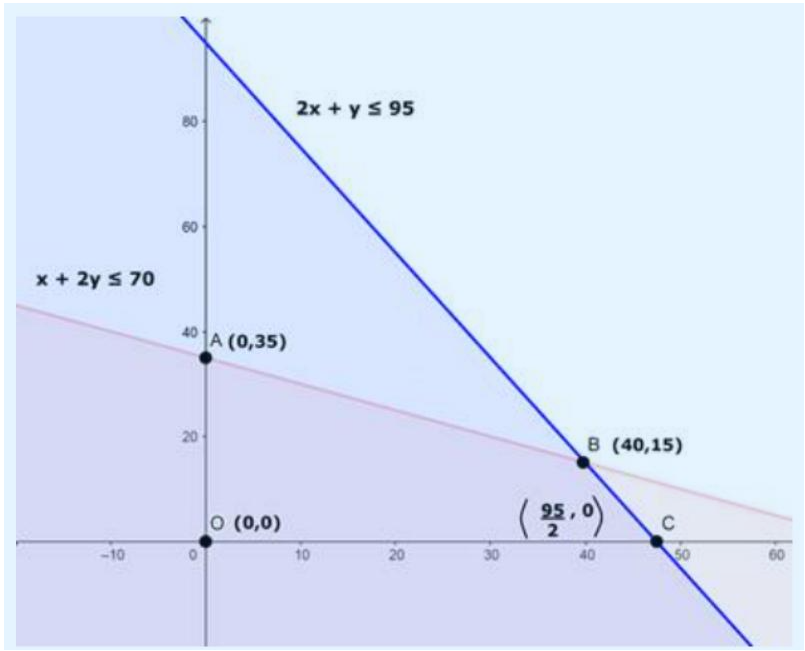
The points OABC is the feasible region of the LPP.
Now from the points O, A, B and C the vertices of the polygon formed by the constraints, one of the points will provide the maximum solution to the function $\mathrm{Z}=\mathrm{x}+\mathrm{y}$
Now checking the points, $O, A, B$ and $C$ by substituting in $Z=x+y$| Z at O(0, 0) | Z = 0 + 0 = 0 |
| Z at A (0, 35) | Z = 0 + 35 = 35 |
| Z B(40, 15) | z = 40 + 15 = 55 |
| Z at $C \left(\frac{95}{2}, 0\right)$ | $Z==\frac{95}{2}+0=\frac{95}{2}=47.5$ |
From the above values, it is clear that Z maximized at point $\mathrm{B}(40,15)$.
View full question & answer→MCQ 161 Mark
The formula $\left[\frac{(1+i)^{n}-1}{\frac{i}{1+i}}\right]$ is used to calculate [A is amount of each annuity, $\mathrm{i}=\frac{r}{100}$, r is rate $\%$, n is time period]
- A
present value of annuity due
- B
future value of annuity due
- C
- D
Answer(B) future value of annuity due
Explanation: future value of annuity due
View full question & answer→MCQ 171 Mark
Which of the following values is used as a summary measure for a sample, such as a sample mean?
Answer(D) Sample Statistic
Explanation: Sample Statistic
View full question & answer→MCQ 181 Mark
If $A$ and $B$ are two matrices such that $A B=A$ and $B A=B$, then $B^{2}$ is equal to:
Answer(A) B
Explanation: $\mathrm{AB}=\mathrm{A} . . .(\mathrm{i})$
BA = B ...(ii)
From equation (ii)
$B \times(A B)=B$
$B^{2} A=B$
From equation (ii)
$B^{2} \mathrm{~A}=\mathrm{BA}$
$B^{2}=B$
Which is the required solution.
View full question & answer→