Questions

Case study (4 Marks)

🎯

Test yourself on this topic

4 questions · timed · auto-graded

Question 14 Marks
Answer
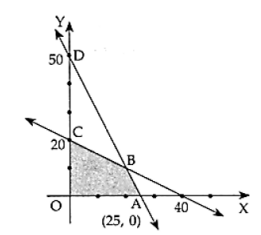
i. From the given figure, $OA =25$ and $OD =50$
The equation of the line AD is $\frac{x}{25}+\frac{y}{50}=1$...(intercept form)
i.e. $2 x+y=50$
ii. The equation of the line BC is $\frac{x}{40}+\frac{y}{20}=1$ i.e. $x +2 y =40$
iii. Solving equations $2 x+y=50$ and $x+2 y=40$ simultaneously, we get $x=20, y-10$
$\therefore$ The coordinates of point $B$ are $(20,10)$.
From the given figure, the coordinates of point $C$ are $(0,20)$.
OR
As (0, 0) lies in the region $2 x+y \leq 50$ and (0,0) also lies in the region $x+2 y \leq 40$,therefore, the constraints for the L.P.P. are $2 x+y \leq 50, x+2 y \leq 40, x \geq 0, y \geq 0$
View full question & answer
Question 24 Marks
The feasible region for an L.P.P. is shown in the adjoining figure. The line CB is parallel to OA.
i. Find the equation of the line OA.
ii. Find the equation of the line BC.
iii. Find the constraints for the L.P.P
OR
Find the minimum value of the objective function Z = 3x - 4y.
Answer
i. $O (0,0), A (6,12)$, so equation of OA is
$
y-0=\frac{12-0}{6-0}(x-0) \Rightarrow y-2 x=0
$
ii. Since $B C$ is parallel to $O A$, so slope of $B C=$ slope of $O A$.
$\therefore$ Equation of BC is $Y -4=2( x -0) \Rightarrow y -2 x =4$.
iii. Constraints for the L.P.P. are
$
y \geq 2 x, y-2 x \leq 4, x \leq 6, x \geq 0, y \geq 0
$
OR
The corner points of the feasible region are (0, 0), (6, 12), (6, 16) and (0, 4). The values of Z = 3x - 4y at these corner points are 0, -30, - 46 and -16. Hence, the minimum value of Z = - 46.
View full question & answer
Question 34 Marks
Loans are an integral part of our lives today. We take loans for a specific purpose - for buying a home, or a car,
or sending kids abroad for education - loans help us achieve some significant life goals. That said, when we talk
about loans, the word “EMI", eventually crops up because the amount we borrow has to be returned to the lender
with interest.
Suppose a person borrows ₹1 lakh for one year at the fixed rate of 9.5 percent per annum with a monthly rest. In
this case, the EMI for the borrower for 12 months works out to approximately ₹8,768.
Example:
In year 2000, Mr. Tanwar took a home loan of ₹3000000 from State Bank of India at 7.5% p.a. compounded
monthly for 20 years.
(a) Find the equated monthly installment paid by Mr. Tanwar.
(b) Find interest paid by Mr. Tanwar in 150th payment.
(c) Find Principal paid by Mr. Tanwar in 150th payment.
OR
Find principal outstanding at the beginning of 193th month.
Answer
Loans are an integral part of our lives today. We take loans for a specific purpose - for buying a home, or a car, or sending kids abroad for education - loans help us achieve some significant life goals. That said, when we talk about loans, the word "EMI", eventually crops up because the amount we borrow has to be returned to the lender with interest.
Suppose a person borrows ₹ 1 lakh for one year at the fixed rate of 9.5 percent per annum with a monthly rest. In this case, the EMI for the borrower for 12 months works out to approximately ₹ 8,768 .
Example:
In year 2000, Mr. Tanwar took a home loan of ₹3000000 from State Bank of India at $7.5 \%$ p.a. compounded monthly for 20 years.
(i) ₹ 24167.82
(ii) ₹ 10458.69
(iii)₹ 13709.13
OR
₹ 410293.41
View full question & answer
Question 44 Marks
View full question & answer
Case study (4 Marks) - Applied Maths STD 12 Science Questions - Vidyadip