Questions

MCQ

🎯

Test yourself on this topic

18 questions · timed · auto-graded

MCQ 11 Mark
Time series analysis helps to
  • A
    predict the future behaviour of a variable.
  • B
    understand the behaviour of a variable in the past
  • all of these.
  • D
    plan future operations
Answer
Correct option: C.
all of these.
(c) all of these.
Explanation: all of these.
View full question & answer
MCQ 21 Mark
$\int e^x\left(\frac{1-x}{1+x^2}\right)^2 d x$ is equal to
  • A
    $-\frac{e^x}{1+x^2}+C$
  • B
    $-\frac{e^x}{\left(1+x^2\right)^2}+C$
  • $\frac{e^x}{1+x^2}+C$
  • D
    $\frac{e^x}{\left(1+x^2\right)^2}+C$
Answer
Correct option: C.
$\frac{e^x}{1+x^2}+C$
(c) $\frac{e^x}{1+z^2}+C$
Explanation: Given $\int e^x\left(\frac{1-x}{1+x^2}\right)^2 d x$
$
\begin{array}{l}
\Rightarrow \int e^x\left(\frac{1-x}{1+x^2}\right)^2 d x=\int e^x\left(\frac{1+x^2-2 z}{\left(1+x^2\right)^2}\right) d x \\
\Rightarrow \int e^x\left(\frac{1+x^2-2 x}{\left(1+x^2\right)^2}\right) d x=\int e^x\left\{\left(\frac{1+x^2}{\left(1+x^2\right)^2}\right)+\left(\frac{-2 x}{\left(1+x^2\right)^2}\right)\right\} d x \\
=\int e^x\left\{\left(\frac{1}{\left(1+x^2\right)}\right)+\left(\frac{-2 x}{\left(1+x^2\right)^2}\right)\right\} d x
\end{array}
$
Now using the property: $\int e^x\left(f(x)+f^{\prime}(x)\right) d x=e^x f(x)$
Now in $\int e^x\left\{\left(\frac{1}{\left(1+x^2\right)}\right)+\left(\frac{-2 x}{\left(1+x^2\right)^2}\right)\right\} d x$
$
\begin{array}{l}
\Rightarrow f(x)=\frac{1}{\left(1+x^2\right)} \\
\Rightarrow f^{\prime}(x)=\frac{-2 x}{\left(1+x^2\right)^2} \\
\Rightarrow \int e^{x}\left\{\left(\frac{1}{\left(1+x^2\right)}\right)+\left(\frac{-2 x}{\left(1+x^2\right)^2}\right)\right\} dx=\frac{e^{x}}{1+x^2}+C \\
\Rightarrow \int e^x\left(\frac{1-x}{1+x^2}\right)^2 d x=\frac{e^2}{1+x^2}+C
\end{array}
$
View full question & answer
MCQ 31 Mark
For the purpose of t-test of significance, a random sample of size (n) 34 is drawn from a normal population, then the degree of freedom (v) is
  • A
    35
  • B
    $\frac{1}{34}$
  • 33
  • D
    34
Answer
Correct option: C.
33
(c) 33
Explanation: Given $n =34$ $\Rightarrow$ degree of freedom $( v )=34-1=33$
View full question & answer
MCQ 41 Mark
Given that x, y and b are real numbers and x < y, b > 0, then
  • A
    $\frac{x}{b} \geq \frac{y}{b}$
  • B
    $\frac{x}{b} \leq \frac{y}{b}$
  • $\frac{x}{b}>\frac{y}{b}$
  • D
    $\frac{x}{b}<\frac{y}{b}$
Answer
Correct option: C.
$\frac{x}{b}>\frac{y}{b}$
(c) $\frac{x}{b}>\frac{y}{b}$
Explanation: $x < y$ and $b <0$
$
\Rightarrow \frac{x}{b}>\frac{y}{b}
$
View full question & answer
MCQ 51 Mark
Feasible region in the set of points which satisfy
  • A
    Non objective functions
  • B
    Some the given constraints
  • C
    The objective functions
  • All of the given constraints
Answer
Correct option: D.
All of the given constraints
(d) All of the given constraints
Explanation: All of the given constraints
View full question & answer
MCQ 61 Mark
A pipe can fill a tank in $n_1$ hours and another pipe can empty it in $n_2\left(n_2>n_1\right)$ hours. If both the pipes are opened together, the tank will be filled in
  • A
    $\left( n _1- n _2\right)$ hours
  • $\frac{n_1 n_2}{n_2-n_1}$ hours
  • C
    $\frac{n_1 n_2}{n_1+n_1}$ hours
  • D
    $\frac{n_1 n_2}{n_1-n_2}$ hours
Answer
Correct option: B.
$\frac{n_1 n_2}{n_2-n_1}$ hours
(b) $\frac{n_1 n_2}{n_2-n_1}$ hours
Explanation: $\frac{n_1 n_2}{n_2-n_1}$ hours
View full question & answer
MCQ 71 Mark
If B > A, then which expression will have the highest values given that A and B are positive integers?
  • A
    A + B
  • B
    AX B
  • can't say
  • D
    A - B
Answer
Correct option: C.
can't say
(c) can't say
Explanation: Cannot say, because when $A =1, B=3$, then
$A \times B =1 \times 3=3$ and $A + B =4$
Here, $A + B > A \times B$
and when $A =2, B=3$, then
$A \times B =2 \times 3=6$ and $A + B =2+3=5$.
Here, $A \times B > A + B$
View full question & answer
MCQ 91 Mark
The solution of the differential equation $\frac{d y}{d x}=\frac{2 y}{x}=0$ with $y (1)=1$ is given by:
  • A
    $x=\frac{1}{y}$
  • $y=\frac{1}{x^2}$
  • C
    $X =\frac{1}{y^2}$
  • D
    $y =\frac{1}{x}$
Answer
Correct option: B.
$y=\frac{1}{x^2}$
(b) $y =\frac{1}{x^2}$
Explanation: We have,
$
\begin{array}{l}
\frac{d y}{d x}+\frac{2 y}{x}=0 \\
\Rightarrow \frac{d y}{d x}=-\frac{2 y}{x} \\
\Rightarrow \frac{d y}{2 y}=-\frac{d x}{x} \\
\Rightarrow \int \frac{d y}{2 y}=-\int \frac{d x}{x} \\
\Rightarrow \frac{1}{2} \log |y|=-\log |x|+\log c \\
\Rightarrow \sqrt{y} x=c \\
\Rightarrow yx^2=c
\end{array}
$
Given that $y(1)=1 \Rightarrow x=y=1$
$
\begin{array}{l}
\Rightarrow c=1 \\
\Rightarrow yx{ }^2=1 \\
\Rightarrow y=\frac{1}{x^2}
\end{array}
$
View full question & answer
MCQ 101 Mark
In a 400 m race, $A$ gives B a start of 5 seconds and beats him by 15 m . In another race of $400 m, A$ beats B by 7 $\frac{1}{7}$ seconds. Their respective speeds are:
  • $8 m / sec , 7 m / sec$
  • B
    5 m/sec, 7 m/sec
  • C
    9 m/sec, 7 m/sec
  • D
    6 m/sec, 7 m/sec
Answer
Correct option: A.
$8 m / sec , 7 m / sec$
(a) $8 m / sec , 7 m / sec$
Explanation: Suppose A covers 400 m in t seconds
Then, B covers 385 m in $( t +5)$ seconds
$
\begin{array}{l}
\therefore B \text { covers } 400 m=\left\{\frac{(t+5)}{385} \times 400\right\} sec \\
=\frac{80(t+5)}{77} sec
\end{array}
$
Also, B covers $400 m=\left(t+7 \frac{1}{7}\right) sec$
$
\begin{array}{l}
=\frac{(7 t+50)}{7} sec \\
\therefore \frac{80(t+5)}{77}=\frac{7 t+50}{7} \\
\therefore 80(t+5)=11(7 t+50) \\
\Rightarrow(80 t-77 t)=(550-400) \\
\Rightarrow 3 t=150 \\
\Rightarrow t=50 \\
\therefore \text { A's speed } \\
=\frac{400}{50} m / sec \\
=8 m / sec \\
\therefore B^{\prime} s \text { speed } \\
=\frac{385}{55} m / sec \\
=7 m / sec
\end{array}
$
View full question & answer
MCQ 111 Mark
The solution of the differential equation $2 x \frac{d y}{d x}- y =3$ represents:
  • parabolas
  • B
    straight lines
  • C
    ellipses
  • D
    circles
Answer
Correct option: A.
parabolas
(a) parabolas
Explanation: $2 x \frac{d y}{d x}= y +3 \Rightarrow \frac{d y}{d x}=\frac{y+3}{2 x} \Rightarrow \frac{2 \frac{d y}{d x}}{y+3}=\frac{1}{x}$
Integration both sides
$
\begin{array}{l}
\int \frac{2 \frac{d y}{d x}}{y+3}=\int \frac{1}{x} \\
\Rightarrow 2 \log (y+3)=\log x+c \\
\Rightarrow(y+3)^2=x+c
\end{array}
$
View full question & answer
MCQ 121 Mark
If X is a binomial variate with parameters n and p , where $0< p <1$ such that $\frac{P(X=r)}{P(X=n-r)}$ is independent of n and $r$, then $p$ equals
  • $\frac{1}{2}$
  • B
    $\frac{1}{4}$
  • C
    $\frac{1}{3}$
  • D
    $\frac{1}{5}$
Answer
Correct option: A.
$\frac{1}{2}$
(a) $\frac{1}{2}$
Explanation: $\because P ( X = r )={ }^{ n } C _{ r }( P )^{ r }( q )^{ n - r }$
$
\begin{array}{l}
=\frac{n!}{(n-r)!r!}(P)^{r}(1-p)^{n-r}[\because q=1-p] \\
P(X=0)=(1-p)^{n}
\end{array}
$
And $P(X=n-r)={ }^n C_{n-r}(P)^{n-r}(q)^{n-(n-r)}$
$
=\frac{n!}{(n-r)!r!}(p)^{n-r}(1-p)^{-r}[\because q=1-p]\left[\because{ }^{n} C_{r}={ }^{n} C_{n-r}\right]
$
Now, $\frac{P(x=r)}{P(x=n-r)}=\frac{\frac{n!}{(n-r) w!} p^r(1-p)^{n-r}}{\frac{n!}{(n-r)+!} p^{n-r}(1-p)^{+r}}$ [using Eqs. (i) and (ii)]
$
=\left(\frac{1-p}{p}\right)^{n-\gamma} \times \frac{1}{\left(\frac{1-p}{p}\right)^\tau}
$
The above expression is independent of n and r , if $\frac{1-p}{p}=1 \Rightarrow \frac{1}{p}=2 \Rightarrow p=\frac{1}{2}$
View full question & answer
MCQ 131 Mark
A fair coin is tossed 100 times. The probability of getting tails an odd number of times is
  • A
    $\frac{5}{8}$
  • B
    $\frac{3}{8}$
  • $\frac{1}{2}$
  • D
    $\frac{1}{8}$
Answer
Correct option: C.
$\frac{1}{2}$
(c) $\frac{1}{2}$
Explanation: A fair coin tossed 100 times then probability of odd or even numbers are same and equals $=\frac{1}{2}$ $\Rightarrow$ The probability of getting tails an odd number of times is also $\frac{1}{2}$
View full question & answer
MCQ 141 Mark
If the total cost function is given by $C(x)=10 x-7 x^2+3 x^3$, then the marginal average cost function (MAC) is given by
  • A
    $-14+18 x$
  • B
    $10-7 x+3 x^2$
  • $-7+6 x$
  • D
    $10-14 x+9 x$
Answer
Correct option: C.
$-7+6 x$
(c) $-7+6 x$
Explanation: $C(x)=10 x-7 x^2+3 x^3$
$
\begin{array}{l}
AC=\frac{C(x)}{x}=10-7 x+3 x^2 \\
\text { Now, } MAC=\frac{d}{d x}(AC)=-7+6 x
\end{array}
$
View full question & answer
MCQ 151 Mark
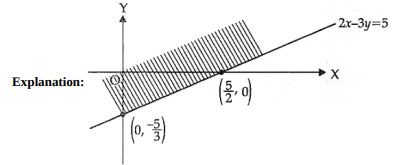
The position of points $O(0,0)$ and $P(2,-2)$ in the region of graph of in equation $2 x-3 y<5$ will be
  • A
    O outside and P inside
  • B
    O and P both inside
  • C
    O and P both outside
  • O inside and P outside
Answer
Correct option: D.
O inside and P outside
(d) O inside and P outside
Image
View full question & answer
MCQ 161 Mark
A person invested ₹ 180000 in a mutual fund in year 2016. If the value of mutual fund increased to ₹ 225000 in year 2020, then compound annual growth rate of his investment is [use $(1.25)^{1 / 4}=1.057$ )
  • A
    57%
  • B
    10.57%
  • 5.7%
  • D
    57.57%
Answer
Correct option: C.
5.7%
(c) $5.7 \%$
Explanation: 5.7\%
View full question & answer
MCQ 171 Mark
A machine makes car wheels and in a random sample of 26 wheels, the test statistic is found to be 3.07 . As per $t$ distribution test (of $5 \%$ level of significance), what can you say about the quality of wheels produced by the machine? $\left(\right.$ Use $\left.t _{25}(0.05)=2.06\right)$
  • A
    Different quality
  • Inferior quality
  • C
    Same quality
  • D
    Superior quality
Answer
Correct option: B.
Inferior quality
(b) Inferior quality
Explanation: Given $n =26$ and $t =3.0$
$
\Rightarrow \text { degree of freedom }=n-1=26-1=25
$
Now, level of significance $=5 \%=0.05$
$
\begin{array}{l}
t_{25}(0.05)=2.06 \\
\because t=3.07>2.06
\end{array}
$
So, the wheels produced by the machine are of inferior quality.
View full question & answer
MCQ 181 Mark
If A is a non-singular matrix, then
  • A
    $| A | \neq\left| A ^{\prime}\right|$
  • B
    $\left| AA ^{\prime}\right| \neq\left| A ^2\right|$
  • $| A |+\left| A ^{\prime}\right| \neq 0$
  • D
    $\left| A ^{-1}\right| \neq| A |^{-1}$
Answer
Correct option: C.
$| A |+\left| A ^{\prime}\right| \neq 0$
(c) $| A |+\left| A ^{\prime}\right| \neq 0$
Explanation: $\because| A | \neq 0$ and $| A |=\left| A ^{\prime}\right|$.
So, $|A|+\left|A^{\prime}\right|=|A|+|A|=2|A| \neq 0$.
$\therefore$ Option (d) is the correct answer.
View full question & answer
MCQ - Applied Maths STD 12 Science Questions - Vidyadip