Question 14 Marks
A bakery in an establishment produces and sells flour-based food baked in an oven such as bread, cakes, pastries, etc. Ujjwal cake store makes two types of cake. First kind of cake requires 200g of flour and 25 g of fat and 2nd type of cake requires 100g of flour and 50 g of fat.
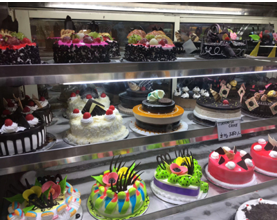
Based on above information answer the following questions.
i. If the bakery make x cakes of first type and y cakes of 2nd type and it can use maximum 5 kg flour, then write the constraint.
ii. If Bakery can use maximum 1 kg fat, then write the constraint.
iii. Represent total number of cakes made by bakery which is represented by Z.
iv. What is the maximum number of total cakes which can be made by bakery, assuming that there is no shortage of ingredients used in making the cakes?
v. What are number of first and second type of cakes?
Based on above information answer the following questions.
i. If the bakery make x cakes of first type and y cakes of 2nd type and it can use maximum 5 kg flour, then write the constraint.
ii. If Bakery can use maximum 1 kg fat, then write the constraint.
iii. Represent total number of cakes made by bakery which is represented by Z.
iv. What is the maximum number of total cakes which can be made by bakery, assuming that there is no shortage of ingredients used in making the cakes?
v. What are number of first and second type of cakes?
Answer
View full question & answer→i. Maximum quantity of flour that can be used by bakery $=5 kg$
$
\begin{array}{l}
\Rightarrow 200 x+100 y \leq 5000 \\
\Rightarrow 2 x+y \leq 50
\end{array}
$
ii. Maximum quantity of fat that can be used by bakery $=1 kg$
$
\begin{array}{l}
\Rightarrow 25 x+50 y \leq 1000 \\
\Rightarrow x+2 y \leq 40
\end{array}
$
iii. Total No. of cake of first type $=x$
Total No. of cake of second type $=y$
$\therefore$ Total no. of cakes $=x+y$
$
\therefore Z=x+y
$
iv. We have
$
\begin{array}{l}
Z=x+y, \text { which is to be maximise under constraints } \\
2 x+y \leq 50 \\
x+2 y \leq 40 \\
x, y \geq 0
\end{array}
$
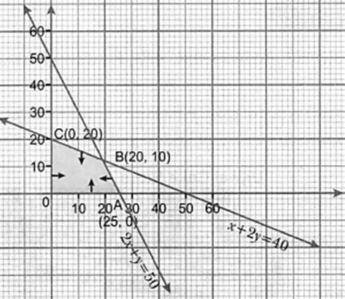
Here, OABC is the feasible region which is bounded.
The co-ordinates of comer points are O(0,0), A (25, 0), B (20,10), C(0, 20)
Now we evaluate Z at each corner points.
Hence, maximum no. of cakes = 30
v. From above table we get
Maximum number of cakes are 30
x = 20 and y = 10
i.e. No. of first kind of cakes = 20
No. of second kind of cakes = 10
$
\begin{array}{l}
\Rightarrow 200 x+100 y \leq 5000 \\
\Rightarrow 2 x+y \leq 50
\end{array}
$
ii. Maximum quantity of fat that can be used by bakery $=1 kg$
$
\begin{array}{l}
\Rightarrow 25 x+50 y \leq 1000 \\
\Rightarrow x+2 y \leq 40
\end{array}
$
iii. Total No. of cake of first type $=x$
Total No. of cake of second type $=y$
$\therefore$ Total no. of cakes $=x+y$
$
\therefore Z=x+y
$
iv. We have
$
\begin{array}{l}
Z=x+y, \text { which is to be maximise under constraints } \\
2 x+y \leq 50 \\
x+2 y \leq 40 \\
x, y \geq 0
\end{array}
$
Here, OABC is the feasible region which is bounded.
The co-ordinates of comer points are O(0,0), A (25, 0), B (20,10), C(0, 20)
Now we evaluate Z at each corner points.
| Comer Point | Z=x+y |
| O(0,0) | 0 |
| A (25,0) | 25 |
| B (20,10) | 30 ← Maximum |
| C (0,20) | 20 |
v. From above table we get
Maximum number of cakes are 30
x = 20 and y = 10
i.e. No. of first kind of cakes = 20
No. of second kind of cakes = 10