Questions

5 Marks Questions

🎯

Test yourself on this topic

6 questions · timed · auto-graded

Question 15 Marks
A loan of ₹ 400000 at the interest rate of 6.75 % p.a. compounded monthly is to be amortized by equal payments at the end of each month for 10 years. Find
i. the size of each monthly payment.
ii. the principal outstanding at the beginning of 61st month.
iii. the interest paid in 61st payment.
iv. the principal contained in 61st payment.
v. total interest paid.
Given $\left.(1.005625)^{120}=1.9603,(1.005625)^{60}=1.4001\right)$
Answer
i. Given $P =₹ 400000, n =120, i =\frac{6.75}{1200}=0.005625$
$\therefore EMI =\frac{400000 \times 0.005625 \times(1.005625)}{(1.005625)^{120}-1}$
$=\frac{400000 \times 0.005625 \times 1.9603}{0.9603}=₹ 4593$.
ii. Principal outstanding at the beginning of 61 rnonths
$\begin{array}{l}=\frac{\operatorname{EMI}\left[(1+i)^{n-k+1}-1\right]}{i(1+i)^{n-k+1}}=\frac{4593\left[(1.005625)^{120-61+1}-1\right]}{0.005625(1.005625)^{120-61+1}} \\ =\frac{4593(1.4001-1)}{0.005625 \times 1.4001}=₹ 233336.89\end{array}$
iii. Interest paid in 61st payment = $\frac{ EMI \left[(1+i)^{n-k+1}-1\right]}{(1+i)^{n-k+1}}$
$=\frac{4593 \times 0.4001}{1.4001}=₹ 1312.52$
iv. Principal paid in 61st payment = EMI - Interest paid in 61st period
= ₹ 4593 - ₹ 1312.52 = ₹ 3280.48
v. Total interest paid = n EMI - P
= 120 * 4593 - 400000 = ₹ 151160.
View full question & answer
Question 25 Marks
A random variable X has the following probability distribution:
X01234567
P(X)0k2 k2 k3 kk22k27k2+k
Find each of the following:
i. k
ii. $P ( X <6)$
iii. $P(X \geq 6)$
iv. $P (0< X <5)$
Answer
i. We know that the sum of all the probabilities in a probability distribution is always
unity. Therefore,we have,
P (X = 0) + P (X = 1) + ....+ P { X = 7 ) = 1
$\begin{array}{l}\Rightarrow 0+ k +2 k +2 k +3 k + k ^2+2 k ^2+7 k ^2+ k =1 \\ \Rightarrow 10 k ^2+9 k -1=0 \\ \Rightarrow(10 k -1)( k +1)=0 \\ \Rightarrow 10 k -1=0 \\ \Rightarrow k=\frac{1}{10}\end{array}$
ii. $\begin{array}{l}( X <6)= P ( X =0)+ P ( X =1)+ P ( X =2)+ P ( X =3)+ P ( X =4)+ P ( X =5) \\ \Rightarrow P ( X <6)=0+ k +2 k +2 k +3 k + k ^2 \\ \Rightarrow P ( X <6)= k ^2+8 k \end{array}$
$\begin{array}{l}\Rightarrow P(X<6)=\left(\frac{1}{10}\right)^2+\frac{8}{10} \ldots\left[\because k =\frac{1}{10}\right] \\ \Rightarrow P(X<6)=\frac{81}{100}\end{array}$
iii. $P(X \geq 6)=P(X=6)+P(X=7)$
$\begin{array}{l}\Rightarrow P ( X \geq 6)=2 k^2+7 k^2+k \\ \Rightarrow P ( X \geq 6)=9 k ^2+ k \\ \Rightarrow P(X \geq 6)=\frac{9}{100}+\frac{1}{10} \ldots\left[\because k =\frac{1}{10}\right] \\ \Rightarrow P(X \geq 6)=\frac{19}{100}\end{array}$
iv. $P (0< X <5)= P ( X =1)+ P ( X =2)+ P ( X =3)+ P ( X =4)$
$\begin{array}{l}\Rightarrow P (0 < X < 5)= k +2 k +2 k +3 k \\ \Rightarrow P (0 < X < 5)=8 k \\ \Rightarrow P(0 < X< 5)=\frac{8}{10}=\frac{4}{5} \quad \ldots\left[\because k =\frac{1}{10}\right]\end{array}$
View full question & answer
Question 35 Marks
Find the probability distribution of the number of green balls drawn when 3 balls are awn, one by one, without replacement from a bag containing 3 green and 5 white balls.
Answer
Let X be a random variable denoting the total number of green balls drawn in three draws without replacement. Clearly, there may be all green, 2 green, 1 green or no green at all. Therefore, X can take values $0,1,2$, and 3 . Let $G_i$ denote the event of getting a green ball in $i ^{\text {th }}$ draw.
Now, we have,
$P(X=0)=$ Probability of getting no green ball in three draws$
\Rightarrow P(X=0)=P\left(\overline{G_1} \cap \overline{G_2} \cap \overline{G_3}\right)=P\left(\overline{G_1}\right) P\left(\overline{G_2} / \overline{G_1}\right) P\left(\overline{G_3} / \overline{G_1} \cap \overline{G_2}\right)=\frac{5}{8} \times \frac{4}{7} \times \frac{3}{6}=\frac{5}{28}
$
F $( X =1)=$ Probability of getting one green ball in three draws
$
\Rightarrow P(X=1)=P\left(\left(G_1 \cap \overline{G_2} \cap \overline{G_3}\right) \cup\left(\overline{G_1} \cap G_2 \cap \overline{G_3}\right) \cup\left(\overline{G_1} \cap \overline{G_2} \cap G_3\right)\right)
$
$\Rightarrow P ( X =1)=P\left(G_1 \cap \overline{G_2} \cap \overline{G_3}\right)+P\left(\overline{G_1} \cap G_2 \cap \overline{G_3}\right)+P\left(\overline{G_1} \cap \overline{G_2} \cap G_3\right)+P\left(\overline{G_1}\right) P\left(\overline{G_2} / \overline{G_1}\right) P\left(G_3 / \overline{G_1} \cap \overline{G_2}\right)$
$\Rightarrow P ( X =1)=\frac{3}{8} \times \frac{5}{7} \times \frac{4}{6}+\frac{5}{8} \times \frac{3}{7} \times \frac{4}{6}+\frac{5}{8} \times \frac{4}{7} \times \frac{3}{6}=\frac{15}{28}$
$P ( X =2)= P \left(\left(G_1 \cap G_2 \cap \overline{G_3}\right)^{\circ} \cap\left(\overline{G_1} \cap G_2 \cap G_3\right) \cup\left(G_1 \cap \overline{G_2} \cap G_3\right)\right)$
$\begin{array}{l}\Rightarrow P ( X =2)= P \left(G_1\right) P\left(G_2 / G_1\right) P\left(\overline{G_3} / G_1 \cap G_2\right)+P\left(\overline{G_1}\right) P\left(G_2 / \overline{G_1}\right) P\left(G_3 / \overline{G_1} \cap G_2\right) \\ +P\left(G_1\right) P\left(\overline{G_2} / G_1\right) P\left(G_3 / G_1 \cap \overline{G_2}\right)\end{array}$
$
\Rightarrow P(X=2)=\frac{3}{8} \times \frac{2}{7} \times \frac{5}{6}+\frac{5}{8} \times \frac{3}{7} \times \frac{2}{6}+\frac{3}{8} \times \frac{5}{7} \times \frac{2}{6}=\frac{15}{56}
$
and,
$P ( X =3)= P \left(G_1 \cap G_2 \cap G_3\right)=P\left(G_1\right) P\left(\frac{G_2}{G_1}\right) P\left(\frac{G_3}{G_1 \cap G_2}\right)=\frac{3}{8} \times \frac{2}{7} \times \frac{1}{6}=\frac{1}{56}$
Therefore, the probability distribution of the number of green balls is given by
X0123
P(X)$\frac{5}{28}$$\frac{15}{28}$$\frac{15}{56}$$\frac{1}{56}$
View full question & answer
Question 45 Marks
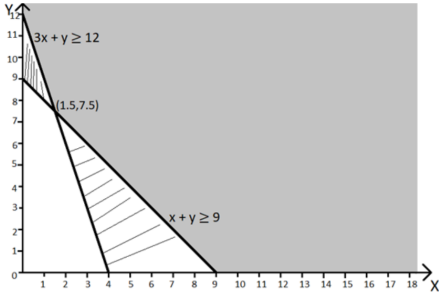
Show that the solution set of the following linear in equations is an unbounded set: $x+y \geq 9,3 x+y \geq 12, x \geq$$0, y \geq 0$
View full question & answer
Question 55 Marks
A farm is engaged in breeding pigs. The pigs are fed on various products grown on the farm. In view of the need to ensure certain nutrient constituents (call them X, Y and Z), it is necessary to buy two additional products, say, A and B. One unit of product A contains 36 units of X, 3 units of Y, and 20 units of Z. One unit of product B contains 6 units of X, 12 units of Y and 10 units of Z. The minimum requirement of X, Y and Z is 108 units, 36 units and 100 units respectively. Product A costs ₹ 20 per unit and product B costs ₹ 40 per unit. Formulate the above as a linear programming problem to minimize the total cost, and solve the problem by using graphical method.
Answer
The data given in the problem can be summarized in the following tabular form:
ProductNutrient constituentConst in ₹
XYZ
A3632020
B6121040
Minimum Required10836100 
Let x units of product A and y units of product B are bought to fulfill the minimum requirement of X, Y and Z and to minimize the cost.
The mathematical formulation of the above problem is as follows:
Minimize Z = 20x + 40y
$\begin{array}{l}\text { Subject to } 36 x+6 y \geq 108 \\ 3 x+12 y \geq 36 \\ 20 x+10 y \geq 100 \\ \text { and, } x, y, z \geq 0\end{array}$
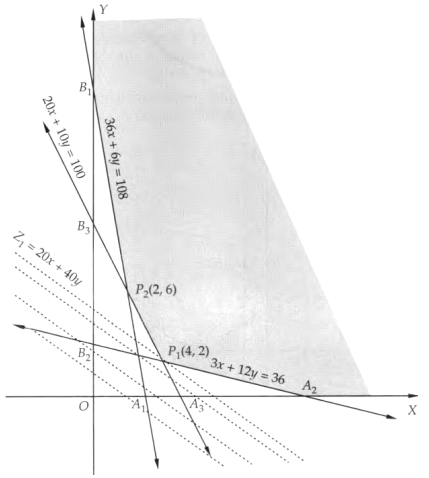
The set of all feasible solutions of the above LPP is represented by the feasible region shaded darkly in Figure. The coordinates of the corner points of the feasible region are $A _2(12,0), P _1(4,2), P _2(2,6)$ and $B _1(0,18)$
Image
Now, we have to find a point or points in the feasible region which give the minimum value of the objective function. For this, let us give some value to Z, say 20, and draw a dotted line 20 = 20x + 40y. Now, draw lines parallel to this line which have at least one point common to the feasible region and locate a line that is nearest to the origin and has at least one point common to the feasible region. Clearly, such a line is $Z _1=20 x +40 y$ and it has a point $P _1(4,2)$ common with the feasible region. Thus, $Z _1=20 x + 40y$ is y is the minimum value of Z, and the feasible solution which gives this value of Z is the comer$P_1(4,2)$ of the shaded region.
The values of the variables for the optimal solution are x = 4, y = 2. Substituting these values in Z = 20x + 40y, we get Z = 160 as
the optimal value of Z.
Hence, 2 units of product A and 4 units of product B are sufficient to fulfill the minimum requirement at a minimum cost of ₹160


View full question & answer
Question 65 Marks
A manufacturer has three machines installed in his factory. Machines I and II are capable of being operated for a most 12 hours whereas Machine III must operate at least for 5 hours a day. He produces only two items, each requiring the use of three machines. The number of hours required for producing one unit each of the items on the three machines is given in the following table:
ItemNumber of hours required by the machine
 IIIIII
A121
B21(5)/(4)
He makes a profit of ₹6.00 on item A and ₹4.00 on item B. Assuming that he can sell all that he produces, how many of each item should he produce so as to maximize his profit? Determine his maximum profit. Formulate this LPP mathematically and then solve it.
Answer
Let x units of item A and y units of item B be manufactured. Therefore, $x, y \geq 0$
ItemNumber of hours required by the machine
 IIIIII
A121
B21(5)/(4)
Machines I and II are capable of being operated for at most 12 hours whereas Machine III must operate at least for 5 hours a day.
According to the question, the constraints are
$\begin{array}{l}x+2 y \leq 12 \\ 2 x+y \leq 12 \\ x+\frac{5}{4} y \geq 5\end{array}$
He makes a profit of ₹6.00 on item A and ₹4.00 on item B. Profit made by him in producing x items of A and y items of B is 6x +4y
Total profit Z = 6x + 4y which is to be maximized
Thus, the mathematical formulation of the given linear programming problem is
Max Z = 6x + 4y, subject to
$\begin{array}{l} x +2 y \leq 12 \\ 2 x + y \leq 12 \\ x +\frac{5}{4} y \geq 5 \\ x , y \geq 0\end{array}$
First, we will convert the inequations into equations as follows:
$x+2 y=12,2 x+y=12, x+\frac{5}{4} y=5, x=0$ and $y=0$
The region represented by $x +2 y \leq 12$
The line x + 2y = 12 meets the coordinate axes at A(12, 0) and B(0, 6) respectively. By joining these points, we obtain the line x +y = 12. Clearly (0, 0) satisfies the x + 2y = 12. So, the region which contains the origin represents the solution set of the inequation $x+2 y \leq 12$
The region represented by $2 x + y \leq 12$
The line 2x + y = 12 meets the coordinate axes at C(6, 0) and D(0, 12) respectively. By joining these points, we obtain the line 2x+ y = 12. Clearly (0, 0) satisfies the 2x + y = 12. So, the region which contains the origin represents the solution set of the inequation $2 x+y \leq 12$
The region represented by $x+\frac{5}{4} y \geq 5$
The line $x+\frac{5}{4} y \geq 5$ meets the coordinate axes at $E (5,0)$ and $F (0,4)$ respectively. By joining these points, we obtain the line $x +$ $\frac{5}{4} y=5$. Clearly $(0,0)$ satisfies the $x+\frac{5}{4} y \geq 5$. So, the region which does not contain the origin represents the solution set of the inequation $x +\frac{5}{4} y \geq 5$
The region represented by $x \geq 0, y \geq 0$ :
Since every point in the first quadrant satisfies these inequations. So, the first quadrant is the region represented by the inequations $x \geq 0$ and $y \geq 0$
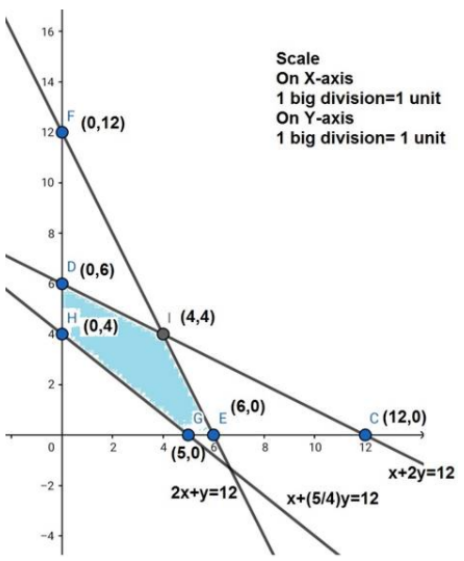
The feasible region determined by the system of constraints
$x+2 y \leq 12,2 x+y \leq 12, x+\frac{5}{4} y \geq 5, x, y \geq 0$ are as follows:
Image
Thus the maximum profit is of ₹40 obtained when 4 units each of items A and B are manufactured
The corner points are D(0, 6), I(4, 4), C(6, 0), G(5, 0), and H(0, 4). The values of Z at these corner points are as follows:
Corner pointsZ=6x+4y
D24
I40
C36
G30
H16
The maximum value of Z is 40 which is attained at I(4, 4).
View full question & answer
5 Marks Questions - Applied Maths STD 12 Science Questions - Vidyadip