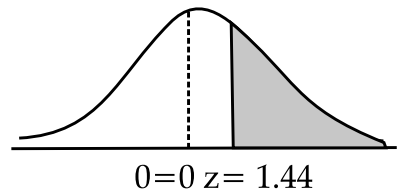
Question 12 Marks
For some computers, the time period between charges of the battery is normally distributed with a mean of 50 hours and a standard deviation of 15 hours. Rohan has one of these computers and needs to know the probability that the time period will be between 50 and 70 hours.
AnswerLet x be the random variable that represents the time period.
Given Mean, $\mu=50$ and standard deviation, $\sigma=15$
By using the transformation equation, we know;
$z=(X-\mu) / \sigma$
For $x=50, z=\frac{(50-50)}{15}=0$
For $x=70, z=\frac{(70-50)}{15}=1.33$
$P(50 < x < 70)=P(0 < z < 1.33)$
$=P(z-1.33)$
$=0.4082$ (from table)
The probability that Rohan's computer has time period between 50 and 70 hours is equal to 0.4082.
View full question & answer→Question 22 Marks
The speeds of cars are measure using a radar unit, on a motorway. The speeds are normally distributed with a mean of $90$ km/hr and a standard deviation of $10$ km/hr. What is the probability that a car selected at chance is moving at more than $100$ km/hr?
AnswerLet the speed of cars is represented by a random variable 'x'
Now, given mean, $\mu=90$ and standard deviation, $\sigma=10$.
To find: Probability that x is higher than 100 or $P(x > 100)$
By using the transformation equation, we know;
$z=\frac{(X-\mu)}{\sigma}$
For $x = 100, z = (100 - 90) / 10 = 1$
Hence, $P(x > 90) = P(z > 1)$
$= 0.5 - P(z = 1)$
$= 0.5-0.3413$
$= 0.1587$ (from table)
View full question & answer→Question 32 Marks
Assume the mean height of children to be $69.25$ cm with a variance of $10.8$ cm. How many children in a school of $1,200$ would you expect to be over $74$ cm tall?
View full question & answer→Question 42 Marks
The average daily procurement of milk by village society in 800 litres with a standard deviation of 100 litres. Find out proportion of societies procuring milk between 800 litres to 1000 litres per day.
AnswerWe are given mean $\mu=800$ and standard deviation $\sigma=100.$ Probability that the procurement of milk between 800 litres to 1000 litres per day is
$P(800 < X <1000)=P\left(\frac{800-800}{100} < z <\frac{1000-800}{100}\right)$
$= P(0 < Z < 2)$
$= 0.4772$ (table value)
Therefore $47.75$ percent of societies procure milk between $800$ litres to $1000$ litres per day.
View full question & answer→Question 52 Marks
Weights of fish caught by a traveller are approximately normally distributed with a mean weight of $2.25$ kg and a standard deviation of $0.25$ kg. What percentage of fish weigh less than $2$ kg?
AnswerWe are given mean $\mu=2.25$ and standard deviation $\sigma=0.25.$ Probability that weight of fish is less than 2 kg is $P(X < 2.0)$
When $x=20 \quad Z=\frac{X-\mu}{\sigma}=\frac{2.0-2.25}{0.25}=-1.0$
$P(Z < - 1.0) = P(Z > 1.0)$
$= 0.5-0.3413$
$= 0.1587$
Therefore $15.87\%$ of fishes weight less than $2$ kg.
View full question & answer→Question 62 Marks
Calculate the probability density function of normal distribution using the following data. $x=3, \mu=4$ and $\sigma=2.$
AnswerGiven, variable, $x = 3$
Mean $\mu=4$ and
Standard deviation $\sigma=2$
By the formula of the probability density of normal distribution, we can write;
$\begin{aligned} f(3,4,2) & =\frac{1}{2 \sqrt{2 \pi}} e^{\frac{-(3-4)^2}{2 \times 2^2}} \\ & =\frac{1}{2 \sqrt{2 \pi}} e^{\frac{-1}{8}} \\ & =\frac{1}{2 \sqrt{2 \pi}} e^{-0.125}\end{aligned}$
$\begin{array}{l}=\frac{1}{2 \sqrt{2 \pi}} \times 0.88250 \\ =0.1761\end{array}$
View full question & answer→Question 72 Marks
If the value of random variable is 2, mean is 5 and the standard deviation is 4, then find the probability density function of the normal distribution.
AnswerGiven,
Variable, $x = 2$
Mean $\mu=5$ and
Standard deviation $\sigma=4$
By the formula of the probability density of normal distribution, we can write;
$\begin{aligned} f(2,5,4) & =\frac{1}{4 \sqrt{2 \pi}} e^{\frac{-(2-2)^2}{2 \times 4^2}} \\ & =\frac{1}{4 \sqrt{2 \pi}} e^0=0.0997\end{aligned}$
View full question & answer→Question 82 Marks
Write the formula for Normal distribution.
AnswerThe probability density function of Normal or Gaussian distribution is given by;
$f(x, \mu, \sigma)=\frac{1}{\sigma \sqrt{2 \pi}} e^{\frac{-(x-\mu)^2}{2 \sigma^2}}$
where,
$x$ is the variable
$\mu$ is the mean
$\sigma$ is the standard deviation
View full question & answer→Question 92 Marks
If $P(X = 0) = P(X = 1) = a$ in a Poisson distribution, show that $a=\frac{1}{e}.$
AnswerLet, $P(X=x)=e^{-m} \frac{m^x}{x!}$
$x=0,1,2, \ldots, \infty$
Then, $P(X=0)=e^{-m}$
and $P(X=1)=e^{-m} m$
Since, given $P(X = 0) = P(X = 1),$ therefore $e^{-m}=e^{-m} m$
$\Rightarrow m=1$
$\text{Also, }P(X=0)=a$
$\Rightarrow e^{-1}=a$
$\Rightarrow a=\frac{1}{e}$
View full question & answer→Question 102 Marks
Six coins are tossed 6400 times. Using Poisson distribution, find approximate probability of getting six heads x times and 2 times.
AnswerLet the coins be unbiased i.e. the probability of getting a head $=$ the probability of getting a tail, for each coin.
$\therefore$ The probability of getting 6 heads with 6 coins
$\begin{aligned} & =\left(\frac{1}{2}\right)^6=\frac{1}{64}=p(\text { say }) \\ n p & =6400 \times \frac{1}{64}=100=m(\text { say })\end{aligned}$
Let $X=$ no. of tosses with heads
Then according to Poisson distribution,
$P(X=x)=e^{-m} \frac{m^x}{x!}=e^{-100} \frac{(100)^x}{x!}$
$\text{and}\quad P(X=2)=e^{-m} \frac{m^2}{2!}$
$=e^{-100} \frac{(100)^2}{2!}=5000~e^{-100}$
View full question & answer→Question 112 Marks
A telephone switch board handles 600 calls on the average during a rush hour. The board can make a maximum of 20 connections per minute. Use poisson distribution to estimate the probability the board will be over taxed during any given minute. $\left[e^{-1}=0.00004539\right]$
AnswerMean (per minute) $=\frac{600}{60}=10$
Hence, the probability for using 0 to 20 calls per minute
$\begin{array}{l}=\sum_0^{20} e^{-m} \frac{m^x}{x!} \\ =e^{-10} \sum_0^{20} \frac{10^x}{x!} \\ =0.00004539 \sum_0^{20} \frac{10^x}{x!}\end{array}$
Thus, the probability that the board will be over taxed during any given minute i.e. when the calls will be more than 20 connections per minute.
$=1-0.00004539 \sum_0^{20} \frac{10^x}{x!}$
View full question & answer→Question 122 Marks
A car-hire-firm has two cars, which it hires, out by the day by day. The number of demands for a car on each day is distributed as Poisson distribution with mean 1.5. Calculate the proportion of days on which neither car is used and proportion of days on which some demand is refused. $\left[e^{-1.5}=0.2231\right]$
AnswerThe proportion of days when no car will be required is
$e^{-m} \frac{m^0}{0!}=0.2231$
The probability when no car, one car, two cars will be required is
$\begin{array}{l}=e^{-m} \frac{m^0}{0!}+e^{-m} \frac{m^1}{1!}+e^{-m} \frac{m^2}{2!} \\ =e^{-m}\left(1+m+\frac{1}{2} m^2\right) \\ =0.2231(1+1.5+1.125) \\ =0.80807375\end{array}$
$\therefore$ The proportion of days on which some demand is refused $= 1 - 0.80807375 = 0.1912625$
View full question & answer→Question 132 Marks
In a Poisson distribution probability for $x = 10\%.$ Find the mean, given that $\text{log}_{e}$ $10=2.3026.$
AnswerLet $m$ be the mean. Then
$P(X=x)=e^{-m} \frac{m^x}{x!}$
$\Rightarrow P(0)=e^{-m}$
$e^{-m}=10 \%=\frac{10}{100}=0.1$
$\text{or }e^{-m}=10$
$m=\log _c 10=2.3026$
View full question & answer→Question 142 Marks
A die is thrown 5 times. Find the probability that an odd number will come up exactly three times.
AnswerHere, $n = 5$
$p = \frac{1}{2}$
and $q=1-p=1-\frac{1}{2}=\frac{1}{2}$
Also, $r = 3$
$\therefore P(X=r)={ }^n C_r(p)^r(q)^{n-r}$
$={ }^5 C_3\left(\frac{1}{2}\right)^3\left(\frac{1}{2}\right)^{5-3}$
$=\frac{5!}{3!2!} \cdot \frac{1}{8} \cdot \frac{1}{4}$"
$=\frac{10}{32}=\frac{5}{16}$
View full question & answer→Question 152 Marks
A coin is tossed 5 times. What is the probability of getting (i) 3 heads, (ii) atmost 3 heads ?
AnswerGiven, $n=5, p=\frac{1}{2}$ and $q=\frac{1}{2}$
Using Binomial distribution $P(x=r)={ }^n C_r P^r q^{n-r}$
(i) Probability of getting exactly three heads,
i.e., $\quad P(x=3)={ }^5 C_3\left(\frac{1}{2}\right)^3\left(\frac{1}{2}\right)^2$
$\begin{array}{l}=\frac{5!}{3!2!} \times \frac{1}{8} \times \frac{1}{4} \\ =\frac{5 \times 4 \times 3!}{3!\times 2 \times 1} \times \frac{1}{32} \\ =\frac{10}{32}=\frac{5}{16}\end{array}$
(ii) Probability of getting at most 3 heads,
i.e., $\quad P(x \leq 3)=1-[P(x=4)+P(x=5)]$
$\begin{array}{l}=1-\left[{ }^5 C_4\left(\frac{1}{2}\right)^4\left(\frac{1}{2}\right)+{ }^5 C_5\left(\frac{1}{2}\right)^5\left(\frac{1}{2}\right)^0\right] \\ =1-\left[5 \times \frac{1}{32}+1 \times \frac{1}{32}\right] \\ =1-\left(\frac{6}{32}\right) \\ =1-\frac{3}{16}=\frac{13}{16}\end{array}$
View full question & answer→Question 162 Marks
Find the probability of guessing correctly at least 8 out of 10 answers on a true-false type examination.
AnswerWe know that,
$P(X=r)={ }^n C_r(p)^r(q)^{n-r}$
Here, $n=10, p=\frac{1}{2}, q=\frac{1}{2}$ and $r \geq 8$
i.e., $r = 8, 9, 10$
$\Rightarrow P(X=r)=P(r=8)+P(r=9)+P(r=10)$
$={ }^{10} C_8\left(\frac{1}{2}\right)^8\left(\frac{1}{2}\right)^{10-8}+{ }^{10} C_9\left(\frac{1}{2}\right)^9\left(\frac{1}{2}\right)^{10-9}+$
${ }^{10} C_{10}\left(\frac{1}{2}\right)^{10}\left(\frac{1}{2}\right)^{10-10}$
$\begin{array}{l}=\left(\frac{10!}{8!2!}+\frac{10!}{9!1!}+1\right)\left(\frac{1}{2}\right)^{10} \\ =[45+10+1]\left(\frac{1}{2}\right)^{10} \\ =56\left(\frac{1}{2}\right)^{10}=\frac{7}{128}\end{array}$
View full question & answer→Question 172 Marks
Use a Poisson Distribution to find probability. If $\mu=0.5,$ find $P(2).$
Answer$P(X)=\frac{\mu^X . e^{-\mu}}{X!}$
$\begin{aligned} P(2) & =\frac{0.5^2 . e^{-0.5}}{2!} \\ & =0.0758\end{aligned}$
View full question & answer→Question 182 Marks
If $X$ follows binomial distribution with parameters $n = 5, p$ and $P(X = 2) = 9~P(X = 3),$ then find the value of $p.$
Answer
$\begin{array}{l}P(X=2)=9 .P(X=3) \text { (where, } n=5 \text { and } q=1-p \text { ) } \\\Rightarrow { }^5 C_2 p^2(1-p)^3=9 .{ }^5 C_2 p^3(1-p)^2 \\\Rightarrow \frac{5!}{2!3!} p^2(1-p)^3=9 \cdot \frac{5!}{3!2!} p^3(1-p)^2 \\\Rightarrow \frac{p^2(1-p)^3}{p^3(1-p)^2}=9 \\\Rightarrow \frac{(1-p)}{p}=9 \\\Rightarrow 9 p+p=1 \\\therefore p=\frac{1}{10}\end{array}$
View full question & answer→Question 192 Marks
Eight coins are tossed together. The probability of getting exactly 3 heads.
AnswerWe know that, probability distribution
$P(X=r)={ }^n C_r(p)^r q^{n-r}$
Here, $n=8, r=3, p=\frac{1}{2}$ and $q=\frac{1}{2}$
$\therefore$ Required probability $={ }^8 C _3\left(\frac{1}{2}\right)^3\left(\frac{1}{2}\right)^{8-3}$
$\begin{array}{l}=\frac{8!}{5!3!}\left(\frac{1}{2}\right)^8 \\ =\frac{8.7 .6}{3.2} \cdot \frac{1}{2^8}=\frac{7}{32}.\end{array}$
View full question & answer→Question 202 Marks
The probability of getting at least one head when a fair coin is tossed 5 times.
Answer$P(x \geq 1)=1-P(x=0)$
$\begin{array}{l}=1-5 C_0\left(\frac{1}{2}\right)^5 \\ =1-\frac{1}{32}\end{array}$
$=\frac{31}{32}$
View full question & answer→Question 212 Marks
The probability that a student is not a swimmer is $1/5.$ Then the probability that out of five students, four are swimmers.
AnswerThe repeated selection of students who are swimmers are Bernoulli trial. Let $X$ denotes the number of students, out of 5 students, who are swimmers.
Probability of students who are not swimmers,
$q=\frac{1}{5}$
$\therefore p=1-q=1-\frac{1}{5}=\frac{4}{5}$
Clearly, $X$ has a binomial distribution with $n=5$ and $p=\frac{4}{5}.$
$\begin{aligned} P(X=x) & ={ }^n C_x q^{n-x} p^x \\ & ={ }^5 C_x\left(\frac{1}{5}\right)^{5-x} \cdot\left(\frac{4}{5}\right)^x\end{aligned}$
$P(4$ students are swimmers$)$
$=P(X=4)={ }^5 C_4\left(\frac{1}{5}\right) \cdot\left(\frac{4}{5}\right)^4$
View full question & answer→Question 222 Marks
Find the probability of getting a doublet twice when a pair of dice is thrown 4 times.
Answer$n=4, p=\frac{6}{36}=\frac{1}{6}$
$q=\frac{5}{6}$
$P(x=2)={ }^{4}C_{2}\left(\frac{1}{6}\right)^2\left(\frac{5}{6}\right)^2$
$=\frac{25}{216}$
View full question & answer→Question 232 Marks
A die is rolled twice. Find the probability of getting an odd number exactly once.
Answer$n=2, p=\frac{1}{2}, q=\frac{1}{2}$
$\begin{array}{l}P(x=1)=2 C_1\left(\frac{1}{2}\right)^1\left(\frac{1}{2}\right)^1 \\ P(x=1)=\frac{1}{2}\end{array}$
View full question & answer→Question 242 Marks
A lot of 100 watches is known to have 10 defective watches. If 8 watches are selected (one by one with replacement) at random, what is the probability that there will be at least one defective watch?
AnswerProbability of defective watch from a lot $100$ watches $=\frac{10}{100}=\frac{1}{10}$
$\therefore p=\frac{1}{10}~ q=\frac{9}{10}~ n=8$ and $r \geq 1$
$\therefore P(r \geq 1)=1-P(r=0)$
$=1-{ }^8 C_0(\frac{1}{10})^{0}(\frac{9}{10})^{8-0}$
$=1-\frac{8!}{0!8!}\cdot (\frac{9}{10})^{8}=1-(\frac{9}{10})^{8}$
View full question & answer→Question 252 Marks
Injection site reaction are the most common adverse events following immunisation. These include pain, etching, swelling or redness around the site of injection. These reactions are usually mild and last for 1-2 days. If the probability that an individual suffers a bad reaction from an injection of a given serum is 0.001, then
Q.1. Determine the probability that out of 2000 individuals exactly 3 individuals suffer from bad reaction. [Given, $e^{-2}=0.13534$ ]
Q.2. Find the probability that out of 2000 individuals more than 2 individuals suffer from bad reaction.
Answer(1) Let p be the probability that an individual suffers a bad reaction from an injection of a given serum and n be the total number of individuals who took the injection.
Given, p = 0.001 and n = 2000
Since, p is very small and n is large, therefore, we apply Poisson's distribution.
We have, $m=n p=2000 \times 0.001=2$
Let X denote the number of individuals who suffer from bad reaction. Then, X is a Poisson variate such that $P(X=r)=\frac{m^r e^{-m}}{r!}, r=0,1,2, \ldots \ldots \infty$
$\therefore \quad P(X=r)=\frac{2^r e^{-2}}{r!}, r=0,1,2, \ldots . \infty$
$\therefore$ Required probability $=P(X=3)$
$\begin{array}{l}=2^3 \frac{e^{-2}}{3!}=\frac{4}{3} e^{-2} \\=\frac{4}{3} \times 0.13534\end{array}$
$=0.18044$
(2) Required probability
$\begin{array}{l}=P(X>2) \\ =1-P(X \leq 2) \\ =1-[P(X=0)+P(X=1)+P(X=2)] \\ =1-\left[e^{-2}+2 \frac{e^{-2}}{1!}+2^2 \frac{e^{-2}}{2!}\right] \\ =1-\frac{1}{e^2}+\frac{2}{e^2}+\frac{2}{e^2} \\ =1-\frac{5}{e^2} \\ =1-5 \times 0.13534 \\ =1-0.67670 \\ =0.323\end{array}$
View full question & answer→Question 262 Marks
In regards to product warranties, manufacturer defines the life span of a product to be the length of time that a product is in production and/or has parts in supply to support the repair or replacement of that product. The life span of certain kinds of electronic devices have mean of 300 hours and standard derivation of 25 hours. Assuming that the distribution of these life spans, which are measured to the nearest hour, can be approximated closely with a normal curve.
Q.1. Find the probability that any one of these electronic devices will have a life span of more than 350 hours. [Given $P(0 \leq Z \leq 2)=0.4772$ ]
Q.2. What percentage will have life spans from 220 to 260 hours. [Given, $P(0 \leq Z \leq 3.2)=0.4993$ and $P(0 \leq Z \leq 1.6)=$ $0.4452]$
Answer(1) Let X denotes the life spans of the given electronic devices. Then X is normally distributed with mean, $\mu=300$ and standard deviation, $\sigma=25$
Let $Z$ be the standard normal variate. Then $Z=\frac{X-\mu}{\sigma}$
$\Rightarrow Z=\frac{X-300}{25}$
when $X = 350,$ we get
$Z=\frac{350-300}{25}$
$=\frac{50}{25}=2$
$\therefore P(X>350)=P(Z>2)$
$\begin{array}{l}=0.5-P(0 \leq Z \leq 2) \\ =0.5-0.4772 \\ =0.0228\end{array}$
(2) When $X = 220,$ we get
$Z=\frac{220-300}{25}=-3.2$
and when X = 260, we get
$Z=\frac{260-300}{25}=-1.6$
$\therefore P(220 \leq X \leq 260)=P(-3.2 \leq Z \leq-1.6)$
$\begin{array}{l}=P(1.6 \leq Z \leq 3.2) \\ =P(0 \leq Z \leq 3.2)-P(0 \leq Z \leq 1.6) \\ =0.4993-0.4452 \\ =0.0541\end{array}$
Thus, 5.41% of the electronic devices will have life spans from 220 to 260.
View full question & answer→Question 272 Marks
A commuter train arrives punctually at a station every 25 minutes. Each morning, a commuter leaves his house and casually walks to the train station. Let $X$ denote the amount of time, in minutes, that commuter waits for the train from the time he reaches the train station. It is known that the probability density function of $X$ is
$f(x)=\left\{\begin{array}{ll}\frac{1}{25}, & \text { for } 0 < x > 25 \\ 0, & \text { otherwise }\end{array}\right.$
Obtain and interpret the expected value of the random variable $X.$
AnswerExpected value of the random variable is
$E ( X )=\int_{-\infty}^{\infty} x f(x) d x$
$\begin{array}{l}=\int_0^{25} x \frac{1}{25} d x \\ =\frac{1}{25} \int_0^{25} x d x \\ =\frac{1}{25}\left[\frac{x^2}{2}\right]_0^{25} \\ =12.5\end{array}$
Therefore, the expected waiting time of the commuter is $12.5$ minutes.
View full question & answer→Question 282 Marks
The time to failure in thousands of hours of an important piece of electronic equipment used in a manufactured DVD payer has the density function.
$f(x)=\left\{\begin{array}{ll}3 e^{-3 x}, & x>0 \\ 0, & \text { otherwise }\end{array}\right.$
Find the expected life of the piece of equipment.
AnswerWe know that
$\begin{aligned} E(X) & =\int_{-\infty}^{\infty} x f(x) d x \\ & =\int_0^{\infty} x 3 e^{-3 x} d x \\ & =3 \int_0^{\infty} x e^{-3 x} d x \\ & =3\left\{\left[x \frac{e^{-3 x}}{-3}\right]-\int_0^{\infty}\left(\frac{e^{-3 x}}{-3}\right) d x\right\}\quad\quad(\because \int u d v=u v-\int v d u)\end{aligned}$
$\begin{array}{l}=\int_0^{\infty} e^{-3 x} d x \\ =\frac{1}{3}\end{array}$
Therefore, the expected life of the piece of equipment is $\frac{1}{3}$ hrs (in thousands).
View full question & answer→Question 292 Marks
A continuous random variable $X$ has $p.d.f$ $f(x)=5 x^4, 0 \leq x \leq 1$. Find $a_1$ and $a_2$ such that
(i) $P\left[X \leq a_1\right]=P\left[X>a_1\right]$
(ii) $P\left[X>a_2\right]=0.05.$
Answer(i) Since $P\left[X \leq a_1\right]= P \left[X>a_1\right]$
$P\left[X \leq a_1\right]=\frac{1}{2}$
i.e., $\int_0^{a_1} f(x) d x=\frac{1}{2}$
i.e., $\int_0^{a_1} 5 x^4 d x=\frac{1}{2}$
$5\left[\frac{x^5}{5}\right]_0^{a_1}=\frac{1}{2}$
$a_1=(0.5)^{\frac{1}{5}}$
(ii) $P\left(X>a_2\right]=0.05$
$\int_{a_2}^1 f(x) d x=0.05$
$\int_{a_2}^1 5 x^4 d x=0.05$
$5\left[\frac{x^5}{5}\right]_{a_2}^1=0.05$
$a_1=[0.95]^{\frac{1}{5}}$
View full question & answer→Question 302 Marks
If you toss a fair coin three times, the outcome of an experiment consider as random variable which counts the number of heads on the upturned faces. Find out the probability mass function and check the properties of the probability mass function.
AnswerLet $X$ is the random variable which counts the number of heads on the upturned faces. The outcomes are stated below| Outcomes | Values of X | Outcomes | Values of X |
| $(HHH)$ | $3$ | $(HTT)$ | $1$ |
| $(HHT)$ | $2$ | $(THT)$ | $1$ |
| $(HTH)$ | $2$ | $(TTH)$ | $1$ |
| $(THH)$ | $2$ | $(TTT)$ | $0$ |
These values are summarized in the following Probability table.| Value of X | $0$ | $1$ | $2$ | $3$ | Total |
| $p\left(x_i\right)$ | $\frac{1}{8}$ | $\frac{3}{8}$ | $\frac{3}{8}$ | $\frac{1}{8}$ | $\sum_{i=0}^3 p\left(x_i\right)=1$ |
(i) $p\left(x_i\right) \geq 0~ \forall ~i$ and
(ii) $\sum_{i=0}^3 p\left(x_i\right)=1$ View full question & answer→Question 312 Marks
If $p(x)=\left\{\begin{array}{ll}\frac{x}{20}, & x=0,1,2,3,4,5 \\ 0, & \text { otherwise }\end{array}\right.$
Find (i) $P(X < 3)$ and (ii) $P(2 < X \leq 4)$
Answer(i) $P(X < 3) = P(X = 0) + P(X = 1) + P(X = 2)$
$=0+\frac{1}{20}+\frac{2}{20}=\frac{3}{20}$
(ii) $P(2 < X \leq 4)=P(X=3)+P(X=4)$
$=\frac{3}{20}+\frac{4}{20}=\frac{7}{20}$
View full question & answer→Question 322 Marks
Find the probability distribution of $X,$ the number of heads in a simultaneous toss of two coins.
AnswerLet $X$ be the number of heads.
Possible values of $X$ are $0, 1, 2$
$P(X=0)=\frac{1}{4}, P(X=1)=\frac{1}{2}, P(X=2)=\frac{1}{4}$.
The probability distribution of $X$ is:| $X$ | $0$ | $1$ | $2$ |
| $P(X)$ | $1/4$ | $1/2$ | $1/4$ |
View full question & answer→Question 332 Marks
The random variable $X$ has a probability distribution $P(X)$ of the following form, where k is some number:
$P(X)=\left\{\begin{array}{l}k, \text { if } x=0 \\ 2 k, \text { if } x=1 \\ 3 k, \text { if } x=2 \\ 0, \text { otherwise }\end{array}\right.$
(i) Find the value of $k$
(ii) Find $P(X < 2)$
AnswerHere,
(i) Since $P(0) + P(1) + P(2) = 1,$ we have
$k + 2k + 3k = 1$
$\text{i.e., } 6k = 1, \text{ or } k = \frac{1}{6}.$
(ii) $P(X < 2) = P(0) + P(1)$
$= k + 2k = 3k = \frac{1}{2}.$
View full question & answer→Question 342 Marks
The probability distribution of the discrete variable X is given as :| $X$ | $2$ | $3$ | $4$ | $5$ |
| $P(X)$ | $\frac{5}{k}$ | $\frac{7}{k}$ | $\frac{9}{k}$ | $\frac{11}{k}$ |
Find the value of $k.$ Answer$\Sigma P(X)=1$
$\Rightarrow \frac{5}{k}+\frac{7}{k}+\frac{9}{k}+\frac{11}{k}=1$
$\Rightarrow k=32$
View full question & answer→Question 352 Marks
Three balls are drawn from a bag containing 2 red and 5 black balls, if the random variable X represents the number of red balls drawn, then how many values X can take?
AnswerAs there are two red balls, the maximum number of red balls can be 2.
$X$ can take values $0, 1, 2.$
View full question & answer→Question 362 Marks
A discrete random variable X has the probability distribution given below :| $X$ | $0.5$ | $1$ | $1.5$ | $2$ |
| $P(X)$ | $k$ | $k^2$ | $2k^2$ | $k$ |
Find the value of $k.$ AnswerWe know that, $\sum_{i=1}^\pi P_i=1$, where $P_i \geq 0$
$\begin{array}{l}\Rightarrow P_1+P_2+P_3+P_1=1 \\ \Rightarrow k+k^2+2 k^2+k=1 \\ \Rightarrow 3 k^2+2 k-1=0 \\ \Rightarrow(3 k-1)(k+1)=0 \\ \Rightarrow k=\frac{1}{3} .\quad\quad\quad(\text{as k is}\geq0)\end{array}$
View full question & answer→Question 372 Marks
For the following probability distribution:| $X$ | $-4$ | $-3$ | $-2$ | $-1$ | $0$ |
| $P(X)$ | $0.1$ | $0.2$ | $0.3$ | $0.2$ | $0.2$ |
Find $E(X).$ Answer$E(X)=\sum X P(X)$
$=-4 \times(0.1)+(-3 \times 0.2)+(-2 \times 0.3)$$+(-1 \times 0.2)+(0 \times 0.2)$
$=-0.4-0.6-0.6-0.2+0=-1.8$
View full question & answer→Question 382 Marks
For the following probability distribution:| $X$ | $1$ | $2$ | $3$ | $4$ |
| $P(X)$ | $1/10$ | $1/5$ | $3/10$ | $2/5$ |
Find $E\left(X^2\right).$ Answer$E\left(X_2\right)=\sum X^2 P(X)$
$=1 \cdot \frac{1}{10}+4 \cdot \frac{1}{5}+9 \cdot \frac{3}{10}+16 \cdot \frac{2}{5}$
$=\frac{1}{10}+\frac{4}{5}+\frac{27}{10}+\frac{32}{5}$
$=\frac{1+8+27+64}{10}=10$
View full question & answer→