Questions

3 Marks Question

🎯

Test yourself on this topic

10 questions · timed · auto-graded

Question 23 Marks
Explain the use of microbes in the production of various beverages with examples.
Answer
Microbes especially ‘yeast’ have been used since ancient era in the production of wine, beer, whiskey, brandi, gin, rum, etc. To fulfill this purpose, the same yeast Saccharomyces cerevisiae, which is commonly known as ‘brewer’s yeast’ is used to produce ethanol in bread-making and malted grains, and fruit juices. Fermentation takes place in all these processes, which is represented by the following equation :
$\begin{array}{c} C _6 H _{12} O _6 \\ \text { Glucose }\end{array} \rightarrow \underset{\text { Ethanol }}{2 C _2 H _5 OH }+2 CO _2$
The production of different types of alcoholic beverages depends on fermentation and different types of processing (with or without distillation) of raw materials. Alcohol, beer, cides, red wine, champagne, sherry, toddy etc. are produced without distillation whereas whiskey, brandi and rum are prepared by distillation of fermented juice.
View full question & answer
Question 33 Marks
Write a short note on bio-fertilizer.###What is bio-fertilizer? Explain with example.
Answer
Bio-fertilizers : Microbes, that increase soil fertility, are called bio-fertilizers. Several nitrogen fixing bacteria like blue-green algae, root fungi etc. increase the fertility of the soil. Some of the important example are as follows :
1. Legume-Rhizobium Symbiosis : Rhizobium species residing in root glands of legume plants provide N2 in a usable form of to the plant.
2. Azolla-Anabaena Symbiosis : Azolla is an aquatic pteritophyte which grows on the surface of the water. Along with this, blue-green algae called Anabaena lives symbiotically and provides nitrate to the plants.
3. Free-living Cyanobacteria and Bacteria : Rivilaria and Nostoc (blug-green algae) and Chlostridium and Azobacter (free living bacteria) fix atmospheric nitrogen while living freely in the soil. Now-a-days efforts are being made to transfer the nitrogen fixing gene (Nif gene) of microbes to higher plants by application of biotechnology techniques.
View full question & answer
Question 43 Marks
Write any five common antibiotics with their sources.
Answer
Antibiotic and their sources :
S.No.AntibioticSource
1ClorotatracyclineStreptomyces orifices
2StreptomycinStreptomyces griseoves
3PenicillinPenicillium notatum
4CephalosporinCephalosporium acremonium
5CycloheximideStreptomyces griseoves
View full question & answer
Question 53 Marks
Write the names of important microbes used in industries. Name any five products in which microbes are used for manufacturing purpose.
Answer
Important microbes used in industries are as follows :
(1) Yeast (fungus)
(2) Fungi
(3) Bacteria
(4) Filamentous bacteria (Actinomycetes)
Microbes are used in the manufacture of following products :
(1) Alcoholic beverages
(2) Curd
(3) Antibiotic
(4) Organic chemical which include vitamins, steroid and enzymes (5) Biogas
View full question & answer
Question 63 Marks
What is Bt? How does it create resistance to the insect?
Answer
Bt is a type of toxin. It is made from a bacteria called Bacillus thurigiensis (in brief Bt).
Bt toxin gets cloned from gene bacteria and get expressed in plants and creates resistance against insects (pests). As a result, there is no need to use pesticides. This is how biopesticides are manufactured, e.g. : Bt cotton, Bt corn, rice, tomato and potato etc.
Bt Cotton : Some breeds of Bacillus thuringiensis produce such proteins that are helpful in killing specific insects like lapidopterans (tobacco bud worm, soldier worm), coleopterans (beetles) and dipterans (flies and mosquitoes). Bt produces some toxic insecticidal proteins. Why does this toxin not kill the Bacillus? In fact, the Bt toxin protein, protoxin is in an active form, as soon as the insect eats this inactive toxin, alkaline pH changes it in its intestine. Due to this, they become soluble and get converted into active form. Active toxin bind to the surface of epithelial cells of the middle intestine and form holes in them due to which the cell swell and burst and as a result the insect dies.
The specific Bt toxin has been isolated from Bt and has been incorporated into many crops like cotton. The choice of genes depends on the crop and the specific pest. Whereas most Bt toxins depend on insect group specificity.
View full question & answer
Question 73 Marks
What is the important of Spirulina as a food?
Answer
Spirulina is a member of blue-green algae. It can be used as a complete diet. Spirulina contains protein, carbohydrate, amino acid, vitamins, minerals, enzymes, fat and pigments. The speciality of protein present in spirulina is that it is excactly same as the body prepares for itself. It contains as much calcium as milk and 15 times more vitamin-A than carrots.
View full question & answer
Question 83 Marks
Write any four differences between bacteria and cyanobacteria.
Answer
Four differences between bacteria and cyanobacteria :
S.No.BacteriaCyanobacteria
1Small cells.Comparatively large cells.
2Can have flagella.Don't have flagella.
3In some bacteria (green bacteria) photosynthesis occurs in a different way in which $O _2$ exists.Oxygen exits normally during photosynthesis as happens in green plants.
4Sexual reproduction by conjugationConjugation did not observed.
View full question & answer
Question 93 Marks
How are viroids different from viruses?
Answer
Differences between Viroids and Viruses :
S.No.VirusesViroids
1They are smaller than bacteria.They are smaller than viruses.
2They may have genetic substance RNA or DNA.While they have only RNA.
3They have a protein coating.They don't have protein coating.
4These cause the following diseas : AIDS, small pox etc.While they cause a disease called potato spindle tuber.
View full question & answer
Question 103 Marks
Describe the habitat of microbes. Why are they grown on nutrient media? Explain.
Answer
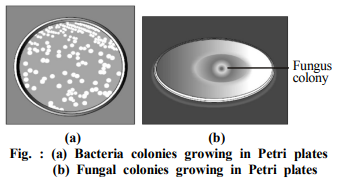
Habitat of Microbes : Microbes are omnipresent. These are found in the soil, water, air, inside our body and in other types of animals and plants. Where life is not possible by any means, such as deep inside geysers (thermal chimneys) where temperature reaches upto 100°C, deep in the soil, several meters below the ice layers and in highly acidic environments, they are found in such places. Microbes include various forms of protozoa, bacteria, fungi and microscopic plants (see figure).
Image
Similar to bacteria and mostly fungi, microbes are grown on nutrient media so that they can grow and take the form of colonies and can bee seen with naked eye (see the figure given above). Such cultures are beneficial during microbial studies.
View full question & answer
3 Marks Question - Biology STD 12 Science Questions - Vidyadip