Questions

5 Marks Questions

🎯

Test yourself on this topic

6 questions · timed · auto-graded

Question 15 Marks
B.
(i) Name the two types of desirable approaches to conserve biodiversity? Explain with examples bringing out the difference between the two types.
(ii) State the features of a stable biological community?
Answer
B.(i)
S. No.In situ conservationEx situ conservation
(i)It is conservation and protection of biodiversity in its natural habitat.It is conservation of selected threatened plant and animal species in places outside their natural habitat.
(i)Population is conserved in the surroundings where they have developed their distinctive features.Population is conserved under simulated conditions that closely resemble their natural habitats.
(iii)eg, national parks, biosphere reserves, wildlife sanctuaries, etc.eg, botanical gardens, zoological parks, wildlife safari, gene banks, etc.

(ii) A stable community should not show too much variation in productivity from year to year; it must be either resistant or resilient to occasional disturbances (natural or man-made), and it must also be resistant to invasions by alien species.
View full question & answer
Question 25 Marks
B. In the future, genetic therapies may be used to prevent, treat, or cure certain inherited disorders in humans. Justify the statement with a suitable example.
Answer
B.,
- Gene therapy is a collection of methods that allows correction of a gene defect that has been diagnosed in a child/embryo. Here genes are inserted into a person's cells and tissues to treat a disease.,
- Correction of a genetic defect involves delivery of a normal gene into the individual or embryo to take over the function of and compensate for the non-functional gene.,
- The first clinical gene therapy was given in 1990 to a 4-year old girl with adenosine deaminase (ADA) deficiency. This enzyme is crucial for the immune system to function.,
- The disorder is caused due to the deletion of the gene for adenosine deaminase.,
- In some children ADA deficiency can be cured by bone marrow, transplantation; in others it can be treated by enzyme replacement, therapy, in which functional ADA is given to the patient by injection. ,
- But the problem with both of these approaches is that they are not completely curative.,
- As a first step towards gene therapy, lymphocytes from the blood of the patient are grown in a culture outside the body.,
- A functional ADA cDNA (using a retroviral vector) is then introduced into these lymphocytes, which are subsequently returned to the patient.,
- However, as these cells are not immortal, the patient requires periodic infusion of such genetically engineered lymphocytes.,
- However, if the gene isolate from marrow cells producing ADA is introduced into cells at early embryonic stages, it could be a permanent cure.
View full question & answer
Question 35 Marks
(i) Explain the significance of each of the following features present in plants given below:, (a) In rose-bay plant the stamens ripen before the stigma., (b) In certain species of primrose, the flowers have short stamen and long style., (c) The bisexual flower of mustard exhibits rejection of self-pollen grain., (ii) Explain how autogamy is prevented in castor and papaya plant respectively.
Answer
(1) (i) In rose-bay plant, the time of maturation of stamen and pistil is not same, the pollen will not be able to germinate on the stigma. This prevents autogamy in rose-bay., (ii) Different position and incompatible placement of the reproductive structure prevent successful pollination and thus autogamy in primrose., (iii) Pollen pistil interaction for same species is not possible; this is a genetic mechanism which prevent the pollen grain from forming pollen tube on the pistil of the same flower., (2) The male and female flowers are present in the same plant but are not in proximity preventing self-fertilization in castor. In papaya, the male flower and female flowers are in different plants, it prevents autogamy.
View full question & answer
Question 45 Marks
A.
(i) Why is there a need to conserve biodiversity? (Any two reasons)
(ii) Name and explain any two causes that are responsible for the loss of biodiversity.
Answer
A.
(i) There are three main reasons for conserving the biodiversity which have been classified into the following categories: (Any two reasons)
- Narrowly utilitarian arguments. Human beings derive direct economic benefits from nature, like food, firewood, fibre, construction material, industrial products (resins, gums, dyes, tannins, etc.) and medicinally important products.
- Broadly utilitarian arguments. Biodiversity plays a major role in maintaining and sustaining supply of goods and services from various species as well as ecological systems. The different ecological services provided are:
→ Amazon forest is estimated to contribute 20 per cent of the total oxygen in the atmosphere on earth.
→ Pollinators like bee, bumble bees, birds and bats pollinate plants to form fruits and seeds.
→ Aesthetic pleasures like bird watching, spring flowers in full bloom, walking through the thick forest, waking up to a bulbul's song, etc. are some other benefits of the ecosystem.
- Ethical reasons there are thousands of plants, animals and microbes on this earth which are not useless. Everyone has some intrinsic value even if it is not of any economic value to us. It is, therefore, our moral duty to ensure well-being of all the living creatures for the utilisation of future generations.
(ii) There are four major causes of biodiversity loss. These are also known as 'The Evil Quartet'.
- Habitat loss and fragmentation Destruction of habitat is the primary cause of extinction of species. When large-sized habitats are broken or fragmented due to human settlements, building of roads, digging of canals, etc., the population of animals requiring large territories and some animals with migratory habitats declines.
- Over-exploitation When biological system is over-exploited by man for the natural resources, it results in degradation and extinction of the resources. For example, Stellar's sea cow, passenger pigeon and many marine fishes.
- Alien (exotic) species invasions Some alien (exotic) species when introduced unintentionally or deliberately, become invasive and cause harmful impact, resulting in extinction of the indigenous and many marine fishes.
- Alien (exotic) species invasions Some alien (exotic) species when introduced unintentionally or deliberately, become invasive and cause harmful impact, resulting in extinction of the indigenous species. Nile perch, a large predator fish when introduced in Lake Victoria (East Africa) caused the extinction of an ecologically unique species of Cichlid fish in the lake.
- Co-extinctions When a species becomes extinct, the plant and animal species associated with it in an obligatory manner, also become extinct. For example, if the host fish species becomes extinct, all those parasites exclusively dependent on it, will also become extinct
View full question & answer
Question 55 Marks
A. Explain how advent of biotechnology has helped in preventing infestation by nematodes and thereby increasing crop yield.
Answer
A.
- Several nematodes parasitize a wide variety of plants and animals including human beings.
- A nematode Meloidegyne incognitia infects the roots of tobacco plants and causes a great reduction in yield.
- A novel strategy was adopted to prevent this infestation which was based on the process of RNA interference (RNAI).
- RNAi takes place in all eukaryotic organisms as a method of cellular defense.
- This method involves silencing of a specific mRNA due to a complementary dsRNA molecule that binds to and prevents translation of the mRNA (silencing).
- The source of this complementary RNA could be from an infection
by viruses having RNA genomes or mobile genetic elements
(transposons) that replicate via an RNA intermediate.
- Using Agrobacterium vectors, nematode-specific genes were
introduced into the host plant.
- The introduction of DNA was such that it produced both sense and anti-sense RNA in the host cells.
- These two RNA's being complementary to each other formed a double stranded (dsRNA) that initiated RNAi and thus, silenced the specific mRNA of the nematode.
- The consequence was that the parasite could not survive in a transgenic host expressing specific interfering RNA. The transgenic plant therefore got itself protected from the parasite.
View full question & answer
Question 65 Marks
A. Cryptorchidism is a condition in which the testes fail to descend into the scrotum. It can also lead to compromised Sertoli cell function and has an impact on Leydig cell function.
(i) Identify at least 3 parameters of male fertility which get affected due to cryptorchidism.
(ii) Which process will be affected if mature spermatids are not released from Sertoli cells?
(iii) Name and explain one assisted reproductive technology (ART process) in which the sperm/semen is used to assist fertilization.
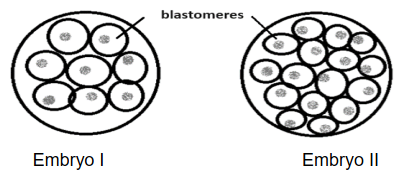
(iv) Name and explain the assisted reproductive technology that should be used to complete the development of embryos I and II shown in the figure given below.
Answer
A.
(i)
- Sperm count decreases, spermatogenesis is impaired;
- Spermatids do not get nourishment to develop into spermatozoa thus spermiogenesis will be affected;
- Leydig cells synthesize and secrete androgen hormones (like testosterone) so secretion of androgens will be affected.
(ii) Spremiation
(iii) Artificial insemination (Al) technique. In this technique, the semen collected either from the husband or a healthy donor is artificially introduced either into the vagina or into the uterus (IUI intra uterine insemination) of the female.
OR
Intra cytoplasmic sperm injection (ICSI) is another specialised procedure to form an embryo in the laboratory in which a sperm is directly injected into the ovum.
(iv) The zygote or early embryos (with upto 8 blastomeres) could be transferred into the fallopian tube (ZIFT-zygote intra fallopian transfer); embryos with more than 8 blastomeres, into the uterus (IUT - intra uterine transfer), to complete its further development.
View full question & answer