Questions

5 Marks Questions

🎯

Test yourself on this topic

6 questions · timed · auto-graded

Question 15 Marks
How and why is the bacterium Thermus aquaticus employed in recombinant DNA technology? Explain.
Answer
The bacterium Thermus aquaticus is employed and used for amplification of the gene of interest using PCR technique. Usually Taq (Thermus aquaticus) DNA polymerase, a thermostable enzyme is isolated from a thermophilic bacterium. The enzyme extends the two primers towards each other in order to copy the DNA segment (act as a template) lying between the two primers.
The step requires the presence of deoxynucleoside triphosphates and Mg2+ and occurs at 72°C.
If these cycles are repeated many times, the DNA segment can be amplified to approximately a billion times the DNA segment are made.
i. These are restriction endonucleases enzymes which cut the DNA molecule at the specific base sequences into fragments with sticky ends.
e.g., Eco RI, Hind II
ii. The enzyme restriction endonuclease cleaves DNA at a specific site resulting in the formation of fragments with single strand portions at the ends called sticky-ends. In practice, the digestion by the restriction enzyme keeping all other conditions at the optimum level and checked by using agarose gel electrophoresis technique.
View full question & answer
Question 25 Marks
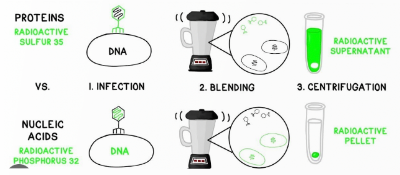
In 1952, Alfred Hershey and Martha Chase took an effort to find the genetic material in organisms. Their experiments led to an unequivocal proof to DNA as genetic material.
Image

Answer the following questions based on Hershey and Chases's experiments:
i. Name the kind of virus they worked with and why?
ii. Why did they use two types of culture media to grow viruses in? Explain.
iii. What was the need for using a blender and later a centrifuge during their experiments? OR
iv. State the conclusion drawn by them after the experiments.
Answer
i. They worked with bacteriophage, i.e. viruses that infect bacteria. These viruses were used because during infection they transfer their genetic material into bacteria.
ii. They used two types of culture media, containing 35S and 32P, so as to compare that which one out of DNA and proteins gets transferred from virus to bacteria and act as genetic material.
iii. A blender and centrifuge were used to open up the bacterial cells and viral particles, so, that genetic material could be visualised.
iv. They concluded that DNA is the genetic material that is passed from virus to bacteria.
View full question & answer
Question 35 Marks
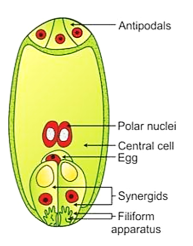
a. Draw a diagram of a fully developed embryo sac of an angiosperm. Label its chalazal end and any other five parts within the embryo sac.
b. Why does the development of an endosperm precede that of the embryo in angiosperm?
c. Number of chromosomes in an onion plant cell is 16. Name the cells of the embryo sac having 16 and 24 chromosomes formed after fertilisation.
Answer
a.
Image
b. The development of an endosperm precede that of the embryo in angiosperm because the cells get packed with reserve food supplies, used for providing the nutrition to the developing embryo.
c. Cells with 16 chromosomes is called zygote and cells with 24 chromosome is called endosperm.
View full question & answer
Question 45 Marks
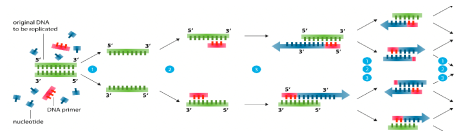
Polymerase chain reaction (PCR) is a laboratory technique used to amplify DNA sequences. The method involves using short DNA sequences called primers to select the portion of the genome to be amplified. The temperature of the sample is repeatedly raised and lowered to help a DNA replication enzyme copy the target DNA sequence. The technique can produce a billion copies of the target sequence in just a few hours.
Image
i. List the three steps involved in Polymerase Chain Reaction (PCR).
ii. Name the source organism of Taq polymerase.
iii. Explain the specific role of this enzyme in PCR.
Answer
i. Amplification of recombinant DNA gene is done using Polymerase Chain Reaction (PCR).
It is carried out in the following steps:
a. Denaturation -The double-stranded DNA is denatured by applying high temperature of 95°C for 15 seconds. Each separated strand acts as a template.
b. Annealing -Two sets of primers are added, which anneal to the 3'end of each separated strand.
c. Extension- DNA polymerase extends the primers by adding nucleotides complementary to the template provided in the reaction. Taq polymerase is used in the reaction, which can tolerate heat. All these steps are repeated many times to get several copies of the desired DNA,
ii. The DNA polymerase used in PCR is Taq polymerase extracted from Thermus aquaticus. It is a thermostable enzyme that can withstand the high temperature used in the denaturation and separation of DNA strands. Hence, it can be used for a number of cycles of DNA amplification without being denatured.
View full question & answer
Question 55 Marks
i. Name the type of DNA that forms the basis of DNA fingerprinting and mention two features of this DNA.
ii. Write the steps carried out in the process of DNA fingerprinting technique, and mention its application.
Answer
i. Satellite DNA or repetitive DNA These sequences normally do not code for any proteins. These sequence show high degree of polymorphism.
ii. Steps carried out in the process of DNA fingerprinting technique are:
(a) isolation of DNA,
(b) digestion of DNA by restriction endonucleases
(c) separation of DNA fragments by electrophoresis
(d) transferring (blotting) of separated DNA fragments to synthetic membranes such as nitrocellulose or nylon.
(e) hybridization on using labelled VNTR probe.
(f) detection of hybridized DNA fragments by autoradiography
The applications of DNA fingerprinting technique are in Forensic science / determining population and genetic diversities / paternity test.
View full question & answer
Question 65 Marks
a. Explain the process of syngamy and triple fusion in angiosperms.
b. Trace the development of the product of syngamy upto its mature stage in a dicot plant.
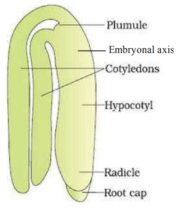
c. Draw and label three important parts of a mature dicot embryo.
View full question & answer
5 Marks Questions - Biology STD 12 Science Questions - Vidyadip