Question 15 Marks
Recombinant DNA vectors are typically attenuated viruses or bacteria that are unrelated to the pathogen of interest.
These vectors can penetrate human cells and often replicate within them, but do not cause disease in the host.
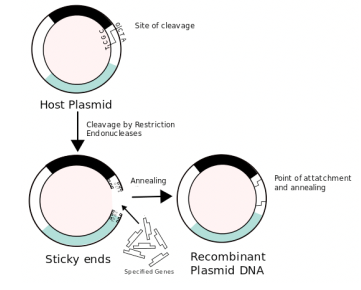
i. A recombinant vector with a gene of interest inserted within the gene of a-galactosidase enzyme, is introduced into a bacterium. Explain the method that would help in selection of recombinant colonies from non-recombinant ones.
ii. Why is this method of selection referred to as insertional inactivation?
These vectors can penetrate human cells and often replicate within them, but do not cause disease in the host.
i. A recombinant vector with a gene of interest inserted within the gene of a-galactosidase enzyme, is introduced into a bacterium. Explain the method that would help in selection of recombinant colonies from non-recombinant ones.
ii. Why is this method of selection referred to as insertional inactivation?
Answer
View full question & answer→i. The insertion of recombinant DNA within the coding sequence of enzyme a-galactosidase results in the inactivation of the
enzyme called insertional inactivation. The colonies do not produce a blue colour in the presence of chromogenic substrate
and are identified as recombinant colonies whereas non-recombinant colonies produce blue colour from the chromogenic
substrate, due to the presence of the activated enzyme.
ii. The method is referred as "insertional inactivation" because the enzyme a-galactosidase produced is inactivated due to insertion of alien DNA within the coding sequence of the enzyme, which acts as a selectable marker to differentiate recombinant colonies from non-recombinant one.
enzyme called insertional inactivation. The colonies do not produce a blue colour in the presence of chromogenic substrate
and are identified as recombinant colonies whereas non-recombinant colonies produce blue colour from the chromogenic
substrate, due to the presence of the activated enzyme.
ii. The method is referred as "insertional inactivation" because the enzyme a-galactosidase produced is inactivated due to insertion of alien DNA within the coding sequence of the enzyme, which acts as a selectable marker to differentiate recombinant colonies from non-recombinant one.