Questions · Page 1 of 5

1 Marks Question

🎯

Test yourself on this topic

50 questions · timed · auto-graded

Question 11 Mark
Briefly describe the following:
Transcription.
Answer
Transcription: The process of copying genetic information from one strand of the DNA into RNA is known as transcription. RNA is assembled simply based on complementarity of the DNA strand, only uracil is substituted in place of thymine. Only a small segment of DNA that codes for a polypeptide is copied.
View full question & answer
Question 21 Mark
Explain (in one or two lines) the function of the following:
Promoter.
Answer
Promoter: It is a region of DNA that helps in initiating the process of transcription. It serves as the binding site for RNA polymerase.
View full question & answer
Question 31 Mark
If the sequence of the coding strand in a transcription unit is written as follows:
5'-ATGCATGCATGCATGCATGCATGCATGC-3'
Write down the sequence of mRNA.
Answer
mRNA: 5'-A U G CAU G CAU G C AU G CA UGCAUGCAUGC-3'.
View full question & answer
Question 41 Mark
Briefly describe the following:
Translation.
Answer
Translation: It refers to the process of polymerisation of amino acids to form a polypeptide. The order and sequence of amino acids are defined by the sequence of bases in the mRNA. It occurs in cytoplasm in both prokaryotes and eukaryotes.
View full question & answer
Question 51 Mark
Explain (in one or two lines) the function of the following:
tRNA.
Answer
tRNA: tRNA or transfer RNA is a small RNA that reads the genetic code present on mRNA. It carries specific amino acid to mRNA on ribosome during translation of proteins.
View full question & answer
Question 61 Mark
If the sequence of one strand of DNA is written as follows:
5'-ATGCATGCATGCATGCATGCATGCATGC-3'
Write down the sequence of complementary strand in 5' → 3' direction.
Answer
The DNA strands are complementary to each other with respect to base sequence. Hence, if the sequence of one strand of DNA is 5'-ATGCATGCATGCATGCATGCATGCATGC-3’ Then, the sequence of complementary strand in 5' to 3' direction will be 3'-TACGTACGTACGTACGTACGTACGTACG-5’ Therefore, the sequence of nucleotides on DNA polypeptide in 5' to 3' direction is 5'-GCATGCATGCATGCATGCATGCATGCAT-3’.
View full question & answer
Question 71 Mark
Briefly describe the following:
Polymorphism.
Answer
Polymorphism: The variation in DNA arising through mutation at non-coding sequences is known as Polymorphism. Such variations are unique to specific sites of DNA and can occur due to deletion, insertion or substitution of bases. It can be observed by making fragments of DNA sample and separating them through electrophoresis. The polymorphism in a DNA sequence is the basis of genetic mapping of the human genome as well as DNA fingerprinting.
View full question & answer
Question 81 Mark
Explain (in one or two lines) the function of the following:
Exons.
Answer
Exons: Exons are the coding sequences of DNA that are transcribed and translated.
View full question & answer
Question 91 Mark
Briefly describe the following:
Bioinformatics.
Answer
Bioinformatics: It is the application of computer science and information technology which deals with handling, storing of huge information of genomics, processing information, analyzing data and creating new knowledge.
View full question & answer
Question 101 Mark
Mention the position of the ribonucleotide, where the OH group is present.
Answer
The OH-group is present at the 2-position.
View full question & answer
Question 111 Mark
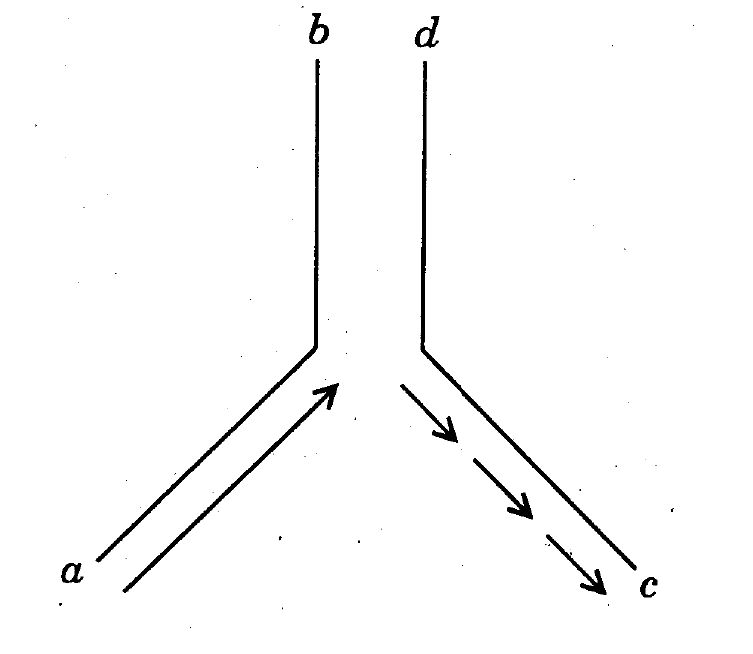
Mention the polarity of the $\text{DNA}$ strands $a-b$ and $c-d$ shown in the replicating fork given below.
Answer
  1. $a - b = 3 - 5$
  2. $c - d = 5 - 3$
View full question & answer
Question 161 Mark
Cattle or even human beings, sometimes give birth to their youngones having extremely different sets of organs like limbs/ position of eye(s), etc. Comment with respect of genetics involved in it.
Answer
Sometimes cattle or even human beings give birin to their youngones that are having different sets of organs like limbs/ position of eye, etc. It happens due to the disturbance in coordinated regulation of expression in sets of genes, which are associated with organ development .
View full question & answer
Question 171 Mark
When and at what end does the tailing' of hnRNA takes place?
Answer
After splicing, tailing occurs at the 3' end of hnRNA.
View full question & answer
Question 181 Mark
A region of a coding $\text{DNA}$ strand has the following nucleotide sequence: $–\text{A T G C}–$ What shall be the nucleotide sequence in:
  1. sister $\text{DNA}$ segment it replicates, and
  2. $\text{M-RNA}$ polynucleotide it transcribes?
Answer
  1. $-\text{TACG}-$
  2. $-\text{AUGC}-$
View full question & answer
Question 191 Mark
Name the chromosome that has
  1. The maximum$/$most number of genes.
  2. The least number of genes.
Answer
  1. Chromosome I has maximum number of genes $(2968).$
  2. $Y-$chromosome has least number of genes $(231).$
View full question & answer
Question 201 Mark
Which one out of an intron and an exon is the reminiscent of antiquity?
Answer
Intron is considered to be the reminiscent of antiquity.
View full question & answer
Question 211 Mark
Write the concept of central dogma.
Answer
The concept of central dogma proposed the unidirectional flow of information from DNA to RNA and then to protein:
$\text{DNA}\xrightarrow{\text{transcription}}\text{mRNA}\xrightarrow{\text{translation}}\text{protien}$
View full question & answer
Question 221 Mark
What is hnRNA?
Answer
The precursor RNA transcribed by RNA polymerase that contains both exons and introns.
View full question & answer
Question 231 Mark
What do you understand by the semiconservative replication of DNA?
Answer
In semiconservative DNA replication, each replicated DNA molecule consists of an old and a new strand i.e., one parental strand and one newly formed daughter strand.
View full question & answer
Question 241 Mark
Why should the DNA be cut into smaller fragments for sequencing?
Answer
DNA is a giant molecule and there are technical limitations in sequencing very long segments of DNA; hence DNA has to be cut into smaller fragments.
View full question & answer
Question 271 Mark
Why is the strand of DNA with 3' → 5 polarity transcribed and not the other strand of 5' → 3' polarity?
Answer
RNA polymerase can polymerise the RNA strand only in 5' → 3' direction.
View full question & answer
Question 281 Mark
Define an anticodon.
Answer
The triplet base present on the tRNA which is complementary to codon on mRNA is called anticodon.
View full question & answer
Question 291 Mark
Define transformation.
Answer
Transformation is a phenomenon by which the DNA isolated from one type of cell, when introduced into another type, is able to bestow some of the properties of the former to the latter.
View full question & answer
Question 311 Mark
When does DNA replication takes place in cell cycle of eukaryotes?
Answer
DNA replication takes place during s-phase of the cell cycle.
View full question & answer
Question 321 Mark
Name the enzyme that transcribes hnRNA in eukaryotes.
Answer
The RNA polymerase-II transcribes the precursor of mRNA, the heterogeneous nuclear RNA (hnRNA).
View full question & answer
Question 341 Mark
________ step in transcription is catalysed by the enzyme DNA-dependent RNA polymerase.
Answer
Elongation step in transcription is catalysed by the enzyme DNA-dependent RNA polymerase.
View full question & answer
Question 351 Mark
If the base adenine constitutes 31 percent of an isolated DNA fragment, then what is the expected percentage of the base cytosine in it?
Answer
According to Chargaff's rule.
A + G = C + T = 50%
$\therefore$ if A = 31% then T = 31%
C + T = 50%
$\therefore$ C = 50% - 31%
= 19%
View full question & answer
Question 361 Mark
Give an example of a human disorder that is caused due to a single gene mutation.
Answer
Sickle cell anaemia/Thalassemia/Phenyl ketonuria.
View full question & answer
Question 371 Mark
What is the base pairing pattern of DNA?
Answer
Guanine pair with cytosine and adenine pair with thymine.
View full question & answer
Question 411 Mark
When and at what end does the ‘tailing’ of hnRNA take place?
Answer
During conversion of hnRNA into functional mRNA, at 3’ end.
View full question & answer
Question 431 Mark
How is a polypeptide chain synthesis terminated during protein synthesis?
Answer
Synthesis of polypeptide chain terminates when a nonsense codon of mRNA reaches the A-site. There are three nonesense codon UAA, UAG and UGA, which are not recognised by any of the tRNAs. Therefore no more amino-acyl tRNA reaches the A site. The P site t-RNA is hydrolysed and the completed polypeptide is released in the presence of GTP dependent release factor.
View full question & answer
Question 441 Mark
What do you call the kind of mutation in which a single base is added to a base strand?
Answer
Point mutation.
View full question & answer
Question 451 Mark
Name the free-living, non-pathogenic nematode, whose genome has been sequenced.
Answer
Caenorhabditis elegans.
View full question & answer
Question 471 Mark
Write the conclusion Griffith arrived at the end of his experiment with Streptococcus pneumoniae.
Answer
Griffith concluded that the R-strain bacteria had somehow been transformed by heat-killed S-strain bacteria. This must be due to transfer of genetic material.
View full question & answer
Question 491 Mark
The presence of _________ group in every ribonucleotide makes RNA labile and reactive.
Answer
The presence of 2'-OH group in every ribonucleotide makes RNA labile and reactive.
View full question & answer
Question 501 Mark
Who was the first to identify DNA and what was the name given to it by him?
Answer
DNA was first isolated by Friedrich Meischer in 1869 who named it as nuclein.
View full question & answer
1 Marks Question - Biology STD 12 Science Questions - Vidyadip