Questions · Page 1 of 4

1 Marks Question

🎯

Test yourself on this topic

50 questions · timed · auto-graded

Question 11 Mark
Define Senescent phase.
Answer
Senescent phase:
It begins from the end of the reproductive phase. During this phase of life span, there is progressive deterioration in the body (like slowing of metabolism, etc.). Old age ultimately leads to death.
View full question & answer
Question 21 Mark
Define Juvenile phase.
Answer
Juvenile phase:
All organisms have to reach a certain stage of growth and maturity in their life before they can reproduce sexually. That period of growth is called juvenile phase. However, this phase is known as vegetative phase in plants. This phase is of different durations in different organisms.
View full question & answer
Question 31 Mark
Define Reproductive phase.
Answer
Reproductive phase:
The end of juvenile/ vegetative phase marks the beginning of reproductive phase. During this phase, the organisms produce offspring. In higher plants, this phase can be easily seen when they come to flower but in animals, the juvenile phase is followed by morphological and physiological changes prior to active reproductive behaviour. The reproductive phase is also of variable period in different organisms like some plants, flower throughout the year while others show seasonal flowering. In animals like birds lay eggs seasonally but when in captivity (as in poultry farms) can be made to lay eggs throughout the year. Placental female mammals, undergo cyclical changes in reproductive organs during this phase.
View full question & answer
Question 41 Mark
Name the vegetative propagules in the following:
  1. Agave.
  2. Bryophyllum.
Answer
Agave - Bulbil.
Bryophyllum- leaf buds/adventitous buds.
View full question & answer
Question 61 Mark
Name an organism where cell division in itself is a mode of reproduction.
Answer
A sexual reproduction in amoeba and paramoecium.
View full question & answer
Question 71 Mark
Why is banana considered a good example of parthenocarpy?
Answer
Formation of fruit without fertilisation/no formation of seeds.
View full question & answer
Question 81 Mark
Name the phase all organisms have to pass through before they can reproduce sexually.
Answer
Juvenile/Growth.
View full question & answer
Question 91 Mark
Offsprings derived by asexual reproduction are called clones. Justify giving two reasons.
Answer
Morphologically (structurally) similar, genetically identical.
View full question & answer
Question 101 Mark
Mention the site where syngamy occurs in amphibians and reptiles respectively.
Answer
Amphibians–outside the body/in external medium.
Reptiles–inside the body.
View full question & answer
Question 141 Mark
Write the name of the organism that is referred to as the ‘Terror of Bengal’.
Answer
Eicchornia crassipes/Water Hyacinth.
View full question & answer
Question 151 Mark
Mention the unique flowering phenomenon exhibited by Strobilanthus kunthiana (neelakuranaji).
Answer
It flowers once in 12 years.
View full question & answer
Question 161 Mark
Mention the pollinating agent of an inflorescence of small dull-coloured flowers with well-exposed stamens and large feathery stigma. Give any one characteristic of pollen grains produced by such flowers.
Answer
Wind, light weight/enormous number/non-sticky.
View full question & answer
Question 171 Mark
The microscopic pollen grains of the past are obtained as fossils. Mention the characteristic of the pollen grains that makes it happen.
Answer
Resistant organic material sporopollenin, present in (hard) outer layer/exine.
View full question & answer
Question 181 Mark
What is the major difference you observe in the offsprings produced by asexual and in progeny produced by sexual reproduction?
Answer
Offsprings of a sexual reproduction - genetically same/clones.Offsprings of sexual reproduction - show variation.
View full question & answer
Question 191 Mark
Give a schematic representation of oogenesis in humans, Mention the number of chromosomes at each stage. Correlate the life phases of the individual with the stage of the process.
View full question & answer
Question 201 Mark
Mention the scientific term used for modified form of reproduction in which seeds are formed without fusion of gametes.
Answer
Apomixis/Agamospermy/Parthenogenesis.
View full question & answer
Question 211 Mark
At what stage does the meiosis occur in an organism exhibiting haploidic life cycle and mention the fate of the products thus produced.
Answer
Meiosis occurs at the zygote stage in an organism exhibiting haploidic life cycle.
Thus, the product formed will be haploid spores.
View full question & answer
Question 221 Mark
Name the phenomenon and the cell responsible for the development of a new individual without fertilisation as seen in honey bees.
Answer
The phenomenon is called parthenogenesis and the cell responsible for it is female gamete, ovum.
View full question & answer
Question 231 Mark
Name the mode of reproduction that helps in producing genetically identical offspring.
Answer
Asexual reproduction.
View full question & answer
Question 241 Mark
Provide an example of each of single-celled organisms, which reproduce by:
  1. Binary fission.
  2. Budding.
Answer
  1. Amoeba/ Paramoecium.
  2. Yeast.
View full question & answer
Question 261 Mark
Name the types of life-cycle in which the zygote undergoes mitosis.
Answer
Haplo-diplontic life cycle and diplontic life cycle.
View full question & answer
Question 271 Mark
Define the term clone.
Answer
Clone is a group of individuals of the same species that are genetically and morphologically identical among themselves and to the parent from which they are formed from.
View full question & answer
Question 281 Mark
Which of the following statements is true for Hydra?
  1. It produces asexual gemmules.
  2. It produces unicellular bud.
  3. It produces multicellular bud.
Answer
Statement (iii) is true.
Multicellular organisms.like Hydra reproduce asexually by producing multlceuular bud that further develops into a new organism.
View full question & answer
Question 311 Mark
All date palm plants bear flowers, but fruits are seen in some. Explain.
OR
All date palm plants bear flowers, but fruits are seen in some. Explain.
Answer
Papaya/ date palm is dioecious the plants which produce only male flowers, do not bear fruits, while the plants which produce female flowers, bear fruits.
View full question & answer
Question 321 Mark
State the difference between meiocyte and gamete with respect to chromosome number.
Answer
A meiocyte is diploid (2n) while a gamete is haploid (n).
View full question & answer
Question 341 Mark
Which of the following statements is true of ginger?
  1. Germinating bud appears from the eye of the stem tuber.
  2. Germinating bud appears from the node of the rhizome.
  3. Germinating bud appears from the notch of the leaf margin.
Answer
  1. Is true of Ginger.
View full question & answer
Question 351 Mark
Which of the following statements is true for Bryophyllum?
  1. Germinating bud appears from the eye of the stem tuber.
  2. Germinating bud appears from the node of the rhizome.
  3. Germinating bud appears from the notch at the leaf margin.
Answer
Statement (iii) is true.
In Bryophyllum, germinating bud appears from the notch at the leaf margin which gets detached and develop into new plants.
View full question & answer
Question 361 Mark
Name an alga that reproduces asexually through zoospores. Why are these reproductive units so called?
Answer
Chlamydomonas reproduces asexually through zoospores. These reproductive structures (units) are called zoospores because they are motile.
View full question & answer
Question 381 Mark
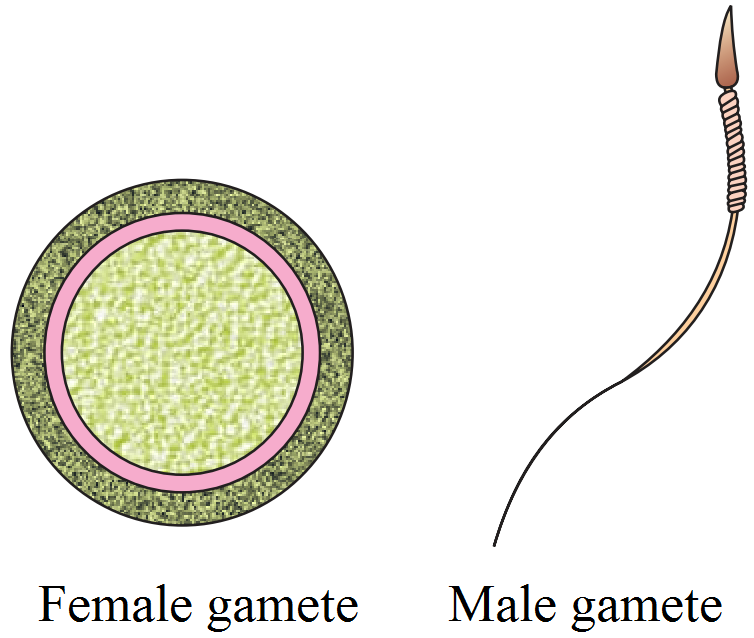
In the figure given below one male and one female gamete of an organism is depicted. Which type of gametes are they?
Answer
The male and female gametes shown in the figure are morphologically different. So, they are heterogametes. The female gamete represents the egg cell and the male gamete represents the sperm.
View full question & answer
Question 391 Mark
What are hermaphrodites?
Answer
The animal bearing both male and female sex organs are called hermaphrodites. Example, earthworms, sponge and tapeworm.
View full question & answer
Question 411 Mark
Define clone.
Answer
Clone is a group of individuals of the same species that are morphologically and genetically similar.
View full question & answer
Question 431 Mark
What marks the end of juvenile phase in flowering plants?
Answer
Initiation of floral buds marks the end of juvenile phase in flowering plants.
View full question & answer
Question 451 Mark
What is the significance of the zygote formed as a result of sexual reproduction?
Answer
Zygote forms the vital link, which ensures continuity of species between organisms of one generation and the next.
View full question & answer
Question 471 Mark
Mention any two conditions that enhance the chance of syngamy in organisms exhibiting external fertilisation.
Answer
The two conditions that enhance the chances of syngamy in organisms exhibiting external fertilisation are:
  1. Synchrony in release of gametes of two patents.
  2. Both gametes should be motile.
View full question & answer
Question 481 Mark
Which ones of the following organisms exhibit binary fission?
Bacillus, Penicillium, Yeast, Amvebu.
Answer
Bacillus and Amoeba.
View full question & answer
Question 491 Mark
What is the major difference you observe in the off springs produced by asexual reproduction and in the progeny produced by sexual reproduction?
Answer
Off springs produced through asexual reproduction are genetically identical (clone) to each other as well as to their parents, while sexually produced off springs show genetic variations leading to evolution.
View full question & answer
Question 501 Mark
Why is a coconut plant referred to as monoecious?
Answer
A coconut plant has both male and female flowers present on same individual thus it is known as monoecious.
View full question & answer
1 Marks Question - Biology STD 12 Science Questions - Vidyadip