Questions · Page 1 of 2

3 Marks Question

🎯

Test yourself on this topic

50 questions · timed · auto-graded

Question 13 Marks
Explain why meiosis and gametogenesis are always interlinked?
Answer
Meiosis is a process of reductional division in which the amount of genetic material is reduced. Gametogenesis is the process of the formation of gametes. Gametes produced by organisms are haploids (containing only one set of chromosomes), while the body of an organism is diploid. Therefore, for producing haploid gametes (gametogenesis), the germ cells of an organism undergo meiosis. During the process, the meiocytes of an organism undergo two successive nuclear and cell divisions with a single cycle of DNA replication to form the haploid gametes.
View full question & answer
Question 23 Marks
Identify each part in a flowering plant and write whether it is haploid (n) or diploid (2n).
  1. Ovary .
  2. Anther .
  3. Egg .
  4. Pollen .
  5. Male gamete .
  6. Zygote .
Answer
Identify each part in a flowering plant and write whether it is haploid (n) or diploid (2n).
  1. Ovary 2n.
  2. Anther 2n.
  3. Egg n.
  4. Pollen n.
  5. Male gamete n.
  6. Zygote 2n.
View full question & answer
Question 33 Marks
What is a bisexual flower? Collect five bisexual flowers from your neighbourhood and with the help of your teacher find out their common and scientific names.
Answer
A flower that contains both the male and female reproductive structure (stamen and pistil) is called a bisexual flower. Examples of plants bearing bisexual flowers are:
  • Water lily (Nymphaea odorata).
  • Rose (Rosa multiflora).
  • Hibiscus (Hibiscus Rosa-sinensis).
  • Mustard (Brassica nigra).
  • Petunia (Petunia hybrida).
View full question & answer
Question 43 Marks
Define external fertilisation. Mention its disadvantages.
Answer
External fertilisation is a type of fertilization that occurs outside the female body, in external medium, such as water.Disadvantages of external fertilisation are:
  • Very less chance of fusion of male and female gametes.
  • Offspring are vulnerable to predators because of no parental care.
View full question & answer
Question 53 Marks
What is vegetative propagation? Give two suitable examples.
Answer
Vegetative propagation is a mode of asexual reproduction in which new plants are obtained from the vegetative parts of plants. It does not involve the production of seeds or spores for the propagation of new plants. Vegetative parts of plants such as runners, rhizomes, suckers, tubers, etc. can be used as propa gules for raising new plants.Examples of vegetative reproduction are:
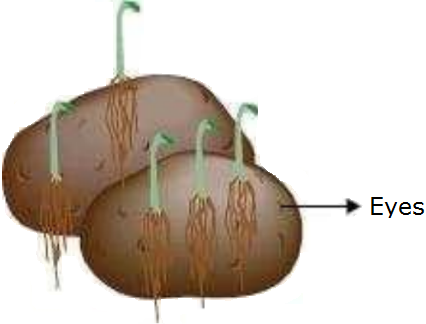
  1. Eyes of potato:
The surface of a potato has several buds called eyes. Each of these buds when buried in soil develops into a new plant, which is identical to the parent plant.
  1. Leaf buds of Bryophyllum:
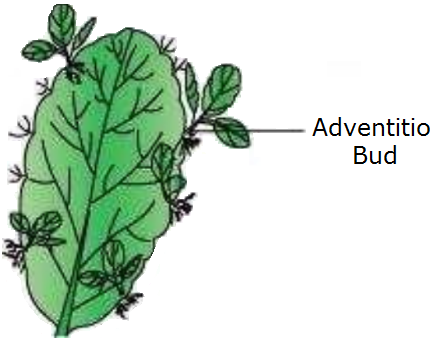
The leaves of Bryophyllum plants bear several adventitious buds on their margins. These leaf buds have the ability to grow and develop into tiny plants when the leaves get detached from the plant and come in contact with moist soil.
View full question & answer
Question 63 Marks
Differentiate between gametogenesis from embryogenesis.
Answer
Differences between gametogenesis and embryogenesis are as follows:
 
Gametogenesis
Embryogenesis
1
It is the formation of male and female gametes.
It is the formation of embryo from the zygote.
2
Gametes are the haploid cells.
Embryo is a diploid cell.
3
Both mitotic & meiotic cell division take place.
Only mitotic division occur.
View full question & answer
Question 73 Marks
Offspring formed due to sexual reproduction have better chances of survival. Why? Is this statement always true?
Answer
Sexual reproduction involves the fusion of the male and the female gamete.
This fusion allows the formation of new variants by the combination of the DNA from two (usually) different members of the species. The variations allow the individuals to adapt under varied environmental conditions for better chances of survival. However, it is not always necessary that the offspring produced due to sexual reproduction has better chances of survival. Under some circumstances, asexual reproduction is more advantageous for certain organisms. For example, some individuals who do not move from one place to another and are well settled in their environment. Also, asexual reproduction is a fast and a quick mode of reproduction which does not consume much time and energy as compared to sexual reproduction.
View full question & answer
Question 83 Marks
  1. Mention the property that enables the explants to regenerate into a new plant.
  2. A banana herb is virus-infected. Describe the method that will help in obtaining healthy banana plants from this diseased plant.
Answer
  1. Totipotency.
  2. Extract the disease free meristem, in vitro culture to get virus free plants.
View full question & answer
Question 93 Marks
Name the type of pollination taking place in coconut palms. List five characteristics of the flowers of coconut plant favouring this type of pollination.
Answer
Anemophily/ wind pollination.Unisexual flower, large quantity of pollen, pollen small/ smooth/ dry, devoid of scent/ nectar, inconspicuous/ not showy.
View full question & answer
Question 103 Marks
Differentiate between an annual and a biennial plant. Provide one example of each.
Answer
Annual: complete their life cycle in one season/normally planted in spring and produce grain before end of growing season/planted in autumn and harvested around mid summer e.g. wheat/barley/rye/rice.
Biennial: They are (monocarpic) plants flower and die in the second season/complete their life cycle in two seasons/show vegetative growth in one season and reproductive growth in second season.
e.g.- Sugarbeet/cabbage/carrot/radish.
View full question & answer
Question 113 Marks
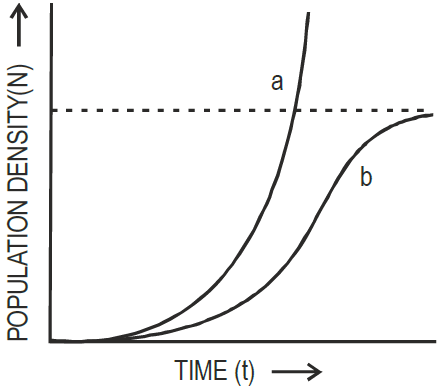
Study the graph given below and answer the question that follow:
  1. Write the status of food and space in the curves (a) and (b).
  2. In the absence of predators, which one of the two curves would appropriately depict the prey population?
  3. Time has been shown on X-axis and there is a parallel dotted line above it. Give the significance of this dotted line.
Answer
  1. a - unlimited food and space.
b - limited food and space.
  1. Curve a.
  2. Carrying capacity/a given habitat has enough resources to support maximum possible number - beyond which no further growth is possible.
View full question & answer
Question 123 Marks
  1. List the three stages the annuals and biennial angiosperms have to pass through during their life cycle.
  2. List and describe any two vegetative propagules in flowering plants.
Answer
  1. Vegetative/Juvenile, Reproductive/Mature, senescence (old age)
  2. vegetative propagules in flowering plants are:
  • Eye, of potato.
  • Rhizome, of ginger.
  • Bulbil, of Agave.
  • Leafbuds, of Bryophyllum.
  • Offset, of water hyacinth.
View full question & answer
Question 133 Marks
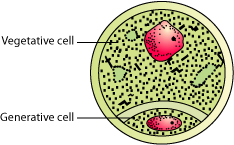
Draw a labelled diagram of the sectional view of a mature pollen grain in angiosperm. Explain the function of its different parts.
Answer
  1. Exine - It can withstand high temperature/strong acids/alkali.
  2. Intine - It is thin and continuous layer made up of cellulose and pectin.
  3. Vegetative cell - It is bigger, has abundant food reserve and a large irregularly shaped nucleus.
  4. Generative cell - It divides mitotically to give rise to the two male gametes.
View full question & answer
Question 143 Marks
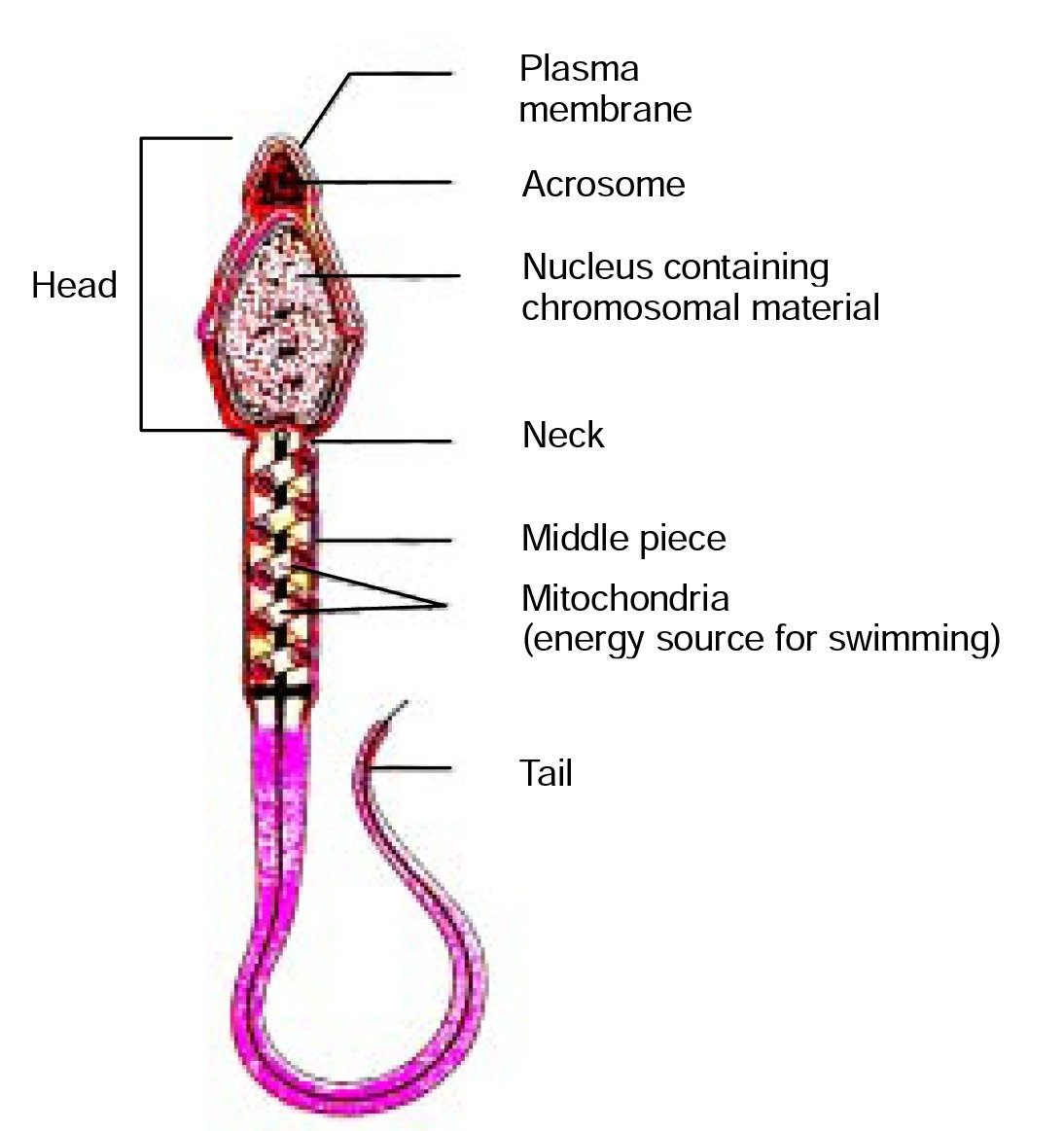
Draw a labelled diagram of the microscopic structure of a human sperm.
Answer

Plasma membrane, acrosome, nucleus, mitochondria tail/centriole/head/neck/middle piece.
View full question & answer
Question 153 Marks
Describe the Polygonum type of embryo sac. Why is it referred to as monosporic?
Answer
Polygonum type embryo sac: Embryo sac in angiosperms is eight nucleate structure (seven - celled structure). Out of the eight nuclei formed by three successive divisions of the functional megaspore three get organised at the micropylar end as egg apparatus, three at the chalazal end as antipodals, and two at the centre as polar nuclei or secondary nucleus (2n), The egg apparatus consists of two synergids and an egg cell (This is monosporic type of development generally referred to as the Polygonum type). Only one megaspore of the tetrad becomes functional/viable that develops into the embryo sac.
View full question & answer
Question 163 Marks
What is agamospermy? How is agamospermy different from parthenogenesis and parthenocarpy?
Answer
  1. Agamospermy: Seeds are formed from nucellus/ without fusion of gametes.
  2. Parthenogenesis: Seeds/ embryo develop from unfertilized female gametes.
  3. Parthenocarpy: Development of fruit in an unfertilized flower/ no viable seeds are formed.
View full question & answer
Question 173 Marks
Differentiate between Parthenocarpy and Parthenogenesis. Give one example of each.
Answer
In most plants, flowers need to be pollinated and fertilized to produce fruits. However, some plants can produce fruits before fertilization or without fertilization. Parthenocarpy is the process which produces fruits from unfertilized ovules in plants. Unfertilized ovules develop into fruits prior to fertilization. These fruits do not contain seeds.
Parthenogenesis is a type of reproduction commonly shown in organisms mainly by some invertebrates and lower plants. It can be described as a process in which unfertilized ovum develops into an individual (virgin birth) without fertilization. Therefore, it can be considered as a method of asexual reproduction.
It is seen in organism like rotifers, honeybees and even some lizards and birds (turkey).
The key difference between parthenogensis and parthenocarpy is, parthenogenesis is shown by animals and plants while pathenocarpy is shown only by plants.
View full question & answer
Question 183 Marks
  1. Name any four vegetative propagules along with their examples.
  2. What are the various natural methods of vegetative propagation?
Answer
  1. Vegetative propagules are the units of vegetative reproduction. These are the vegetative parts of the plants which give rise to new plants, when they come into contact with damp soil or water.
Examples:
  • Eyes in potato.
  • Rhizome of banana and ginger.
  • Leaf bud, in Bryophyllum.
  • Bulbils in Agave.
  1. There three natural methods of vegetative propagation are:
  • From Root.
  • From stem.
  • By leaves.
View full question & answer
Question 193 Marks
  1. Name two groups of plants each, which have a:
  1. Haploid body and
  2. Diploid body.
  1. What is meant by gamete transfer?
Answer
  1.  
  1. Algae and bryophytes.
  2. Pteridophytes, gymnosperms, angiosperms.
  1. Gamete transfer refers to the process by which male and female gametes are physically brought together to facilitate their fusion.
View full question & answer
Question 203 Marks
With which type of reproduction do we associate the reduction division? Analyse the reasons for it.
Answer
Reduction division (meiosis) is associated with sexual reproduction. The reasons for this are:
  • Since sexual reproduction involves the fusion of two types of gametes (male and female), they must have haploid number of chromosomes.
  • The cell (meiocyte) which gives rise to gametes often has diploid number of chromosomes and it is only by reducing the number by half that we can get haploid gametes.
  • Reduction division also ensures maintenance of constancy of chromosome number from generation to generation.
View full question & answer
Question 213 Marks
Reptiles and frogs are oviparous animals; yet they differ in certain aspects of reproduction. Bring out the differences and mention which of the two animals has more survival advantage.
Answer
Reptiles
Frogs
In reptiles, fertilisation is internal.
In frogs, fertilisation is external
They lay fertilised eggs in safe places.
Both male and female gametes are laid in water.
Eggs have a calcareous shell for protection.
Eggs have no calcareous shell, but have a mucilaginous covering.
View full question & answer
Question 223 Marks
How do homogametes differ from heterogametes? Give an example of an organism for each of the two kinds.
Answer
Homogametes
Heterogametes
When the two fusing gametes are similar in appearance and cannot be categorised into male and female gametes, they are called homogametes, e.g. Cladophora.
When the two fusing gametes are dissimilar in morphology and/or physiology and can be categorised into male and female gametes, they are called heterogametes, e.g. human beings.
View full question & answer
Question 233 Marks
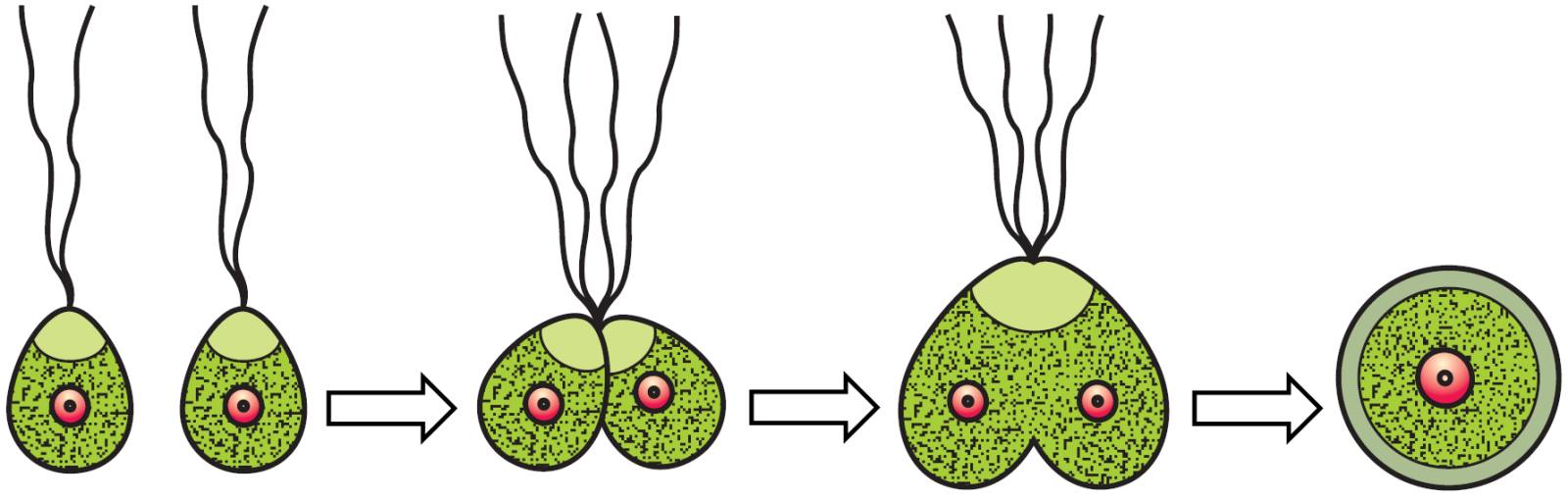
  1. State the type of gametes shown in the diagram.
  2. Identify the process taking place and the resultant structure.
  3. Name an organism that reproduces in this manner.
Answer
  1. Isogametes.
  2. Fertilisation is taking place and zygote is the resultant structure.
  3. Cladophora/ Chlamydomonas.
View full question & answer
Question 253 Marks
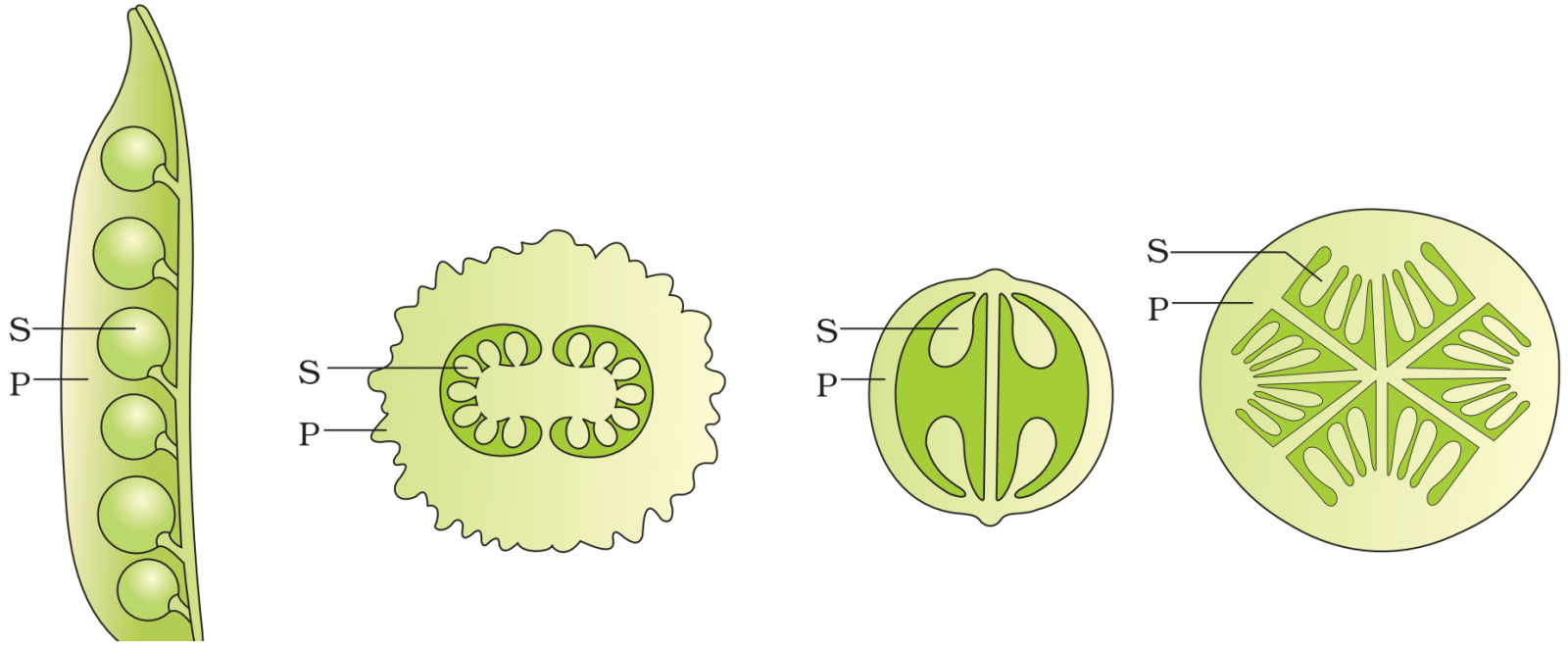
Answer the following question based on the figures given below:
  1. What do S and P denote?
  2. Name the parts from Which they do develop?
  3. What is the term given to the point of attachment of the ovules in the fruit?
  4. What is the ploidy of embryo and the tissues in the ovary?
  5. What is the function of pericarp in fruit?
Answer
  1. S- seeds, P- pericarp.
  2. Ovule-Seeds, Ovary-Fruit.
  3. Pericarp.
  4. Diploid (2n).
  5. It has thick wall which helps in protection.
View full question & answer
Question 263 Marks
What is fertilisation? Where does it take place in the following:
  1. Flowering plants.
  2. Frogs.
Answer
The process of fusion of male gamete with the female gamete is called fertilisation or syngamy. It results in the formation of a diploid cell called zygote.It is mainly of two types:
  1. External Fertilisation:
In majority of the aquatic organisms, e.g. algae, fish and in amphibians, the process of fertilisation takes place outside the body of the organism, i.e. in water. This type of gametic fusion is called external fertilisation.
To enhance the chances of fertilisation, the organisms exhibiting external fertilisation discharge a large number of gametes in water, e.g. bony fishes, frogs, etc.
By this process, a large number of offsprings are produced with the disadvantage of them being vulnerable to predator. This threatens their survival upto adulthood.
  1. Internal Fertilisation:
In most of the terrestrial organisms, e.g. fungi, higher animals (reptiles, birds and mammals) and majority of plants such as bryophytes, pteridophytes, gymnosperms and angiosperms, the process of fertilisation takes place inside the body of the organism. This type of gametic fusion is called internal fertilisation.
  • Flowering plant- Inside plant body, internal fertilization.
  • Frogs- Outside body, external fertilisation.
View full question & answer
Question 273 Marks
Coconut palm is monoecious while date is dioecious. Why are they called so?
Answer
In some plants and fungi, male and female reproductive structures may be present on the same plant, such plants are called homothallic or monoecious, e.g. chara, cucurbita, coconut palm, etc. While, in some lower plants, male and female reproductive structures may be present on different plants. These plants are known as heterothallic or dioecious, e.g. Marchantia, date palm, etc.
View full question & answer
Question 283 Marks
The embryonal protection and care are comparatively better in viviparous species than oviparous organisms. Explain.
Answer
The embryonal protection and care are better in viviparous species because development of zygote takes place inside female and proper nutrients are provided to developing embryo through mother's body.
View full question & answer
Question 293 Marks
What are the three major phases in the life cycle of an organism? Define each phase.
OR
Discuss the similarities in pattern of sexual reproduction.
Answer
Juvenile phase, Reproductive phase, Senescent phase
Juvenile phase: The phase of growth in the organisms before reproductive maturity.
Reproductive phase: In this phase organism attains reproductive maturity.
Senescent phase: The phase between reproductive maturity and death.
View full question & answer
Question 303 Marks
  1. What are meiocytes?
  2. If the chromosome number in meiocytes of human beings, housefly, potato, apple, dog and maize are 46, 12, 48, 34,78 and 20, respectively. What will be the chromosome numbers in gametes of these species?
Answer
  1. Meiocyte is a type of cell that differentiates into a gamete through the process of meiosis. Through meiosis, the diploid meiocyte divides into four genetically different haploid gametes.
  • The diploid number in potato is 48.
  • The diploid number in housefly is 12.
  1. S. No.
    chromosome numbers in gametes
    Species Name
    1.
    23
    Human begin
    2.
    6
    Housefly
    3.
    24
    Potato
    4.
    17
    Apple
    5.
    39
    Dog
    6.
    10
    Maize
View full question & answer
Question 313 Marks
  1. Define life span.
  2. Mention the life span of:
  1. Crocodile.
  2. Crow.
  3. Parrot and
  4. Butterfly.
Answer
  1. Life span is the period of time from birth to natural death of an organism.
  2.  
  1. 60 years.
  2. 15 years.
  3. 140 years.
  4. 1-2 weeks.
View full question & answer
Question 323 Marks
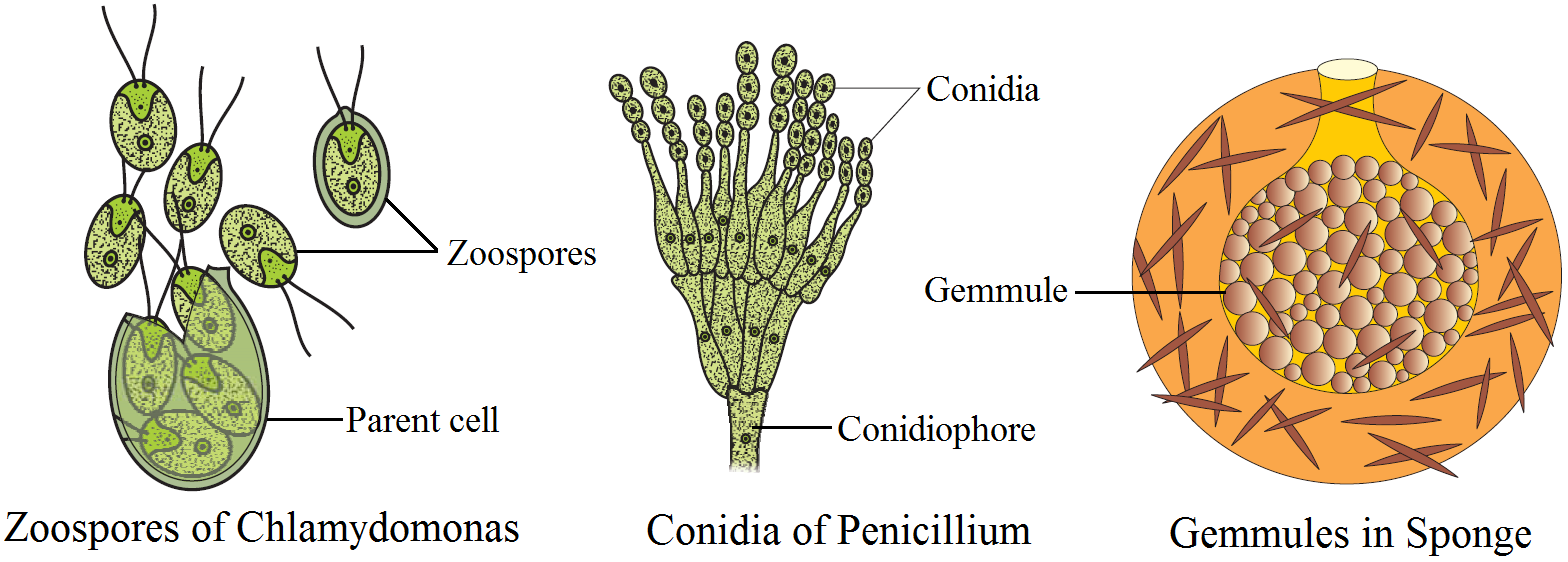
Draw the sketches of a zoospore and a conidium. Mention two dissimilarities between them and at least one feature common to both structures.
Answer

Dissimilarities: Zoospores are motile whereas conidia are non-motile. Zoospores are produced in a sporangium whereas conidia are produced externally.
Common feature: Both are the means of asexual reproduction.
View full question & answer
Question 343 Marks
In certain simple plants, why are male gametes produced in large numbers as compared to the female gametes? Is it applicable in animals also? Yes or not.
Answer
In those plants, water is the medium through which gamete transfer takes place. A large number of the male gametes, however, fail to reach the female gametes.
To compensate this loss of male gametes during transport, they are produced in large numbers.
  • Yes it is also applicable in animals.
View full question & answer
Question 353 Marks
Justify the statement ‘Vegetative reproduction is also a type of asexual reproduction'.
Answer
Vegetative propagation is also a type of asexual reproduction because,
  1. This is uniparental.
  2. Clone formation takes place.
  3. There is no fertilisation.
  4. There is no gamete formation.
View full question & answer
Question 363 Marks
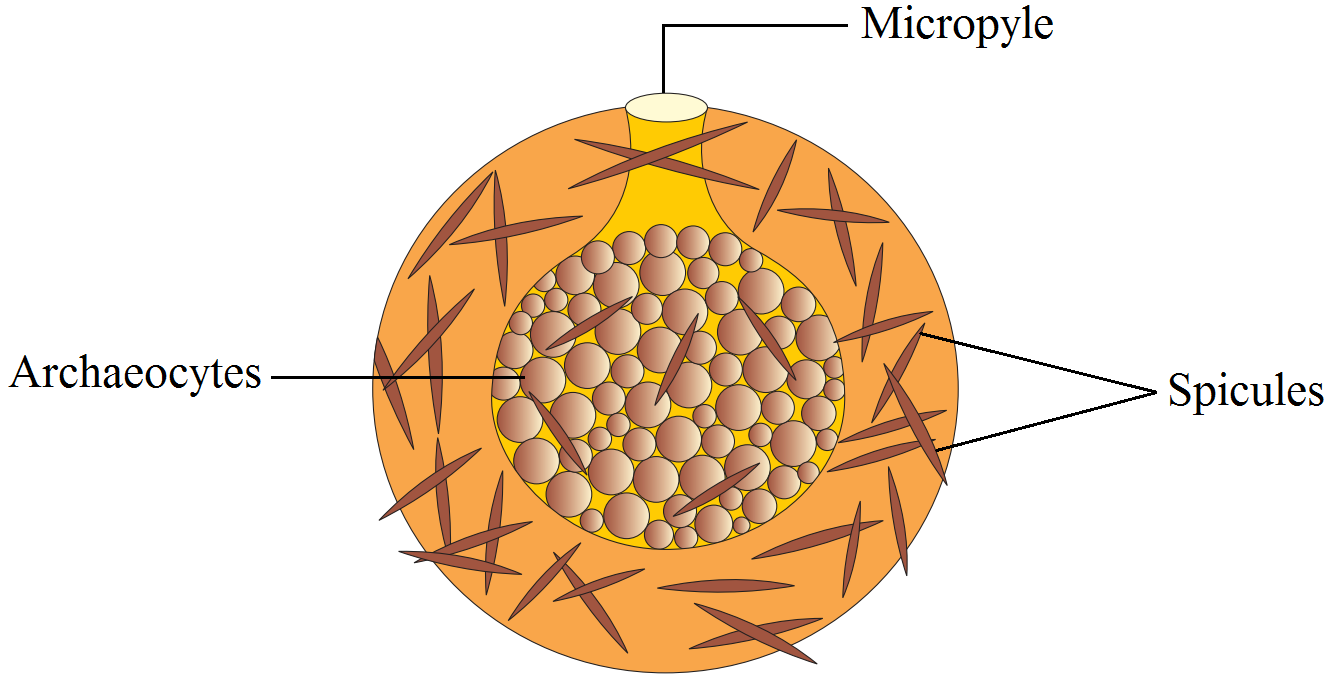
What are gemmules? Name the organism which produce gemmules. Make a labeled diagram of gemmule.
Answer
Gemmules are internal buds formed inside the parent's body.
Example: Fresh water sponges (Spongilla).
View full question & answer
Question 373 Marks
'Fertilisation is not an obligatory event for fruit production in certains plants'. Explain the statement.
Answer
Yes, it is observed in parthenocarpic fruits. The ‘seedless fruits’ that are available in the market such as pomegranate, grapes etc., are infact good examples. Flowers of these plants are sprayed by a growth hormone that induces fruit development even though fertilisation has not occurred. The ovules of such fruits, however, fail to develop into seeds.
View full question & answer
Question 383 Marks
How will an organism be benefitted, if it reproduces through spores?
Answer
There are some benefits for the organism which reproduces through spore formation such as:
  1. Reproduction through spores is simple as well as faster mode of reproduction.
  2. he spores are light in weight thus, keep floating in the air. This helps in their dispersal.
View full question & answer
Question 393 Marks
Is it possible to consider vegetative propagation observed in certain plants like Bryophyllum, water hyacinth, ginger etc., as a type of asexual reproduction? Give two/ three reasons.
Answer
Vegetative propagation in certain plants; like Bryophyllum, water hyacinth, ginger, etc. can be termed as asexual reproduction. Following are some to the reasons for this:
  • Reproduction involves a single parent.
  • Meiosis does not happen during any stage of reproduction.
  • Offspring get the set of DNA from a single parent.
View full question & answer
Question 403 Marks
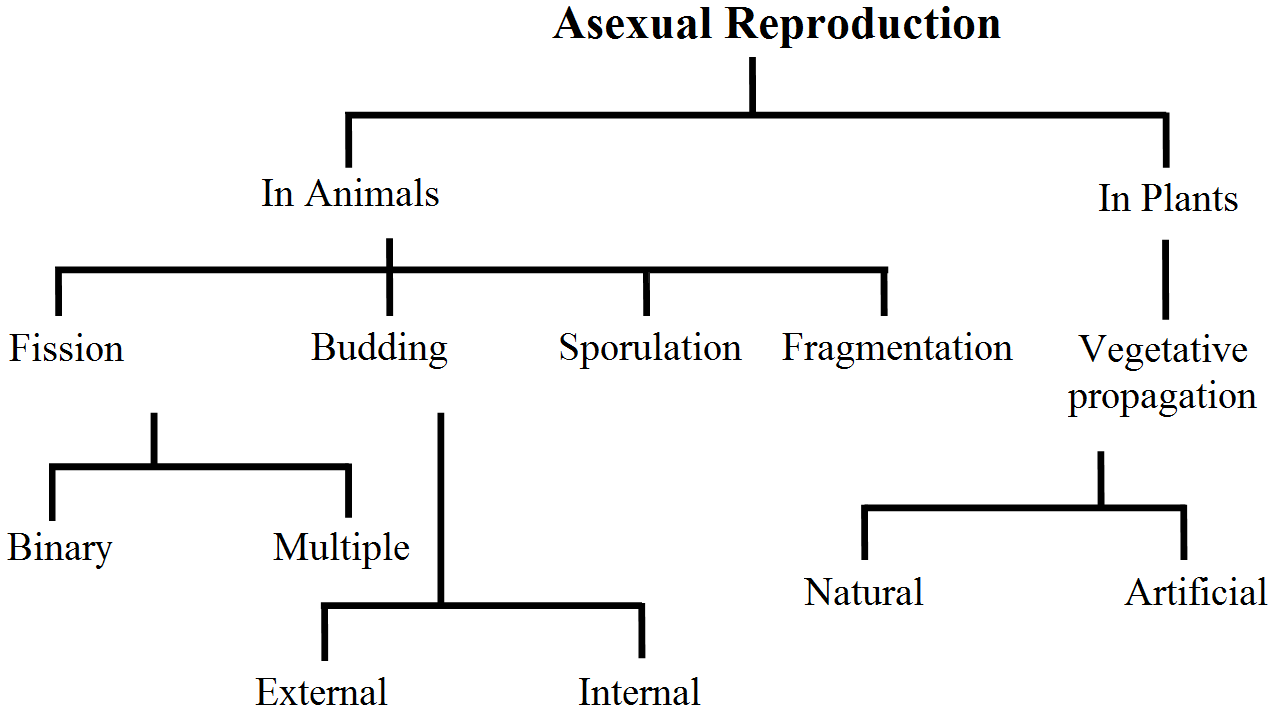
Write the modes of asexual reproduction in the following organisms.
Sycon, Penicillium, Spongilla, Paramecium, Yeast, Marchantia, Amoeba and Chlamydomonas.
Answer
Organism
Modes of Reproduction
Sycon
External budding
Penicillium
Conidia
Spongilla
Internal budding (Gemmule)
Paramecium
Binary fission (transverse)
Yeast
Budding (External)
Marchantia
Gemmae
Amoeba
Binary fission (Simple)
Chlamydomonas
Zoospores
View full question & answer
Question 413 Marks
It is generally observed that the number of male gametes produced is several thousand times the number of female gametes. Explain.
Answer
The number of male gametes produced is more than the female gametes because male gametes are usually motile and they have to compete with one another for their existence. While the female gamete is stationary. At the end only one male gamete fuses with the female gamete for the fertilization to take place.
View full question & answer
Question 423 Marks
Parthenocarpy does not involve fusion of gametes yet it leads to production of fruits. How?
Answer
Parthenocarpy can be natural or artificial process. In this, the process of fertilization (fusion of gametes) does not take place and fruit formed is seedless. Fusion of gametes is not needed in this process and fruit formation is direct.
View full question & answer
Question 433 Marks
List the changes observed in an angiosperm flower subsequent to pollination and fertilisation.
Answer
1.
Ovary
Fruit
2.
Ovary wall
Pericarp (fruit wall)
3.
Ovule
Seed
4.
Outer integument
Testa (Outer seed coat)
5.
Inner integument
Tegmen (Inner seed coat)
6.
Secondary nucleus
Endosperm
7.
Egg
Zygote
8.
Synergids and antipodals
Degenerate
9.
Hilum, funicle and micropyle
Shows no changes
View full question & answer
Question 443 Marks
Define Parthenogenesis. Give two examples.
Answer
Development of female gamete (ovum) into a complete organism without fertilization is known as parthenogenesis.
Examples:
  1. Rotifers.
  2. Drones of honeybee.
View full question & answer
Question 453 Marks
Although sexual reproduction is a long drawn, energy-intensive complex form of reproduction, many groups of organism in Kingdom Animalia and Plantae prefer this mode of reproduction.
Give at least three reasons for this.
Answer
  1. Sexual reproduction brings about variation in the offspring.
  2. Since gamete formation is preceded by meiosis, genetic recombination occurring during crossing over (meiosis-I), leads to a great deal of variation in the DNA of gametes.
  3. The organism has better chance of survival in a changing environment
View full question & answer
Question 463 Marks
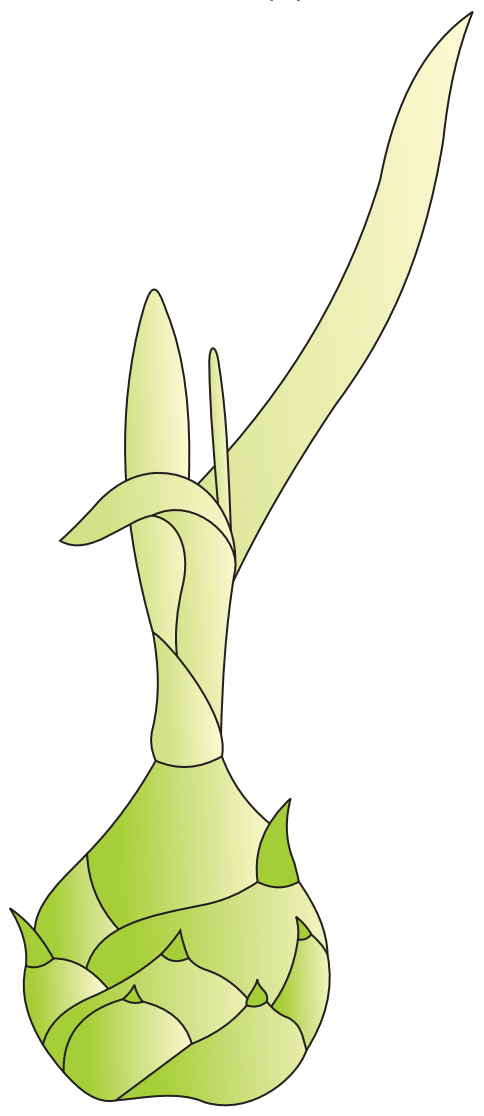
Observe the diagram given below and answer the questions that follows.
  1. What does the given diagram show?
  2. Name any two plants (other than the one shown in fig.) which reproduce by the same method?
  3. What are these plant parts referred to?
Answer
  1. The given diagram shows a bulbil of Agave.
  2. Two other plants which reproduce by same method are Oxalis and lily.
  3. The plant parts which help in vegetative (asexual) reproduction are referred to as vegetative propagules.
View full question & answer
Question 473 Marks
Only asexual reproduction can give rise to individuals resembling their parent. Do you agree with the statement? Support your answer with an example.
Answer
When the offspring is produced by a single parent without the involvement of gametic fusion, the reproduction is called as asexual reproduction. It involves only mitotic cell division. Meiosis does not occur in asexual reproduction. Offsprings produced by asexual reproduction are identical to one another and exact copies of their parents. Such a group of morphologically and genetically similar individuals are called clone.

Asexual reproduction occurs in unicellular organisms (monerans and protists), some lower animals (sponges, coelenterates, certain worms) plants and tunicates. It is absent in higher invertebrates and vertebrates.
View full question & answer
Question 483 Marks
Suggest a possible explanation why the seeds in a pea pod are arranged in a row, whereas those in tomato are scattered in the juicy pulp.
Answer
In a pea pod, the pericarp is not differentiated into many layers. In a tomato fruit, the pericarp is differentiated into epicarp, mesocarp and endocarp. Most of the edible part or tomato is composed of mesocarp which is juicy and fleshy. Moreover, placentation is responsible for arrangement of seeds in a fruit. A pea flower shows marginal placentation, while a tomato shows axial placentation.
View full question & answer
Question 493 Marks
Differentiate between external fertilisation and internal fertilisation with an example for each.
Answer
External fertilisation
Internal fertilisation
When fusion of gametes (syngamy) occurs outside the body of the organism, it is called external fertilisation.
When fusion of gametes (syngamy) occurs inside the body of the organism, it is called internal fertilisation.
A large number of gametes are released in the surrounding medium by such animals.
The number of ova produced is less, but a large number of male gametes are formed, as they have to travel towards the ovum.
Chances of survival of offspring are less. e.g. frog and bonyfish.
Chances of survival of offspring are high. e.g, birds, human beings, etc.
View full question & answer
Question 503 Marks
Describe the two major events that occur during embryogenesis and mention their significance.
Answer
  • During embryogenesis, the zygote undergoes a number of mitotic divisions; this is to increase the number of cells.
  • The cells thus formed undergo differentiation; this process helps groups of cells to undergo modifications to form specialised tissues and organs.
View full question & answer