Questions · Page 1 of 15

M.C.Q (1 Marks)

🎯

Test yourself on this topic

50 questions · timed · auto-graded

MCQ 11 Mark
The reagents with which glucose does not react to give the corresponding tests/products are

$A$. Tollen's reagent  $B$. Schiff's reagent $C$. $\mathrm{HCN}$ $D$. $\mathrm{NH}_2 \mathrm{OH}$ $E$. $\mathrm{NaHSO}_3$

Choose the correct options from the given below:

  • A
    $A$ and $D$
  • $B$ and $E$
  • C
    $E$ and $D$
  • D
    $B$ and $C$
Answer
Correct option: B.
$B$ and $E$
b
Despite having the aldehyde group glucose does not give Schiff's test and it does not form the hydrogen sulphite addition product with $\mathrm{NaHSO}_3$.
View full question & answer
MCQ 21 Mark
The incorrect statement regarding enzymes is :
  • A
    Like chemical catalysts enzymes reduce the activation energy of bio processes.
  • Enzymes are polysaccharides.
  • C
    Enzymes are very specific for a particular reaction and substrate.
  • D
    Enzymes are biocatalysts.
Answer
Correct option: B.
Enzymes are polysaccharides.
b
Which is incorrect statement regarding enzymes

$(1)$ Like chemical catalysts enzymes reduce the activation energy of bio process $\Rightarrow$ This is correct statement.

$(2)$ Enzymes are polysaccharides $\Rightarrow$ This is incorrect statement because enzymes are protein in nature

$(3)$ Enzymes are very specific for a particular reaction and substrate $\Rightarrow$ This is correct statement.

$(4)$ Enzymes are biocatalyst $\Rightarrow$ This is correct statement.

View full question & answer
MCQ 31 Mark
The incorrect statement regarding chirality is :
  • A
    The product obtained by $S _{ N } 2$ reaction of haloalkane having chirality at the reactive site shows inversion of configuration.
  • Enantiomers are superimposable mirror images on each other.
  • C
    A racemic mixture shows zero optical rotation.
  • D
    $S_{N} 1$ reaction yields $1: 1$ mixture of both enantiomers.
Answer
Correct option: B.
Enantiomers are superimposable mirror images on each other.
b
Enantiomers are non-superimposable mirror images of each other.
View full question & answer
MCQ 41 Mark
The $RBC$ deficiency is deficiency disease of :
  • Vitamin $\mathrm{B}_{12}$
  • B
    $\operatorname{Vitamin} \mathrm{B}_{6}$
  • C
    $\operatorname{Vitamin} \mathrm{B}_{1}$
  • D
    Vitamin $\mathrm{B}_{2}$
Answer
Correct option: A.
Vitamin $\mathrm{B}_{12}$
a
Vitamin $\mathrm{B}_{12}$
View full question & answer
MCQ 51 Mark
The reaction of concentrated sulphuric acid with carbohydrates $\left( C _{12} H _{22} O _{11}\right)$ is an example of
  • A
    Sulphonation
  • Dehydration
  • C
    Oxidation
  • D
    Reduction
Answer
Correct option: B.
Dehydration
b
Concentrated sulphuric acid is a strong dehydrating agent and it readily dehydrate carbohydrates into carbon.
View full question & answer
MCQ 61 Mark
Which of the following statement is not true about glucose?
  • It is an aldopentose.
  • B
    It is an aldohexose.
  • C
    It contains five hydroxyl groups.
  • D
    It is a reducing sugar.
Answer
Correct option: A.
It is an aldopentose.
a
Structure of Glucose
CHO
H-C-OH
HO-C-H
H-C-OH
H-C-OH
CH $_{2}$ OH

It is an aldohexose.
5 -OH groups are present.
It is a reducing sugar as it contains
- CHO group.

View full question & answer
MCQ 71 Mark
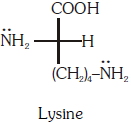
Which of the following is a basic amino acid :
  • Lysine
  • B
    Serine
  • C
    Alanine
  • D
    Tyrosine
Answer
Correct option: A.
Lysine
a
Since it contains more number of $- NH _{2}$ groups as compared to $- COOH$ groups hence it is basic amino acid.
View full question & answer
MCQ 81 Mark
Sucrose on hydrolysis glves 
  • A
    $\alpha$ $-D-$Fructose $+\beta$ $-D-$Fructose
  • B
    $\beta$ $-D-$Glucose $+\alpha$ $-D-$Fructose
  • C
    $\alpha$ $-D-$Glucose $+\beta$$- D -$ Glucose
  • $\alpha$ $-D-$Glucose $+\beta$ $-D-$Fructose
Answer
Correct option: D.
$\alpha$ $-D-$Glucose $+\beta$ $-D-$Fructose
d
Sucrose$\xrightarrow[{{\text{(Hydrolysis)}}}]{{{H_3}{O^ + }}}$$\alpha$ $-D-$Glucose $+\beta$ $-D-$Fructose
View full question & answer
MCQ 91 Mark
The non-essential amino acid among the following is
  • A
    valine
  • B
    leucine
  • alanine
  • D
    lysine
Answer
Correct option: C.
alanine
c
non-essential amino acid $\to$ alanine

Essential amino acid $\to$ valine, leucine, lysine

View full question & answer
MCQ 101 Mark
Which structure(s) of proteins remains(s) intact during denaturation process ?
  • A
    Both secondary and tertiary structures
  • Primary structure only
  • C
    Secondary structure only
  • D
    Tertiary structure only
Answer
Correct option: B.
Primary structure only
b
During denaturation $2^o$ and $3^o$ structures are destroyed but $1^o$ structure remains intact
View full question & answer
MCQ 111 Mark
The artificial sweetner stable at cooking temperature and does not provide calories is
  • A
    Saccharin
  • B
    Aspartame
  • Sucralose
  • D
    Alitame
Answer
Correct option: C.
Sucralose
c
Sucralose is stable at cooking temperature and does not provide calories
View full question & answer
MCQ 121 Mark
The difference between amylose and amylopectin is
  • Amylopectin have $1 \rightarrow 4 \alpha$ -linkage and $1 \rightarrow 6\alpha$ -linkage 
  • B
    Amylose have $1 \rightarrow 4 \alpha$-linkage and $1 \rightarrow 6\beta$-linkage 
  • C
    Amylopectin have $1 \rightarrow 4 \alpha$ -linkage and $1 \rightarrow 6 \beta-$linkage 
  • D
    Amylose is made up of glucose and galactose
Answer
Correct option: A.
Amylopectin have $1 \rightarrow 4 \alpha$ -linkage and $1 \rightarrow 6\alpha$ -linkage 
a
Amylose is long unbranched chaln with $\alpha-\mathrm{D}$ - Glucose with held by $\mathrm{C}_{1}-\mathrm{C}_{4}$ glucosidic linkage whereas amylopectin is branched chain polymer of $\alpha -D$ glucose unit in which chain is formed by $\mathrm{C}_{1}-\mathrm{C}_{4}$ glycosidic linkage while branching occurs by $\mathrm{C}_{1}-\mathrm{C}_{6}$ glucosidic linkage.
View full question & answer
MCQ 131 Mark
Which of the following amino acid is not optically active?
  • A
    Proline
  • B
    Serine
  • C
    Leucine
  • Glycine
Answer
Correct option: D.
Glycine
d
ગ્લાયસિન $\quad HOOC - CH _{2}- NH _{2}$
View full question & answer
MCQ 141 Mark
The letter $‘D'$ in $D-$glucose signifies
  • A
    configuration at all Chiral Carbons
  • B
    dextrorotatory
  • C
    that it is a monosaccharide
  • configuration at thepenultimate Chiral Carbon
Answer
Correct option: D.
configuration at thepenultimate Chiral Carbon
d
છેલ્લેથી બીજા (penultimate) કિરાલ કાર્બનનું બંધારણ
View full question & answer
MCQ 151 Mark
Which of the following statements is not correct?
  • A
    Ovalbumin is a simple food reserve in egg- white.
  • B
    Blood proteins thrombin and fibrinogen are involved in blood clotting.
  • Denaturation makes the proteins more active.
  • D
    Insulin maintains sugar level in the blood of a human body.
Answer
Correct option: C.
Denaturation makes the proteins more active.
c
Due to denaturation of proteins, globules unfold and helix get uncoiled and protein loses its biological activity
View full question & answer
MCQ 161 Mark
In a protein molecule various amino acids are linked together by
  • peptide bond
  • B
    dative bond
  • C
    $\alpha -$glycosidic bond
  • D
    $\beta -$glycosidic bond
Answer
Correct option: A.
peptide bond
a
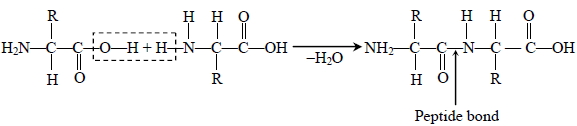
The peptide bond is an amide bond which links amino acids together to form proteins.
View full question & answer
MCQ 171 Mark
The central dogma of molecular genetics states that the genetic information flows from
  • A
    Amino acids $\rightarrow $ Proteins $\rightarrow \, DNA$
  • B
    $DNA \rightarrow \,$ Carbohydrates $\rightarrow \,$ Proteins
  • $DNA \rightarrow \, RNA \, \rightarrow \,$ Proteins
  • D
    $DNA \rightarrow \, RNA \,\rightarrow \,$ Carbohydrates
Answer
Correct option: C.
$DNA \rightarrow \, RNA \, \rightarrow \,$ Proteins
c
Central dogma model contains following steps:

$\mathrm{DNA} \stackrel{\text { Transcription }}{\longrightarrow} \mathrm{RNA} \stackrel{\text { Translation }}{\longrightarrow}$ Protein

View full question & answer
MCQ 181 Mark
Which one given below is a non-reducing sugar ?
  • A
    Glucose
  • Sucrose
  • C
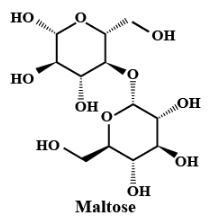
    Maltose
  • D
    Lactose
Answer
Correct option: B.
Sucrose
b
sucrose is non-reducing sugar because it has one $-CHO$ group
View full question & answer
MCQ 191 Mark
The correct statement regarding $RNA$ and $DNA,$ respectively is
  • A
    the sugar component in $RNA$ is a arabinose and the sugar component in $DNA$ is ribose
  • B
    the sugar component in $RNA$ is $2'-$deoxyribose and the sugar component in $DNA$ is arabinose
  • C
    the sugar component in $RNA$ is arabinose and the sugar component in $DNA$ is $2'-$deoxyribose
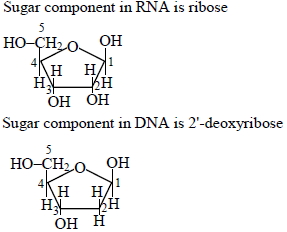
  • the sugar component in $RNA$ is ribose and the sugar component in $DNA$ is $2'-$deoxyribose.
Answer
Correct option: D.
the sugar component in $RNA$ is ribose and the sugar component in $DNA$ is $2'-$deoxyribose.
d

View full question & answer
MCQ 201 Mark
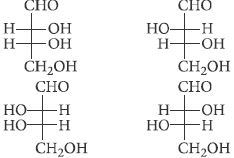
The correct corresponding order of names of four aldoses with configuration given below respectively, is
  • A
    $L-$erythrose, $L-$threose, $L-$erythrose, $D-$threose
  • B
    $D-$threose, $D-$erythrose, $L-$threose, $L-$erythrose
  • C
    $L-$erythrose, $L-$threose, $D-$erythrose, $D-$threose
  • $D-$erythrose, $D-$threose, $L-$erythrose, $L-$threose.
Answer
Correct option: D.
$D-$erythrose, $D-$threose, $L-$erythrose, $L-$threose.
d
If $-OH$ group is on the right-hand side to the last carbon with respect to the highest oxidised carbon at the top, it is called $D-isomer$ and if it is on the left side, it is called $L-isomer$.So, the names of the compounds are $D-erythrose$,$D-threose$,$L-erythrose$, $L-threose$,respectively.
View full question & answer
MCQ 211 Mark
Which of the following hormones is produced under the conditions of stress which stimulate glycogenolysis in the liver of human beings?
  • A
    Thyroxin
  • B
    Insulin
  • Adrenaline
  • D
    Estradiol
Answer
Correct option: C.
Adrenaline
c
Adrenaline hormones in creases pulse rate and controls blood pressure. It releases glucose from liver glycogen and fatty acids from fats in emergency
View full question & answer
MCQ 221 Mark
$D(+)-$ glucose reacts with hydroxyl amine and yields an oxime. The structure of the oxime would be
  • A
    $\begin{array}{*{20}{c}}
      {\,\,\,\,\,\,\,\,\,\,\,\,\,\,\,\,\,\,\,CH = NOH} \\ 
      | \\ 
      {H - C - OH} \\ 
      | \\ 
      {HO - C - H} \\ 
      | \\ 
      {HO - C - H} \\ 
      | \\ 
      {H - C - H} \\ 
      | \\ 
      {\,\,\,\,\,\,\,\,\,\,\,\,C{H_2}OH} 
    \end{array}$
  • B
    $\begin{array}{*{20}{c}}
      {\,\,\,\,\,\,\,\,\,\,\,\,\,\,\,\,\,\,\,CH = NOH} \\ 
      | \\ 
      {HO - C - H} \\ 
      | \\ 
      {HO - C - H} \\ 
      | \\ 
      {H - C - OH} \\ 
      | \\ 
      {H - C - OH} \\ 
      | \\ 
      {\,\,\,\,\,\,\,\,\,\,\,\,C{H_2}OH} 
    \end{array}$
  • C
    $\begin{array}{*{20}{c}}
      {\,\,\,\,\,\,\,\,\,\,\,\,\,\,\,\,\,\,\,CH = NOH} \\ 
      | \\ 
      {HO - C - H} \\ 
      | \\ 
      {H - C - OH} \\ 
      | \\ 
      {HO - C - H} \\ 
      | \\ 
      {H - C - OH} \\ 
      | \\ 
      {\,\,\,\,\,\,\,\,\,\,\,\,C{H_2}OH} 
    \end{array}$
  • $\begin{array}{*{20}{c}}
      {\,\,\,\,\,\,\,\,\,\,\,\,\,\,\,\,\,\,\,CH = NOH} \\ 
      | \\ 
      {H - C - OH} \\ 
      | \\ 
      {HO - C - H} \\ 
      | \\ 
      {H - C - OH} \\ 
      | \\ 
      {H - C - OH} \\ 
      | \\ 
      {\,\,\,\,\,\,\,\,\,\,\,\,C{H_2}OH} 
    \end{array}$
Answer
Correct option: D.
$\begin{array}{*{20}{c}}
  {\,\,\,\,\,\,\,\,\,\,\,\,\,\,\,\,\,\,\,CH = NOH} \\ 
  | \\ 
  {H - C - OH} \\ 
  | \\ 
  {HO - C - H} \\ 
  | \\ 
  {H - C - OH} \\ 
  | \\ 
  {H - C - OH} \\ 
  | \\ 
  {\,\,\,\,\,\,\,\,\,\,\,\,C{H_2}OH} 
\end{array}$
d
$\underset{D\,-\,(+)\,-\,glucos e}{\mathop{\begin{matrix}
   \begin{matrix}
   \begin{matrix}
   \,\,\,\,\,\,\,CH=O  \\
   |\,\,\,\,\,\,  \\
   H-C-OH\,\,\,  \\
   |\,\,\,\,\,\,  \\
\end{matrix}  \\
   HO-C-H\,\,\,\,\,\,\,\,  \\
   |\,\,\,\,  \\
   H-C-OH  \\
\end{matrix}  \\
   |\,\,\,\,\,  \\
   H-C-OH  \\
   \begin{matrix}
   |\,\,\,\,  \\
   \,\,\,\,\,\,\,\,\,\,C{{H}_{2}}OH  \\
\end{matrix}  \\
\end{matrix}}}$  $+\,N{{H}_{2}}OH\,\,\xrightarrow[-\,{{H}_{2}}O]{}$ $\underset{glu\operatorname{co}xime}{\mathop{\begin{matrix}
   \begin{matrix}
   \begin{matrix}
   \,\,\,\,\,\,\,\,\,\,\,\,\,\,CH=NOH  \\
   |\,\,\,\,\,\,  \\
   H-C-OH\,\,\,  \\
   |\,\,\,\,\,\,  \\
\end{matrix}  \\
   HO-C-H\,\,\,\,\,\,\,\,  \\
   |\,\,\,\,  \\
   H-C-OH  \\
\end{matrix}  \\
   |\,\,\,\,\,  \\
   H-C-OH  \\
   \begin{matrix}
   |\,\,\,\,  \\
   \,\,\,\,\,\,\,\,\,\,C{{H}_{2}}OH  \\
\end{matrix}  \\
\end{matrix}}}$​
View full question & answer
MCQ 231 Mark
In $DNA,$ the linkages between different nitrogenous bases are
  • A
    phosphate linkage
  • $H-$bonding
  • C
    glycosidic linkage
  • D
    peptide linkage
Answer
Correct option: B.
$H-$bonding
b
View full question & answer
MCQ 241 Mark
The change in optical rotation, with time, of freshly prepared solution of sugar is known as
  • A
    Rotatory motion
  • B
    Inversion
  • C
    Specific rotation
  • Mutarotation
Answer
Correct option: D.
Mutarotation
d
(d) $\mathop {\mathop {\alpha - D - {\rm{Glucose}}}\limits_{[\alpha ] = + {{112}^o}} }\limits_{(36\% )} $ $\rightleftharpoons $ $\mathop {\mathop {{\rm{Equilibrium\, mixture}}}\limits_{{{{\rm{[}}\alpha {\rm{]}}}_{\rm{D}}} = + {{52}^o}} }\limits_{(0.02\% )} $  $\rightleftharpoons $ $\mathop {\mathop {\beta - D - {\rm{Glucose}}}\limits_{{{[\alpha ]}_D} = + {{19}^o}} }\limits_{(64\% )} $

Glucose has two forms $\alpha$ and $\beta$. When either of these two is dissolved in water and allowed to stand, it gets converted to an equilibrium mixture of $\alpha$  and $\beta$ forms.

View full question & answer
MCQ 251 Mark
Which of the following monosaccharide is a pentose
  • A
    Galactose
  • B
    Glucose
  • C
    Fructose
  • Arabinose
Answer
Correct option: D.
Arabinose
d
(d) Arabinose is an aldopentose

$HOC{H_2} - {(CHOH)_3} - CHO$

View full question & answer
MCQ 261 Mark
General formula for carbohydrates is
  • A
    ${C_n}{H_{2n}}{O_{2n + 2}}$
  • B
    ${C_x}{({H_2}O)_{2x}}$
  • ${C_x}{({H_2}O)_y}$
  • D
    None of these
Answer
Correct option: C.
${C_x}{({H_2}O)_y}$
c
(c) Carbohydrates are hydrates of carbon. Their general formula is ${C_x}{({H_2}O)_y}$.
View full question & answer
MCQ 271 Mark
Benedict solution provides
  • A
    $A{g^ + }$
  • B
    $L{i^ + }$
  • $C{u^{ + 2}}$
  • D
    $B{a^{ + 2}}$
Answer
Correct option: C.
$C{u^{ + 2}}$
c
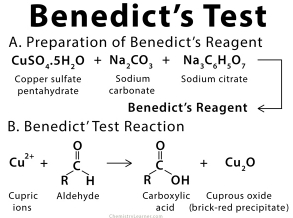
Benedict's solution is used to test for reducing sugars (free aldehyde group). The aldehyde gets oxidised and in the process, reduces the $Cu ^{+}$found in the complex provided by Benedict solution to form copper$(I)$ oxide, $Cu _2 O$.
View full question & answer
MCQ 281 Mark
A certain compound gives negative test with ninhydrin and positive test with Benedict's solution. The compound is
  • A
    A protein
  • A monosaccharide
  • C
    A lipid
  • D
    An amino acid
Answer
Correct option: B.
A monosaccharide
b
(b) Protein gives blue-violet colour with ninhydrin ($2$, $2$ - dihydroxyindane - $1$, $3$ -diene)

Carbohydrates gives brown red ppt. with benedict’s solution ($Alk$. $CuS{O_4} + $ Citrate ions)

View full question & answer
MCQ 291 Mark
An organic compound answers Molisch's test as well as Benedict's test. But it does not answer Scliwanoff's test. Most probably, it is
  • A
    Sucrose
  • B
    Protein
  • C
    Fructose
  • Maltose
Answer
Correct option: D.
Maltose
d
An organic compound answers Molisch's test as well as Benedict's test. But it does not answer Scliwanoff's test. Most probably, it is Maltose. It is a reducing sugar. Molisch's test is used to detect all kinds of carbohydrates. The Benedict's test identifies reducing sugars (monosaccharides and some disaccharides), which have free ketone or aldehyde functional groups. Scliwanoff's test is simple test that is used for the detection/presence of fructose or keto group in a sugar solution.
View full question & answer
MCQ 301 Mark
Hydrolysis of sucrose is called
  • A
    Esterification
  • B
    Saponification
  • Inversion
  • D
    Hydration
Answer
Correct option: C.
Inversion
c
When sucrose is hydrolyzed, the direction of rotation of plane-polarized light becomes inverted. This is why it is called the inversion of sucrose. It is an important reaction and is catalyzed in an acidic medium.
View full question & answer
MCQ 311 Mark
The compound which does not contain an asymmetric carbon atom is
  • Glycolaldehyde
  • B
    Glyceraldehyde
  • C
    Glucose
  • D
    Galactose
Answer
Correct option: A.
Glycolaldehyde
a
An asymmetric carbon atom (chiral carbon) is a carbon atom that is attached to four different types of atoms or groups of atoms.Glycolaldehyde, $1\,g \mid$ $A$ to $Z$ | Chemikalien | Carl Roth - France Glycoaldehyde do not have chiral carbon atom.
View full question & answer
MCQ 321 Mark
Glucose and fructose form
  • Same osazone
  • B
    Same acid on oxidation
  • C
    Same alcohol when reduced
  • D
    Different osazone
Answer
Correct option: A.
Same osazone
a
Glucose and fructose form same osazone. The two compounds differ only at carbon number $1$ and $2$ and both of them get involved in osazone formation and thus the osazone formed is identical for both.
View full question & answer
MCQ 331 Mark
On heating with conc. ${H_2}S{O_4},$ sucrose gives
  • A
    $CO$ and $C{O_2}$
  • B
    $CO$ and $S{O_2}$
  • C
    $CO,\,\,C{O_2}$ and $S{O_2}$
  • None of these
Answer
Correct option: D.
None of these
d
In the presence of concentrated sulfuric acid, sucrose is dehydrated to produce carbon and water. The heat of the reaction vaporizes the water causing the column of carbon to form.Reaction :$C _{12} H _{22} O _{11}+\text { conc. } H _2 SO _4 \rightarrow 12 C +11 H _2 O$
View full question & answer
MCQ 341 Mark
Starch can be used as an indicator for the detection of traces of
  • A
    Glucose in aqueous solution
  • B
    Protein in blood
  • Iodine in aqueous solution
  • D
    Urea in blood
Answer
Correct option: C.
Iodine in aqueous solution
c
Starch solution is colourless but changes its colour in iodine solution.Starch $+$ Iodine $\rightarrow$ Starch Iodine
View full question & answer
MCQ 351 Mark
Which one of the following compounds is found abundantly in nature
  • A
    Fructose
  • B
    Starch
  • C
    Glucose
  • Cellulose
Answer
Correct option: D.
Cellulose
d
Cellulose is the most abundant organic polymer on Earth.
View full question & answer
MCQ 361 Mark
Sugar can be tested in urine by
  • A
    Molisch test
  • B
    Dunstan's test
  • Benedict's test
  • D
    Legal's test
Answer
Correct option: C.
Benedict's test
c
(c) Glucose + Benedict's solution $\to$ Red colour $(C{u_2}O)$.
View full question & answer
MCQ 371 Mark
Which of the following statements about ribose is incorrect
  • A
    It is a polyhydroxy compound
  • B
    It is an aldehyde sugar
  • It has six carbon atoms
  • D
    It exhibits optical activity
Answer
Correct option: C.
It has six carbon atoms
c
$Hint:$ A carbohydrate is a polyhydroxy aldehyde or ketone.

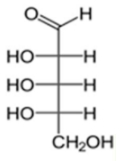
$Explanation- $Ribose is a monosaccharide having five carbons, thus called pentose sugar. Ribose is the most important pentose present in living organisms. It is an aldose sugar, having an aldehydic functional group. Its molecular formula is represented as $C_5​ H_{10}​ O_5$ . The structural formula of ribose is as follow:

View full question & answer
MCQ 381 Mark
The aqueous solution of a carbohydrate gives dark blue colour with iodine. It is
  • A
    Glucose
  • B
    Fructose
  • C
    Sucrose
  • Starch
Answer
Correct option: D.
Starch
d
(d) Starch + ${I_2}$ $\to$ Blue colour.
View full question & answer
MCQ 391 Mark
Which of the following pentoses will be optically active

$\begin{array}{*{20}{c}}{CHO}\\|\\{HCOH}\\|\\{HOCH}\\|\\{HCOH}\\|\\{C{H_2}OH}\\I\end{array}$                    $\begin{array}{*{20}{c}}{CHO}\\|\\{HCOH}\\|\\{HCOH}\\|\\{HOCH}\\|\\{C{H_2}OH}\\{II}\end{array}$            $\begin{array}{*{20}{c}}{CHO}\\|\\{HCOH}\\|\\{HCOH}\\|\\{HCOH}\\|\\{C{H_2}OH}\\{III}\end{array}$

  • All
  • B
    $II$ and $III$
  • C
    $I$
  • D
    $II$
Answer
Correct option: A.
All
a
(a) All are optically active.
View full question & answer
MCQ 401 Mark
Which of the following statements is right
  • Cellulose are linear polymers of $\beta - $glucose molecules with $\beta - 1,\,4 - $linkages
  • B
    Starches are polymers of $\alpha - $glucose molecules with $\beta - 1,\,4 - $linkages and some $\beta - 1,\,6 - $cross-linkages
  • C
    Proteins are polyamides of $\beta - $amino acids
  • D
    The structural information about their biosynthesis is contained in a class of compounds called nucleic acids, e.g. $RNA$ and $DNA$
Answer
Correct option: A.
Cellulose are linear polymers of $\beta - $glucose molecules with $\beta - 1,\,4 - $linkages
a
Proteins are natural polymers. They are large biological molecules consisting of one or more chains of $\alpha$ - amino acids.

Starch is a polymer of glucose. It exists in two forms amylose and amylopectin. Amylose is formed by linkage of glucose by $\alpha-1,4$ glucose unit. It is a linear polymer. Amylopectin is a branched polymer of glucose where two polymeric chains of glucose of alpha 1,4 glucose unit are linked by $\alpha-1,6$ linkage.

Cellulose is linear homopolysaccharide of $\beta$ - glucose units, which are linked together by $\beta-1,4$ glycosidic bonds.

View full question & answer
MCQ 411 Mark
When amylases catalyse the hydrolysis of starch, the final product obtained is chiefly
  • A
    Cellobiose
  • B
    Glucose
  • Maltose
  • D
    Sucrose
Answer
Correct option: C.
Maltose
c
(c) ${\text{Starch}}\,\,\,\xrightarrow{{{\text{Amylase}}}}\,\,\,{\text{Maltose}}$
View full question & answer
MCQ 421 Mark
Indigestible carbohydrate, which is also a constituent of our diet, is
  • Cellulose
  • B
    Galactose
  • C
    Maltose
  • D
    Starch
Answer
Correct option: A.
Cellulose
a
(a) We can’t digest cellulose which is a polysaccharide.
View full question & answer
MCQ 431 Mark
In the viscose process the solvent for cellulose consists of
  • A
    Ether and alcohol
  • B
    Copper sulphate and ammonia
  • Sodium hydroxide and carbon disulphide
  • D
    Acetic acid and acetic anhydride
Answer
Correct option: C.
Sodium hydroxide and carbon disulphide
c
In the viscose process the solvent for cellulose consists of Sodium hydroxide and carbon disulphide in viscose process uses carbon disulfide to convert cellulose into cellulose xanthate, which is soluble in aqueous alkali solutions $( NaOH )$, before forming fibers in an acidic coagulation bath.
View full question & answer
MCQ 441 Mark
To detect the reducing and non reducing sugars, which of the following test is used
  • A
    Molisch test
  • B
    Biuret test
  • Fehling's test
  • D
    Millions test
Answer
Correct option: C.
Fehling's test
c
$a)$.Molisch's test is a chemical test which is used to check for the presence of carbohydrates in a given analyte.

$b)$. The biuret test, also known as Piotrowski's test, is a chemical test used for detecting the presence of peptide bonds. In the presence of peptides, a copper $(II)$ ion forms mauve-colored coordination complexes in an alkaline solution.

$c)$.Fehling’s test is used for reducing sugars and non-reducing sugars, supplementary to the Tollens’ reagent test. The test was developed by German chemist Hermann von Fehling in $1849$.

$d).$ Millon's reagent is an analytical reagent used to detect the presence of soluble proteins.

View full question & answer
MCQ 451 Mark
The safest and the most common alternative of sugar is
  • A
    Glucose
  • B
    Aspartame
  • Saccharin
  • D
    Cyclodextrin
Answer
Correct option: C.
Saccharin
c
It’s obvious.
View full question & answer
MCQ 461 Mark
The specific rotation of equilibrium mixture of $\alpha - D-$ glucose and $\beta - D-$ glucose, is ....... $^o$
  • A
    $ + {19}$
  • B
    $ + {112}$
  • $ + {52}$
  • D
    $ + {100}$
Answer
Correct option: C.
$ + {52}$
c
Each of these two forms can be synthesized and isolated as pure compounds.

$(1)$.The alpha $(\alpha)$ anomer of $D$-glucose has a specific rotation of $+112$ degrees in water.

$(2)$.The beta ( $\beta$ ) anomer of $D$-glucose has a specific rotation of $+19$ degrees. $(18.7$ actually, but rounding up to $19)$.

And when either anomer is dissolved in water, the value of the specific rotation changes over time eventually reaching the same value of $+52^{\circ}$.

The specific rotation of $\alpha$-D-glucopyranose decreases from $+112^{\circ}$ to

$+52^{\circ}$.

The specific rotation of $\beta$-D-glucopyranose increases from $+19^{\circ}$ to

$+52^{\circ}$.This behaviour is called mutarotation

View full question & answer
MCQ 471 Mark
Glucose and mannose are
  • Epimers
  • B
    Anomers
  • C
    Ketohexoses
  • D
    Disaccharides
Answer
Correct option: A.
Epimers
a
(a) Glucose and mannose are epimers because they both differ in configuration at $C-2$ and the Isomer which differ at ${C_2}$ position known as epimers of each other.
View full question & answer
MCQ 481 Mark
In fructose, the possible optical isomers are
  • A
    $12$
  • $8$
  • C
    $16$
  • D
    $4$
Answer
Correct option: B.
$8$
b
(b) Fructose has three chiral centres and hence $23 = 8$ optical isomers are possible.
View full question & answer
MCQ 491 Mark
Which one of the following is a polysaccharide
  • A
    Nylon
  • Amylose
  • C
    Ribose
  • D
    Polyethylene
Answer
Correct option: B.
Amylose
b
(b) Amylose is a polysaccharide.
View full question & answer
MCQ 501 Mark
When glucose reacts with bromine water, the main product is
  • A
    Acetic acid
  • B
    Saccharic acid
  • C
    Glyceraldyhyde
  • Gluconic acid
Answer
Correct option: D.
Gluconic acid
d
(d) Glucose on reaction with bromine water followed by oxidation gives gluconic acid

$\mathop {{C_6}{H_{12}}{O_6}}\limits_{{\text{Glucose}}}  + (O)\xrightarrow{{B{r_2}/{H_2}O}}\mathop {C{H_2}OH{{(CHOH)}_4}COOH}\limits_{{\text{Gluconic acid}}} $

View full question & answer