Explain the following with an example (i) Reaction of phenol with zine dust. (ii) Oxidation reaction of phenol.
Answer
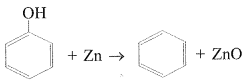
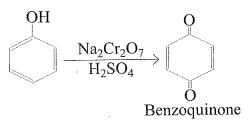
→ Reaction of phenol with zinc dust: Phenol is converted to benzene on heating with zinc dust. → Oxidation Oxidation of phenol with chromic acid produces a conjugated diketone known as benzoquinone. In the presence of air, phenols are slowly oxidised to dark coloured mixtures containing quinones.
What happens when the vapours of a primary, secondary and tertiary alcohol are passed over heated copper at 573 K temperature? Explain with chemical equation.
Answer
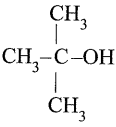
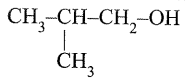
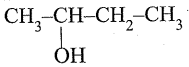
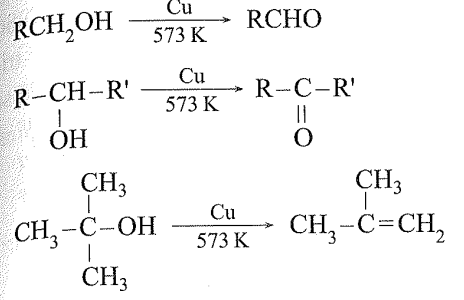
→ When the vapours of a primary, secondary and tertiary alcohol are passed over heated copper at 573 K, dehydrogenation takes place and an aldehyde or a ketone is formed while tertiary alcohols undergo dehydration.
Write a note on the reaction of alcohols with phosphrous trihalides.
Answer
$\rightarrow $ Alcohols react with phosphrous trihalides to give corresponded alkyl halides. This reaction is useful for preparation of alkyl halides from alcohols.
$3R-OH + PX_3 \rightarrow 3R-X + H_3PO_3 (X = Cl, Br)$
Explain the reaction of alcohols with hydrogen halides. $\#\#\#$ Short note: Lucas test
Answer
$\rightarrow$ Alcohols react with hydrogen halides to form alkyl halides.
$R - OH + HCl \xrightarrow{ ZnCl _2} R - Cl + H _2 O$
$\rightarrow$ The difference in reactivity of three classes of alcohols with $ \text{HCl}$ distinguishes them from one another.
$\rightarrow$ Alcohols are soluble in Lucas reagent $($conc. $ \text{HCl}$ and $ZnCl_2)$ while their halides are immiscible and produce turbidity in solution.
$\rightarrow$ In case of tertiary alcohols, turbidity is produced immediately as they form the halides easily.
$\rightarrow$ Primary alcohols do not produce turbidity at room temperature.
$\rightarrow$ This is how alcohols can be distinguished by Lucas test.
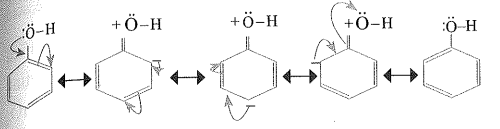
→ Acidity of phenols: The reactions of phenol with metals (e.g., sodium, aluminium) and sodium hydroxide indicate its acidic nature. The hydroxyl group, in phenol is directly attached to 2 the sp hybridised carbon of benzene ring which acts as an electron withdrawing group. Due to this, the charge distribution in phenol molecule, as depicted in its resonance structures, causes the oxygen of -OH group to be positive → The reaction of phenol with aqueous sodium hydroxide indicates that phenols are stronger acids than alcohols and water.
'Alcohols are versatile compounds' discuss exaction of this statement by giving suitable example.
Answer
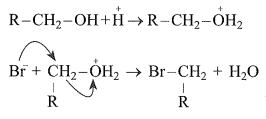
→ Alcohols are versatile compounds. They react both as nucleophiles and electrophiles. The bond between O-H is broken when alcohols react as nucleophiles. → Alcohols as nucleophiles (i) (ii) The bond between C O is broken when they react as electrophiles. Protonated alcohols react in this manner. → Protonated alcohols as electrophiles
How are alcohol compounds prepared by reduction of carboxylic acids and esters? Explain.
Answer
$\rightarrow$ By reduction of carboxylic acids and esters :
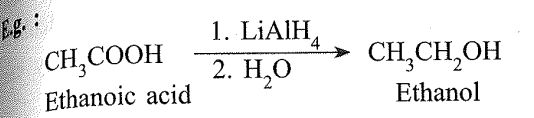
Carboxylic acids are reduced to primary alcohls in excellent yields by lithium aluminium hydride, a strong reducing agent.
$RCOOH \xrightarrow[\text { (ii) } H _2 O ]{\text { (i) } LAH _4} RCH _2 OH$
$\rightarrow$ However, $LiAlH_{4,}$ is an expensive reagent and therefore, used for preparing special chemicals only. Commercially, acids are reduced to alcohols by converting them to esters followed by their reduction using hydrogen in the presence of catalyst $($catalytic hydrogenation$).$
$RCOOH \xrightarrow[ H ^{+}]{ R ^{\prime} OH } RCOOR' \xrightarrow[\text { Catalyst }]{ H _2} RCH _2 OH + R ^{\prime} OH$
Explain the preparation of alcohol by reduction of aldehydes and ketones.
Answer
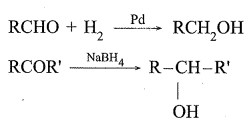
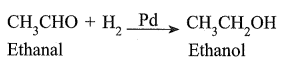
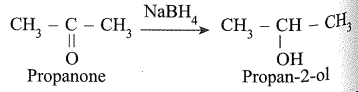
$\rightarrow$ By reduction of aldehydes and ketones: Aldehydes and ketones are reduced to the correspoinding alcohols by addition of hydrogen in the presence of catalysts $($catalytic hydrogenation$).$ The usual catalyst is a finely divided metal such as platinum, palladium or nickel. It is also prepared by treating aldehydes and ketones with sodium borohydrode $(NaBH_4)$ or lithium aluminium hydride $(LiAlH_4).$
Aldehydes yield primary alcohols whereas ketones give secondary alcohols.
E.g.:
$(1)$
$(2)$
Discuss the classification of monohydric alcohols containing $C_{sp}^2-OH$ bond.
Answer
$\rightarrow$ Compounds containing $C_{sp}^2-OH$ bond : These alcohols contain $-OH$ group bonded to a carbon$-$carbon double bond i.e., to a vinylic carbon or to an aryl carbon. These alcohols are also known as vinylic alcohols.
$\rightarrow$ Vinylic alcohol: $CH_2= CH - OH$
Explain the classification of alcohols and phenols on the basis of number of hydroxyl groups.
Answer
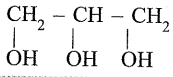
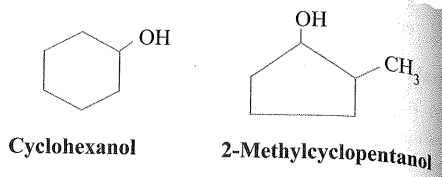
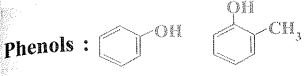
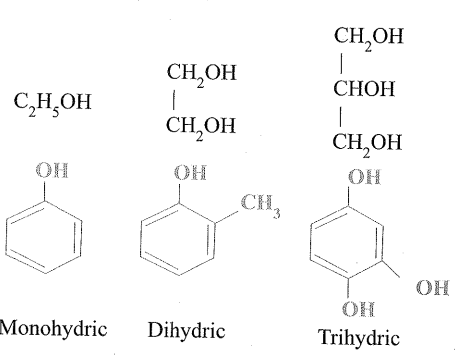
→ Alcohols and phenols may be classified as mono-, di, tri or polyhydric compounds depending on whether they contain one, two, three or many hydroxyl groups respectively in their structures as given below :