Questions

2 Marks Questions

🎯

Test yourself on this topic

11 questions · timed · auto-graded

Question 22 Marks
Explain denaturation of proteins.
Answer
Due to the physical changes like change in temperature, pressure, or chemical change like change in pH, hydrogen bonds are disturbed. Because of this protein globules unfold and helix gets uncoiled and protein loses its biological activity. This is called denaturation of protein. Denaturation of protein is an irreversible process.
Example : The coagulation of egg white on boiling.
View full question & answer
Question 32 Marks
What happens when surcose is heated with dilute $H _2 SO _4$ or dilute HCl ?
Answer
On heating sucrose with dilute $H _2 SO _4$ or dilute HCl , it hydrolysis to form glucose and fructose.
Image
View full question & answer
Question 42 Marks
What is the difference between glucose and starch?
Answer
(i) Glucose does not react with iodine solution whereas starch gives blue colour with iodine solution.
(ii) Glucose does not undergo hydrolysis whereas hydrolysis of starch gives glucose.
(iii) Glucose gives red precipitate with Fehling's solution but starch does not give this test.
View full question & answer
Question 52 Marks
(i) When does sickle cell anemia disease appears?
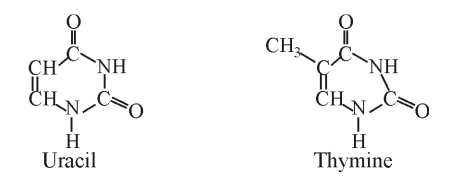
(ii) What is the difference between the structure formula of thymine and uracil?
(iii) Define heredity and chromosome.
View full question & answer
Question 62 Marks
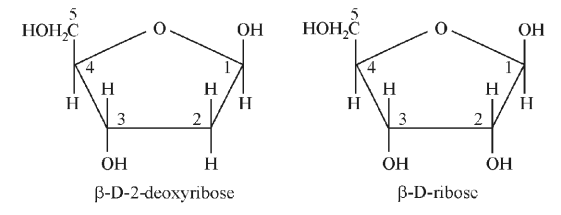
Describe the structure of sugars present in DNA and RNA.
Answer
DNA contains $\beta$-D-2-deoxyribose whereas RNA contains $\beta$-D-ribose sugar.
Image
View full question & answer
Question 82 Marks
What is epimerization? Explain.
Answer
Aldose whose configuration of carbon atom C 2 differs are called epimers of each other and the process of conversion of one epimer into another epimer is called epimerization. Example: Glucose and mannose. In glucose the - OH group on C 2 is on the right hand side while in mannose it is on the left side.
View full question & answer
Question 102 Marks
Glucose is an aldohexose monosaccharide. Why does it react with hydrogen cyanide to form cyanohydrin but does not react with sodium hydrogen sulphite?
Answer
D-glucose exist in cyclic forms $\alpha$- and $\beta$- in which the aldehyde group is involved in the formation of a ring and is not free. Therefore, it does not react with NaHSO3. However, with reagents like HCN and phenyl - hydrazine, the ring structure cleaves and the aldehydic group becomes free. Therefore, D-glucose does not react with HCN.
View full question & answer
Question 112 Marks
Explain the difference between reucing and non-reducing sugars with examples.
Answer
Reducing sugars have reducing properties, hence they reduce Fehling's solution and Tollens' reagent, like- all monosaccharides, maltose and lactose. Non-reducing sugars do not have reducing properties, hence they do not reduce Fehling's solution and Tollens' reagent. Example : Sucrose.

View full question & answer
2 Marks Questions - Chemistry STD 12 Science Questions - Vidyadip