Question 11 Mark
Write the IUPAC name of the following coordination compound:
$\left[\mathrm{Co}\left(\mathrm{NH}_3\right)_6\right] \mathrm{Cl}_3$
AnswerHexaamminecobalt (III) chloride.
View full question & answer→Question 21 Mark
Write the formula for the following coordination compound:
Tris (ethane–1, 2–diamine) chromium (III) chloride.
AnswerTris (ethane-1, 2-diamine) chromium (III) chloride $-\left[\mathrm{Cr}(\mathrm{en})_3\right] \mathrm{Cl}_3$
View full question & answer→Question 31 Mark
Write the IUPAC name of the following coordination compound:
$\left[\mathrm{Pt}\left(\mathrm{NH}_3\right)_2 \mathrm{Cl}\left(\mathrm{NH}_2 \mathrm{CH}_3\right)\right] \mathrm{Cl}$
AnswerDiamminechlorido (methylamine) platinum (II) chloride.
View full question & answer→Question 41 Mark
Specify the oxidation numbers of the metals in the following coordination entities:
$\left[\mathrm{Cr}\left(\mathrm{NH}_3\right)_3 \mathrm{Cl}_3\right]$
Answer$\left[\mathrm{Cr}\left(\mathrm{NH}_3\right)_3 \mathrm{Cl}_3\right]$
$x + 0 + 3 (-1) = 0$
$x = +3$
View full question & answer→Question 51 Mark
$\left[\mathrm{Fe}\left(\mathrm{H}_2 \mathrm{O}\right)_6\right]^{3+}$ is strongly paramagnetic whereas $\left[\mathrm{Fe}(\mathrm{CN})_6\right]^{3-}$ is weakly paramagnetic. Explain.
AnswerIn presence of $\mathrm{CN}^{-}$, (a strong ligand) the 3d electrons pair up leaving only one unpaired electron. The hybridisation is $\mathrm{d}^2 \mathrm{sp}^3$ forming inner orbital complex. In the presence of $\mathrm{H}_2 \mathrm{O}$, (a weak ligand), 3d electrons do not pair up. The hybridisation is $\mathrm{sp}^3 \mathrm{d}^2$ forming an outer orbital complex containing five unpaired electrons, thus greater the number of unpaired electrons more is the paramagnetic behavior.
View full question & answer→Question 61 Mark
Write the formula for the following coordination compound:
Tetraamminediaquacobalt (III) chloride.
AnswerTetraaminediaquacobalt (III) chloride - $\left[\mathrm{Co}\left(\mathrm{NH}_3\right)_4\left(\mathrm{H}_2 \mathrm{O}\right)_2\right] \mathrm{Cl}_3$
View full question & answer→Question 71 Mark
Discuss briefly giving an example in case the role of coordination compounds in:
Medicinal chemistry.
AnswerRole of coordination compounds in medicinal chemistry:
Certain coordination compounds of platinum (for example, cis-platin) are used for inhibiting the growth of tumours.
View full question & answer→Question 81 Mark
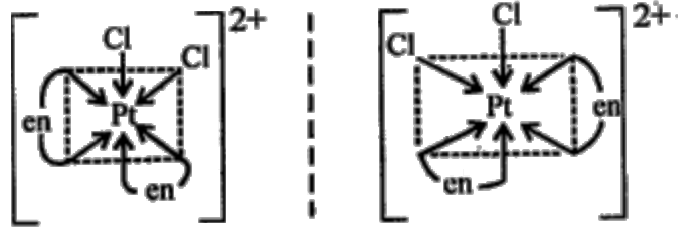
Draw the structures of optical isomers of: $\left[\mathrm{PtCl}_2(e n)_2\right]^{2+}$
Answer
$\left(\right.$ cis-isomer only $)\mathrm{Cis}-\left[\mathrm{PtCl}_2(\mathrm{en})_2\right]^{2+}$
View full question & answer→Question 91 Mark
Using IUPAC norms write the systematic name of the following:
$\left[\mathrm{Co}\left(\mathrm{NH}_3\right)_6\right] \mathrm{Cl}_3$
AnswerHexaammine cobalt (111) chloride.
View full question & answer→Question 101 Mark
Using IUPAC norms write the systematic name of the following:
$\left[\mathrm{Ti}\left(\mathrm{H}_2 \mathrm{O}\right)_6\right]^{3+}$
AnswerHexaaquatitanium (III) ion.
View full question & answer→Question 111 Mark
Predict the number of unpaired electrons in the square planar $[Pt(CN)_4]^{2–}$ ion.
Answer
$[Pt(CN)_4]^{2-}:$ the outer shell electronic
configurationof Pt is $5d^96s^1.$
In $+2$ state of Pt,is $5d^8$,i.e.,
For squre planer geometry, hybridisation is $dsp^2.$
Hence, the two d $e^{-1}s$ pair up to make one
d-orbital empty. So, there is no unpaired $r^-$
View full question & answer→Question 121 Mark
Write the IUPAC name of the following coordination compound:
$\mathrm{K}_2\left[\mathrm{PdCl}_4\right]$
AnswerPotassium tetrachloridopalladate (II).
View full question & answer→Question 131 Mark
Discuss briefly giving an example in case the role of coordination compound in:
Biological systems.
AnswerRole of coordination compounds in biological systems:
We know that photosynthesis is made possible by the presence of the chlorophyll pigment. This pigment is a coordination compound of magnesium. In the human biological system, several coordination compounds play important roles. For example, the oxygen-carrier of blood, i.e., haemoglobin, is a coordination compound of iron.
View full question & answer→Question 141 Mark
Using IUPAC norms write the formula for the following:
Pentaamminenitrito-O-cobalt (III).
Answer$\left[\mathrm{Co}\left(\mathrm{NH}_3\right)_5(\mathrm{ONO})\right]^{2+}$
View full question & answer→Question 151 Mark
Specify the oxidation number of the metal in the following coordination entitie:
$\mathrm{K}_3\left[\mathrm{Fe}(\mathrm{CN})_6\right]$
Answer$\mathrm{K}_3\left[\mathrm{Fe}(\mathrm{CN})_6\right]$
$3 + x + 6 (-l) = 0$
$x = +3$
View full question & answer→Question 161 Mark
Discuss briefly giving an example in case the role of coordination compounds in:
Extraction/ metallurgy of metals.
AnswerRole of coordination compounds in extraction/ metallurgy of metals:The process of extraction of some of the metals from their ores involves the formation of complexes. For example, in aqueous solution, gold combines with cyanide ions to form $[Au(CN)_2].$ From this solution, gold is later extracted by the addition of zinc metal.
View full question & answer→Question 171 Mark
Using IUPAC norms write the formula for the following:
Hexaamminecobalt (III) sulphate.
Answer$\left.\mathrm{Co}\left(\mathrm{NH}_3\right)_6\right]^2\left(\mathrm{SO}_4\right)_3$
View full question & answer→Question 181 Mark
Using IUPAC norms write the systematic name of the following:
$\left[\mathrm{Ni}\left(\mathrm{NH}_3\right)_6\right] \mathrm{Cl}_2$
AnswerHexaammine nickel (II) chloride.
View full question & answer→Question 191 Mark
How many geometrical isomers are possible in the following coordination entitie?
$\left[\mathrm{Co}\left(\mathrm{NH}_3\right)_3 \mathrm{Cl}_3\right]$
Answer$\left[\mathrm{Co}\left(\mathrm{NH}_3\right)_3 \mathrm{Cl}_3\right]$
Two geometrical isomers are possible (fac and mer) in this coordination entity.
View full question & answer→MCQ 201 Mark
How many ions are produced from the complex $\ce{Co(NH_3)_6Cl_2}$ in solution?
AnswerThe given complex can be written as $\ce{Co(NH_3)_6Cl_2}.$
Thus, $\ce{[Co(NH_3)_6]^+}$ along with two $Cl^-$ ions are produced.
View full question & answer→Question 211 Mark
Using IUPAC norms write the systematic name of the following:
$\left[\mathrm{Co}(\mathrm{en})_3\right]^{3+}$
AnswerTris (ethane -1, 2-diamine) cobaIt (III) ion.
View full question & answer→Question 221 Mark
Draw the structures of optical isomers of:
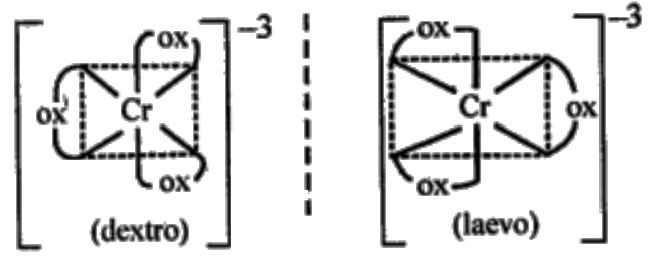
$\left[\mathrm{Cr}\left(\mathrm{C}_2 \mathrm{O}_4\right)_3\right]^{3-}$
Answer$\left[\mathrm{Cr}\left(\mathrm{C}_2 \mathrm{O}_4\right)_3\right]^{3-} \Rightarrow\left[\mathrm{Cr}(\mathrm{ox})_3\right]^{3-}$
View full question & answer→Question 231 Mark
Draw the structures of optical isomers of:
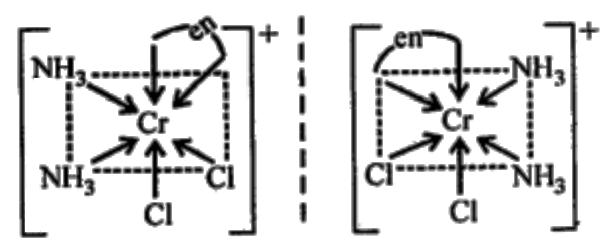
$\left[\mathrm{Cr}\left(\mathrm{NH}_3\right)_2 \mathrm{Cl}_2(\mathrm{en})\right]^{+}$
Answer(cis-isomer only) Cis - $\left[\mathrm{Cr}\left(\mathrm{NH}_3\right)_2 \mathrm{Cl}_2(\mathrm{en})\right]^{+}$
View full question & answer→Question 241 Mark
Specify the oxidation number of the metal in the following coordination entitie:
$\left[\mathrm{CoBr}_2(\mathrm{en})_2\right]^{+}$
Answer$\left[\mathrm{CoBr}_2(\mathrm{en})_2\right]^{+}$
$x + 2 (-1) + 0 = +1$
$x = +3$
View full question & answer→Question 251 Mark
Using IUPAC norms write the formula for the following:
Diamminedichloridoplatinum (II).
Answer$\left[\mathrm{Pt}\left(\mathrm{NH}_3\right)_2 \mathrm{Cl}_2\right]$
View full question & answer→Question 261 Mark
Write the IUPAC name of the following coordination compound:
$\mathrm{[Co(NH_3)_5Cl]Cl_2}$
AnswerPentaamminechloridocobalt (III) chloride.
View full question & answer→Question 271 Mark
Using IUPAC norms write the systematic name of the following:
$\left[\mathrm{Pt}\left(\mathrm{NH}_3\right)_2 \mathrm{Cl}\left(\mathrm{NH}_2 \mathrm{CH}_3\right)\right] \mathrm{Cl}$
AnswerDiammine chlorido (methylamine) platinum (II) chloride.
View full question & answer→Question 281 Mark
Using IUPAC norms write the formula for the following:
Potassium tri (oxalato) chromate (III).
Answer$\mathrm{K}_3\left[\mathrm{Cr}\left(\mathrm{C}_2 \mathrm{O}_4\right)_3\right]$
View full question & answer→Question 291 Mark
Using IUPAC norms write the formula for the following:
Hexaammineplatinum (IV).
Answer$\left[\mathrm{Pt}\left(\mathrm{NH}_3\right)_6\right]^{4+}$
View full question & answer→Question 301 Mark
Using IUPAC norms write the systematic name of the following:
$\mathrm{[Ni(CO)_4]}$
AnswerTetra carbonyl nickel (0).
View full question & answer→Question 311 Mark
Using IUPAC norms write the systematic name of the following: $[Mn(H_2O)_6]^{2+}$
AnswerHexaaquamanganese (II) ion.
View full question & answer→Question 321 Mark
Write the formula for the following coordination compound:
Amminebromidochloridonitrito-N-platinate (II).
AnswerAmine bromido chlorido nitrito-N-platinate $(II) – [Pt(NH_3)BrCl(NO_2)]$
View full question & answer→Question 331 Mark
Using IUPAC norms write the formula for the following:
Potassium tetracyanonickelate (II).
Question 341 Mark
Using IUPAC norms write the systematic name of the following:
$[NiCl_4]^{2–}$
AnswerTetrachloridonickelate (II) ion.
View full question & answer→Question 351 Mark
Write the IUPAC name of the following coordination compound:
$K_3[Fe(C_2O_4)_3]$
AnswerPotassium trioxalatoferrate (III).
View full question & answer→Question 361 Mark
Using IUPAC norms write the formula for the following:
Tetrahydroxozincate (II).
Answer$[Zn(OH)_4J]^{2-}$
View full question & answer→Question 371 Mark
Using IUPAC norms write the formula for the following:
Tetrabromidocuprate (II).
Answer$[CuBr_4]^{2-}$
View full question & answer→Question 381 Mark
What will be the correct order for the wavelengths of absorption in the visible region for the following:
$[Ni(NO_2)_6]^{4–}, [Ni(NH_3)_6]^{2+}, [Ni(H_2O)_6]^{2+}?$
AnswerAs metal ion is fixed, the increasing field strengths,
i.e., the CFSE values of the ligands from the spectro-chemical series are in the order: $H_2O < NH_{3 }< NO_2^-;$
Thus, the energies absorbed for excitation will be in the order:
$[\text{Ni}(\text{H}_{2}\text{O})_{6}]^{2+} < [\text{Ni}(\text{N}\text{H}_{3})_{6}]^{2+} < [\text{Ni}(\text{N}\text{O}_{2})_{6}]^{4-}$
As $\text{E}=\frac{\text{hc}}{\lambda}$
the wavelenghs absorbed will be in the opposite order.
View full question & answer→Question 391 Mark
How many geometrical isomers are possible in the following coordination entitie?
$[Cr(C_2O_4)_3]^{3–}$
Answer$[Cr(C_2O_4)_3]^{3–}$
No geometrical isomers are possible in this coordination entity.
View full question & answer→Question 401 Mark
Write the formulas for the following coordination compounds:
Iron(III) hexacyanoferrate(II)
AnswerIron(III) hexacyanoferrate(II) $Fe_4[Fe(CN)_6]_3.$
View full question & answer→Question 411 Mark
Give evidence that $[Co(NH_3)_5Cl]SO_4$ and $[Co(NH_3)_5SO_4]Cl$ are ionisation isomers.
AnswerThe ionisation isomers dissolve in water to yield different ions and thus react differently to various reagents:
$[Co(NH_3)_5Cl]SO_4 + Ba^{2+} → BaSO_4(s) ↓$
$[Co(NH_3)_5SO_4]Cl + Ba^{2+} →$ No reaction
$[Co(NH_3)_5Cl]SO_4 + Ag^+ →$ No reaction
$[Co(NH_3)_5SO_4] Cl+ Ag+ → AgCl(s)$
View full question & answer→MCQ 421 Mark
Amongst the following, the most stable complex is:
AnswerCorrect option: C. $\ce{[Fe(C_2O_4)_3]^{3–}}$
In each of the given complex, $Fe$ is in $+3$ oxidation state. As $\ce{{[C_2O_4}]^{2-}}$ is didentate chelating ligand, it forms chelate rings and hence $(c)$ out of complexes given above is the most stable complex.
View full question & answer→Question 431 Mark
Using IUPAC norms write the systematic name of the following: $[Co(NH_3)_4Cl(NO_2)]Cl$
AnswerTetraammine chlorido nitrito-N-cobalt (IV) chloride.
View full question & answer→Question 441 Mark
Write the formula for the following coordination compound:
Dichloridobis (ethane–1, 2–diamine) platinum (IV) nitrate.
AnswerDichlororidobis (ethane-1, 2-diamine) platinum (IV) nitrate - $\left[\mathrm{PtCl}_2(\mathrm{en})_2\right]\left(\mathrm{NO}_3\right)_2$
View full question & answer→Question 451 Mark
Using IUPAC norms write the formula for the following:
Potassium tetrachloridopalladate (II).
Answer$\mathrm{K}_2\left[\mathrm{PdCl}_4\right]$
View full question & answer→Question 461 Mark
Specify the oxidation number of the metal in the following coordination entitie:
$\left[\mathrm{Co}\left(\mathrm{H}_2 \mathrm{O}\right)(\mathrm{CN})(\mathrm{en})_2\right]^{2+}$
Answer$\left[\mathrm{Co}\left(\mathrm{H}_2 \mathrm{O}\right)(\mathrm{CN})(\mathrm{en})_2\right]^{2+}$
$x + 0 + (-1) + 0 = +2$
$x = +3$
View full question & answer→Question 471 Mark
Write the IUPAC name of the following coordination compound:
$\mathrm{K}_3\left[\mathrm{Fe}(\mathrm{CN})_6\right]$
AnswerPotassium hexacyanoferrate (III).
View full question & answer→Question 481 Mark
Discuss briefly giving an example in case the role of coordination compounds in:
Analytical chemistry.
AnswerRole of coordination compounds in analytical chemistry:During salt analysis, a number of basic radicals are detected with the help of the colour changes they exhibit with different reagents. These colour changes are a result of the coordination compounds or complexes that the basic radicals form with different ligands.
View full question & answer→Question 491 Mark
Calculate the overall complex dissociation equilibrium constant for the $\mathrm{Cu}\left(\mathrm{NH}_3\right)_4{ }^{2+}$ ion, given that $\beta_4$ for this complex is $2.1 \times 10^{13}$.
Answer$\beta_{4} =2.1\times10^{13}$
The overall complex dissociation equilibrium constant is the reciprocal of the overall stability constant, $\beta_{4}$
$\therefore\frac{1}{\beta_{4}}=\frac{1}{2.1\times10^{13}}$
$=4.7\times10^{-14}$
View full question & answer→Question 501 Mark
Specify the oxidation number of the metal in the following coordination entitie:
$\left[\mathrm{PtCl}_4\right]^{2-}$
Answer$\left[\mathrm{PtCl}_4\right]^{2-}$
$x - 4 = -2$
$x = +2$
View full question & answer→