Questions · Page 2 of 2

3 Marks Question

Question 513 Marks
Calculate the standard free energy change for the following reaction at $25°C$.
$\text{Au(s) + Ca}^{2+}(1\text{M})\xrightarrow{ \ \ \ \ \ \ \ }\text{Au}^{3+}(1\text{m) + Ca(s)}$
$\text{E}^{\circ}_{\text{Au}^{3+}/\text{Au}}=+1.50\text{V},=\text{E}^{\circ}_{\text{Ca}^{2+}/\text{Ca}}-2.87\text{V}$
Predict whether the reaction will be spontaneous or not at $25°C$. Which of the above two half cells will act as an oxidising agent and which one will be a reducing agent?
Answer
$\text{E}^{\circ}_{\text{cell}}=\text{E}^{\circ}_{\text{Ca}^{2+}/\text{Ca}}-\text{E}^{\circ}_{\text{Au}^{3+}/\text{Au}}$
$=(-2.87\text{V})-(1.50\text{V})=-4.37\text{V}$
$\Delta_{\text{r}}\text{G}^{\circ}_{\text{cell}}=-6\times96500\times(-4.37\text{V})$
$=+2530.230\text{kJ/ mol}$
Since $\Delta_{\text{r}}\text{G}^{\circ}$ is positive, therefore, reaction is non-spontaneous.
$Au^{3+}/Au$ half cell will be an oxidising agent while $Ca^{2+}/Ca$ half cell will be a reducing agent.
View full question & answer
Question 523 Marks
The emf of a cell corresponding to the reaction.
$\text{Zn(s)}+2\text{H}^+(\text{aq})\xrightarrow{ \ \ \ \ \ }\text{Zn}^{2+}(0.1\text{M})+\text{H}_2(\text{g 1 atm} )$ is 0.28 volt at 25°C.
Write the half-cell reactions and calculate the pH of the solution at the hydrogen electrode.
$\text{E}^{\circ}_{\text{Zn}^{2+}/\text{Zn}}=-0.76\text{V},\text{E}^{\circ}_{\text{H}^+/\text{H}_2}=0\text{V}$
Answer
Half-cell reactions:
$\begin{matrix}\text{At anode: } \ \ \ \ \text{Zn}\xrightarrow{ \ \ \ \ \ }\text{Zn}^{2+}+2\text{e}^-\\\text{At cathode:} \ \ \ 2\text{H}^++2\text{e}^-\xrightarrow{ \ \ \ \ }\text{H}_2\\ \ \ \ \ \ \ \ \ \ \ \ \ \ \ \ \ \ \ \ \ \ \ \ \ \ \ \ \ \ \ \ \ \ \overline{ \ \ \ \ \ \ \ \ \ \ \ \ \ \ \ \ \ \ \ \ \ \ \ \ \ \ \ \ \ \ \ \ \ \ \ \ \ \ \ \ \ \ \ \ \ \ }\\ \ \ \ \ \ \ \ \ \ \ \ \ \text{Cell reaction:}\text{ Zn + 2H}^+\xrightarrow{ \ \ \ \ \ }\text{Zn}^{2+}+\text{H}_2\end{matrix}$
$\text{E}_{\text{cell}}=\text{E}^{\circ}_{\text{cell}}-\frac{0.0591}{\text{n}}\log\frac{[\text{Zn}^{2+}]}{[\text{H}^+]^2}$
$=\Big(\text{E}^{\circ}_{\text{H}^+/\text{H}_2}-\text{E}^{\circ}_{\text{Zn}^{2+}/\text{Zn}}\Big)-\frac{0.0591}{2}\log\frac{0.1}{[\text{H}^+]^2}$
$=[0-(-0.76)]-0.02955[\log10^{-1}-2\log(\text{H}^+)]$
$0.28=0.76-0.02955(-1+2)\text{pH}$ $[\because\text{pH}=-\log(\text{H}^+)]$
$2\text{pH}-1=16.244$
$\text{pH}=8.62$
View full question & answer
Question 533 Marks
Estimate the minimum potential difference needed to reduce $Al_2O_3$ at $500°C$. The free energy change for the decomposition reaction,
$\frac{2}{3}\text{Al}_2\text{O}_3\frac{4}{3}\text{Al + O}_2\text{ is }960\text{kJ (F = 96500C mol}-1)$
Answer
$\text{Al}_2\text{O}_3(2\text{Al}^{3+}+3\text{O}^{2-})\xrightarrow{ \ \ \ \ \ }2\text{Al}+\frac{3}{2}\text{O}_2,\text{n}=6\text{e}^-$
$\therefore\frac{2}{3}\text{Al}_2\text{O}_3\xrightarrow{ \ \ \ \ \ \ \ }\frac{4}{3}\text{Al + O}_2,\text{n}=\frac{2}{3}\times6\text{e}^-=4\text{e}^-$
$\Delta_{\text{r}}\text{G}=960\times1000=960000\text{J}$
Now, $\Delta_{\text{r}}\text{G}=-\text{nFE}_{\text{cell}}$
$\Rightarrow\text{E}_{\text{cell}}=-\frac{\Delta_{\text{r}}\text{G}}{\text{nF}}=\frac{-960000}{4\times96500}$
$\Rightarrow\text{E}_{\text{cell}}=-2.487\text{V}$
$\therefore$ Minimum potential difference needed to reduce $Al_2O_3$ is $-2.487V$.
View full question & answer
Question 543 Marks
Calculate the equilibrium constant for the reaction,$\text{Cd}^{2+}(\text{aq})+\text{Zn(s)}\xrightarrow{ \ \ \ \ \ \ \ }\text{Zn}^{2+}(\text{aq) + Cd(s)}$
If $\text{E}^{\circ}_{\text{Cd}^{2+}/\text{Cd}}=-0.403\text{V;}\text{ E}^{\circ}_{\text{Zn}^{2+}/\text{Zn}}=-0.763\text{V}$
Answer
$\text{E}^{\circ}_{\text{cell}}=\text{E}^{\circ}_{\text{Cd}^{2+}/\text{Cd}}-\text{E}^{\circ}_{\text{Zn}^{2+}/\text{Zn}}$
$=-0.403\text{V}-(-0.763\text{V})=0.360\text{V, n}=2$
$\log\text{K}_{\text{c}}=\Big(\frac{\text{nE}^{\circ}_{\text{cell}}}{0.059}\Big)=\Big(\frac{2\times0.360}{0.059}\Big)=\Big(\frac{0.720}{0.059}\Big)=2=12.20$
$\text{K}_{\text{c}}=\text{antilog}(12.20)=1.585\times10^{12}$
View full question & answer
Question 553 Marks
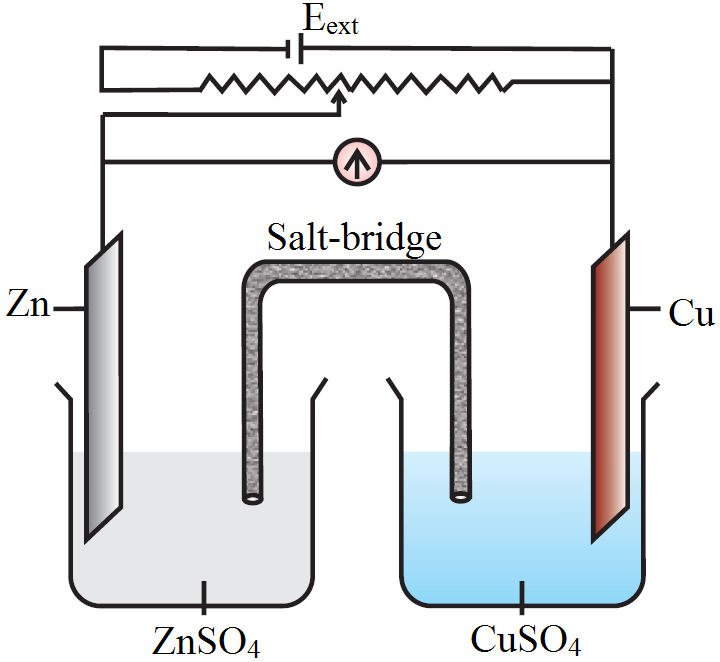
The electrochemical cell given alongside converts the chemical energy released during the redox reaction
$\text{Zn(s) + Cu}^{2+}\text{(aq)}\xrightarrow{ \ \ \ \ \ \ \ }\text{Zn}^{2+}(\text{aq) + Cu(s)}$
to electrical energy. It gives an electrical potential of $1.1V$ when concentration $Zn^{2+}$ and $Cu^{2+}$ ions is unity. State the direction of flow of current and also specify whether zinc and copper are deposited or dissolved at their respective electrodes when:
  1. An external opposite potential of less than $1.1V$ is applied.
  2. An external potential of $1.1V$ is applied.
  3. An external potential of greater than $1.1V$ is applied.
Answer
  1. Reaction continues to take place. Electrons flow from Zn electrode to copper electrode, hence current flows from Cu to Zn. Zn dissolves and copper deposits at their respective electrodes.
  2. The reaction stops and no current flows. A state of equilibrium is achieved and no change is observed at zinc and copper electrodes.
  3. Reaction takes place in opposite directions. Electrons flow from copper electrode to zinc electrode and hence current flows from Zn to Cu. Zinc deposits and copper dissolves at their respective electrodes. The cell functions as an electrolytic cell.
View full question & answer
Question 563 Marks
Given that $\Lambda^{0}_{\text{m}}(\text{HCl})=426\text{ S cm}^2\text{mol}^{-1},\Lambda^{0}_{\text{m}}(\text{NaCl})\\=126\text{ S cm}^2\text{mol}^{-1}$
$\Lambda^{0}_{\text{m}}(\text{CH}_3\text{COONa})=91\text{ S cm}^2\text{mol}^{-1}$
Answer
$\Lambda^{0}_{\text{m}}(\text{CH}_3\text{COOH})=\Lambda^{0}_{\text{CH}_3\text{COO}^-}+\Lambda^{0}_{\text{H}^+}$
$=\Lambda^{0}_{\text{CH}_3\text{COO}^-}=\Lambda^{0}_{\text{Na}^{+}}+\Lambda^{0}_{\text{H}^{+}}+\Lambda^{0}_{\text{Cl}^{-}}-\Big(\Lambda^{0}_{\text{Na}^{+}}+\Lambda^{0}_{\text{Cl}^{-}}\Big)$
$=\Lambda^{0}_{\text{m(CH}_3\text{COONa})}+\Lambda^{0}_{\text{m(HCl})}-\Lambda^{0}_{\text{m(NaCl})}$
$=(91+426+126)\text{S cm}^2\text{mol}^{-1}$
$=391\text{ S cm}^2\text{mol}^{-1}$
View full question & answer
Question 573 Marks
A zinc rod is dipped in $0.1M$ solution of $ZnSO_4$. The salt is 95% dissociated at this dilution at $298K$. Calculate the electrode potential $\Big(\text{E}^{\circ}_{\text{Zn}^{2+/\text{Zn}}}=-0.76\text{V}\Big).$
Answer
The electrode reactionwritten as reduction reaction is
$\text{Zn}^{2+}+2\text{e}^-\xrightarrow{ \ \ \ \ \ \ }\text{Zn(n = 2})$
Applying Nernst equation, we get
$\text{E}_{\text{Zn}^{2+}/\text{Zn}}=\text{E}^{\circ}_{\text{Zn}^{2+}/\text{Zn}}-\frac{0.0591}{2}\log\frac{1}{[\text{Zn}^{2+}]}$
As $0.1M$ $ZnSO_4$ solution is 95% dissociated, this means that in the solution,
$[\text{Zn}^{2+}]=\frac{95}{100}\times0.1\text{M}=0.095\text{M}$
$\text{E}_{\text{Zn}^{2+}/\text{Zn}}=-076-\frac{0.0591}{2}\log\frac{1}{0.095}$
$=-0.76-0.02955(\log1000-\log95)$
$=-0.76-0.02955(3-1.9777)$
$=-0.76-0.03021=-0.79021\text{V}$
View full question & answer
Question 583 Marks
When a current of 0.75 A is passed through a $\mathrm{CuSO}_4$ solution for $25 \mathrm{~min}, 0.369 \mathrm{~g}$ of copper is deposited at the cathode. Calculate the atomic mass of copper.
Answer
$\text{W = Z}\times\text{I}\times\text{t}$
$0.369=\frac{\text{M}}{2\times96500}\times0.75\times25\times60$ (M = molar mass of copper)
$\text{M}=63.3\text{g}/\text{mol}$
View full question & answer
Question 593 Marks
Aqueous copper sulphate solution and aqueous silver nitrate solution are electrolysed by $1$ ampere current for $10$ minutes in separate electrolytic cells. Will the mass of copper and silver deposited on the cathode be same or different? Explain your answer.
Answer
It will be different. According to Faraday’s second law, the amounts of different substances liberated by the same quantity of electricity passing through the electrolytic solution are proportional to their chemical equivalent weights, $\frac{\text{Atomic mass of metal}}{\text{No. of electrons}}$ electrons required to reduce the cation. Here, for the electrode reactions:
$\text{Cu}^{2+}+2\text{e}^{-}\xrightarrow{\ \ \ \ \ \ \ \ \ \ \ \ }\text{Cu(s)}$
$\text{Ag}^{+}+\text{e}^{-}\xrightarrow{\ \ \ \ \ \ \ \ \ \ \ \ }\text{Ag(s)}$
Hence, one mole of $Cu^{2+}$ and $Ag^{3+}$ require 2 mol of electron (2F) and 1 mol of electrons (F1) respectively.
View full question & answer
Question 603 Marks
At what pH of HCl solution will hydrogen gas electrode show electrode potential of $-0.118 V$ ? $\mathrm{H}_2$ gas is passed at $298 K$ and $1$ atm pressure.
Answer
$\text{H}^++\text{e}^-\xrightarrow{ \ \ \ \ \ \ \ \ }\frac{1}{2}\text{H}_2$
Applying Nernst equation,
$\text{E}_{\text{H}^+/\frac{1}{2}\text{H}_2}=\text{E}^{\circ}_{\text{H}^+/\frac{1}{2}\text{H}_2}-\frac{0.059}{\text{n}}\log\frac{1}{[\text{H}^+]}$
$-0.118=0-\frac{0.059}{1}\log\frac{1}{[\text{H}^+]}$
$-0.118=0.059\log[\text{H}^+]$
$-0.118=-0.059\text{pH}$
$\text{pH}=2$
View full question & answer
3 Marks Question - Page 2 - Chemistry STD 12 Science Questions - Vidyadip