MCQ 11 Mark
A compound which liberates reddish brown gas around the anode during electrolysis in its molten state is$-$
- A
- B
Copper $(II)$ oxide.
- C
Copper $(II)$ sulphate.
- ✓
Lead $(II)$ bromide.
AnswerCorrect option: D. Lead $(II)$ bromide.
We know that Bromine gas is reddish brown in colour and which can only liberates during electrolysis of Lead $(II)$ bromide $(PbBr_2)$ During electrolysis of Lead $(II)$ bromide , Positive lead ions $($cations$)$ move to the cathode and gain electrons to become lead metal and negative bromide ions $($anions$)$ move to the anode and loose an electron to make chlorine atoms. Two bromine atoms then combine and the diatomic bromine gas $(Br_2)$ is released at the anode.
View full question & answer→MCQ 21 Mark
How much charge in Faraday is required for the reduction of $1$ mole of $Ag^+$ to $Ag?$
- A
$19.29 \times 10^4C$
- ✓
$96487C$
- C
$38.59 \times 10^4C$
- D
$4824C$
AnswerCorrect option: B. $96487C$
According to the problem: Let the formula required charge $n \times F$
$n =$ difference of charge on ions
$F$ is constant $= 96487C$
Here $n = 1$
Hence required charge $= 1 \times 96487C$
$= 96487C.$
View full question & answer→MCQ 31 Mark
Negative terminal of a dry cell is formed by:
AnswerThe dry cell consists of Zinc container which acts as anode and the cathode is a carbon $($graphite$)$ rod.
View full question & answer→MCQ 41 Mark
The process used to decompose compounds using electric current is called :
AnswerThe process used to decompose compounds using electric current is called electrolysis.
View full question & answer→MCQ 51 Mark
Which of the following is not true?
- A
The electrode which pushes electrons into external circuit is known as anode
- B
The electrode which pulls electrons out of external circuit is known as cathode
- C
Weak electrolytes conduct relatively small quantity of electricity than strong electrolytes
- ✓
Effect of dilution on conductance of strong electrolyte can be explained by Arrhenius theory.
AnswerCorrect option: D. Effect of dilution on conductance of strong electrolyte can be explained by Arrhenius theory.
View full question & answer→MCQ 61 Mark
Tin cans, used for storing food are made by electroplating:
AnswerTin cans, used for storing food, are made by electroplating tin onto iron. Tin is less reactive than iron. Thus, food does not come into contact with iron and
is protected from getting spoilt.
View full question & answer→MCQ 71 Mark
In electrochemical cell, oxidation and reduction occurs at:
- ✓
Anode and cathode respectively.
- B
Cathode and anode respectively.
- C
- D
AnswerCorrect option: A. Anode and cathode respectively.
Oxidation occurs at the electrode termed the anode and reduction occurs at the electrode called the cathode. In both galvanic and electrolytic cells, oxidation takes place at the anode and electrons flow from the anode to the cathode. and reduction takes place at cathode. The anode of an electrolytic cell is positive $($cathode is negative$),$ since the anode attracts anions from the solution.
View full question & answer→MCQ 81 Mark
The presence of electrolytes $.........$ the rate of corrosion.
AnswerThe presence of electrolyte increase the concentration of electron and thus increasing the mobility of electron due to which rate of corrosion increases.
View full question & answer→MCQ 91 Mark
Which metals does not corrode easily?
AnswerIn the activity series, metals are on the top of the series react and corrode easily as these metals are highly reactive like iron corrodes easily in the presence of water and air forming its oxide layer while metals present at the bottom are least reactive and do not corrode easily like gold, silver and platinum are some of them.
View full question & answer→MCQ 101 Mark
Which of the following is true for electrolytic refining?
AnswerCorrect option: B. Pure metal is used at cathode and impure metal at anode.
Impure metal will release electron hence form anode electrode and pure metal will absorb electron hence it will be posses as cathode electrode. Pure metal is used as the cathode and impure metal as anode.
View full question & answer→MCQ 111 Mark
- ✓
Donates electrons to hydrogen ions.
- B
Accepts electrons from hydrogen ions.
- C
Donates electrons to sulphate ions.
- D
Accepts electrons from sulphate ions.
AnswerCorrect option: A. Donates electrons to hydrogen ions.
According electron configuration of copper atom, there is one electron in the outermost shell. For becoming a stable atom, the copper electrode will donate electrons to hydrogen atom.
View full question & answer→MCQ 121 Mark
The passage of electricity in the Daniell cell when $Zn$ and $Cu$ electrodes are connected:
- A
From $Cu$ to $Zn$ inside the cell.
- ✓
From $Cu$ to $Zn$ outside the cell.
- C
From $Zn$ to $Cu$ outside the cell.
- D
AnswerCorrect option: B. From $Cu$ to $Zn$ outside the cell.
View full question & answer→MCQ 131 Mark
Which of the following statements is incorrect?
- A
Conductance of an electrolytic solution increases with dilution.
- ✓
Conductance of an electrolytic solution decreases with dilution.
- C
Conductivity of an electrolytic solution decreases with dilution.
- D
Equivalent conductivity of an electrolytic solution increases with dilution.
AnswerCorrect option: B. Conductance of an electrolytic solution decreases with dilution.
View full question & answer→MCQ 141 Mark
A photo$-$cell employs photoelectric effect to convert:
- A
Change in the frequency of light into a change in electric voltage.
- ✓
Change in the intensity of illumination into a change in photoelectric current.
- C
Change in the intensity of illumination into a change in the work function of the photocathode.
- D
Change in the frequency of light into a change in the electric current.
AnswerCorrect option: B. Change in the intensity of illumination into a change in photoelectric current.
In photoelectric effect when monochromatic radiations of suitable frequency fall on the photo-sensitive plate called cathode, the photoelectrons are emitted which get accelerated towards the anode. These electrons flow in the outer circuit resulting in the photoelectric current.
Using the incident radiations of a fixed frequency, it is found that the photoelectric current increases linearly with the intensity of incident light.
View full question & answer→MCQ 151 Mark
Electrolytes which allow large current to pass through them are known as:
AnswerElectrolytes which allow large current to pass through them are known as strong electrolytes.
View full question & answer→MCQ 161 Mark
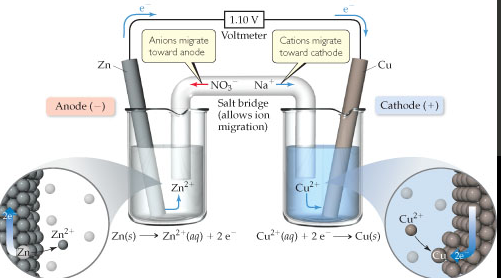
In a galvanic cell electron flow will be from:
- ✓
Negative electrode to positive electrode.
- B
Positive electrode to negative electrode.
- C
There will be no flow of electrons.
- D
Cathode to anode in the extenal circuit.
AnswerCorrect option: A. Negative electrode to positive electrode.
Electron flows opposite to the direction of current, i.e. from low to high voltage.
$\therefore$ Electron flows from negative to the positive electrode.
View full question & answer→MCQ 171 Mark
Resistivity is reciprocal of $......$ of an electrolyte.
AnswerResistivity is reciprocal of specific conductance $(k).$
View full question & answer→MCQ 181 Mark
In an electrolytic cell cathode acts as:
AnswerAt cathode reduction occurs, therefore, cathode acts as a reducing agent by supplying electrons.
View full question & answer→MCQ 191 Mark
Chemical compounds which conduct electricity in the fused or in aqueous solution state and undergo chemical decomposition due to the flow of current through it are known as:
AnswerChemical compounds which conduct electricity in the fused or in aqueous solution state and undergo chemical decomposition due to the flow of current through it are known as electrolytes. e.g $\text{NaCl}$
View full question & answer→MCQ 201 Mark
Electrolytes which allow small amount of electricity to pass through them are known as:
AnswerElectrolytes which allow small amount of electricity to pass through them are known as weak electrolytes.
View full question & answer→MCQ 211 Mark
Use the data and find out the most stable oxidised species$.\ \text{E}^\ominus_{\text{cr}_2\text{O}^{2-}_7/\text{cr}^{3+}}=1.33\text{V}\ \ \ \text{E}^\ominus_{\text{Cl}_2/\text{Cl}^-}=1.36\text{V}$ $\text{E}^\ominus_{\text{MnO}^-_4/\text{Mn}^{2+}}=1.51\text{V}\ \ \ \ \text{E}^\ominus_{\text{Cr}^{3+}/\text{Cr}}=-0.74\text{V}$
AnswerCorrect option: A. $\text{Cr}^{3+}$
$\text{Cr}^{3+}/Cr$ has most negative value of standard reduction potential. Hence, $\text{Cr}^{3+}$ is the most oxidized species.
View full question & answer→MCQ 221 Mark
Select incorrect statement:
- A
If salt$-$bridge is removed, potential falls to zero.
- B
Liquid$-$junction potential developed across the boundary of the two solutions of different concentration cells are used.
- ✓
Calomel electrode contains calcium chloride solution in contact with $Pt$ electrode.
- D
Quinhydrone electrode is reversible to $H+.$
AnswerCorrect option: C. Calomel electrode contains calcium chloride solution in contact with $Pt$ electrode.
Calomel eletrode contains calomel paste $\ce{(H_{g2}Cl_2)}$ in contact with $\ce{Hg(l)}$ and $\ce{(aq) KCl}$ solution$. Pt$ electrode is dipped to make contact.
View full question & answer→MCQ 231 Mark
The hydrogen formed by the action of zinc on sulphuric acid forms a layer of gas on the surface of copper plate in a simple voltaic cell, because of which:
- A
Internal resistance of the cell increases.
- B
Hydrogen ions are unable to reach the anode.
- C
Polarisation takes place at the anode.
- ✓
AnswerThe hydrogen formed by the action of zinc on sulphuric acid forms a layer of gas on the surface of a copper plate in a simple voltaic cell, because of which$:-$
$\rightarrow $ Internal resistance of cell increases
$\rightarrow $ Hydrogen ions are unable to reach the anode
$\rightarrow $ polarisation takes place at an anode.
View full question & answer→MCQ 241 Mark
Lead acid cell and alkalic cells are:
MCQ 251 Mark
Conductivity of an electrolytic solution depends on $......$
$a.$ Nature of electrolyte.
$b.$ Concentration of electrolyte.
$c.$ Power of $AC$ source.
$d.$ Distance between the electrodes.
- ✓
$a$ and $b$
- B
$a$ and $c$
- C
$b$ and $c$
- D
$a$ and $d$
AnswerCorrect option: A. $a$ and $b$
Conductivity or specific conductance $k\ ($kappa$).$ It is the conductance of solution kept between two electrodes with $1m^2$ area of cross section and distance of $1m.$ It is the reciprocal of resistivity $(p).$
$\text{K}=\frac{1}{\text{p}}$
$\text{S.I}$ unit of $k=\text{sm}^{-1}$
It depends on the nature of the electrolyte and concentration of the electrolyte.
View full question & answer→MCQ 261 Mark
For the given cell$, \text{Mg}|\text{Mg}^{2+}\|\text{Cu}^{2+}|\text{Cu}:$
$a. Mg$ is cathode.
$b. Cu$ is cathode.
$c.$ The cell reaction is $\text{Mg}+\text{Cu}^{2+}\xrightarrow{\ \ \ \ \ \ \ \ \ \ \ }\text{Mg}^{2+}+\text{Cu}$
$d. Cu$ is the oxidising agent.
- A
$a$ and $b$
- B
$a$ and $c$
- ✓
$b$ and $c$
- D
$a$ and $d$
AnswerCorrect option: C. $b$ and $c$
Left side of the cell represent oxidation half$-$cell and right side represent reduction half$-$cell.
View full question & answer→MCQ 271 Mark
Conductivity $k,$ is equal to $......$
$a. \frac{1}{\text{R}}\frac{1}{\text{A}}$
$b. \frac{\text{G}^*}{\text{R}}$
$c. \wedge_{\text{m}}$
$d. \frac{\text{l}}{\text{A}}$
- ✓
$a$ and $b$
- B
$a$ and $c$
- C
$b$ and $c$
- D
$a$ and $d$
AnswerCorrect option: A. $a$ and $b$
$\text{R}=\frac{\rho\text{L}}{\frac{\text{Al}}{\rho}}=\frac{1}{\text{R}}\frac{1}{\text{A}}$
Conductivity $k =$ Conductance $(G) \times $ Cell constant $(G^*)$
View full question & answer→MCQ 281 Mark
The cathode in the central compartment of Castner Kellner cell used for the manufacture of $\text{NaOH}$ is:
AnswerThe apparatus shown is divided into two types of cells separated by slate walls. The first type, shown on the right and left of the diagram, uses an electrolyte of sodium chloride solution, a graphite anode $(A),$ and a mercury cathode (M). The other type of cell, shown in the center of the diagram, uses an electrolyte of sodium hydroxide solution, a mercury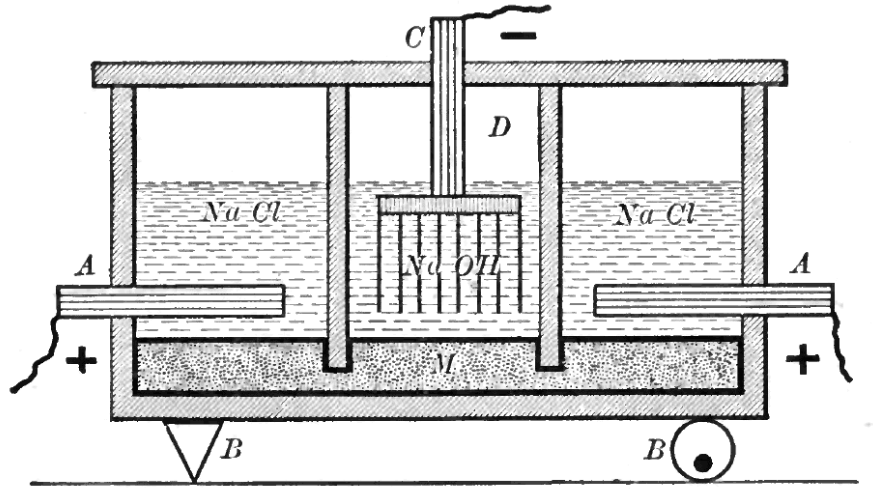
View full question & answer→MCQ 291 Mark
The $\text{EMF}$ of a galvanic cell is determined by using a:
Answer$\text{EMF}$ is measured by using a voltmeter while standard $\text{EMF}$ by a potentiometer.
View full question & answer→MCQ 301 Mark
In hydrogen evolution type of corrosion with respect to hydrogen electrode which of the following is correct ?
- ✓
The metal with more negative $\text{SRP}$ value under the given conditions.
- B
$1$ the metal with more positive $\text{SRP}$ value under the given conditions.
- C
The metal with both negative and positive $\text{SRP}$ values.
- D
AnswerCorrect option: A. The metal with more negative $\text{SRP}$ value under the given conditions.
Any metal lying below hydrogen electrode will reduce $H^+$ ions to give $H^2$ gas, while any metal lying above hydrogen will not reduce $H^+$ ions. Thus metals like $\text{Fe, Zn, Cd}$ etc lying below hydrogen with more negative $\text{SRP}$ capable of reacting with dilute acids while metals like $\text{Ag, Cu}$ etc which lie above hydrogen electrode, can not evolve hydrogen with dilute acids.
View full question & answer→MCQ 311 Mark
The electric charge for electrode deposition of $1g$ equivalent of a substance is:
AnswerCorrect option: D. charge on $1$ mole of electrons.
Charge on one mole of electrons is equal to one Faraday, so one gram equivalent of a substance will be deposited by one mole of electrons$. 1g$ equivalent of a substance means one equivalent of substance which have total charge of one mole of electron.
View full question & answer→MCQ 321 Mark
Which of the following statement is not correct about an inert electrode in a cell?
- A
It does not participate in the cell reaction.
- B
It provides surface either for oxidation or for reduction reaction.
- C
It provides surface for conduction of electrons.
- ✓
It provides surface for redox reaction.
AnswerCorrect option: D. It provides surface for redox reaction.
Inert electrode does not participate in redox reaction and acts only as source or sink for electrons. It provides surface either for oxidation or for reduction reaction.
View full question & answer→MCQ 331 Mark
$\wedge^{{\circ}}_\text{m}\text{H}_2\text{O}$ is equal to $.......$
$a. \wedge^{{\circ}}_{\text{m}(\text{HCl})}+\wedge^{{\circ}}_{\text{m}(\text{NaOH})}-\wedge^{{\circ}}_{\text{m}(\text{NaCl})}$
$b. \wedge^{{\circ}}_{\text{m}(\text{HNO}_3)}+\wedge^{{\circ}}_{\text{m}(\text{NaNO}_3)}-\wedge^{{\circ}}_{\text{m}(\text{NaOH})}$
$c. \wedge^{{\circ}}_{\text{(HNO}_3)}+\wedge^{{\circ}}_{\text{m}(\text{NaOH})}-\wedge^{{\circ}}_{\text{m}(\text{NaNO}_3)}$
$d. \wedge^{{\circ}}_{\text{m}(\text{NH}_4\text{OH})}+\wedge^{{\circ}}_{\text{m}(\text{HCl})}-\wedge^{{\circ}}_{\text{m}(\text{NH}_4\text{Cl})}$
- A
$a$ and $b$
- B
$b$ and $c$
- ✓
$a$ and $c$
- D
$a$ and $d$
AnswerCorrect option: C. $a$ and $c$
$\wedge^{{\circ}}_{\text{m}(\text{H}_2\text{O)}}=\wedge^{{\circ}}_{\text{m}(\text{HCl})}+\wedge^{{\circ}}_{\text{m}(\text{NaOH})}-\wedge^{{\circ}}_{\text{m}(\text{NaCl})}$
$\wedge^{{\circ}}_{\text{m}(\text{H}^+)}+\wedge^{{\circ}}_{\text{m}(\text{OH}^-)}=\wedge^{{\circ}}_{\text{m}(\text{H}^+)}+\wedge^{{\circ}}_{\text{m}(\text{cl}^-)}+\wedge^{{\circ}}_{\text{m}(\text{Na}^+)}+\wedge^{{\circ}}_{\text{m}(\text{OH}^-)}-\wedge^{{\circ}}_{\text{m}(\text{Na}^+)}-\wedge^{{\circ}}_{\text{m}(\text{cl}^-)}$
$\wedge^{{\circ}}_{\text{m}(\text{HNO}_3)}+\wedge^{{\circ}}_{\text{m}(\text{NaOH})}-\wedge^{{\circ}}_{\text{m}(\text{NaNO}_3)}=\wedge^{{\circ}}_{\text{m}(\text{H}_2\text{O})}$
$\wedge^{{\circ}}_{\text{m}(\text{H}^+)}+\wedge^{{\circ}}_{\text{m}(\text{NO}^-_3)}+\wedge^{{\circ}}_{\text{m}(\text{Na}^+)}+\wedge^{{\circ}}_{\text{m}(0\text{H}^-)}-\wedge^{{\circ}}_{\text{m}(\text{Na}^+)}-\wedge^{{\circ}}_{\text{m}(\text{NO}^-_3)}=\wedge^{{\circ}}_{\text{m}(\text{H}^+)}+\wedge^{{\circ}}_{\text{m}(\text{OH}^-)}$
$\wedge^{{\circ}}_{\text{m}(\text{NH}_4\text{OH})}+\wedge^{{\circ}}_{\text{m}(\text{HCl})}-\wedge^{{\circ}}_{\text{m}(\text{NH}_4\text{Cl})}=\wedge^{{\circ}}_{\text{m}(\text{H}_2\text{0})}$
However, the sum of molar conductivities of constituent ions gives the molar conductivity of water but here $\ce{NH_4OH}$ is a weak electrolyte of which complete decomposition is not possible.
View full question & answer→MCQ 341 Mark
$1$ In electro$-$chemical corrosion of metals, the metal undergoing corrosion:
AnswerDuring corrosion, the oxidation of metal to metal ions occur. Hence the metal undergoing corrosion acts as anode.
View full question & answer→MCQ 351 Mark
An electrochemical cell can behave like an electrolytic cell when $.......$
- A
$\text{E}_{\text{Cell}}=0$
- B
$\text{E}_{\text{Cell}}>\text{E}_{\text{ext}}$
- ✓
$\text{E}_\text{ext}>\text{E}_{\text{Cell}}$
- D
$\text{E}_{\text{Cell}}=\text{E}_{\text{ext}}$
AnswerCorrect option: C. $\text{E}_\text{ext}>\text{E}_{\text{Cell}}$
If an external opposite potential is applied on the galvanic cell and increased reaction continues to take place till the opposing voltage reaches the value $1.1V.$
At this stage no current flow through the cell and if there is any further increase in the external potential then reaction starts functioning in opposite direction.
Hence, this works as an electrolytic cell.
View full question & answer→MCQ 361 Mark
Internal resistance of a battery cell increases with:
- A
Increase in concentration of electrolyte.
- ✓
Increase in distance between two electrodes.
- C
Increase in area of the plates inside the electrolyte.
- D
Increase in size of the electrodes.
AnswerCorrect option: B. Increase in distance between two electrodes.
Internal resistance of a battery cell:
- increases with increase in distance between two electrodes.
- decreases with increase in concentration of electrolyte.
- decreases with increase in area of the plate inside the electrolyte.
- decreases with increase in size of the electrodes.
View full question & answer→MCQ 371 Mark
Rusting of iron is a chemical reaction. The reaction can be termed as:
- A
- B
- ✓
Both $(A)$ and $(B).$
- D
AnswerCorrect option: C. Both $(A)$ and $(B).$
Rusting of iron is a combination reaction. It occurs as follows$-$
$\mathrm{Fe}+\mathrm{H}_2 \mathrm{O}+\mathrm{O}_2 \rightarrow \mathrm{Fe}_2 \mathrm{O}_3 \times \mathrm{H}_2 \mathrm{O}$
View full question & answer→MCQ 381 Mark
The weights of various ions liberated by passing the same current through different electrolytes are in the ratio of their:
AnswerThe weights of various ions liberated by passing the same current through different electrolytes are in the ratio of their Equivalent weights.
View full question & answer→MCQ 391 Mark
A metal is released in the electrolysis of a salt. It gets deposited on the :
- A
- B
Half of positive terminal and half of negative terminal.
- ✓
- D
AnswerThe metal which is released in the electrolysis is of simple salt, so it would generally be deposited on the cathode.
For example, suppose we take sodium chloride $\text{(NaCl)}$ then on breaking this into simpler form we get,
$\mathrm{NaCl} \rightarrow \mathrm{Na}^{+}+\mathrm{Cl}^{-}$
This can be said that as $Na$ acquires positive charge, it shall move to negative electrode $($or negative terminal$)$ i.e. cathode.
View full question & answer→MCQ 401 Mark
One Faraday is equal to $.......$
- A
$69500$ coulombs
- B
$91500$ coulombs
- C
$91400$ coulombs
- ✓
$96500$ coulombs
AnswerCorrect option: D. $96500$ coulombs
The Faraday constant $($named after Michael Faraday$)$ is the magnitude of electric charge per mole of electrons. It is equal to $96500$ coulombs.
View full question & answer→MCQ 411 Mark
When copper rod donates electrons to hydrogen ions, it gains $..........$ charge.
AnswerWe know that when an atom donates electrons, the atom becomes positive charge and when the atom receives the electrons, it becomes negative charge.
View full question & answer→MCQ 421 Mark
The electric charge for electrode deposition of $1g$ equivalent of a substance is:
AnswerCorrect option: D. The charge on one mole of electrons.
The quantity of electricity required to deposit or librate $1g$ equivalent of any substance by the passage of electric current.
It is equal to the charge present on $1\ mol$ of electrons. One faraday is equivalent to $96500 C.$
View full question & answer→MCQ 431 Mark
Maintenance$-$free batteries, now in use, in place of common batteries, have:
- A
Electrodes made of lead$-$lead oxide.
- ✓
Electrodes made of calcium$-$containing lead alloy.
- C
Non$-$aqueous solvents as medium.
- D
AnswerCorrect option: B. Electrodes made of calcium$-$containing lead alloy.
Calcium$-$tin$-$lead alloys are used for making grids for maintenance$-$free batteries. The calcium content in such alloys for positive grids has varied generally from about $0.06$ to about $0.1\%$ by weight of the alloy while the tin has generally ranged from about $0.1$ up to $0.8\%$ and even more. More typically, the calcium content in such alloys when used for making maintenance$-$free battery grids has been at least about $0.08\%$ by weight or more.
View full question & answer→MCQ 441 Mark
The process of breaking down of a compound by passing electric current through it is called:
AnswerElectrolysis is chemical decomposition produced by passing electric current through a liquid or solution containing ions.
View full question & answer→MCQ 451 Mark
The factors that promote electro chemical corrosion are $.......$
AnswerPure metals are resistive to corrosion. If there are impurities in a metal, a local galvanic cell is created with the metal as an anode and the impurity as a cathode. The result is the corrosion of the metal. And in the presence of a high concentration of oxygen, corrosion will be faster. Also when the conductivity of solutions is higher, the corrosion will be faster.
View full question & answer→MCQ 461 Mark
An example of secondary battery cell is:
AnswerVoltiac cell, daniel cell, Lachanche cell, Bunsen cell, fuel are some well known example of primary battery cells. Whereas, lead acid cell and edison alkaline cell are two well known example of secondary cells.
View full question & answer→MCQ 471 Mark
- ✓
Positively charged electrode.
- B
Negatively charged electrode.
- C
Wire used to connect the electrodes.
- D
Electrolyte which conducts electricity.
AnswerCorrect option: A. Positively charged electrode.
An Anode is a positively charged electrode through which conventional current flows in a circuit.
View full question & answer→MCQ 481 Mark
In the electrolysis of aqueous sodium chloride solution which of the half cell reaction will occur at anode?
$a. \text{Na}^+(\text{aq})+\text{e}^-\xrightarrow{\ \ \ \ \ \ \ \ \ \ \ \ \ \ \ \ }\text{Na}(\text{s});\ \ \ \ \text{E}^{\ominus}_{\text{Cell}}=-2.71\text{V}$
$b. 2\text{H}_2\text{O}(\text{l})\xrightarrow{\ \ \ \ \ \ \ \ \ \ \ \ \ \ \ \ }\text{O}_2(\text{g})+4\text{H}^+(\text{aq})+4\text{e}^{-};\ \ \ \ \text{E}^{\ominus}_{\text{Cell}}=1.23\text{V}$
$c. \text{H}^+(\text{aq})+\text{e}^-\xrightarrow{\ \ \ \ \ \ \ \ \ \ \ \ \ \ \ \ }\frac{1}{2}\text{H}_2(\text{g});\ \ \ \ \text{E}^{\ominus}_{\text{Cell}}=0.00\text{V}$
$d. \text{Cl}^-(\text{aq})\xrightarrow{\ \ \ \ \ \ \ \ \ \ \ \ \ \ \ \ }\frac{1}{2}\text{Cl}_2(\text{g})+\text{e}^-;\ \ \ \ \text{E}^{\ominus}_{\text{Cell}}=1.36\text{V}$
- A
$a$ and $b$
- B
$a$ and $c$
- C
$b$ and $c$
- ✓
$b$ and $d$
AnswerCorrect option: D. $b$ and $d$
At the anode, the following oxidation reactions are possible.
$\text{Cl}^-\xrightarrow{\ \ \ \ \ \ \ \ \ \ \ \ \ \ \ \ }\frac{1}{2}\text{Cl}_2(\text{g})+\text{e}^-;\ \ \ \ \text{E}^{\ominus}_{\text{Cell}}=1.36\text{V}$
$2\text{H}_2\text{O}\xrightarrow{\ \ \ \ \ \ \ \ \ \ \ \ \ \ \ \ }\text{O}_2+4\text{H}^++4\text{e}^{-};\ \ \ \ \text{E}^{\ominus}_{\text{Cell}}=1.23\text{V}$
lower value of $E^0$ is preferred and therefore, water should get oxidised in preference to $Cl^-(aq).$ However, on account of overpotential of oxygen,
reaction $\text{Cl}^-\xrightarrow{\ \ \ \ \ \ \ \ \ \ \ \ \ }\frac{1}{2}\text{Cl}_2+\text{e}^-$ is preferred.
View full question & answer→MCQ 491 Mark
The difference between the electrode potentials of two electrodes when no current is drawn through the cell is called $.......$
Answer$\text{EMF}$ is the difference between the electrode potentials of two electrodes. when no current is drawn through the cell.
View full question & answer→MCQ 501 Mark
Molar conductivity of ionic solution depends on $........$
$a.$ Temperature.
$b.$ Distance between electrodes.
$c.$ Concentration of electrolytes in solution.
$d.$ Surface area of electrodes.
- A
$a$ and $b$
- B
$b$ and $c$
- ✓
$a$ and $c$
- D
$b$ and $d$
AnswerCorrect option: C. $a$ and $c$
Molar conductivity of ionic solution depends on temperature and concentration of electrolytes in solution.
View full question & answer→