Questions

5 Marks Questions

🎯

Test yourself on this topic

5 questions · timed · auto-graded

Question 15 Marks
$i.$ Tert$-$Butylamine cannot be prepared by the action of $NH_3$ on tert$-$butyl bromic. Explain why?
$ii.$ Suggest a convenient method for the preparation of tert$-$butylamine.
Answer
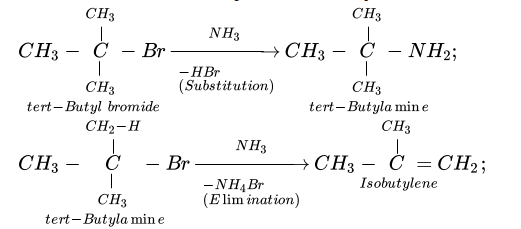
$i.$ Tert$-$Butyl bromide being a $3^\circ$ alkyl halide on treatment with a base $(i.e., NH_3)$ prefers to undergo elimination rather than substitution. Therefore, the product is isobutylene rather than tert$-$butylamine.
Image
$ii. 1^\circ$ amines containing tert$-$alkyl groups can be prepared by action of suitable Grignard reagents and $o-$methylhydroxylamine For example,

Image
View full question & answer
Question 25 Marks
State the reactions and reaction conditions for the following conversions:
i. Benzene diazonium chloride to nitrobenzene.
ii. Aniline to benzene diazonium chloride.
iii. Ethylamine to methylamine.
View full question & answer
Question 35 Marks
$FeSO_4$ solution mixed with $\left( NH _4\right)_2 SO _4$ solution in $1:1$ molar ratio gives the test of $Fe ^{2+}$ ion but $CuSO _4$ solution mixed with aqueous ammonia in $1: 4$ molar ratio does not give the test of $Cu ^{2+}$ ion. Explain why?
Answer
$\left( NH _4\right)_2 SO _4+ FeSO _4+6 H _2 O \rightarrow FeSO _4 \cdot\left( NH _4\right)_2 SO _4 \cdot 6 H _2 O$ (Mohr's Salt) $CuSO _4+4 NH _3+5 H _2 O \rightarrow\left[ Cu \left( NH _3\right)_4\right] SO _4 \cdot 5 H _2 O$ (tetramminocopper$(ii)$ sulphate)
Both the compounds i.e., $FeSO _4 \cdot\left( NH _4\right)_2 SO _4 \cdot 6 H _2 O$ and $\left[ Cu \left( NH _3\right)_4\right] SO _4 \cdot 5 H _2 O$ fall under the category of addition compounds with only one major difference i.e., the former is an example of a double salt, while the latter is a coordination compound. A double salt is an addition compound that is stable in the solid state but that which breaks up into its constituent ions in the dissolved state. These compounds exhibit individual properties of their constituents. For e.g. $FeSO _4 \cdot\left( NH _4\right)_2 SO _4 \cdot 6 H _2 O$ breaks into $Fe ^{2+}$, $NH ^{4+}$ and $SO _4{ }^{2-}$ ions. Hence, it gives a positive test for $Fe ^{2+}$ ions.A coordination compound is an addition compound which retains its identity in the solid as well as in the dissolved state. However, the individual properties of the constituents are lost. This happens because $\left[ Cu \left( NH _3\right)_4\right] SO _4 .5 H _2 O$ does not show the test for $Cu ^{2+}$. The ions present in the solution of $\left[ Cu \left( NH _3\right)_4\right] SO _4 \cdot 5 H _2 O$ are $\left[ Cu \left( NH _3\right)_4\right]^{2+}$ and $SO _4{ }^{2-}$.
View full question & answer
Question 45 Marks
a. Amongst the following, the most stable complex is:
i. $\left[ Fe \left( H _2 O \right)_6\right]^{3+}$
ii. $\left[ Fe \left( NH _3\right)_6\right]^{3+}$
iii. $\left[ Fe \left( C _2 O _4\right)_3\right]^{3-}$
iv. $\left[ FeCl _6\right]^{3+}$
b. What will be the correct order for the wavelength of absorption in the visible region for the following:
$
\left[Ni\left(NO_2\right)_6\right]^{4-},\left[Ni\left(NH_3\right)_6\right]^{2+},\left[Ni\left(H_2 O\right)_6\right]^{2+}
$
Answer
a. Complexes containing didentate or polydentate ligands are more stable than those containing monodentate ligands. In each of the given complex, Fe is in +3 state. As $C _2 O _4{ }^{2-}$ is didentate chelating ligand, hence is the most stable complex.b. As metal ion is fixed, the wavelength of absorption will decided by the field strengths (CFSE values) of the ligands. From the spectrochemical series, the order of CFSE is: $H _2 O < NH _3< NO _2$
Thus, the energies absorbed for excitation will be in the order:
$
\left[Ni\left(NH_3\right)_6\right]^{2+}<\left[Ni\left(H_2 O\right)_6\right]^{2+}<\left[Ni\left(NO_2\right)_6\right]^{4-}
$
As wavelength and energy are inversely related. The wavelengths absorbed will be in the opposite order:
$
\left[Ni\left(NH_3\right)_6\right]^{2+}>\left[Ni\left(H_2 O\right)_6\right]^{2+}>\left[Ni\left(NO_2\right)_6\right]^{4-}
$
View full question & answer
Question 55 Marks
Attempt any five of the following:
(a) Which sugar is present in milk?
(b) Why must vitamin C be supplied regularly in diet?
(c) What type of substance is phenylanine hydroxylate? Write its importance.
(d) Define denaturation of protein. What is the effect of denaturation on the structure of protein?
(e) Name the linkage connecting monosaccharide units in polysaccharides.
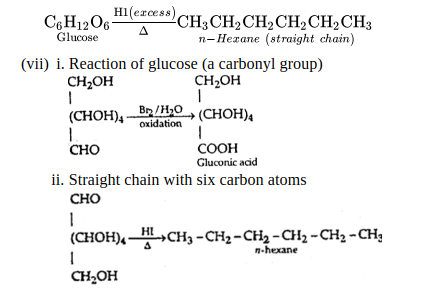
(f) How do you explain the presence of all six carbon atoms in glucose in a straight chain?
(g) Write the reactions showing the presence of following in the open structure of glucose:
i. a carbonyl group
ii. chain with six carbon atoms
Answer
Attempt any five of the following:
(i) Lactose is the type of sugar that occurs naturally in milk. It is found in the milk of animals such as cows and goats, as well as human breast milk.
(ii) Vitamin 'C' is water soluble vitamin and hence excess of it is readily excreted in the urine so, it cannot be stored in our body and hence, it should be regularly supplied in the diet.
(iii)It is an enzyme whose deficiency causes mental redardation.
(iv)When a protein is subjected to a change in temperature or chemical change then it loses its biological activity.2º and 3º structures are destroyed but 1º structure remains intact.
(v) The monosaccharide units are linked through the glycosidic linkage in the polysaccharide.
(vi)Glucose on prolonged heating with HI and red phosphorus gives n-hexane HI (excess) suggest that all six carbon atom are in straight chain.
Image
View full question & answer
5 Marks Questions - Chemistry STD 12 Science Questions - Vidyadip