Questions

M.C.Q (1 Marks)

🎯

Test yourself on this topic

12 questions · timed · auto-graded

MCQ 11 Mark
Which of the following compound gives an oxime with hydroxylamine:
  • $\ce{CH_3COCH_3}$
  • B
    $\ce{CH_3COCH}$
  • C
    $\ce{(CH_3CO)_2O}$
  • D
    $\ce{CH_3COCI}$
Answer
Correct option: A.
$\ce{CH_3COCH_3}$
Aldehyde and ketones give nucleophilic addition reactions. Other carbonyl compounds do not give nucleophilic addition reactions
View full question & answer
MCQ 21 Mark
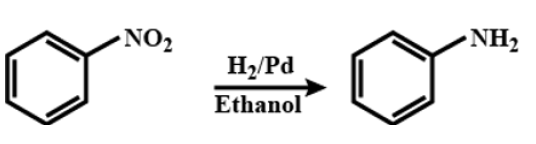
A student was preparing aniline in the lab. She took a compound "X" and reduced it in the presence of Ni as a catalyst. What could be the compound "X"
  • Nitrobenzene
  • B
    1-Nitrohexane
  • C
    Benzonitrile
  • D
    1-Hexanenitrile
Answer
Correct option: A.
Nitrobenzene
(a) Nitrobenzene
Image
View full question & answer
MCQ 31 Mark
A first$-$order reaction is found to have a rate constant, $k = 5.5 \times 10^{-1}4s^{-1}.$ The time taken for completion of the reaction is:
  • A
    $1.26 \times 10^{13} s$
  • B
    $2.52 \times 10^{13} s$
  • C
    $0.63 \times 10^{13} s$
  • It never goes to completion
Answer
Correct option: D.
It never goes to completion
First order reaction $[R] = [Ro] e^{-kt}$ If $[R]=0$ then
$e^{- kt} = 0$ which is not possible for any finite value of $t.$
Here, $t$ is $\infty $.
View full question & answer
MCQ 41 Mark
Which one of the following sets correctly represents the increase in the paramagnetic property of the ions?
  • A
    $\mathrm{Ti}^{3+}<\mathrm{Fe}^{2+}<\mathrm{Cr}^{3+}<\mathrm{Mn}^{2+}$
  • B
    $\mathrm{Ti}^{3+}<\mathrm{Mn}^{2+}<\mathrm{Fe}^{2+}<\mathrm{Cr}^{3+}$
  • C
    $\mathrm{Mn}^{2+}<\mathrm{Fe}^{2+}<\mathrm{Cr}^{3+}<\mathrm{Ti}^{3+}$
  • $\mathrm{Ti}^{3+}<\mathrm{Cr}^{3+}<\mathrm{Fe}^{2+}<\mathrm{Mn}^{2+}$
Answer
Correct option: D.
$\mathrm{Ti}^{3+}<\mathrm{Cr}^{3+}<\mathrm{Fe}^{2+}<\mathrm{Mn}^{2+}$
No. of unpaired electrons $Ti^{3+}(1), Cr^{3+}(3), Fe^{2+ }(4)$ and $Mn^{2+} (5)$ Paramagnetism depends on the number of unpaired electrons
View full question & answer
MCQ 51 Mark
Which of the following contains only ẞ-D- glucose as its monosaccharide unit:
  • A
    Sucrose
  • Cellulose
  • C
    Starch
  • D
    Maltose
Answer
Correct option: B.
Cellulose
(b) Cellulose
Starch contains only a glucose, sucrose contains α-D-glucose and ß-D-fructose glucose, maltose contains α-D-glucose and cellulose is a polymer of ß-D-glucose.
View full question & answer
MCQ 61 Mark
  • A
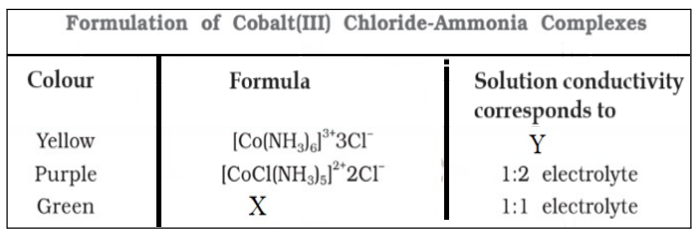
    $X=\left[\mathrm{Co}\left(\mathrm{NH}_3\right)_6\right]^{2+} 3 \mathrm{Cl}^{-}, \mathrm{Y}=1: 3$
  • $X=\left[\mathrm{Co}\left(\mathrm{NH}_3\right)_4 \mathrm{Cl}_2\right]^{+} \mathrm{Cl},-\mathrm{Y}=1: 3$
  • C
    $X=\left[\mathrm{Co}\left(\mathrm{NH}_3\right)_4 \mathrm{Cl}_2\right]^{+} \mathrm{Cl}^{-}, \mathrm{Y}=1: 1$
  • D
    $X=\left[\mathrm{Co}\left(\mathrm{NH}_3\right)_4 \mathrm{Cl}_2\right]^{3+} 3 \mathrm{Cl}^{-}, \mathrm{Y}=1: 1$
Answer
Correct option: B.
$X=\left[\mathrm{Co}\left(\mathrm{NH}_3\right)_4 \mathrm{Cl}_2\right]^{+} \mathrm{Cl},-\mathrm{Y}=1: 3$
(b) $\mathrm{X}=\left[\mathrm{Co}\left(\mathrm{NH}_3\right)_4 \mathrm{Cl}_2\right]^{+} \mathrm{Cl}^{-}, \quad \mathrm{Y}=1: 3$
View full question & answer
MCQ 71 Mark
When $\ce{C_6H_5COOCOCH_2}$ is treated with $\ce{H_2O}$, the product obtained is:
  • A
    Benzoic acid and ethanol
  • Benzoic acid and ethanoic acid
  • C
    Acetic Acid and phenol
  • D
    Benzoic anhydride and methanol
Answer
Correct option: B.
Benzoic acid and ethanoic acid
$\ce{C_6H_5COOCOCH_3H_2OC_6H_5COOH + CH_3COOH}$
View full question & answer
MCQ 81 Mark
The initial concentration of $R$ in the reaction $R\rightarrow P$ is $4.62 \times 10^{-2} \ce{mol / L}$ What is the half life for the reaction if $k = 2.31 \times 10^{-2} \ce{mol L ^{-1}S^{-1}}$
  • A
    $30 s$
  • B
    $3 s$
  • C
    $1 s$
  • $10 s$
Answer
Correct option: D.
$10 s$
the order of reaction is zero as the unit of $k$ is $\ce{mol L}^{-1}s^{-1}.$
Thus half life $= [R]^\circ / 2k = 4.62 \times 10^{-2}/2 \times 2.31 \times 10^{-2}$
View full question & answer
MCQ 91 Mark
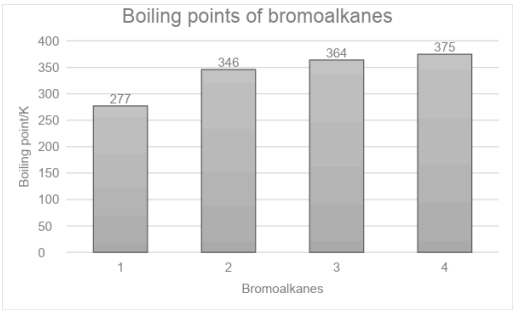
Study the graph showing the boiling points of bromoalkanes and identify the compounds.

Image
  • A
    1 = Bromomethane, 2= 2-Bromobutane, 3= 1-Bromobutane, 4= 2-Bromo-2-methylpropane
  • B
    1=1-Bromobutane, 2= 2-Bromo-2-methylpropane, 3= 2-Bromobutane, 4= Bromomethane
  • C
    1 = Bromomethane, 2=1-Bromobutane, 3= 2-Bromo-2-methylpropane, 4= 2-Bromobutane,
  • 1 =Bromomethane, 2= 2-Bromo-2-methylpropane, 3-2- Bromobutane, 4= 1-Bromobutane
Answer
Correct option: D.
1 =Bromomethane, 2= 2-Bromo-2-methylpropane, 3-2- Bromobutane, 4= 1-Bromobutane
(d) 1 =Bromomethane, 2= 2-Bromo-2-methylpropane, 3=2- Bromobutane, 4= 1-Bromobutane
View full question & answer
MCQ 101 Mark
Match the properties given in column $I$ with the metals in column $II$
Column $I$ Column $II$
$(1)$ Actinoid having configuration $(RN)5f^76d^17s^2 $ $(A) \ Ce$
$(2)$ Lanthanoid which has $4f^{14}$ electronic confi guration in $+3$ oxidation state. $(B) \ Lu$
$(3)$ Lanthanoid which show $+4$ Oxidation state $(C) \ Cm$
  • $(1)-(C), (2)-(B), (3)-(A)$
  • B
    $(1)-(C), (2)-(A), (3)-(B)$
  • C
    $(1)-(A), (2)-(B), (3)-(C)$
  • D
    $(1)-(B), (2)-(A), (3)-(C)$
Answer
Correct option: A.
$(1)-(C), (2)-(B), (3)-(A)$
View full question & answer
MCQ 111 Mark
Which one of the following has the highest dipole moment?
  • A
    $\mathrm{CH}_3 \mathrm{~F}$
  • $\mathrm{CH}_3 \mathrm{Cl}$
  • C
    $\mathrm{CH}_3 \mathrm{I}$
  • D
    $\mathrm{CH}_3 \mathrm{Br}$
Answer
Correct option: B.
$\mathrm{CH}_3 \mathrm{Cl}$
(b)CH3Cl
The order followed is this CH3I<CH3Br<CH3F< CH3Cl, though F is most electronegative, the bond length is small as compared to C-Cl. Dipole moment is the product of the charge and the bond length.
View full question & answer
MCQ 121 Mark
Ammonolysis of ethyl chloride followed by reaction of the amine so formed with 1 mole of methyl chloride gives an amine that
  • A
    reacts with Hinsberg reagent to form a product soluble in an alkali.
  • B
    on reaction with Nitrous acid, produced nitrogen gas.
  • reacts with Benzenesulphonyl chloride to form a product that is insoluble in alkali.
  • D
    does not react with Hinsberg reagent.
Answer
Correct option: C.
reacts with Benzenesulphonyl chloride to form a product that is insoluble in alkali.
(c) reacts with Benzenesulphonyl chloride to form a product that is insoluble in alkali
View full question & answer
M.C.Q (1 Marks) - Chemistry STD 12 Science Questions - Vidyadip