Questions

3 Marks Question

Take a timed test

7 questions · self-marked practice — reveal the answer and mark yourself.

Question 13 Marks
Determine the value of equilibrium constant $(Kc)$ and $\Delta G^\theta$ for the following reaction. $\ce{N i(s) + 2 A g^{+}(aq) \rightarrow N i^{2+}(aq) + 2Ag(s)}$
$E^\theta=1.05 V\left(1 F=96500 C mol^{-1}\right)$
Answer
We have,
$\ce{N i(s) + 2Ag^{+}(aq) \rightarrow N i^{2+}(aq) + 2 Ag(s)}$
For the reaction $n =2, E_{\text {cell }}^\theta=1.05 V$
$\Delta G^\theta=-n F E^\theta$
$\Delta G^\theta=-2 \times 96500 C \times 1.05 V$
$\Delta G^\theta=-202.65 kJ mol^{-1}$
For Equilibrium constant, we have,
$\Delta G^\theta=-2.303 R T \log K_c$
$\log K_c=-\frac{\Delta G^{\Theta}}{2.303 R T}$
$=-\frac{20250}{2.303 \times 8.314 \times 298}$
$K_c=\operatorname{Antilog}(35.5161)$
$K_c=3.284 \times 10^{35}$
View full question & answer
Question 23 Marks
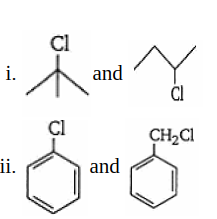
In each of the following pairs of compounds, identify the compound which will undergo $S_N1$ reaction faster.
Image
Answer
$i.$ Since $3^\circ$ carbocations are more stable than $2^\circ$ carbon cations therefore Image will react faster.
$ii.$ Benzyl chloride readily forms benzyl cation which is stabilized by resonance. Thus, benzyl chloride undergoes $S_N1$ reaction faster than chlorobenzene.
View full question & answer
Question 33 Marks
When a steady current of $2A$ was passed through two electrolytic cells $A$ and $B$ containing electrolytes $ZnSO_4$ and $CuSO_4$ connected in series, $2g$ of $Cu$ were deposited at the cathode of cell $B.$ How long did the current flow? What mass of $Zn$ was deposited at cathode of cell $A$?
$[$Atomic mass: $Cu = 63.5 \ g \ mol^{-1}, Zn = 65 \ g \ mol^{-1}; 1F = 96500 \ C \ mol^{-1}]$
Answer
Steady current $= 2A$
copper deposited at cathode of cell $B = 2g$
Cell $B$ contains $CuSO_4$ and reaction may be represented as,
$CuSO _4 \rightarrow Cu ^{2+}+ SO _4^{2-}$
The reaction happens at cathode as,
$Cu^{2+} + 2e^- \rightarrow Cu$
So, $1 \ mol  \ Cu$ deposited by $2F$ charge
$63.5 g \ Cu\rightarrow 2 \times 96500$
$2g \ Cu \rightarrow x$
$x =\frac{2 \times 2 \times 96500}{63.5}=6078.74 C$
we know formula
$Q = It$
$6078.74=2 \times t$
$t =\frac{6078.74}{2}=3039.37 \ Sec$
From faraday's second law of electrolysis,
$\frac{\omega t \text { of } C u}{\omega t \text { of } Z n}=\frac{E q \omega t C u}{E q \cdot \omega t Z n}$
$\frac{2}{x}=\frac{63.5 / 2}{65 / 2}$
$x=\frac{2}{0.9769}=2.047 g$
weight of $Zn$ deposited $= 2.047 g$
View full question & answer
Question 43 Marks
An aromatic compound $A \ ($Molecular formula $C_8H_8O)$ gives positive $2, 4-\text{DNP}$ test. It gives a yellow precipitate of compound $B$ on treatment with iodine and sodium hydroxide solution. Compound $A$ does not give Tollen's or Fehling's test. On drastic oxidation with potassium permanganate it forms a carboxylic acid $C ($Molecular formula $C_7H_6O_2),$ which is also formed along with the yellow compound in the above reaction. Identify $A, B$ and $C$ and write all the reactions involved.
Answer
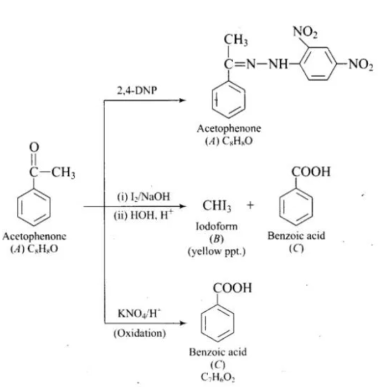
The molecular formula of the compound is $C_8H_8O.$ As A does not give Tollens or Fehling's test. It must be a ketone. It gives a positive test with $2, 4-\text{DNP,}$ and iodoform test. It means it is methyl ketone. $B$ is iodoform and $C$ is benzoic acid.
Image
View full question & answer
Question 53 Marks
Write the structures of the major products expected from the following reactions:
$a.$ Mononitration of $3-$methylphenol
$b.$ Dinitration of $3-$methylphenol
$c.$ Mononitration of phenyl methanoate
Answer
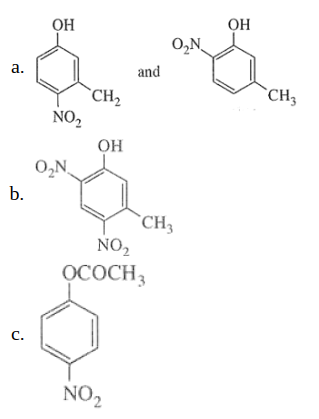
The combined influence of $-OH$ and $-CH_3$ groups determine the position of the incoming group. Keeping in view that both $-OH$ and $-CH_3$ are $o-$ and $p-$directing groups, the following products are obtained:
Image
View full question & answer
Question 63 Marks
The rate constant for a first order reaction is $60s^{-1}.$ How much time will it take to reduce the concentration of the reactant $\frac{1}{10}th$ its initial value?
Answer
Given, $k=60 s^{-1},[R]_o=100 M$ and $[R]=100 M \times \frac{1}{10}=10 M$
$t=\frac{2.303}{k} \log \frac{[R]_0}{[R]}=\frac{2.303}{k} \log \left[\frac{100}{10}\right]$
$t=\frac{2.303}{60} \log 10=0.0384 s$
View full question & answer
3 Marks Question - Chemistry STD 12 Science Questions - Vidyadip