Questions

M.C.Q (1 Marks)

🎯

Test yourself on this topic

12 questions · timed · auto-graded

MCQ 11 Mark
Give IUPAC name of the compound given below.
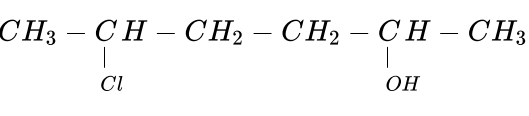
Image
  • A
    2-Chloro-5-hydroxyhexane
  • B
    5-Chlorohexan - 2 - ol
  • C
    2-Hydroxy-5-chlorohexane
  • 2-Chlorohexan - 5 - ol
Answer
Correct option: D.
2-Chlorohexan - 5 - ol
(d) II < I < III
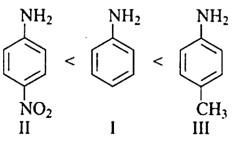
Image
Electron withdrawing group decreases the basic strength of aniline while electron releasing groups increases the basic strength of aniline.

View full question & answer
MCQ 21 Mark
The correct increasing order of basic strength for the following compounds is __________ .
Image
  • A
    III < I < II
  • III < II < I
  • C
    II < III < I
  • D
    II < I < III
Answer
Correct option: B.
III < II < I
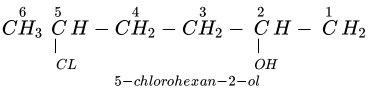
(b) 5-Chlorohexan - 2 - ol
Image
-OH is given preference over -Cl so numbering is done so that -OH gets the lowest number.
View full question & answer
MCQ 31 Mark
How to do the following conversion: $RCOOCI + ? \rightarrow RCHO$
  • A
    Using $H_2-Pd, BaSO_4$
  • B
    Using $ \text{DIBAL-H}$
  • C
    Using $H_2 - Pd$
  • D
    Using $NaBH_4$
Answer
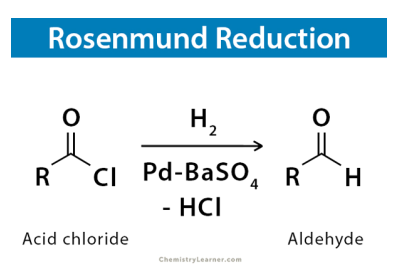
Catalytic hydrogenation of acid chloride using $H_2-Pd, BaSO_4$ converts acid chloride selectively to aldehydes $(BaSO_4$ reduces the activity of palladium$).$ This is known as Rosenmund Reduction.
Image
View full question & answer
MCQ 41 Mark
The slope of the line in the plot of concentration [A] Vs. time (s) indicate
  • A
    $+ k$
  • $- k$
  • C
    $\frac{+k}{2.303}$
  • D
    $\frac{-k}{2.303}$
Answer
Correct option: B.
$- k$
(b) -k
Explanation: Slop of the line indicates = -k while the intercept represents [R]0.
View full question & answer
MCQ 51 Mark
Among the following, which bivalent ion of the first transition series shows a maximum magnetic moment?
  • A
    $Co^{2+}$
  • B
    $Ni^{2+}$
  • $Mn^{2+}$
  • D
    $Fe^{2+}$
Answer
Correct option: C.
$Mn^{2+}$
$Mn^{2+}$ has $d^5$ configuration so a maximum number of unpaired electrons and hence maximum magnetic moment. This magnetic moment can be calculated by using the spin only formula: $\mu_{so} = \angle n(n+2),$ where $n=$ number of unpaired electrons.
View full question & answer
MCQ 61 Mark
Carbon tetrachloride has a dipole moment:
  • $\mu=0$
  • B
    $\mu=1$
  • C
    $\mu=2$
  • D
    $\mu=4$
Answer
Correct option: A.
$\mu=0$
$\ce{CCl_4}$ is a symmetrical molecule. Hence, the dipole moment is zero.
View full question & answer
MCQ 71 Mark
Match the items of column $I$ with appropriate entries of column $II.$
Column $I$ Column $II$
$(a) \frac{\Delta P }{ P ^{\circ}{ }_A}$ $(i) \ \frac{\Delta T _{ b }}{ m }$
$(b) \ K_b$ $(ii) \ mol$ fraction of solute
$(c) \ i$ $(iii) \ \frac{\Delta T _{ f }}{ m }$
$(d) \ K_f$ $(iv)$ Ratio of observed molar mass to actual molar mass
  • $(a) (ii), (b) - (i), (c) - (iv), (d) - (iii)$
  • B
    $(a) (iv), (b) - (i), (c) - (ii), (d) - (iii)$
  • C
    $(a) (ii), (b) - (iv), (c) - (i), (d) - (iii)$
  • D
    $(a) (iv), (b) - (iii), (c) - (ii), (d) - (i)$
Answer
Correct option: A.
$(a) (ii), (b) - (i), (c) - (iv), (d) - (iii)$
$(a) - (ii), (b) - (i), (c) - (iv), (d) - (iii)$
View full question & answer
MCQ 81 Mark
If $75\%$ of a first order reaction was completed in $32\ min,$ then $50\%$ of the reaction was completed in $........$
  • A
    $24\ min$
  • B
    $4\ min$
  • $16\ min$
  • D
    $8\ min$
Answer
Correct option: C.
$16\ min$
$75\%$ completion means $2$ half lifes so $50\%$ completion means only one half life.
$k=\frac{2.303}{t} \log \frac{a}{a-x}$
$k=\frac{2.303}{32} \log \left(\frac{100}{100-75}\right) \ldots(1)$
$k=\frac{2.303}{t} \log \left(\frac{100}{100-50}\right) \ldots(2)$
from $(1)$ and $(2),$ we get
$t = 16\ mins$
View full question & answer
MCQ 91 Mark
The common name for pentanedioic acid is:
  • A
    Succinic acid
  • B
    Pimelic acid
  • C
    Oxalic acid
  • Glutaric acid
Answer
Correct option: D.
Glutaric acid
$\rightarrow$ Pentanedioic acid is known as glutaric acid.
$\rightarrow \ce{(COOH)_{2}}$ is known as oxalic acid.
$\rightarrow$ Butanedioic acid is known as succinic acid.
$\rightarrow$ Hexanedioic acid is known as adipic acid.
$\rightarrow$ Heptanedioic acid is known as pimelic acid. 
View full question & answer
MCQ 101 Mark
One mole of an organic compound $ 'A \ '$ with the formula $\ce{C_3H_8O}$ reacts completely with two moles of $\ce{HI}$ to form $X$ and $Y.$ When $' \ Y \ '$ is boiled with aqueous alkali forms $\text{Z. Z}$ answers the iodoform test. The compound $'A \ '$ is $.......$
  • A
    methoxyethane
  • B
    ethoxyethane
  • Propan$-2-01$
  • D
    Propan$-1-01$
Answer
Correct option: C.
Propan$-2-01$
 Ether reacts with $\ce{HI}$ to form alcohol and alkyl iodide. Alcohol on oxidation will give the iodoform test.
View full question & answer
MCQ 111 Mark
DNA fingerprinting means the
  • A
    sequencing the nucleotides in DNA
  • B
    sequencing the bases present in double helix
  • information regarding the unique sequence of bases on DNA for a person
  • D
    information reagrding the unique imprints on the fingertip for a person
Answer
Correct option: C.
information regarding the unique sequence of bases on DNA for a person
(c) information regarding the unique sequence of bases on DNA for a person
Explanation: A sequence of bases on DNA is unique for a person and information regarding this is called DNA fingerprinting. It is same for every cell and cannot be altered by any known treatment.
View full question & answer
MCQ 121 Mark
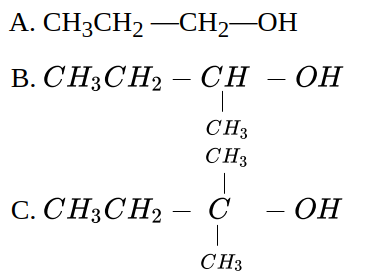
The order of reactivity of following alcohols with halogen acids is ______.
Image
  • A
    (A) > (C) > (B)
  • (C) > (B) > (A)
  • C
    (B) > (A) > (C)
  • D
    (A) > (B) > (C)
Answer
Correct option: B.
(C) > (B) > (A)
(b) (C) > (B) > (A)
Explanation: Haloalkanes are prepared from alcohol and halogen acids where the hydroxyl group of the alcohol is replaced by the halogen. Options (A) (B) and (C) are primary, secondary, tertiary alcohols respectively. Tertiary alcohols are more reactive than secondary and primary alcohol, the secondary halide is more reactive than primary halide and they form haloalkanes from haloacids at room temperature without catalysts. The order of reactivity of alcohols is 3°>2°>1°.
View full question & answer