Questions

M.C.Q (1 Marks)

🎯

Test yourself on this topic

12 questions · timed · auto-graded

MCQ 11 Mark
Hinsberg's reagent is$:$
  • A
    Benzene sulphonic acid
  • B
    Benzene sulphonamide
  • C
    Phenyl isocyanide
  • Benzene sulphonyl chloride
Answer
Correct option: D.
Benzene sulphonyl chloride
Benzene sulphonyl chloride, $\ce{C_6H_5SO_2Cl_2},$ is called Hinsberg reagent. It is used to distinguish between primary, secondary and tertiary amines
View full question & answer
MCQ 21 Mark
$ \text{IUPAC}$ name of m$-$cresol is $......$
  • A
    $3-$chlorophenol
  • B
    benzene$-1, 3-$diol
  • C
    $3-$methoxyphenol
  • $3-$methylphenol
Answer
Correct option: D.
$3-$methylphenol

Image
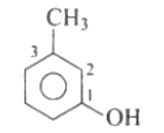
$-OH$ is a functional group and $-CH_3$  is the substituent.
We start numbering from the side of the main functional group $-OH.$
$ \text{IUPAC}$ name$: 3-$methyl phenol
View full question & answer
MCQ 31 Mark

This reaction is known as:
  • A
    Rosenmund reduction
  • Etard reaction
  • C
    Cannizzaro reaction
  • D
    Aldol condensation
Answer
Correct option: B.
Etard reaction
(b) Etard reaction
Explanation: Etard reaction
View full question & answer
MCQ 41 Mark
The rate of the first$-$order reaction is $0.69 \times 10^{-2} mol \ L^{-1} min^{-1}$ and the initial concentration is $0.2 \ mol \ L^{-1}$ the half$-$life period is$:$
  • $1200 s$
  • B
    $600 s$
  • C
    $0.33 s$
  • D
    $1 s$
Answer
Correct option: A.
$1200 s$
rate of first$-$order $= k [ R ]$
$k=\frac{\text { rate }}{[R]}=\frac{0.69 \times 10^{-2} mol \ L^{-1} min^{-1}}{0.2 \ mol \ \ L^{-1}}$
$k=3.45 \times 10^{-2} min^{-1}=\frac{3.45 \times 10^{-2} s^{-1}}{60}$
now,
$t_{1 / 2}=\frac{0.69}{k}=\frac{0.69 \times 60}{3.45 \times 10^{-2}}=1200 \ s$
the half$-$life period is $=1200 \ s$
View full question & answer
MCQ 51 Mark
Oxidation state of central metal atom in the given complex is:
$
\left[Co\left(NH_3\right)_4\left(H_2 O\right)_2\right] Cl_3
$
  • A
    $+1$
  • $+3$
  • C
    $+4$
  • D
    $+2$
Answer
Correct option: B.
$+3$
(b) +3
Explanation: +3
View full question & answer
MCQ 61 Mark
A dibromo derivative of an alkane reacts with sodium metal to form an alicyclic hydrocarbon. The derivative is
  • A
    1,1-dibromopropane
  • B
    2, 2- dibromobutane
  • C
    1, 2 dibromoethane
  • 1, 4-dibromobutane
Answer
Correct option: D.
1, 4-dibromobutane
(d) 1, 4-dibromobutane
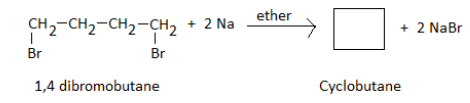
Explanation: Of all the given options, it is possible with 1,4-dibromobutane to form cyclobutane as shown by intramolecular wurtz reaction.
Image
View full question & answer
MCQ 71 Mark
Match the items given in column I with that in column II:
Column IColumn II
(a) Hypertonic(i) NaCl.
(b) Hypotonic(ii) Solution having higher osmotic pressure than other solution.
(c) Isotonic(iii) Solution having lower osmotic pressure than other solution.
(d) Electrolyte(iv) Solutions having same osmotic pressure.
  • A
    (a) (ii), (b) - (iv), (c) - (iii), (d) - (i)
  • B
    (a) (i), (b) - (ii), (c) - (iii), (d) - (iv)
  • C
    (a) (iv), (b) - (iii), (c) - (ii), (d) - (i)
  • (a) (ii), (b) - (iii), (c) - (iv), (d) - (i)
Answer
Correct option: D.
(a) (ii), (b) - (iii), (c) - (iv), (d) - (i)
(d) (a) - (ii), (b) - (iii), (c) - (iv), (d) - (i)
Explanation: (a) (ii), (b) - (iii), (c) - (iv), (d) - (i)
View full question & answer
MCQ 81 Mark
For the reaction $A + 2B \rightarrow C + D,$ the rate law is given by $r = k[A] [B]^2,$ the concentration of $A$ is kept constant while that of $B$ is doubled. The rate of the reaction will$:$
  • A
    not change
  • B
    become half
  • quadruple
  • D
    double
Answer
Correct option: C.
quadruple
The rate of the reaction is quadruple.
View full question & answer
MCQ 91 Mark
Acetone is treated with excess of ethanol in the presence of hydrochloric acid. The product obtained is$:$
  • $(CH_3)_2C(OH)(OC_2H_5)$
  • B
    $\left( CH _3\right)_2 C \left( OC _2 H _5\right)\left( OC _2 H _5\right)$
  • C
    $CH _3 COOH$
  • D
    $\left( CH _3\right)_2 CH ( OH )$
Answer
Correct option: A.
$(CH_3)_2C(OH)(OC_2H_5)$
Ketones or aldehydes react with alcohols to form acetals. This reaction of alcohol on aldehydes or ketones is catalyzed in the presence of acid and is a reversible reaction. Firstly a hemiacetal $\left( CH _3\right)_2 C ( OH )\left( OC _2 H _5\right)$ is formed which further reacts with alcohol to give acetal.
$\left(CH_3\right)_2 C\left(OC_2 H_5\right)\left(OC_2 H_5\right) CH_3 COCH_3+2 C_2 H_5 OH \stackrel{H^{+}}{\rightleftarrows}\left(CH_3\right)_2 C\left(OC_2 H_5\right)\left(OC_2 H_5\right)$
View full question & answer
MCQ 101 Mark
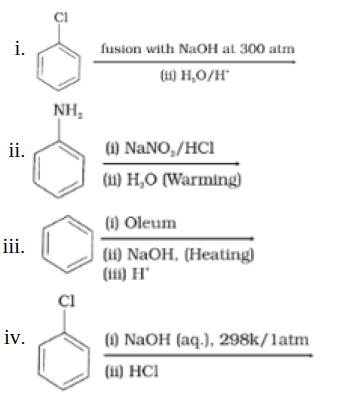
Which of the following reactions will yield phenol?
Image
  • A
    i, iii, iv
  • B
    ii, iii, iv
  • i, ii, iii
  • D
    i, ii, iv
Answer
Correct option: C.
i, ii, iii
(c) i, ii, iii
Explanation:
→ Preparation of phenols from haloarenes: Chlorobenzene is an example of haloarenes which is formed by monosubstitution of the benzene ring. When chlorobenzene is fused with sodium hydroxide at 623K and 320 atm sodium phenoxide is produced. Finally, sodium phenoxide on acidification gives phenols.
→ Preparation of phenols from diazonium salts: When an aromatic primary amine is treated with nitrous (NaNO2 +HCI) acid at 273-278 K, diazonium salts are obtained. These diazonium salts are highly reactive in nature. Uponwarming with water, these diazonium salts finally hydrolyse to phenols. Phenols can also be obtained from diazoniumsalts by treating it with dilute acids.
→ Preparation of phenols from benzene sulphonic acid: Benzenesulphonic acid can be obtained from benzene by reacting it with oleum. Benzenesulphonic acid thus formed is treated with molten sodium hydroxide at high temperature which leads to the formation of sodium phenoxide. Finally, sodium phenoxide on acidification gives phenols.
View full question & answer
MCQ 111 Mark
Amino acid is.
  • $H _2 N^2 \cdot CH _2 \cdot COOH$
  • B
    $Cl - CH _2 \cdot COOH$
  • C
    $HO . CH _2 COOH$
  • D
    $CH _3 COONH _4$
Answer
Correct option: A.
$H _2 N^2 \cdot CH _2 \cdot COOH$
(a) $H _2 N^2 \cdot CH _2 \cdot COOH$
Explanation: Amino acids contain amino $\left(- NH _2\right)$ and carboxyl $(- COOH )$ functional groups.
View full question & answer
MCQ 121 Mark
Which of the following has highest boiling point?
  • $\ce{C_2H_5-I}$
  • B
    $\ce{C_2H_5-F}$
  • C
    $\ce{C_2H_5-CI}$
  • D
    $\ce{C_2H_5-Br}$
Answer
Correct option: A.
$\ce{C_2H_5-I}$
For the same alkyl group the boiling points of haloalkanes are in the order of $\ce{RF < RCI < RBr < RI}$ as with the increase in size of halogen atom the magnitude of van der Waals forces of attraction increases, resulting in higher boiling points.
View full question & answer
M.C.Q (1 Marks) - Chemistry STD 12 Science Questions - Vidyadip