Questions

2 Marks Questions

Take a timed test

6 questions · self-marked practice — reveal the answer and mark yourself.

Question 12 Marks
What happens when calcium ethanoate is dry distilled?
Answer
Calcium ethanoate on dry distillation gives propanone.
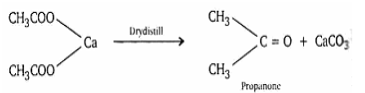
Image
View full question & answer
Question 22 Marks
Define the terms: Van't Hoff factor
Answer
Van't Hoff factor: Van't hoff factor 'i' is a correction factor defined as the ratio between the actual concentration of particles produced when the substance is dissolved and the concentration of a substance as calculated from its mass.
$
i=\frac{\text { Observed value of colligative property }}{\text { Normal value of colligative property }}
$
View full question & answer
Question 32 Marks
A person suffering from high blood pressure should take less common salt, why?
Answer
Common salt contains$ Na^+$ and $Cl^-$ which increase osmotic pressure of blood, therefore increase blood pressure. So an increase in salt intake retains the fluids which raises the blood pressure by increasing the blood volume and can increase the work load on the heart.
View full question & answer
Question 42 Marks
Answer the following$:$
$(a)$ Give two examples of non$-$chemical process which obeys the first order kinetics.
$(b)$ The following results have been obtained during the kinetic studies for the reaction:
$P+2Q → R + 2S$
Exp. Initial $P(mol/L)$ Initial $Q (mol/L)$ Init. Rate of Formation of $R(M \ min-1)$
$1$ $0.10$ $0.10$ $3.0 \times 10^{-4}$
$2$ $0.30$ $0.30$ $9.0 \times 10^{-4}$
$3$ $0.10$ $0.30$ $3.0 \times 10^{-4}$
$4$ $0.10$ $0.40$ $6.0 \times 10^{-4}$
Determine the rate law expression for the reaction.
Answer
Answer the following$:$
$(i) i.$ Rate of growth of population, if there is no change of birth and death rates.
$(ii)$ Radioactive decay in which the number of nuclei disintegrating is proportional to the number of nuclei present.
$(iii)$ Let the rate law expression be rate $= k[P] [Q]$ from the table we know that
Rate $1 = 3.0 \times 10^{-4} = k (0.10)^x (0.10)^y$
Rate $2 = 9.0 x 10^{-4} = k(0.30)^x (0.30)^y$
$\text { Rate } 3=3.0 \times 10^{-4}= k (0.10)^{ x }(0.30)^{ y }$
$\frac{\text { Rate } 1}{\text { Rate } 3}=\left(\frac{1}{3}\right)^y \text { or } 1=\left(\frac{1}{3}\right)^y$
$\text { So } y =0$
$\frac{\text { Rate } 2}{\text { Rate } 3}=(3)^{ x } \text { or } 3=(3)^{ y }$
$\text { So } x =1$
$\text { Rate }= k [ P ]$
View full question & answer
Question 52 Marks
Transition metals can act as catalysts because these can change their oxidation state. How does $Fe(III)$ catalyze the reaction between iodide and persulphate ions?
Answer
Transition metals can act as catalysts because these can change their oxidation state. The reaction between iodide and persulphate ions catalyzes by Fe is as follows:
$2 I^{-}+S_2 O_8^{2-} \xrightarrow{Fe(III)} I_2+2 SO_4^{2-}$
Role of $Fe ( IIII )$ ions:
$2 Fe^{3+}+2 I^{-} \longrightarrow 2 Fe^{2+}+I_2$
$2 Fe^{2+}+S_2 O_8^{2-} \longrightarrow 2 Fe^{3+}+2 SO_4^{2-}$
View full question & answer