Question 14 Marks
Read the following text carefully and answer the questions that follow$:$ Raoult's law states that for a solution of volatile liquids, the partial vapour pressure of each component of the solution is directly proportional to its mole fraction present in solution. Dalton's law of partial pressure states that the total pressure $(P_{total})$ over the solution phase in the container will be the sum of the partial pressures of the components of the solution and is given as$: P_{total} = P1 + P2$
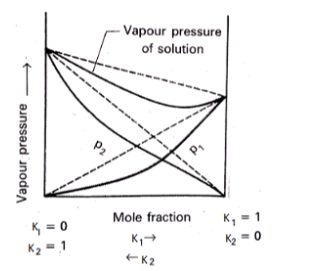
$i.$ Is the above$-$mentioned Raoult's law applicable for non$-$volatile liquids?
$ii.$ What type of deviation from Raoult's law does the above graph represent?
$iii.$ Give an example of such system. $OR$
$iii.$ A solution of two liquids boils at a temperature more than the boiling point of either of them. What type of deviation will be shown by the solution formed in terms of Raoult's law?
$i.$ Is the above$-$mentioned Raoult's law applicable for non$-$volatile liquids?
$ii.$ What type of deviation from Raoult's law does the above graph represent?
$iii.$ Give an example of such system. $OR$
$iii.$ A solution of two liquids boils at a temperature more than the boiling point of either of them. What type of deviation will be shown by the solution formed in terms of Raoult's law?
Answer
View full question & answer→$i. KCl$ in a $\ kg$ of water would be expected to increase the boiling point by $2 \times 0.52 \ K=1.04 \ K$. This could led us to conclude that mass of $2$ moles of particles is $74.5 \ g$ hence mass of $1$ mole of $KCl$ would be $37.25 \ g .$ Hence, in case of $KCl$ where dissociation occurs experimentally determined molar mass is always lower than true value.
$ii.$ Negative Deviation.
$iii.$ A liquid mixture consisting of $20 \%$ acetone and $80 \%$. chloroform by mass.
$ii.$ Negative Deviation.
$iii.$ A liquid mixture consisting of $20 \%$ acetone and $80 \%$. chloroform by mass.