Questions

M.C.Q (1 Marks)

Take a timed test

12 questions · 11 auto-graded MCQ + 1 self-marked written.

MCQ 11 Mark
Aniline reacts with sodium nitrite and hydrochloric acid at 273-278K to give:
  • A
    Chlorobenzene
  • Benzene diazonium chloride
  • C
    o-chloroaniline
  • D
    Benzene
Answer
Correct option: B.
Benzene diazonium chloride
(b) Benzene diazonium chloride
Explanation: Benzene diazonium chloride
View full question & answer
MCQ 21 Mark
The reaction $C _2 H _5 ONa + C _2 H _5 I \rightarrow C _2 H _5 OC _2 H _5+ NaI$ is known as:
  • Williamson's synthesis
  • B
    Grignard's synthesis
  • C
    Wurtz's synthesis
  • D
    Kolbe's synthesis
Answer
Correct option: A.
Williamson's synthesis
(a) Williamson's synthesis Explanation: Williamson's synthesis: When an alkyl halide reacts with sodium alkoxide, ether is formed. This reaction is known as Williamson's synthesis. The reaction generally follows the $S_N 2$ mechanism for primary alcohols.
$ R-X+R^{\prime}-\ddot{O} \stackrel{+}{N} a \rightarrow R-\ddot{O}-R^{\prime}+N a X $
                                    Williamson's synthesis
View full question & answer
MCQ 31 Mark
Iodoform test is given by
  • A
    Ethanoic acid
  • B
    Pentan-3-one
  • C
    Methoxymethane
  • Pentan-2-one
Answer
Correct option: D.
Pentan-2-one
(d) Pentan-2-one
Explanation: Pentan-2-one
View full question & answer
MCQ 41 Mark
Rate of reaction does not remain constant throughout because
  • A
    The density of reactants keep on changing
  • Concentration of reactants keep on changing
  • C
    Volume of reactants keep on changing
  • D
    Temperature of reactants keep on changing
Answer
Correct option: B.
Concentration of reactants keep on changing
(b) Concentration of reactants keep on changing.
Explanation: Rate of reaction is dependent on the concentration of reactants if the concentration of reactants change then the rate of reaction become non-uniform.
View full question & answer
MCQ 51 Mark
Interstitial compounds are formed when small atoms are trapped inside the crystal lattice of metals. Which of the following is not the characteristic property of interstitial compounds?
  • A
    They retain metallic conductivity.
  • B
    They have high melting points in comparison to pure metals.
  • They are chemically very reactive.
  • D
    They are very hard.
Answer
Correct option: C.
They are chemically very reactive.
(c) They are chemically very reactive.
Explanation: Interstitial compounds are chemically inert not reactive.
View full question & answer
MCQ 61 Mark
Which of the following compounds has the highest boiling points?
  • A
    $CH _3 CH _2 CH _2 Cl$
  • $CH _3 CH _2 CH _2 CH _2 Cl$
  • C
    $\left( CH _3\right)_3 Cl$
  • D
    $CH _3 CH \left( CH _3\right) CH _2 Cl$
Answer
Correct option: B.
$CH _3 CH _2 CH _2 CH _2 Cl$
The forces of attraction between the molecules of a compound get stronger as they get bigger in size and have more electrons. Also, for a straight-chain compound, the points of interaction between the molecules are more than for a branched compound having the same molecular formula. Thus $CH_3CH_2CH_2CH_2Cl$ has the highest melting point since it is the longest chain compound among the given options.
View full question & answer
MCQ 71 Mark
Match the types of solutions given Column I to the examples given in Column II.
Column IColumn II
(a) Solution of gas in gas(i) Brass
(b) Solution of solid in solid(ii) Air
(c) Solution of liquid in gas(iii) Zinc amalgam
(d) Solution of liquid in solid(iv) Chloroform in Nitrogen
  • A
    (a) (iii), (b) - (iv), (c) - (i), (d) - (ii)
  • B
    (a) (iv), (b) - (iii), (c) - (ii), (d) - (i)
  • C
    (a) (i), (b) - (ii), (c) - (iii), (d) - (iv)
  • (a) (ii), (b) - (i), (c) - (iv), (d) - (iii)
Answer
Correct option: D.
(a) (ii), (b) - (i), (c) - (iv), (d) - (iii)
(d) (a) (ii), (b) - (i), (c) - (iv), (d) - (iii)
Explanation: (a) (ii), (b) - (i), (c) - (iv), (d) - (iii)
View full question & answer
MCQ 81 Mark
A reaction follows second order kinetics. How is the rate of reaction affected if the concentration of the reactant is reduced to half? Choose the correct value from the following:
  • A
    four times
  • $\frac{1}{4}$ of the original value
  • C
    three times
  • D
    eight times
Answer
Correct option: B.
$\frac{1}{4}$ of the original value
(b) $\frac{1}{4}$ of the original value
Explanation: $\frac{1}{4}$ of the original value
View full question & answer
MCQ 91 Mark
Give the products of the reaction
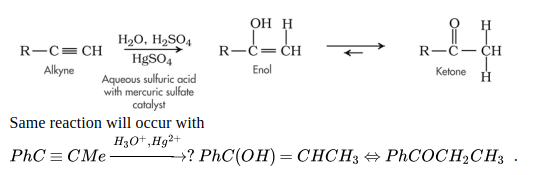
$PhC \equiv CMe \xrightarrow{H_3 O^{+}, Hg^{2+}} ?$
  • A
    $PhCH_2CH_2CHO$
  • B
    $PhCOCH_2CH_3$
  • C
    $PhCOCOMe$
  • D
    $PhCH_2COCH_3$
Answer
Hydration of given alkyne will occur according to Markovnikoff's rule leading to the formation of enol which will tautomerise to give keto form.
The general reaction of alkyne hydrations shown below$:$
Image
View full question & answer
MCQ 101 Mark
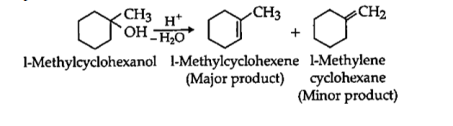
The major product of acid catalysed dehydration of 1-methylcyclohexanol is:
  • A
    1-methylenecyclohexane
  • 1-methylcyclohexene
  • C
    1-methylcyclohexane
  • D
    1-cyclohexylmethanol
Answer
Correct option: B.
1-methylcyclohexene
(b) 1-methylcyclohexene
Explanation: According to Saytzeff rule, i.e., highly substituted alkene is major product. Here dehydration reaction takes place, alkene is formed due to the removal of a water molecule
Image
View full question & answer
MCQ 111 Mark
On hydrolysis, which of the following carbohydrates gives glucose and fructose?
  • A
    Starch
  • B
    Maltose
  • C
    Lactose
  • Sucrose
Answer
Correct option: D.
Sucrose
(d) Sucrose
Explanation: When hydrolyzed sucrose gives two products that is: glucose and fructose.
View full question & answer
MCQ 121 Mark
Which one of the following is a synthetic halogen compound?
  • A
    Chloramphenicol
  • B
    Diphenyl hydramine
  • Chloroquine
  • D
    Omeprazole
Answer
Correct option: C.
Chloroquine
(c) Chloroquine
Explanation: Chloroquine is a synthetic halogen compound. It is used for the treatment of malaria.
View full question & answer
M.C.Q (1 Marks) - Chemistry STD 12 Science Questions - Vidyadip