Questions · Page 1 of 4

M.C.Q (1 Marks)

🎯

Test yourself on this topic

50 questions · timed · auto-graded

MCQ 11 Mark
The condensation polymer among the following is:
  • A
    Rubber
  • Protein
  • C
    Poly vinyl chloride
  • D
    Polyethene
Answer
Correct option: B.
Protein
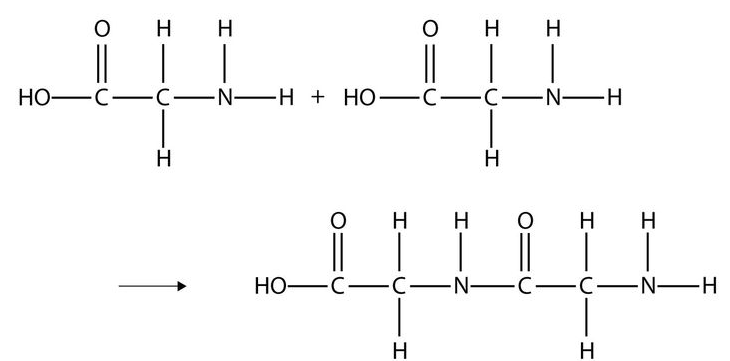
Proteins are polymers of amino acids covalently linked through peptide bonds into a chain. These are formed by removal of water molecule and through condensation reaction.
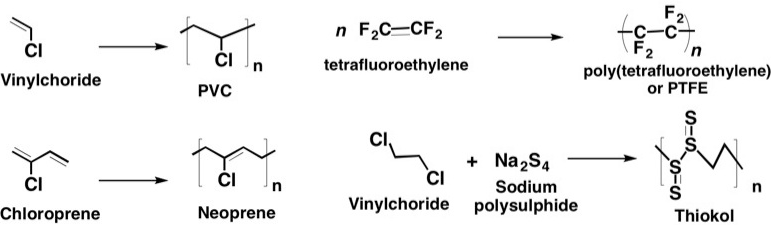
$\text{PVC},$ rubber and polyethene are formed through addition polymerisation.
View full question & answer
MCQ 21 Mark
Which of the following is wrong?
  • A
    $\text{PMMA}$ is called plexiglass
  • B
    $\text{PTFE}$ is called teflon
  • $\text{SBR}$ is natural rubber
  • D
    $\text{LDPE}$ is called low density polythene
Answer
Correct option: C.
$\text{SBR}$ is natural rubber
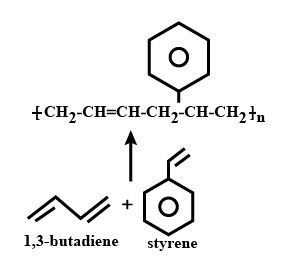
$\text{SBR}$ stands for styrene $-$ butadiene rubber.
It is a copolymer but it is a synthetic polymer and not natural rubber.
View full question & answer
MCQ 31 Mark
Teflon constitutes:
  • A
    Carbon, flourine $\ \&\ $ hydrogen
  • B
    Carbon, chlorine $\ \&\ $ hydrogen
  • Carbon $\ \&\ $ flourine
  • D
    Carbon $\ \&\ $ chlorine
Answer
Correct option: C.
Carbon $\ \&\ $ flourine
Teflon is the brand name of Polytetrafluoroethylene $\text{(PTFE)}$ is a synthetic fluoropolymer of tetrafluoroethylene.
The constituents of tetrafluoroethylene are carbon and fluorine formula is $\left(\mathrm{C}_2 \mathrm{F}_4\right)_n$​.
View full question & answer
MCQ 41 Mark
Which one is resistant to vegetable and mineral oils?
  • Neoprene
  • B
    Glyptal
  • C
    Nitrile rubber
  • D
    Both $B$ and $C$
Answer
Correct option: A.
Neoprene
Neoprene has superior resistance to vegetable and mineral oils.
The material used in the neoprene is nothing but the rubber which has strong resistant towards vegetable and mineral oil.
View full question & answer
MCQ 51 Mark
Which of the following statements is not true about low density polythene?
  • A
    Tough.
  • Hard.
  • C
    Poor conductor of electricity.
  • D
    Highly branched structure.
Answer
Correct option: B.
Hard.
Low density polythene: It is obtained by the polymerisation of ethane under high pressure of $1000$ to $2000$ atmosphere at a temperature of $350K$ to $570K$ in the presence of traces of dioxygen or a peroxide initiator $($catalyst$).$ They are flexible in nature.
View full question & answer
MCQ 61 Mark
Polyacrylamide gel is prepared by mixing acrylamide and $........$ at fixed proportions.
  • A
    Glycol
  • Bisacrylamide
  • C
    Hydrazine
  • D
    None of the above
Answer
Correct option: B.
Bisacrylamide
Polyacrylamide gel $=$ Acerylamide $+$ Bisacrylamide.
View full question & answer
MCQ 71 Mark
Which of the following polymers are thermoplastic?
$a.$ Teflon.
$b.$ Natural rubber.
$c.$ Neoprene.
$d.$ Polystyrene.
  • A
    $a$ and $b$
  • B
    $a$ and $c$
  • C
    $b$ and $c$
  • $a$ and $d$
Answer
Correct option: D.
$a$ and $d$
Teflon and polystyrene are thermoplastics since they can be moulded again by heating and melting.
View full question & answer
MCQ 81 Mark
Common application of $\text{GRN}$ in life is:
  • Making oil seals
  • B
    Manufacture of hose pipes
  • C
    Tank lining
  • D
    All the above
Answer
Correct option: A.
Making oil seals
View full question & answer
MCQ 91 Mark
Dacron $($a polymer$)$ is obtained by the condensation polymerization of:
  • A
    Phenol and formaldehyde
  • B
    Phenol and phthalic acid
  • C
    Terepthalic acid and formaldehyde
  • Dimethyl terephthalate and ethylene glycol
Answer
Correct option: D.
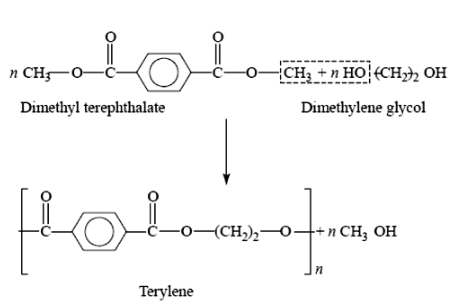
Dimethyl terephthalate and ethylene glycol
The polymer of ethylene glycol and terephthalic acid is known as terylene or dacron.
View full question & answer
MCQ 101 Mark
Which of the following statements is not true about polymers?
  • A
    Polymers have high viscosity.
  • B
    Polymers do not carry any charge.
  • C
    Polymers scatter light.
  • Polymers have low molecular weight.
Answer
Correct option: D.
Polymers have low molecular weight.
Polymers have very high molecular weight $\left(10^3=10^7 \mu\right)$.
Hence, they are called macromolecules. The rest of the properties are given in option $A, B$ and $C$ are true.
View full question & answer
MCQ 111 Mark
Polymer formation from monomers starts by:
  • Condensation reaction between monomers.
  • B
    Coordination reaction between monomers.
  • C
    Conversion of one monomer into other monomer.
  • D
    Hydrolysis of monomers.
Answer
Correct option: A.
Condensation reaction between monomers.
Polymer formation is caused by the condensation of $2$ or more bifunctional monomers with the elimination of simple molecules like water, ammonia, alcohol etc.
In these reactions, the product of each step is again a bifunctional species $\ \&\ $ the sequence of condensation goes on.
View full question & answer
MCQ 121 Mark
Rubber is heated with sulphur and the process is known as:
  • A
    Galvanization
  • Vulcanization
  • C
    Bessemerization
  • D
    Sulphonation
Answer
Correct option: B.
Vulcanization
Natural Rubber is heated in the presence of sulphur. This produces cross$-$linking and leads to a harder material that is markedly more resistant to heat and relatively more elastic. This process is called vulcanization.
View full question & answer
MCQ 131 Mark
What is not true regarding free radical polymerisation of propene?
  • A
    Without proper control, atactic polypropylene is formed.
  • B
    Use of Ziegler$-$Natta catalyst results in isotactic polypropylene.
  • During polymerisation, a linear unbranched, crystalline polymer is usually obtained.
  • D
    During polymerisation, a secondary free radical is produced in every step.
Answer
Correct option: C.
During polymerisation, a linear unbranched, crystalline polymer is usually obtained.
The statement $(C)$ is not true. During polymerization, a branched polymer is usually obtained. Chain branching always occur during olefenic polymerization due to abstraction of some $H-$radical from the growing polymer chain.
Note$:\ 1^\circ $ free radical forms $2^\circ $ free radical by abstracting hydrogen at middle of another chain, which further adds to propene and there is growing of the branch. Ziegler Natta catalyst is titanium chloride and triethyl aluminum $\left[\mathrm{TiCl}_4+\mathrm{Al}\left(\mathrm{C}_2 \mathrm{H}_5\right)_3\right]$
View full question & answer
MCQ 141 Mark
What are blended fibres?
  • A
    Mixture of two natural fibres
  • B
    Mixture of two synthetic fibre
  • C
    Mixture of natural and synthetic fibres
  • All of above
Answer
Correct option: D.
All of above
Blended fibres are made by combining various fibres to enhance the property of the product.
For eg: spandex and cotton is a natural mix for sports clothing and undergarments to improve stretching properties and prevent odour.
A blended fabric helps overcome the disadvantages of natural and synthetic fibre.
View full question & answer
MCQ 151 Mark
Polymerisation in which two or more chemically different monomers take part is called:
  • A
    Addition polymerisation
  • Copolymerisation
  • C
    Chain polymerisation
  • D
    Homopolymerisation
Answer
Correct option: B.
Copolymerisation
Copolymerisation is a polymerization reaction in which a mixture of more than one monomeric species is allowed to polymerize to form a copolymer.
View full question & answer
MCQ 161 Mark
When formaldehyde is heated with phenol in the presence of an alkali, the product formed is:
  • A
    Rubber
  • Bakelite
  • C
    Chloroprene
  • D
    Neoprene
Answer
Correct option: B.
Bakelite
Bakelite forms in a condensation reaction of phenol and formaldehyde, with wood flour or asbestos fiber as a filler, under high pressure and heat in a time frame of a few minutes of curing. The result is a hard plastic material.
Molecular Formula$:\ \left(\mathrm{C}_6 \mathrm{H}_6 \mathrm{O} \cdot \mathrm{CH}_2 \mathrm{O}\right)_n$
Making Bakelite was a multi-stage process. It began with the heating of phenol and formaldehyde in the presence of a catalyst such as hydrochloric acid, zinc chloride, or the base ammonia
View full question & answer
MCQ 171 Mark
The process involving heating of rubber with sulphur is called $.......$
  • A
    Galvanisation
  • Vulcanization
  • C
    Bessemerisation
  • D
    Sulphonation
Answer
Correct option: B.
Vulcanization
Vulcanisation of Rubber $-$ Natural rubber becomes soft at high temperature $(>335 K)$ and brittle at low temperature $(<283 K)$ and shows high water absorption capacity.
The process of vulcanisation includes heating of raw rubber with sulphur and an appropriate additive at temperature range between $373 K$ to $415 K.$ Sulphur foms crosslinks at reactive sites of double bonds and thus, rubber gets stiffened.
View full question & answer
MCQ 181 Mark
Dacron is polymer of:
  • A
    Glycol and formaldehyde
  • B
    Glycol and phenol
  • C
    Glycol and phthalic acid
  • Glycol and terephthalic acid
Answer
Correct option: D.
Glycol and terephthalic acid
Dacron, also known as Terylene; a polymer formed from polymerization of ethylene glycol and Terephthalic acid.
How is dacron obtained from ethylene glycol and terephthalic acid ?
View full question & answer
MCQ 191 Mark
Which of the following monomers are unsuitable for condensation polymerization?
  • A
    Hydroxy acids.
  • B
    Butane$-$dioic acid and glycol.
  • C
    Diamines and dicarboxylic acids.
  • Propanoic acid and ethanol.
Answer
Correct option: D.
Propanoic acid and ethanol.
Propanoic acid and ethanol, both are monofunctional monomers $\mathrm{CH} 3-\mathrm{CH}_2-\mathrm{OH}, \mathrm{CH}_3-\mathrm{CH}_2 \mathrm{COOH}$ which are not suitable for a polycondensation reaction to take place because once they combine by condensation polemerisation further polymerisation is not possible.
View full question & answer
MCQ 201 Mark
Cellulose, protein and starch are classified as:
  • Natural polymers
  • B
    Aldehydes
  • C
    Esters
  • D
    Synthetic polymers
Answer
Correct option: A.
Natural polymers
Cellulose, protein and starch are classified as natural polymers. They are obtained from either plants or animals.
They are named as plant polymers and animal polymers.
Other examples of natural polymers include jute, linen, silk and wool etc.
​​​​​​​
View full question & answer
MCQ 211 Mark
The polymer, which is the constituent of cotton is:
  • Cellulose
  • B
    Ester
  • C
    Rayon
  • D
    Nylon
Answer
Correct option: A.
Cellulose
Cotton is $99\%$ cellulose. Cellulose is a macromolecule. A polymer made up of a long chain of glucose molecules linked by $C−1$ to$ C−4$ oxygen bridges with an elimination of water.
Wood pulp, rayon, and cellophane are also constructed of cellulose polymers.
View full question & answer
MCQ 221 Mark
The process by which smaller molecules combine to give a molecule with a higher molecular weight is known as:
  • A
    Condensation
  • Polymerisation
  • C
    Catenation
  • D
    Isomerisation
Answer
Correct option: B.
Polymerisation
Polymerisation is the joining together of two or more simple molecules called Monomers to form a new compound of the same empirical formula called a polymer which has higher molecular weight.
View full question & answer
MCQ 231 Mark
Chloroprene is the monomer of:
  • A
    $\text{PVC}$
  • Neoprene
  • C
    Polystyrene
  • D
    Polythene
Answer
Correct option: B.
Neoprene
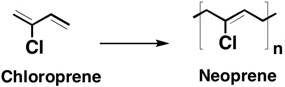
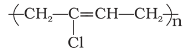
Neoprene polymerizes from its monomer unit chloroprene.
View full question & answer
MCQ 241 Mark
$.......$ is used for making parachutes and stockings.
  • A
    Cotton
  • Nylon
  • C
    Wool
  • D
    Bakelite
Answer
Correct option: B.
Nylon
Nylon is the strongest man-made fiber prepared by polymerizing amide molecules.
Nylon is used in the making of different types of clothes, ropes, sleeping bags, parachutes, tents etc because the fiber of nylon is stronger than a steel wire of the same thickness.
View full question & answer
MCQ 251 Mark
Which of the following are addition polymers?
$a.$ Nylon.
$b.$ Melamine formaldehyde resin.
$c.$ Orlon.
$d.$ Polystyrene.
  • A
    $a$ and $b$
  • B
    $a$ and $c$
  • C
    $b$ and $c$
  •  $a$ and $d$
Answer
Correct option: D.
 $a$ and $d$
The addition polymers are formed by the repeated addition of monomer molecules possessing double or triple bonds, e.g., the formation of polythene from ethene and polypropene from propene. However, the addition polymers formed by the polymerisation of a single monomeric species are known as homopolymers.
View full question & answer
MCQ 261 Mark
Which of the following polymers are used as fibre?
$a.$ Polytetrafluoroethane.
$b.$ Polychloroprene.
$c.$ Nylon.
$d.$ Terylene.
  • A
    $a$ and $b$
  • B
    $a$ and $c$
  • C
    $b$ and $c$
  • $c$ and $d$
Answer
Correct option: D.
$c$ and $d$
Fibres are the thread forming solids which possess high tensile strength and high modulus. These characteristics can be attributed to the strong intermolecular forces like hydrogen bonding. These strong forces also lead to close packing of chains and thus impart crystalline nature. The examples are polyamides $($nylon $6, 6),$ polyesters $($terylene$),$ etc.
View full question & answer
MCQ 271 Mark
Polymer used to make gasket of pressure cooker is:
  • A
    Polythene
  • B
    Nylon
  • Teflon
  • D
    Thiokol
Answer
Correct option: C.
Teflon
Polymer used to make gasket of pressure cooker is teflon. Teflon is formed by free radical vinyl polymerisation of the monomer tetrafluoroethylene.
View full question & answer
MCQ 281 Mark
Generally, polyamides are $.......$
  • Fibres
  • B
    Thermoplastics
  • C
    Thermosetting
  • D
    Elastomeres
Answer
Correct option: A.
Fibres
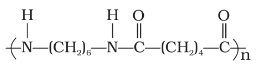
Polyamides are generally fibers because of the intermolecular forces like hydrogen bonding which gives them high tensile strength.
View full question & answer
MCQ 291 Mark
The tensile strength, elasticity and resistance to abrasion can be increased by a process called:
  • A
    Galvanisation
  • Vulcanization
  • C
    Bessemerisation
  • D
    Sulphonation
Answer
Correct option: B.
Vulcanization
In vulcanization, there is formation of crosslinks of sulphur at the reactive sites of the double bond which stiffens the rubber and also increase the resistance to abrasion and tensile strength, the elasticity of the rubber.
View full question & answer
MCQ 301 Mark
Polymer used in making capsules is:
  • A
    Poly glycolic acid
  • B
    Poly lactic acid
  • C
    Nylon $- 2 -$ Nylon $- 6$
  • $\text{PHBV}$
Answer
Correct option: D.
$\text{PHBV}$
$\text{PHBV}$ is Poly ($−3−$ hydroxy butyrate $- co -3-$hydroxy valerate).
$\text{PHBV}$ is used in speciality packaging, orthropaedic devices and in controlled release of drugs.
$\text{PHBV}$ undergoes bacterial degradation in the environment.
View full question & answer
MCQ 311 Mark
Which of the following polymer is used in pigment?
  • Buna $- S$
  • B
    Neoprene
  • C
    Teflon
  • D
    Orlon
Answer
Correct option: A.
Buna $- S$
Buna $- S$ is used to bind pigmented coatings.
It is the polymer derived from styrene and buta $-$ diene.
View full question & answer
MCQ 321 Mark
The people who weave the clothes are called:
  • Weavers
  • B
    Clothesmans
  • C
    Tailors
  • D
    Workers
Answer
Correct option: A.
Weavers
People who weave clothes are called weavers. The person makes fabric by weaving fibre. Weaving is a method of textile production consisting of two different types of thread that are interlaced at right angles to form the cloth
View full question & answer
MCQ 331 Mark
Which one of these is a monomer of Bakelite?
  • A
    Vinyl acetate
  • B
    Tetrafluoroethylene
  • Formaldehyde
  • D
    Propylene
Answer
Correct option: C.
Formaldehyde
Bakelite is a condensation polymer of phenol and formaldehyde.
Bakelite is widely used for making molded products.
It was the first plastic made from synthetic components.
View full question & answer
MCQ 341 Mark
Which of the following polymer is biodegradable?
 
  • A
  • B
  • D
Answer
Correct option: C.
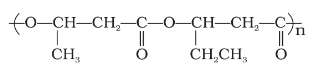
Poly $\beta-$ hydroxybutyrate-co $\beta-$ hydroxy valerate (PHBV):


It is obtained by the copolymerization of 3-hydroxybutanoic acid and 3-hydroxypentanoic acid. PHBV is used in speciality packaging orthopaedic devices and in controlled release of drugs. PHBV undergoes bacterial degradation in the environment.
View full question & answer
MCQ 351 Mark
In vulcanisation of rubber,
  • A
    Sulphur reacts to form new compound.
  • Sulphur cross links are introduced.
  • C
    Sulphur forms a very thin protective layer over rubber.
  • D
    All of the above.
Answer
Correct option: B.
Sulphur cross links are introduced.
In vulcanisation of rubber, sulphur cross links are introduced. Natural rubber is mixed with $3$ to $5\%$ sulphur and heated at $100−150^\circ C$ to form cross linking of cis$-1, 4$ polyisoprene chains through disulphide bonds $(-S-S-).$ Vulcanization of rubber makes it more strong, tough and elastic.
View full question & answer
MCQ 361 Mark
Which of the following is an elastomer?
  • Vulcanized rubber
  • B
    Dacron
  • C
    Polystyrene
  • D
    Melamine
Answer
Correct option: A.
Vulcanized rubber
An elastomer is a polymer with viscoelasticity $($colloquially "elasticity"$),$ generally having low Young's modulus and high failure strain compared with other materials.
Vulcanized rubber is a natural elastomer that has been made more durable by a biochemical process that cures the rubber.
Vulcanized rubber is an elastomer.
View full question & answer
MCQ 371 Mark
The non$-$metal used to treat rubber in the process of vulcanization is:
  • Sulphur
  • B
    Phosphorus
  • C
    Carbon
  • D
    Chloride
Answer
Correct option: A.
Sulphur
The nonmetal used to treat rubber in the process of vulcanization is sulphur. Natural rubber is soft, sticky and has less tensile strength. Vulcanization makes rubber more strong, tough and elastic.
Natural rubber is mixed with $3$ to $5 \%$ sulphur and heated at $100$ to $\text{150 deg C,}$ which results in cross linking of chains of cis$-1,4-$polyisoprene through disulphide $(−S−S−)$ bonds.
View full question & answer
MCQ 381 Mark
Which one of the following is not an example of chain growth polymer?
  • A
    Neoprene
  • B
    Buna $- S$
  • C
    $\text{PMMA}$
  • Glyptal
Answer
Correct option: D.
Glyptal
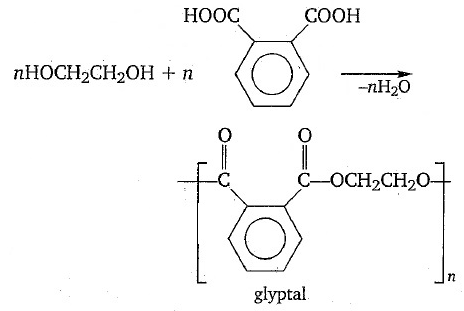
Glyptal is a condensation or step growth polymer of ethylene glycol and phthalic acid.
Neoprene, buna $- S$ and $\text{PMMA}$ are chain growth polymers.
View full question & answer
MCQ 391 Mark
Sulphur is used in:
  • A
    Welding
  • B
    Electroplating
  • Vulcanising rubber
  • D
    The manufacture of paints
Answer
Correct option: C.
Vulcanising rubber
Vulcanization is addition of sulphur in natural rubber by chemical process to improve its durability.
View full question & answer
MCQ 401 Mark
During long distance travel you would like to take drinking water in a bottle made up of:
  • A
    Glass
  • Plastic
  • C
    Leather
  • D
    Steel
Answer
Correct option: B.
Plastic
Plastic have low toxicity due to their insolubility in water and because they are biochemically inert due to large molecular weight. Plastic products contain a variety of additives. Plastic is light, durable and doesn't react chemically with water.
View full question & answer
MCQ 411 Mark
Polymers may also be made up of:
  • A
    Cellulose acetate
  • B
    Coal
  • C
    Crude oil
  • All of the above
Answer
Correct option: D.
All of the above
Polymers are made of repeat units derived from natural gas or coal or crude oil. But building block repeat units can sometimes be made from renewable materials such as polylactic acid from corn or cellulosics from cotton linters.
Some plastics have always been made from renewable materials such as cellulose acetate used for screwdriver handles and gift ribbon.
View full question & answer
MCQ 421 Mark
Which one of the following is not a correct match?
  • A
    Teflon $-$ Tetrafluoroethylene.
  • B
    Plexi glass $-$ Methyl methacrylate.
  • Orlon $-$ Glycerol, phthalic anhydride.
  • D
    Buna$-S -$ Styrene$, 1-3$ butadiene.
Answer
Correct option: C.
Orlon $-$ Glycerol, phthalic anhydride.
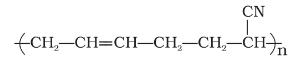
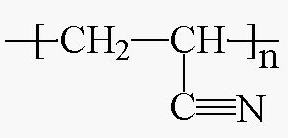
Acrylonitrile $\left(\mathrm{CH}_2=\mathrm{CHCN}\right)$ is the monomer unit of orlon polymer.
View full question & answer
MCQ 431 Mark
The s-block element used as a catalyst in the manufacture of Buna$-S$ rubber is:
  • A
    $Mg$
  • B
    $Ca$
  • C
    $Ba$
  • $Na$
Answer
Correct option: D.
$Na$
The $s -$ block element used as a catalyst in the manufacture of Buna$-S$ rubber is sodium $(Na)$ metal.
Buna $- S$ or styrene butadiene rubber $\text{(SBR)}$ is a copolymer of styrene and $1, 3 -$ butadiene.
View full question & answer
MCQ 441 Mark
$PP\ ($Polypropylene$)$ is used for making $.......$
  • Disposable cups
  • B
    Liquid detergents
  • C
    Grocery bags
  • D
    Electric switches
Answer
Correct option: A.
Disposable cups
$PP\ ($Polypropylene$)$ is used for making disposable cups.
View full question & answer
MCQ 451 Mark
Bakelite is a product of the reaction between:
  • A
    Formaldehyde and $\text{NaOH}$
  • B
    Aniline and Urea
  • Phenol and Methanal
  • D
    Phenol and Chloroform
Answer
Correct option: C.
Phenol and Methanal
Bakelite is formed by co$-$polymerization of phenol and formaldehyde $($methanal$).$
Bakelite is a product of the reaction between:
View full question & answer
MCQ 461 Mark
Which of the following is a fully flourinated polymer?
  • A
    Thiokol
  • Teflon
  • C
    Neoprene
  • D
    $\text{PVC}$
Answer
Correct option: B.
Teflon
Polytetrafluoroethylene $\text{(PTFE)}$ or Teflon is formed by tetrafluoroethylene. Thiokol, Neoprene, and $\text{PVC}$ are formed by polysulphide, chloroprene, vinylchloride.
View full question & answer
MCQ 471 Mark
Fomaldehyde is the starting material for the manufacture of :
  • Bakelite
  • B
    Caprolactam
  • C
    $D.T$
  • D
    Rayon
Answer
Correct option: A.
Bakelite
View full question & answer
MCQ 481 Mark
Synthetic human hair wigs are made from a copolymer of vinyl chloride and acrylonitrile and is called:
  • A
    $\text{PVC}$
  • B
    Polyacrylonitrile
  • C
    Cellulose
  • Dynel
Answer
Correct option: D.
Dynel
Dynel is a co $-$ polymer of vinyl chloride and acrylonitrile.
View full question & answer
MCQ 491 Mark
Which of the following statements is incorrect?
  • A
    Polypropylene is a thermoplastic polymer.
  • B
    Melamine-formaldehyde is a thermosetting polymer.
  • Mixture of styrene and methyl methacrylate can form ionic addition polymer.
  • D
    Low density polythene is a poor conductor of electricity.
Answer
Correct option: C.
Mixture of styrene and methyl methacrylate can form ionic addition polymer.
Mixture of styrene and methyl methacrylate can form a copolymer and not an ionic addition polymer.
Hence, the statement in option is incorrect.
Other statements are correct.
View full question & answer
MCQ 501 Mark
Which of the following polymers is used to manufacture clothes for firefighters?
  • A
    Thiokol
  • B
    Kevlar
  • Nomex
  • D
    Dynel
Answer
Correct option: C.
Nomex
Nomex is used to manufacture clothes for firefighters . It is also used to prepare protective clothes for race car drivers. Dynel is used in the preparation of human hair wigs.
Thiokol is used in rubber. Kevlar is used to prepare bullet proof vests and helmets.
View full question & answer
M.C.Q (1 Marks) - Chemistry STD 12 Science Questions - Vidyadip