Questions · Page 2 of 2

2 Marks Questions

Question 512 Marks

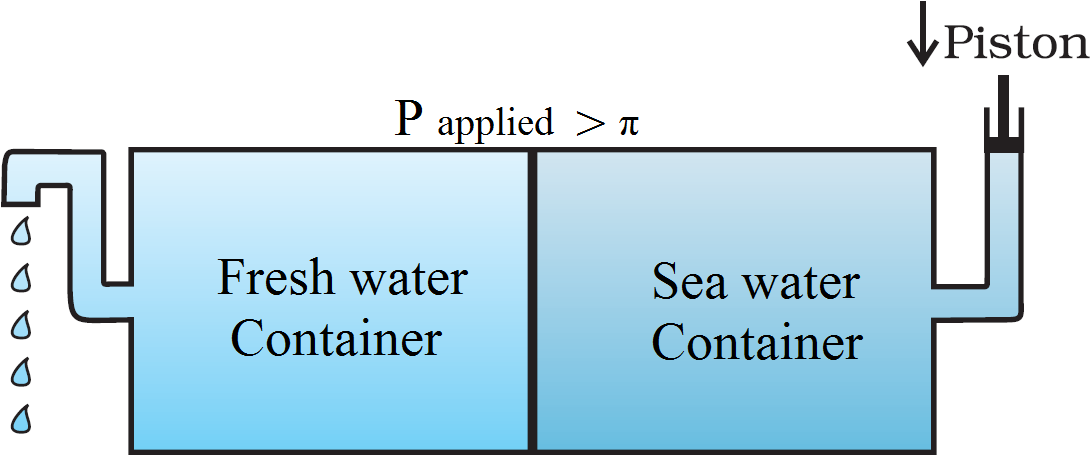
Given alongside is the sketch of a plant for carrying out a process.
  1. Name the process occurring in the given plant.
  2. To which container does the net flow of solvent take place?
  3. Name one SPM which can be used in this plant.
  4. Give one practical use of the plant.
Answer
  1. Reverse osmosis.
  2. Fresh water container.
  3. Cellulose acetate placed on a suitable support.
  4. Desalination of sea water.
View full question & answer
Question 522 Marks
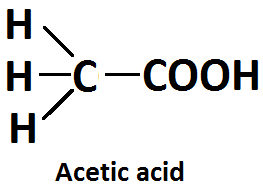
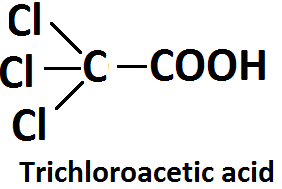
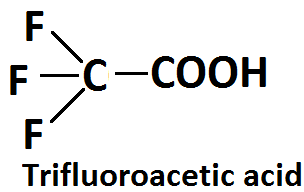
The depression in freezing point of water observed for the same amount of acetic acid, trichloroacetic acid and trifluoroacetic acid increases in the order given above. Explain briefly.
Answer


Among H, Cl, and F, H is least electronegative while F is most electronegative. Then, F can withdraw electrons towards itself more than Cl and H. Thus, trifluoroacetic acid can easily lose H + ions i.e., trifluoroacetic acid ionizes to the largest extent. Now, the more ions produced, the greater is the depression of the freezing point. Hence, the depression in the freezing point increases in the order:
Acetic acid < trichloroacetic acid < trifluoroacetic acid.
View full question & answer
Question 532 Marks
After removing the outer shell of two eggs in dil. HCl, one is placed in distilled water and the other in a saturated solution of NaCl. What will you observe and why?
Answer
Egg in water will swell whereas in NaCl solution it will shrink. This is because due to osmosis, the net flow of solvent is from less concentrated to more concentrated solution.
View full question & answer
Question 542 Marks
Calculate the mole fraction of benzene in solution containing $30\%$ by mass in carbon tetrachloride.
Answer
$30\% $ by mass of $C_6H_6$ in $CCl_4 => 30 g C_6H_6$ in $100\ g$ solution
$\therefore$ no. of moles of $C_6H_6, (^nC_6H_6) = 30/78 = 0.385$
$($molar mass of $C_6H_6 = 78g)$
no. of moles of,
$\text{CCl}_4 (^\text{n}\text{CCl}_4)=\frac{70}{154}=0.455$
$^\text{x}\text{C}_6\text{H}_6=\frac{^\text{n}\text{C}_6\text{H}_6}{^\text{n}\text{C}_6\text{H}_6+^\text{n}\text{CCl}_4}$
$=\frac{0.385}{0.385+0.455}=\frac{0.385}{0.84}=0.458$
$^\text{x}\text{CCl}_4=1-0.458=0.542$
View full question & answer
Question 552 Marks
If the solubility product of $CuS$ is $6 \times 10^{–16},$ calculate the maximum molarity of $CuS$ in aqueous solution.
Answer
Solubility product of $CuS$, $K_{sp} = 6 x 10^{-16}$ $\text{CuS}\rightleftharpoons\text{Cu}^{2+}+\text{S}^{2-}$ Suppose solubility of $CuS$ is $x\ mol^{-1}$ This would give $x\ mol^{-1}$ of $Cu^{2+}$ ions and $x\ mol\ L^{-1}$ of $S^{2-}$ ions on dissociation. $[Cu^{2+}] = x\ mol^{-1}\ [S^{2-}] = x\ mol^{-1}$ $\text{K}_\text{sp}=[\text{Cu}^{2+}][\text{S}^{2-}]=(\text{x})(\text{x})=\text{x}^2$
$\text{K}_\text{sp}=6\times10^{-16}$
$\therefore\ 6\times10^{-16}=\text{x}^2$
$\text{or}\ \text{ x}=\sqrt{6\times10^{-16}}=2.45\times10^{-8}$
Maximum molarity $= 2.45 x 10^{-8}\ M.$
View full question & answer
Question 562 Marks
Components of a binary mixture of two liquids A and B were being separated by distillation. After some time separation of components stopped and composition of vapour phase became same as that of liquid phase. Both the components started coming in the distillate. Explain why this happened.
Answer
Since both the components are appearing in the distillate and composition of liquid and vapour is same, this shows that liquids have formed azeotropic mixture and hence cannot be separated at this stage by distillation.
View full question & answer
Question 572 Marks
A sample of drinking water was found to be severely contaminated with chloroform $(CHCl_3)$ supposed to be a carcinogen. The level of contamination was $15$ ppm (by mass):
  1. Express this in percent by mass.
  2. Determine the molality of chloroform in the water sample.
Answer
  1. $15$ ppm (by mass) means $15$ parts per million $(106)$ of the solution.
Therefore, percent by mass $=\frac{15}{10^6}\times100\%$
$= 1.5 \times 10^{-3}%$
  1. Molar mass of chloroform $(CHCl_3) = 1 \times 12 + 1 \times 1 + 3 \times 35.5$
$= 119.5\ g\ mol^{-1}$
Now, according to the question,
$15$ g of chloroform is present in 106 g of the solution.
i.e., $15\ g$ of chloroform is present in $(106 - 15) â‰ED † 106$ g of water.
Therefore, Molality of the solution = $\frac{\frac{15}{119.5}\text{mol}}{10^6\times10^{-3}\text{Kg}}$
$= 1.26 \times 10^{-4}m.$
View full question & answer
Question 582 Marks
A solution is obtained by mixing 300 g of 25% solution and 400 g of 40% solution by mass. Calculate the mass percentage of the resulting solution.
Answer
Total amount of solute present in the mixture is given by,$300\times\frac{25}{100}+400\times\frac{40}{100}$
= 75 + 160
= 235 g
Total amount of solution = 300 + 400 = 700 g
Therefore, mass percentage (w/w) of the solute in the resulting solution, $=\frac{235}{700}\times100\%$
= 33.57%
And, mass percentage (w/w) of the solvent in the resulting solution,
= (100 - 33.57)%
= 66.43%
View full question & answer
Question 592 Marks
The partial pressure of ethane over a solution containing $6.56 \times 10^{–3}\ g$ of ethane is 1 bar. If the solution contains $5.00 \times 10^{–2}\ g$ of ethane, then what shall be the partial pressure of the gas?
Answer
We know that, $m = K_H \times P$
$\therefore 6.56 \times 10^{-2}g = K_H \times 1$ bar $.... (i)$
$\therefore 5.00 \times 10^{-2}g = K_H \times P .... (ii)$
$K_H= 6.56 \times 10^{-2}/1$ bar $($from $i)$
$K_H = 5.00 \times 10^{-2}/P$ bar $($from $ii)$
$\therefore\ \frac{6.56\times10^{-2}}{1}=\frac{5.00\times10^{-2}}{\text{P}}$
$\therefore\ \text{P}=\frac{5.00}{6.56}=0.762\text{ bar.}$
View full question & answer
Question 602 Marks
Answer the following question:
Why a person suffering from high blood pressure is advised to take minimum quantity of common salt?
Answer
Osmotic pressure is directly proportional to the concentration of the solutes. Our body fluid contains a number of solutes. On taking large amount of common salt, $\mathrm{Na}^{+}$and $\mathrm{Cl}^{-}$ions enter into the body fluid thereby raising the concentration of the solutes. As a result, osmotic pressure increases which may rupture the blood cells.
View full question & answer
Question 612 Marks
What is meant by positive and negative deviations from Raoult's law and how is the sign of $\triangle _{mix}H$ related to positive and negative deviations from Raoult's law?
Answer
Solutions having vapour pressures more than that expected from Raoult's law are said to exhibit positive deviation. In these solutions solvent-solute interactions are weaker and $\Delta_{\text{Sol}}\text{H}$ is positive because stronger $A - A$ or $B - B$ interactions are replaced by weaker $A - B$ interactions. Breaking of the stronger interactions requires more energy & less energy is released on formation of weaker interactions. So overall $\Delta_{\text{Sol}}\text{H}$ is positive. Similarly $\Delta_{\text{Sol}}\text{V}$ is positive i.e. the volume of solution is some what more than sum of volumes of solvent and solute.
So there is expansion in volume on solution formation. Similarly in case of solutions exhibiting negative deviations, $A - B$ interactions are stronger than $A - A\ \&\ B - B.$ So weaker interactions are replaced by stronger interactions so, there is release of energy i.e. $\Delta_{\text{Sol}}\text{H}$ is negative.
View full question & answer
2 Marks Questions - Page 2 - Chemistry STD 12 Science Questions - Vidyadip