Question 13 Marks
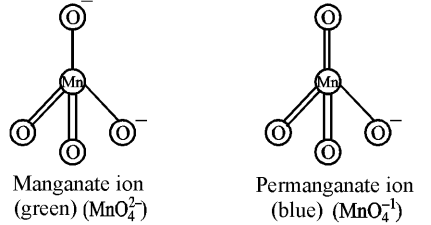
Permanganate ion $\left( MnO _4^{-}\right)$gives different reduction products at different concentration of hydrogen ions, write their equations.
Answer
View full question & answer→The products formed in the reduction reaction of permanganate ion depend on the concentration of hydrogen ion. The reactions occurring at different concentration of $H ^{+}$ are as follows:
$
\begin{aligned}
MnO_{+7}^{-}+e^{-} & \rightarrow \underset{+6}{MnO_4^{2-}} \\
MnO_4^{-}+4 H^{+}+3 e^{-} & \rightarrow \underset{+4}{MnO_2}+2 H_2 O \\
MnO_4^{-}+8 H^{+}+5 e^{-} & \rightarrow Mn^{2+}+4 H_2 O
\end{aligned}
$
Water should be oxidized by permanganate ion at $\left[ H ^{+}\right]$ $=1$ but this reaction happens very slowly but in this. The rate of reaction increases by using $Mn ^{2+}$ ion as a catalyst or by increasing the temperature.
$
\begin{aligned}
MnO_{+7}^{-}+e^{-} & \rightarrow \underset{+6}{MnO_4^{2-}} \\
MnO_4^{-}+4 H^{+}+3 e^{-} & \rightarrow \underset{+4}{MnO_2}+2 H_2 O \\
MnO_4^{-}+8 H^{+}+5 e^{-} & \rightarrow Mn^{2+}+4 H_2 O
\end{aligned}
$
Water should be oxidized by permanganate ion at $\left[ H ^{+}\right]$ $=1$ but this reaction happens very slowly but in this. The rate of reaction increases by using $Mn ^{2+}$ ion as a catalyst or by increasing the temperature.