Questions

4 Marks Each

🎯

Test yourself on this topic

13 questions · timed · auto-graded

Question 14 Marks

Write SQL queries for (i) to (iv) and find outputs for SQL queries (v) to (viii), which are based on the tables.


Table: VEHICLE

Code VTYPE PERKM
101 VOLVO BUS 160
102 AC DELUXE BUS 150
103 ORDINARY BUS 90
105 SUV 40
104 CAR 20

Note:

•PERKM is Freight Charges per kilometer

•VTYPE is Vehicle Type

NO NAME TDATE KM CODE NOP
101 Janish Kin 2015-11-13 200 101 32
103 Vedika sahai 2016-04-21 100 103 45
105 Tarun Ram 2016-03-23 350 102 42
102 John Fen 2016-02-13 90 102 40
107 AhmedKhan 2015-01-10 75 104 2
104 Raveena 2015-05-28 80 105 4
106 Kripal Anya 2016-02-06 200 101 25

Note:

•NO is Traveller Number

•KM is Kilometer travelled

•NOP is number of travellers travelled in vehicle

•TDATE is Travel Date

(i) To display NO, NAME, TDATE from the table TRAVEL in descending order of NO.

(ii) To display the NAME of all the travellers from the table TRAVEL who are travelling by vehicle with code 101 or 102.

(iii) To display the NO and NAME of those travellers from the table TRAVEL who travelled between ‘2015-12-31 ’and ‘2015-04-01 ’.

(iv) To display all the details from table TRAVEL for the travellers, who have travelled distance more than 100 KM in ascending order of NOP.

(v) SELECT COUNT (*), CODE FROM TRAVEL GROUP BY CODE HAVING COUNT(*)>1;

(vi) SELECT DISTINCT CODE FROM TRAVEL;

(vii) SELECT A.CODE,NAME,VTYPE FROM TRAVEL A,VEHICLE B WHERE A.CODE=B. CODE AND KM <90;

(viii) SELECT NAME,KM*PERKM FROM TRAVEL A, VEHICLE B WHERE A.CODE=B.CODE AND A.CODE=‘105 ’;

Answer

(i) Select no, name, tdate from travel order by no desc;

(ii) Select name from travel where code=101 or code=102;

(iii) Select no, name from travel where tdate between ‘2015-04-01 ’and ‘2015-12-31 ’;

(iv) Select * from travel where km >100 order by nop;

(v) Count(*) Code
2 101
2 102

(vi) Distinct code
101
102
103
104
105

(vii) Code Name Vtype

104

105

Ahmed khan

Raveena

Car

SUV

(viii) Name km*perkm

Raveena 3200
View full question & answer
Question 24 Marks
Consider the following DEPT and EMPLOYEE tables. Write SQL queries for (i) to (iv) and find outputs for SQL queries
(v) to (viii).

Table: DEPT

DCODE DEPARTMENT LOCATION
D01 INFRASTRUCTURE DELHI
D02 MARKETING DELHI
D03 MEDIA MUMBAI
D05 FINANCE KOLKATA
D04 HUMAN RESOURCE MUMBAI

Table: EMPLOYEE

ENO NAME DOJ DOB GENDER DCODE
1001 George K 2013-09-02 1991-09-01 MALE D01
1002 Ryma Sen 2012-12-11 1990-12-15 FEMALE D03
1003 Mohitesh 2013-02-03 1987-09-04 MALE D05
1007 Anil Jha 2014-01-17 1984-10-19 MALE D04
1004 Manila Sahai 2012-12-09 1986-11-14 FEMALE D01
1005 R SAHAY 2013-11-18 1987-03-31 MALE D02
1006 Jaya Priya 2014-06-09 1985-06-23 FEMALE D05

Note: DOJ refers to date of joining and DOB refers to date of Birth of employees.

(i) To display Eno, Name, Gender from the table EMPLOYEE in ascending order of Eno.

(ii) To display the Name of all the MALE employees from the table EMPLOYEE.

(iii) To display the Eno and Name of those employees from the table EMPLOYEE who a born between ‘1987‐01‐01 ’and ‘1991‐12‐01 ’.

(iv) To count and display FEMALE employees who have joined after ‘1986‐01‐01 ’.

(v) Select count(*),dcode from employee group by dcode having count(*)>1;

(vi) Select distinct department from dept;

(vii) Select name, department from employee e, dept d where e.dcode=d.dcode and en0 <1003;

(viii) select max(doj), min(dob) from employee;

Answer

(i) Select Eno,name,gender from employee order by eno;

(ii) Select name from employee where gender=’male ’;

(iii) Select Eno,name from employee where dob between ‘1987-01-01 ’and ‘1991-12-01 ’;

or

Select eno,name from employee where dob >=‘1987-01-01 ’and dob <=‘1991-12-01 ’;

or

select eno,name from employee where dob >‘1987-01-01 ’and dob <‘1991-12-01 ’;

(iv) Select count(*) from employee where gender=’female ’and doj >‘1986-01-01 ’;

or

Select * from employee where gender=’female ’and doj >‘1986-01-01 ’;

(v) Count Dcode

2

2

d01

d05

(vi) Department

Infrastructure

Marketing

Media

Finance

Human resource

(vii) Name Department

George k

Ryma sen

Infrastructure

Media

(viii) Max(doj) Min(dob)
20140609 19841019
View full question & answer
Question 34 Marks

Consider the following DEPT and WORKER tables. Write SQL queries for (i) to (iv) and find outputs for SQL queries (v) to (viii):

Table: DEPT

DCODE DEPARTMENT CITY
D01 MEDIA DELHI
D02 MARKETING DELHI
D03 INFRASTRUCTURE MUMBAI
D05 FINANCE KOLKATA
D04 HUMAN RESOURCE MUMBAI

Table: WORKER

WNO NAME DOJ DOB GENDER DCODE
1001 George K 2013-09-02 1991-09-01 MALE D01
1002 Ryma Sen 2012-12-11 1990-12-15 FEMALE D03
1003 Mohitesh 2013-02-03 1987-09-04 MALE D05
1007 Anil Jha 2014-01-17 1984-10-19 MALE D04
1004 Manila Sahai 2012-12-09 1986-11-14 FEMALE D01
1005 R SAHAY 2013-11-18 1987-03-31 MALE D02
1006 Jaya Priya 2014-06-09 1985-06-23 FEMALE D05

Note: DOJ refers to date of joining and DOB refers to date of Birth of workers.

(i) To display Wno, Name, Gender from the table WORKER in descending order of Wno.

(ii) To display the Name of all the FEMALE workers from the table WORKER.

(iii) To display the Wno and Name of those workers from the table WORKER who are born between ‘1987-01-01 ’and ‘1991-12-01 ’.

(iv) To count and display MALE workers who have joined after ‘1986-01-01 ’.

(v) SELECT COUNT(*), DCODE FROM WORKER GROUP BY DCODE HAVING COUNT(*)>1;

(vi) SELECT DISTINCT DEPARTMENT FROM DEPT;

(vii) SELECT NAME, DEPARTMENT, CITY FROM WORKER W,DEPT D WHERE W.DCODE=D.DCODE AND WNO <1003;

(viii) SELECT MAX(DOJ), MIN(DOB) FROM WORKER;

Answer

(i) SELECT Wno,Name,Gender FROM Worker ORDER BY Wno DESC;

(ii) SELECT Name FROM Worker WHERE Gender=’FEMALE ’;

(iii) SELECT Wno, Name FROM Worker WHERE DOB BETWEEN ‘1987-01-01 ’AND ‘1991-12-01 ’;

OR

SELECT Wno, Name FROM Worker WHERE DOB >=‘1987-01-01 ’AND DOB <=‘1991-12-01 ’

(iv) SELECT COUNT(*) FROM Worker WHERE GENDER=’MALE ’AND DOJ >‘1986-01-01 ’;

(v) COUNT(*) DCODE

2

2

D01

D05

(vi) Department

MEDIA

MARKETING

Infrastructure

Finance

Human Resource

(vii) Name Department City

George K

Ryma Sen

Media

Infrastructure

Delhi

Mumbai

(viii) Max(doj) Min(dob)
2014-06-09 1984-10-19
View full question & answer
Question 44 Marks

Answer the (a) and (b) on the basis of the following tables STORE and ITEM:

Table: STORE

SNo SName AREA
S01 ABC Computronics GK II
S02 All Infotech Media CP
S03 Tech Shoppe Nehru Place
S05 Hitech Tech Store CP

Table: ITEM

INo IName Price SNo
T01 Mother Board 12000 S01
T02 Hard Disk 5000 S01
T03 Keyboard 500 S02
T04 Mouse 300 S01
T05 Mother Board 13000 S02
T06 Key Board 400 S03
T07 LCD 6000 S04
T08 LCD 5500 S05
T09 Mouse 350 S05
T10 Hard disk 4500 S03

(a) Write the SQL queries (1 to 4):

(i) To display IName and Price of all the items in the ascending order of their Price.

(ii) To display the SNo and SName or all stores located in CP.

(iii) To display the minimum and maximum price of each IName from the table Item.

(iv) To display the IName, price of all items and their respective SName where they are available.

(b) Write the output of the following SQL commands (i) to (iv):

(i) Select distinct iname from item where price >= 5000;

(ii) Select area, count(*) from store group by area;

(iii) Select count(distinct area) from store;

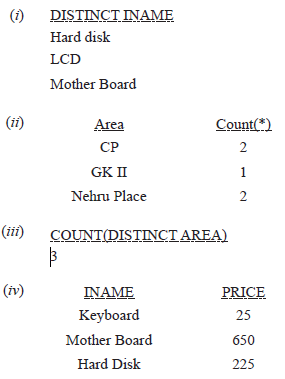
(iv) Select iname, price*0.05 discount from item where sno in (‘s02 ’, ‘s03 ’);

Answer

(a) (i) SELECT IName, price from Item ORDER BY Price;

(ii) SELECT SNo, SName FROM Store WHERE Area=’CP ’;

(iii) SELECT IName, MIN(Price), MAX(Price) FROM Item GROUP BY IName;

(iv) SELECT IName, Price, SName FROM Item, Store Where Item.SNo =Store.SNo;

(b)

View full question & answer
Question 54 Marks
Write SQL queries for (a) to (f) and write the outputs for the SQL queries mentioned shown in (g1) to (g4) parts on the basis of tables ITEMS and TRADERS:

Table: ITEMS

CODE INAME QTY PRICE COMPANY TCODE
1001 DIGITAL
PAD 12i
120 11000 XENITA T01
1006 LED
SCREEN 40
70 38000 SANTORA T02
1004 CAR GPS
SYSTEM
50 21500 GEOKNOW T01
1003 DIGITAL
CAMERA
12X
160 8000 DIGICLICK T02
1005 PEN DRIVE
32GB
600 1200 STOREHOME T03

Table: TRADERS

TCode TName CITY
T01 ELECTRONIC SALES MUMBAI
T03 BUSY STORE CORP DELHI
T02 DISP HOUSE INC CHENNAI

(a) To display the details of all the items in the ascending order of item names (i.e. INAME).

(b) To display item name and price of all those items, whose price is in range of 10000 and 22000 (both values inclusive).

(c) To display the number of items, which are traded by each trader. The expected output of this query should be:

T01 2

T02 2

T03 1

(d) To display the price, item name and quantity (i.e. qty) of those items which have quantity more than 150.

(e) To display the names of those traders, who are either from DELHI or from MUMBAI.

(f) To display the names of the companies and the names of the items in descending order of company names.

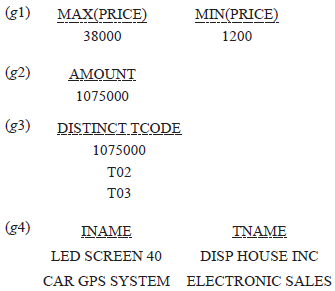
(g1) Select max(price), min(price) from items;

(g2) Select price*qty amount from items where code=1004;

(g3) Select distinct tcode from items;

(g4) Select iname, tname from items i, traders t where i.tcode=t.tcode and qty <100;

Answer

(a) SELECT * FROM ITEMS ORDER BY INAME;

(b) SELECT INAME, PRICE FROM ITEMS WHERE PRICE BETWEEN 10000 AND 22000;

(c) SELECT TCODE, COUNT(*) FROM ITEMS GROUP BY TCODE;

(d) SELECT PRICE, INAME, QTY FROM ITEMS WHERE QTY >150;

(e) SELECT INAME FROM TRADERS WHERE CITY IN (‘DELHI ’, ‘MUMBAI ’);

(f) SELECT COMPANY, INAME FROM ITEMS ORDER BY COMPANY DESC;

View full question & answer
Question 64 Marks

Consider the following tables CARHUB and CUSTOMER and answer (a) and (b) parts of this question:

Table: CARHUB

Vcode VehicleName Make Color Capacity Charges
100 Innova Toyota WHITE 7 15
102 SX4 Suzuki BLUE 4 14
104 C Class Mercedes RED 4 35
105 A-Star Suzuki WHITE 3 14
108 Indigo Tata SILVER 3 12

Table: CUSTOMER

CCode CName VCode
1 Hemant Sahu 101
2 Raj Lal 108
3 Feroza Shah 105
4 Ketan Dhal 104

(a) Write SQL commands for the following statements:

(i) To display the names of all white colored vehicles

(ii) To display name of vehicle, make and capacity of vehicles in ascending order of their sitting capacity

(iii) To display the highest charges at which a vehicle can be hired from CARHUB.

(iv) To display the customer name and the corresponding name of the vehicle hired by them.

(b) Give the output of the following SQL queries:

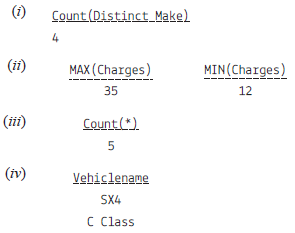
(i) Select count(distinct make) from cabhub;

(ii) Select max(charges), min(charges) from carhub;

(iii) Select count(*), make from carhub;

(Iv) Select vehiclename from carhub where capacity = 4;

Answer

(a) (i) Select vehiclename from carhub where color = ‘white ’;

(ii) Select vehiclename, make, capacity from carhub order by capacity;

(iii) Select max(charges) from carhub;

(iv) Select cname, vehiclename, from customer, carhub where customer.vcode = carhub. vcode;

(b)

View full question & answer
Question 74 Marks

Consider the following tables WORKER and PAYLEVEL and answer (a) and (b) parts of this question:

Relation: WORKER

ECODE NAME DESIG PAYLEVEL DOJ DOB
11 Radhey Shyam Supervisor P001 13-Sep-2004 23-Aug-1981
12 Chander Nath Operator P003 22-Feb-2010 12-Jul-1987
13 Fizza Operator P003 14-June-2009 14-Oct-1983
15 Ameen Ahmed Mechanic P002 21-Aug-2006 13-Mar-1984
18 Sanya Clerk P002 19-Dec-2005 09-June-1983

Relation: PAYLEVEL

PAYLEVEL PAY ALLOWANCE
P001 26000 12000
P002 22000 10000
P003 12000 6000

(a) Write SQL commands for the following statements:

(i) To display the details of all WORKERs in descending order of DOB.

(ii) To display NAME and DESIG of those WORKERs whose PLEVEL is either P001 or P002.

(iii) To display the content of all the WORKERs table, whose DOB is in between ’19-JAN- 1984 ’and ’18-JAN-1987 ’.

(iv) To add a new row with the following: 19, ‘Daya kishore ’, ‘Operator ’, ‘P003 ’, ’19-Jun-2008 ’, ’11-Jul-1984 ’

(b) Give the output of the following SQL queries:

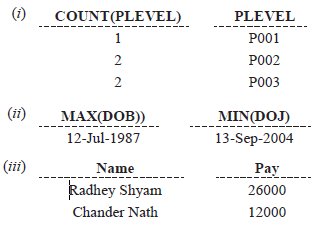
(i) Select count(plevel), plevel from worker group by plevel;

(ii) Select max(dob), min(doj) from worker;

(iii) Select name, pay from worker w, paylevel p where w.plevel=p.plevel and w.ecode <13;

(iv) Select plevel, pay+allowance from paylevel where plevel=’p003 ’;

Answer
(a) (i) SELECT * FROM WORKER ORDER BY DOB DESC;

(ii) SELECT NAME, DESIG FROM WORKER WHERE PLEVEL IN (“P001 ”, “P002 ”);

(iii) SELECT * FROM WORKER WHERE DOB BETWEEN “19-JAN-1984 ”AND “18- JAN-1987 ”;

(iv) INSERT INTO WORKER VALUES(19, ‘Daya kishore ’, ‘Operator ’, ‘P003 ’, ’19-Jun-2008 ’, ’11-Jul-1984 ’);

(b)

View full question & answer
Question 84 Marks

Consider the following tables GAMES and PLAYER. Write SQL commands for the statements (a) to (d) and give outputs for SQL queries (e1) to (e4)

Relation: GAMES

GCode Game Name Number Prize Money Schedule Date
101 Carom Board 2 5000 23-Jan-2004
102 Badminton 2 12000 12-Dec-2003
103 Table Tennis 4 8000 14-Feb-2004
105 Chess 2 9000 01-Jan-2004
108 Lawn Tennis 4 25000 19-Mar-2004

Relation: PLAYER

PCode Name Gcode
1 Nabi Ahmad 101
2 Ravi Sahai 108
3 Jatin 101
4 Nazneen 103

(a) To display the name of all Games with their Gcodes

(b) To display details of those games which are having PrizeMoney more than 7000.

(c) To display the content of the GAMES table in ascending order of ScheduleDate.

(d) To display sum of PrizeMoney for each of the Number of participation groupings (as shown in column Number)

(e1) Select COUNT(DISTINCT Number) FROM GAMES;

(e2) Select MAX(ScheduleDate),MIN(ScheduleDate) FROM GAMES;

(e3) Select SUM(PrizeMoney) FROM GAMES;

(e4) Select DISTINCT Gcode FROM PLAYER;

Answer

(a) SELECT GAMENAME, GCODE FROM GAMES;

(b) SELECT * FROM GAMES WHERE PRIZE MONEY >7000;

(c) SELECT * FROM GAMES ORDER BY SCHEDULEDATE;

(d) SELECT NUMBER, SUM(PRIZEMONEY) FROM GAMES GROUP BY NUMBER;

(e1) COUNT (DISTINCT NUMBER)

2

4

(e2) MAX(ScheduleDate) MIN(ScheduleDate)
----------------- -----------------
19-Mar-2004 12-Dec-2003

(e3) SUM (Prize Money)

59000

(e4) DISTINCT (GCODE)

101

108

103

View full question & answer
Question 94 Marks

Write SQL commands for (a) to (f) and write the outputs for (g) on the basis of tables FURNITURE and ARRIVALS

Table: FURNITURE

NO ITEMNAME TYPE DATEOFSTOCK PRICE DISCOUNT
1 White lotus Double Bed 23/02/2002 30000 25
2 Pink feather Baby cot 20/01/2002 7000 20
3 Dolphin Baby cot 19/02/2002 9500 20
4 Decent Office Table 01/01/2002 25000 30
5 Comfort zone Double Bed 12/01/2002 25000 25
6 Donald Baby cot 24/02/2002 6500 15
7 Royal Finish Office Table 20/02/2002 18000 30
8 Royal tiger Sofa 22/02/2002 31000 30
9 Econo sitting Sofa 13/12/2001 9500 25
10 Eating Paradise Dining Table 19/02/2002 11500 25

Table: ARRIVALS

NO ITEMNAME TYPE DATEOFSTOCK PRICE DISCOUNT
1 Wood Comfort Double Bed 23/03/2003 25000 25
2 Old Fox Sofa 20/02/2003 17000 20
3 Micky Baby cot 21/02/2003 7500 15

(a) To show all information about the Baby cots from the FURNITURE table.

(b) To list the ITEMNAME which are priced at more than 15000 from the FURNITURE table.

(c) To list ITEMNAME and TYPE of those items, in which date of stock is before 22/01/2002 from the FURNITURE table in descending order of ITEMNAME.

(d) To display ITEMNAME and DATEOFSTOCK of those items, in which the discount t percentage is more than 25 from FURNITURE table.

(e) To count the number of items, whose TYPE is “Sofa ”from FURNITURE table.

(f) To insert a new row in the ARRIVALS table with the following data:

14,“Valvet touch ”, “Double bed ”, {25/03/03}, 25000,30

(g) Give the output of following SQL statement

Note: Outputs of the above mentioned queries should be based on original data given in both the tables i.e., without considering the insertion done in (f) part of this question.

(i) Select COUNT(distinct TYPE) from FURNITURE;

(ii) Select MAX(DISCOUNT) from FURNITURE, ARRIVALS;

(iii) Select AVG(DISCOUNT) from FURNITURE where TYPE=”Baby cot ”;

(iv) Select SUM(Price) from FURNITURE where DATEOFSTOCK <12/02/02;

Answer

(a) SELECT * FROM FURNITURE WHERE TYPE = “Baby cot ”;

(b) SELECT ITEMNAME FROM FURNITURE WHERE PRICE >15000;

(c) SELECT ITEMNAME, TYPE FROM FURNITURE WHERE DATEOFSTOCK <”2002/01/22 ”ORDER BY ITEMNAME DESC;

(d) SELECT ITEMNAME, DATEOFSTOCK FROM FURNITURE WHERE DISCOUNT >25;

(e) SELECT COUNT(*) FROM FURNITURE WHERE TYPE=”Sofa ”;

(f) INSERT INTO ARRIVAL VALUES (14, “Valvet touch ”, “Double bed ”, “2003/03/03 ”);

(g) (i) 5

(ii) 30

(iii) 18.33

(iv) 65500

View full question & answer
Question 104 Marks

Write SQL commands for the following queries on the basis of Club relation given below:

Relation: Club

Coach-ID CoachName Age Sports date_of_app Pay Sex
1 Kukreja 35 Karate 27/03/1996 1000 M
2 Ravina 34 Karate 20/01/1998 1200 F
3 Karan 34 Squash 19/02/1998 2000 M
4 Tarun 33 Basketball 01/01/1998 1500 M
5 Zubin 36 Swimming 12/01/1998 750 M
6 Ketaki 36 Swimming 24/02/1998 800 F
7 Ankita 39 Squash 20/02/1998 2200 F
8 Zareen 37 Karate 22/02/1998 1100 F
9 Kush 41 Swimming 13/01/1998 900 M
10 Shailya 37 Basketball 19/02/1998 1700 M

(a) To show all information about the swimming coaches in the club.

(b) To list the names of all coaches with their date of appointment (date_of_app) in descending order.

(c) To display a report showing coach name, pay, age, and bonus (15% of pay) for all coaches.

(d) To insert a new row in the Club table with ANY relevant data:

(e) Give the output of the following SQL statements:

(i) Select COUNT(Distinct Sports) from Club;

(ii) Select Min(Age) from Club where SEX = “F ”;

Answer

(a) SELECT * FROM CLUB WHERE SPORTS = “Swimming ”;

(b) SELECT Name FROM CLUB ORDER BY date_ of_app desc;

(c) SELECT COACHNAME, PAY, AGE, PAY*15/100 AS BONUS FROM CLUB;

(d) INSERT INTO CLUB VALUES (11, “Neelam ”, 35, “Basketyball ”, “2000/04/01 ”, 2200, “F ”);

(e) (i) 4

(ii) 34

View full question & answer
Question 114 Marks

Write SQL commands for the following queries based on the relation Teacher given below:

Table: Teacher

No Name Age Department Date_of_join Salary Sex
1 Jugal 34 Computer 10/01/97 12000 M
2 Sharmila 31 History 24/03/98 20000 F
3 Sandeep 32 Maths 12/12/96 30000 M
4 Sangeeta 35 History 01/07/99 40000 F
5 Rakesh 42 Maths 05/09/97 25000 M
6 Shyam 50 History 27/06/98 30000 M
7 Shiv Om 44 Computer 25/02/97 21000 M
8 Shalakha 33 Maths 31/07/97 20000 F

(a) To show all information about the teacher of Computer department.

(b) To list the names of female teachers who are in Maths department.

(c) To list the names of all teachers with their date of joining in ascending order.

(d) To display teacher ’s name, salary, age for male teachers only.

(e) To count the number of teachers with Age >23.

Answer

(a) SELECT * FROM TEACHER WHERE DEPARTMENT = “Computer ”;

(b) SELECT NAME FROM TEACHER WHERE DEPARTMENT = “Maths ”AND SEX = “F ”;

(c) SELECT NAME FROM TEACHER ORDER BY DATE_OF_JOIN;

(d) SELECT NAME, SALARY, AGE FROM TEACHER WHERE SEX = “M ”;

(e) SELECT COUNT(*) FROM TEACHER WHERE AGE >23;

View full question & answer
Question 124 Marks

Consider the following tables Product and Client. Write SQL commands for the statements (i) to (iv) and give outputs for SQL queries (v) to (viii)

TABLE: PRODUCT

P_ID Product Name Manufacturer Price
TP01 Talcom Powder LAK 40
FW05 FaceWash ABC 45
BS01 Bath Soap ABC 55
SH06 Shampoo XYZ 120
FW12 Face Wash XYZ 95

TABLE: CLIENT

C_ID ClientName City P_ID
01 Cosmetic Shop Delhi FW05
06 Total Health Mumbai BS01
12 Live Life Delhi SH06
15 Pretty Woman Delhi FW12
16 Dreams Bangalore TP01

(i) To display the details of those Clients whose City is Delhi

(ii) To display the details of Products whose Price is in the range of 50 to 100 (Both values included)

(iii) To display the ClientName, City from Table Client, and ProductName and Price from table Product, with their corresponding matching P_ID

(iv) To increase the Price of all Products by 10

(v) SELECT DISTINCT CITY FROM Client;

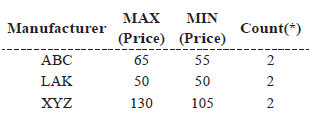
(vi) SELECT Manufacturer, MAX(Price), Min(Price), Count(*) FROM Product GROUP BY Manufacturer;

(vii) SELECT ClientName, ManufacturerName FROM Product, Client WHERE Client.Prod_Id = Product.P_Id;

Answer
(i) Select * from client where city=”Delhi ”;

(ii) Select * from product where price between 50 and 100;

(iii) Select a.clientname,a.city ,b.productname, b.price from client a, product b where a.P_ID and b.P_ID;

(iv) Update product set price = price +10;

(v) City

Banglore

Delhi

Mumbai

(vi)

(vii)

Client Name Manufacturer
Total Health ABC
Cosmetic Shop ABC
Pretty Woman XYZ
Live Life XYZ
Dreams LAK
View full question & answer
Question 134 Marks

Write the SQL query questions from (i) to (iv) and write the output of SQL command for questions from (v) to (vii) given below:

Table: EMPLOYEES

EMPID FIRST NAME LAST NAME ADDRESS CITY
010 George Smith 83 First
Street
Howard
105 Mary Jones 842 Vine
Ave.
Losantiville
152 Sam Tones 33 Elm St. Paris
215 Sarah Ackerman 440 U.S. 110 Upton
244 Manila Sengupta 24 Friends
Street
New Delhi
300 Robert Samuel 9 Fifth Cross Washington
335 Henry Williams 12 Moore
Street
Boston
400 Rachel Lee 121 Harrison
St.
New York
441 Peter Thompson 11 Red Road Paris

Table: EMPSALARY

EMPID SALARY BENEFITS DESIGNATION
010 75000 15000 Manager
105 65000 15000 Manager
152 80000 25000 Director
215 75000 12500 Manager
244 50000 12000 Clerk
300 45000 10000 Clerk
355 40000 10000 Clerk
4000 32000 7500 Salesman
441 28000 7500 Salesman

Write the SQL commands for the following :

(i) To show firstname, lastname, address and city of all employees living in paris.

(ii) To display the content of Employees table in ascending order of Firstname.

(iii) To display the firstname,lastname and total salary of all managers from the tables employee and empsalary, where total salary is calculated as salary+benefits.

(iv) To display the maximum salary among managers and clerks from the table Empsalary.

Give the Output of following SQL commands:

(v) Select firstname, salary from employees, empsalary where designation = ‘Salesman ’and Employees.

empid=Empsalary.empid;

(vi) Select count(distinct designation) from empsalary;

(vii) Select designation, sum(salary) from empsalary group by designation having count(*) >2;

Answer
(i) Select FIRSTNAME, LASTNAME, ADDRESS, CITY From EMPLOYEES

Where CITY= ‘Paris ’;

(ii) Select * From EMPLOYEES

Order By FIRSTNAME;

(iii) Select FIRSTNAME, LASTNAME, SALARY + BENEFITS "TOTAL SALARY "From EMPLOYEES, EMPSALARY

Where EMPLOYEES.EMPID=EMPSALARY.

EMPID;

(iv) Select Max(SALARY) From EMPSALARY Where DESIGNATION = 'Manager' OR

DESIGNATION = ‘Clerk ’;

(v) FIRSTNAME SALARY

Rachel 32000

Peter 28000

(vi) COUNT (DISTINCT DESIGNATION)
4
(vii) DESIGNATION SUM(SALARY)

Manager 215000

Clerk 135000

View full question & answer
Generate Paper FreeAll Database Management – SQL topics
4 Marks Each - Computer Science STD 12 Science Questions - Vidyadip