MCQ 1511 Mark
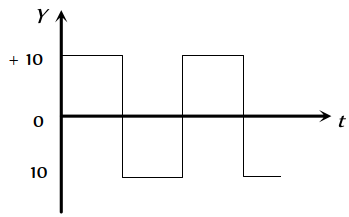
The r.m.s. voltage of the wave form shown is
- ✓
$10\ V$
- B
$7\ V$
- C
$6.37 V$
- D
AnswerCorrect option: A. $10\ V$
$V_{r m s}=\sqrt{\frac{1}{T} \int_0^T 10^2 d t}=10 \mathrm{~V}$
View full question & answer→MCQ 1521 Mark
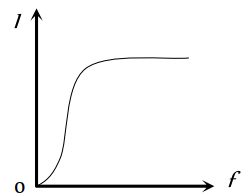
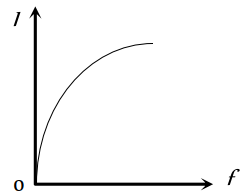
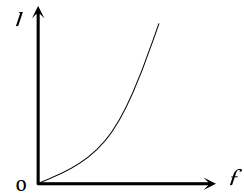
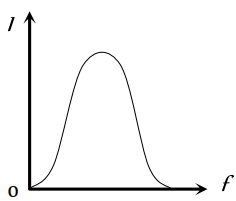
An ac source of variable frequency $f$ is connected to an $L C R$ series circuit. Which one of the graphs in figure. represents the variation of current of current $l$ in the circuit with frequency $f$
AnswerAs explained in solution (1) for frequency $0-f_r, Z$ decreases hence $(i=V / Z)$, increases and for frequency $f_r-\infty, Z$ increases hence $i$ decrees.
View full question & answer→MCQ 1531 Mark
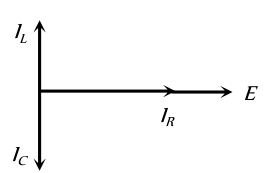
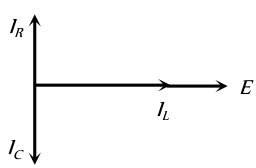
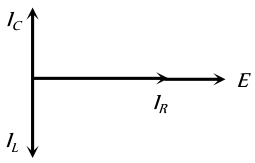
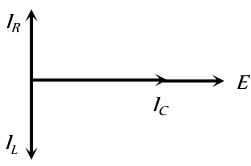
An alternating emf is applied across a parallel combination of a resistance $R$, capacitance $C$ and an inductance $L$. If $l, l, l$ are the currents through $R, L$ and $C$ respectively, then the diagram which correctly represents, the phase relationship among $l, l, l$ and source emf $E$, is given by
AnswerI lags behind $I$ by a phase of $\frac{\pi}{2}$, while $/$ leads by a phase of $\frac{\pi}{2}$
View full question & answer→MCQ 1541 Mark
The figure shows variation of $R, X$ and $X$ with frequency $f$ in a series $L, C, R$ circuit. Then for what frequency point, the circuit is inductive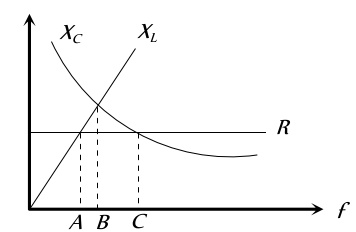
- A
(a) $A$
- B
(b) $B$
- ✓
(c) $C$
- D
AnswerCorrect option: C. (c) $C$
(c) At $A: X_C>X_L$At $B: X_C=X_L$At $C: X_C
View full question & answer→MCQ 1551 Mark
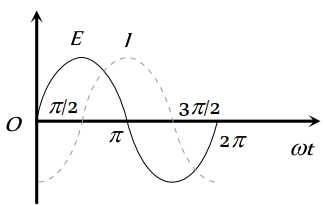
The variation of the instantaneous current $(I)$ and the instantaneous emf $(E)$ in a circuit is as shown in fig. Which of the following statements is correct
- A
The voltage lags behind the current by $\pi / 2$
- ✓
The voltage leads the current by $\pi / 2$
- C
The voltage and the current are in phase
- D
The voltage leads the current by $\pi$
AnswerCorrect option: B. The voltage leads the current by $\pi / 2$
At $t=0$, phase of the voltage is zero, while phase of the current is $-\frac{\pi}{2}$ i.e., voltage leads by $\frac{\pi}{2}$
View full question & answer→MCQ 1561 Mark
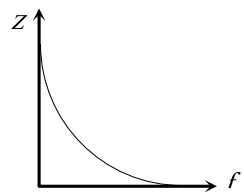
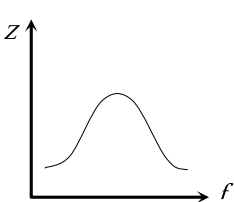
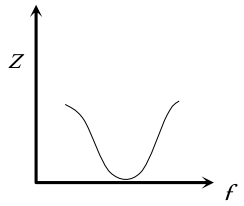
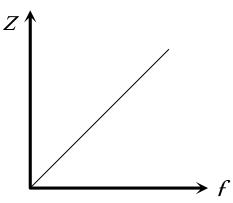
Which one of the following curves represents the variation of impedance $(Z)$ with frequency $f$ in series $L C R$ circuit
Answer$Z=\sqrt{R^2+\left(2 \pi f L-\frac{1}{2 \pi f C}\right)^2}$From above equation at $f=0 \Rightarrow z=\infty$When $f=\frac{1}{2 \pi \sqrt{L C}}$ (resonant frequency) $\Rightarrow Z=R$For $f>\frac{1}{2 \pi \sqrt{L C}} \Rightarrow Z$ starts increasing.i.e., for frequency $0-f, Z$ decreasesand for $f$ to $\infty, Z$ increases. This is justified by graph $c$.
View full question & answer→MCQ 1571 Mark
In a series circuit $C=2 \mu F, L=1 mH$ and $R=10 \Omega$, when the current in the circuit is maximum, at that time the ratio of the energies stored in the capacitor and the inductor will be
- A
$1: 1$
- B
$1: 2$
- C
$2: 1$
- ✓
$1: 5$
AnswerCorrect option: D. $1: 5$
(d) Current will be maximum in the condition of resonance so$i_{\max }=\frac{V}{R}=\frac{V}{10} A$
Energy stored in the coil $W_L=\frac{1}{2} L i_{\max }^2=\frac{1}{2} L\left(\frac{E}{10}\right)^2$
$=\frac{1}{2} \times 10^{-3}\left(\frac{E^2}{100}\right)=\frac{1}{2} \times 10^{-5} E^2 \text { joule }$
$\therefore$ Energy stored in the capacitor
$W_C=\frac{1}{2} C E^2=\frac{1}{2} \times 2 \times 10^{-6} E^2=10^{-6} E^2 \text { joule } $
$\therefore \frac{W_C}{W_L} =\frac{1}{5}$
View full question & answer→MCQ 1581 Mark
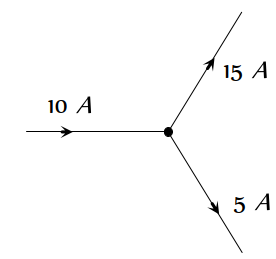
Is it possible
- ✓
- B
- C
- D
Insufficient data to reply
View full question & answer→MCQ 1591 Mark
If $i=t^2 \quad 0
AnswerCorrect option: C. (c) $\frac{T^2}{\sqrt{5}}$
(c) $i_{r m s}=\sqrt{\frac{1}{T} \int_0^T i^2 d t}=\frac{T^2}{\sqrt{5}}$
View full question & answer→MCQ 1601 Mark
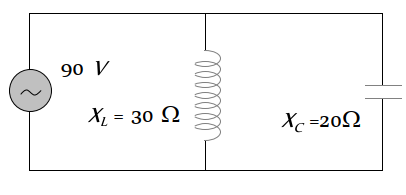
In the adjoining figure the impedance of the circuit will be
- A
$12\ ohm$
- B
$50\ ohm$
- ✓
$60\ ohm$
- D
$90\ ohm$
AnswerCorrect option: C. $60\ ohm$
$i_L=\frac{90}{30}=3 \mathrm{~A}, \quad i_C=\frac{90}{20}=4.5 \mathrm{~A}$
Net current through circuit $i=i_C-i_L=1.5 \mathrm{~A}$
$\therefore Z=\frac{V}{i}=\frac{90}{1.5}=60 \Omega$
View full question & answer→MCQ 1611 Mark
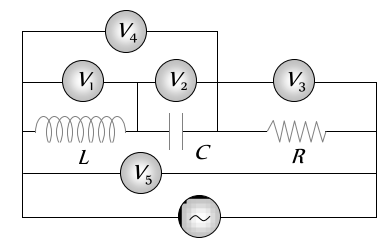
In the adjoining ac circuit the voltmeter whose reading will be zero at resonance is
- A
(a) $V$
- B
(b) $\quad V$
- C
(c) $\quad V$
- ✓
(d) $V$
AnswerCorrect option: D. (d) $V$
(d) At resonance net voltage across $L$ and $C$ is zero.
View full question & answer→MCQ 1621 Mark
For a series $R L C$ circuit $R=X=2 X$. The impedance of the circuit and phase difference (between) $V$ and $i$ will be
- A
$\frac{\sqrt{5} R}{2}, \tan ^{-1}(2)$
- ✓
$\frac{\sqrt{5} R}{2}, \tan ^{-1}\left(\frac{1}{2}\right)$
- C
$\sqrt{5} X_C, \tan ^{-1}(2)$
- D
$\sqrt{5} R, \tan ^{-1}\left(\frac{1}{2}\right)$
AnswerCorrect option: B. $\frac{\sqrt{5} R}{2}, \tan ^{-1}\left(\frac{1}{2}\right)$
$ X_L=R, X_C=R / 2$
$ \therefore \tan \phi=\frac{X_L-X_C}{R}=\frac{R-\frac{R}{2}}{R}=\frac{1}{2}$
$\Rightarrow \phi=\tan ^{-1}(1 / 2)$
Also $Z=\sqrt{R^2+\left(X_L-X_C\right)^2}=\sqrt{R^2+\frac{R^2}{4}}=\frac{\sqrt{5}}{2} R$
View full question & answer→MCQ 1631 Mark
An $L C R$ series circuit with a resistance of $100 ohm$ is connected to an ac source of $200 V($ r.m.s. $)$ and angular frequency $300 rad / s$. When only the capacitor is removed, the current lags behind the voltage by $60^{\circ}$. When only the inductor is removed the current leads the voltage by $60^{\circ}$. The average power dissipated is
- A
$50 W$
- B
$100 W$
- C
$200 W$
- ✓
$400 W$
AnswerCorrect option: D. $400 W$
$ \tan \phi=\frac{X_L}{R}=\frac{X_C}{R} \Rightarrow \tan 60^{\circ}=\frac{X_L}{R}=\frac{X_C}{R} $
$ \Rightarrow X_L=X_C=\sqrt{3} R$
i.e. $Z=\sqrt{R^2+\left(X_L-X_C\right)^2}=R$
So average power $P=\frac{V^2}{R}=\frac{200 \times 200}{100}=400 \mathrm{~W}$
View full question & answer→MCQ 1641 Mark
An ac source of angular frequency $\omega$ is fed across a resistor $r$ and a capacitor $C$ in series. The current registered is $l$. If now the frequency of source is changed to $\omega / 3$ (but maintaining the same voltage), the current in then circuit is found to be halved. Calculate the ratio of reactance to resistance at the original frequency $\omega$
- ✓
$\sqrt{\frac{3}{5}}$
- B
$\sqrt{\frac{1}{5}}$
- C
$\sqrt{\frac{2}{5}}$
- D
$\sqrt{\frac{4}{5}}$
AnswerCorrect option: A. $\sqrt{\frac{3}{5}}$
At angular frequency $\omega$, the current in $R C$ circuit is given by$i_{r m s}=\frac{V_{r m s}}{\sqrt{R^2+\left(\frac{1}{\omega C}\right)^2}}$
Also $\frac{i_{r m s}}{2}=\frac{V_{r m s}}{\sqrt{R^2+\left(\frac{1}{\frac{\omega}{3} C}\right)^2}}=\frac{V_{r m s}}{\sqrt{R^2+\frac{9}{\omega^2 C^2}}}$
From equation (i) and (ii) we get $3 R^2=\frac{5}{\omega^2 C^2} \Rightarrow \frac{\frac{1}{\omega C}}{R}=\sqrt{\frac{3}{5}} \Rightarrow \frac{X_C}{R}=\sqrt{\frac{3}{5}}$
View full question & answer→MCQ 1651 Mark
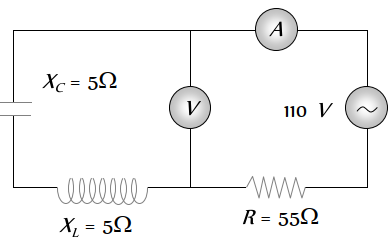
The reading of ammeter in the circuit shown will be
- A
$2\ A$
- B
$2.4\ A$
- ✓
- D
$1.7\ A$
AnswerGiven $X_L=X_C=5 \Omega$, this is the condition of resonance.
So $V_L=V_C$, so net voltage across $L$ and $C$ combination will be zero.
View full question & answer→MCQ 1661 Mark
Match the following Currents(1) $x_0 \sin \omega t$(2) $x_0 \sin \omega t \cos \omega t$(3) $x_0 \sin \omega t+x_0 \cos \omega t$(a) 1. (i), 2. (ii), 3. (iii)(c) 1. (i), 2. (iii), 3. (ii)r.m.s. values(i) $x$(ii) $\frac{x_0}{\sqrt{2}}$ (iii) $\frac{x_0}{(2 \sqrt{2})}$
- A
(a) 1. (i), 2. (ii), 3. (iii)
- ✓
(b) 1. (ii), 2. (iii), 3. (i)
- C
(c) 1. (i), 2. (iii), 3. (ii)
- D
AnswerCorrect option: B. (b) 1. (ii), 2. (iii), 3. (i)
(b) 1. $r m s$ value $=\frac{\lambda_0}{\sqrt{2}}$2. $x_0 \sin \omega t \cos \omega t=\frac{x_0}{2} \sin 2 \omega t \Rightarrow r m s$ value $=\frac{\mathrm{x}_0}{2\sqrt{2}}$3. $x_0 \sin \omega t+x_0 \cos \omega t \Rightarrow r m s$ value $=\sqrt{\left(\frac{x_0}{\sqrt{2}}\right)^2+\left(\frac{x_0}{\sqrt{2}}\right)^2}$$=\sqrt{x_0^2}=x_0$
View full question & answer→MCQ 1671 Mark
In a certain circuit current changes with time according to $i=2 \sqrt{t}$. r.m.s. value of current between $t=2$ to $t=4 s$ will be
- A
$3\ A$
- B
$3 \sqrt{3}\ A$
- ✓
$2 \sqrt{3}\ A$
- D
$(2-\sqrt{2})\ A$
AnswerCorrect option: C. $2 \sqrt{3}\ A$
$\overline{i^2} =\frac{\int i^2 d t}{\int d t}=\frac{\int_2^4(4 t) d t}{\int_2^4 d t}=\frac{4 \int_2^4 t d t}{2}=2\left[\frac{t^2}{2}\right]_2^4=\left[t^2\right]_2^4=12$
$ \Rightarrow i_{m s}=\sqrt{i^2}=\sqrt{12}=2 \sqrt{3} \mathrm{~A}$
View full question & answer→MCQ 1681 Mark
A telephone wire of length $200\ km$ has a capacitance of $0.014\ \mu F$ per $km$. If it carries an ac of frequency $5\ kHz$, what should be the value of an inductor required to be connected in series so that the impedance of the circuit is minimum
- ✓
$0.35\ mH$
- B
$35\ mH$
- C
$3.5\ mH$
- D
AnswerCorrect option: A. $0.35\ mH$
Capacitance of wire
$C=0.014 \times 10^{-6} \times 200=2.8 \times 10^{-6} F=2.8 \mu F$
For impedance of the circuit to be minimum $X_L=X_C \Rightarrow 2 \pi \nu L=\frac{1}{2 \pi \nu C}$
$\Rightarrow L=\frac{1}{4 \pi^2 \nu^2 C}=\frac{1}{4(3.14)^2 \times\left(5 \times 10^3\right)^2 \times 2.8 \times 10^{-6}}$
$=0.35 \times 10^{-3} H=0.35\ mH$
View full question & answer→MCQ 1691 Mark
The process by which ac is converted into dc is known as
MCQ 1701 Mark
The r.m.s. voltage of domestic electricity supply is $220$ volt . Electrical appliances should be designed to withstand an instantaneous voltage of
- A
$220 V$
- ✓
$311 V$
- C
$330 V$
- D
$440 V$
AnswerCorrect option: B. $311 V$
Peak voltage $=\sqrt{2} \times 220=311 \mathrm{~V}$
View full question & answer→MCQ 1711 Mark
The voltage of domestic ac is $220$ volt. What does this represent
View full question & answer→MCQ 1721 Mark
The root mean square value of the alternating current is equal to
AnswerCorrect option: C. $\frac{1}{\sqrt{2}}$ times the peak value
View full question & answer→MCQ 1731 Mark
The peak value of an Alternating current is $6$ amp, then r.m.s. value of current will be
- A
$3\ A$
- B
$3 \sqrt{3} \ A$
- ✓
$3 \sqrt{2} \ A$
- D
$2 \sqrt{3}\ A$
AnswerCorrect option: C. $3 \sqrt{2} \ A$
$i_{r . m . s}=\frac{6}{\sqrt{2}}=3 \sqrt{2} \mathrm{~A}$
View full question & answer→MCQ 1741 Mark
In a circuit, the current lags behind the voltage by a phase difference of $\pi / 2$. The circuit contains which of the following
- A
Only $R$
- ✓
Only $L$
- C
Only $C$
- D
$R$ and $C$
AnswerCorrect option: B. Only $L$
View full question & answer→MCQ 1751 Mark
The resonant frequency of a circuit is $f$. If the capacitance is made 4 times the initial values, then the resonant frequency will become
- ✓
$f / 2$
- B
$2 f$
- C
$f$
- D
$f / 4$
AnswerCorrect option: A. $f / 2$
If the current is wattless then power is zero. Hence phase difference $\phi=90^{\circ}$
View full question & answer→MCQ 1761 Mark
A $12$ ohm resistor and a $0.21$ henry inductor are connected in series to an ac source operating at $20$ volts, $50$ cycle/second. The phase angle between the current and the source voltage is
- A
$30^{\circ}$
- B
$40^{\circ}$
- ✓
$80^{\circ}$
- D
$90^{\circ}$
AnswerCorrect option: C. $80^{\circ}$
$80^{\circ}$
View full question & answer→MCQ 1771 Mark
When $100$ volt $dc$ is applied across a coil, a current of $1$ amp flows through it. When $100$ volt $ac$ at $50$ cycle $S^{-1}$ is applied to the same coil, only $0.5$ ampere current flows. The impedance of the coil is
- A
$100 \Omega$
- ✓
$200 \Omega$
- C
$300 \Omega$
- D
$400 \Omega$
AnswerCorrect option: B. $200 \Omega$
$200 \Omega$
View full question & answer→MCQ 1781 Mark
The reactance of a $25 \mu F$ capacitor at the ac frequency of $4000\ Hz$ is
AnswerCorrect option: B. $\sqrt{\frac{5}{\pi}} ohm$
View full question & answer→MCQ 1791 Mark
In a series circuit $R=300 \Omega, L=0.9 H, C=2.0 \mu F$ and $\omega$ $=1000\ rad / \sec$. The impedance of the circuit is
- A
$1300 \Omega$
- B
$900 \Omega$
- ✓
$500 \Omega$
- D
$400 \Omega$
AnswerCorrect option: C. $500 \Omega$
$500 \Omega$
View full question & answer→MCQ 1801 Mark
An ac circuit consists of an inductor of inductance $0.5 H$ and a capacitor of capacitance $8 \mu F$ in series. The current in the circuit is maximum when the angular frequency of ac source is
- ✓
$500\ rad / sec$
- B
$2 \times 10 rad / sec$
- C
$4000\ rad / sec$
- D
$5000\ rad / sec$
AnswerCorrect option: A. $500\ rad / sec$
Current will be maximum at the condition of resonance.
So,$ \text { resonant frequency } \omega_0=\frac{1}{\sqrt{L C}}=\frac{1}{\sqrt{0.5 \times 8 \times 10^{-6}}}$
$ =500\ \mathrm{rad} / \mathrm{s}$
View full question & answer→MCQ 1811 Mark
An inductance of $1 mH$ a condenser of $10 \mu F$ and a resistance of 50 $\Omega$ are connected in series. The reactances of inductor and condensers are same. The reactance of either of them will be
- A
$100 \Omega$
- B
$30 \Omega$
- C
$3.2 \Omega$
- ✓
$10 \Omega$
AnswerCorrect option: D. $10 \Omega$
$ \text { Given } \omega L=\frac{1}{\omega C} \Rightarrow \omega^2=\frac{1}{L C} $
$ \text { or } \omega=\frac{1}{\sqrt{10^{-3} \times 10 \times 10^{-6}}}=\frac{1}{\sqrt{10^{-8}}}=10^4 $
$ X_L=\omega L=10^4 \times 10^{-3}=10 \Omega$
View full question & answer→MCQ 1821 Mark
A resistance of $300 \Omega$ and an inductance of $\frac{1}{\pi}$ henry are connected in series to a ac voltage of 20 volts and $200 Hz$ frequency. The phase angle between the voltage and current is
- ✓
$\tan ^{-1} \frac{4}{3}$
- B
$\tan ^{-1} \frac{3}{4}$
- C
$\tan ^{-1} \frac{3}{2}$
- D
$\tan ^{-1} \frac{2}{5}$
AnswerCorrect option: A. $\tan ^{-1} \frac{4}{3}$
Phase angle $\tan \phi=\frac{\omega L}{R}=\frac{2 \pi \times 200}{300} \times \frac{1}{\pi}=\frac{4}{3}$
$\therefore \phi=\tan ^{-1} \frac{4}{3}$
View full question & answer→MCQ 1831 Mark
A capacitor is a perfect insulator for
MCQ 1841 Mark
An inductive circuit contains resistance of $10 \Omega$ and an inductance of $20 H$. If an ac voltage of $120 V$ and frequency $60 Hz$ is applied to this circuit, the current would be nearly
- A
$0.32 amp$
- ✓
$0.016 amp$
- C
$0.48 amp$
- D
$0.80 amp$
AnswerCorrect option: B. $0.016 amp$
$i=\frac{V}{\sqrt{R^2+\omega^2 L^2}}=\frac{120}{\sqrt{100+4 \pi^2 \times 60^2 \times 20^2}}=0.016 \mathrm{~A}$
View full question & answer→MCQ 1851 Mark
A resonant ac circuit contains a capacitor of capacitance $10^{-6} F$ and an inductor of $10^{-4} H$. The frequency of electrical oscillations will be
- A
$10^5 Hz$
- B
$10 Hz$
- ✓
$\frac{10^5}{2 \pi} H z$
- D
$\frac{10}{2 \pi} H z$
AnswerCorrect option: C. $\frac{10^5}{2 \pi} H z$
$v=\frac{1}{2 \pi \sqrt{L C}}=\frac{1}{2 \pi \sqrt{10^{-6} \times 10^{-4}}}=\frac{10^5}{2 \pi} \mathrm{Hz}$
View full question & answer→MCQ 1861 Mark
A choke coil is preferred to a rheostat in ac circuit as
- ✓
It consumes almost zero power
- B
- C
- D
AnswerCorrect option: A. It consumes almost zero power
A choke coil contains high inductance but negligible resistance, due to which power loss becomes appreciably small.
View full question & answer→MCQ 1871 Mark
Current in the circuit is wattless, if
- A
Inductance in the circuit is zero
- ✓
Resistance in the circuit is zero
- C
- D
Resistance and inductance both are zero
AnswerCorrect option: B. Resistance in the circuit is zero
Resistance in the circuit is zero
View full question & answer→