MCQ 11 Mark
On centigrade scale the temperature of a body increases by $30$ degrees. The increase in temperature on Fahrenheit scale is
- A
$50^{\circ}$
- B
$40^{\circ}$
- C
$30^{\circ}$
- ✓
$54^{\circ}$
AnswerCorrect option: D. $54^{\circ}$
(d) Difference of $100^{\circ} \mathrm{C}=$ difference of $180^{\circ} \mathrm{F}$
$\therefore$ Difference of $30^{\circ}=\frac{180}{100} \times 30=54^{\circ}$
View full question & answer→MCQ 21 Mark
An iron bar of length $10 \mathrm{~m}$ is heated from $0^{\circ} \mathrm{C}$ to $100^{\circ} \mathrm{C}$. If the coefficient of linear thermal expansion of iron is $10 \times 10^{-} /{ }^{\circ} \mathrm{C}$, the increase in the length of bar is
- A
$0.5 \mathrm{~cm}$
- ✓
$1.0 \mathrm{~cm}$
- C
$1.5 \mathrm{~cm}$
- D
$2.0 \mathrm{~cm}$
AnswerCorrect option: B. $1.0 \mathrm{~cm}$
(b) Increase in length $\Delta L=L \alpha \Delta \theta$$=10 \times 10 \times 10 \times(100-0)=10 \mathrm{~m}=1 \mathrm{~cm}$
View full question & answer→MCQ 31 Mark
A block of mass $100 \mathrm{gm}$ slides on a rough horizontal surface. If the speed of the block decreases from $10 \mathrm{~m} / \mathrm{s}$ to $5 \mathrm{~m} / \mathrm{s}$, the thermal energy developed in the process is
- ✓
$3.75 \mathrm{~J}$
- B
$37.5 \mathrm{~J}$
- C
$0.375 \mathrm{~J}$
- D
$0.75 \mathrm{~J}$
AnswerCorrect option: A. $3.75 \mathrm{~J}$
(a) According to energy conservation, change in kinetic energy appears in the form of heat (thermal energy).$\begin{aligned}& \Rightarrow \text { i.e. Thermal energy }=\frac{1}{2} m\left(v_1^2-v_2^2\right) \quad[\because \underset{\text { (Joule) }}{W}=\underset{\text {(Joule) }}{Q}] \\& =\frac{1}{2}\left(100 \times 10^{-3}\right)\left(10^2-5^2\right)=3.75 \mathrm{~J}\end{aligned}$
View full question & answer→MCQ 41 Mark
A brass disc fits simply in a hole of a steel plate. The disc from the hole can be loosened if the system
Answer(d) Since, the coefficient of linear expansion of brass is greater than that of steel. On cooling, the brass contracts more, so, it get loosened.
View full question & answer→MCQ 51 Mark
A metal rod of silver at $0^{\circ} \mathrm{C}$ is heated to $100^{\circ} \mathrm{C}$. It's length is increased by $0.19 \mathrm{~cm}$. Coefficient of cubical expansion of the silver rod is
- ✓
$5.7 \times 10 \%{ }^{\circ} \mathrm{C}$
- B
$0.63 \times 10 \%{ }^{\circ} \mathrm{C}$
- C
$1.9 \times 10 \% \mathrm{C}$
- D
$16.1 \times 10 \%$
AnswerCorrect option: A. $5.7 \times 10 \%{ }^{\circ} \mathrm{C}$
(a)
$\alpha=\frac{\Delta L}{L_0(\Delta \theta)}=\frac{0.19}{100(100-0)}=1.9 \times 10^{-5} /{ }^{\circ} \mathrm{C}$
Now $\gamma=3 \alpha=3 \times 1.9 \times 10 \%\ { }^{\circ} \mathrm{C}=5.7 \times 10 \%\ \mathrm{C}$
View full question & answer→MCQ 61 Mark
The thermal capacity of a body is $80 \mathrm{cal}$, then its water equivalent is
AnswerCorrect option: C. $80 \mathrm{gm}$
(c) We know that thermal capacity of a body expressed in calories is equal to water equivalent of the body expressed in grams.
View full question & answer→MCQ 71 Mark
The temperature of a body on Kelvin scale is found to be $x K$. When it is measured by Fahrenheit thermometer, it is found to be $x^{\circ} F$, then the value of $x$ is
- A
$40$
- B
$313$
- ✓
$574.25$
- D
$301.25$
AnswerCorrect option: C. $574.25$
(c) $\frac{F-32}{9}=\frac{K-273}{5}$
$ \Rightarrow \frac{x-32}{9}=\frac{x-273}{5} \Rightarrow x=574.25$
View full question & answer→MCQ 81 Mark
A vessel contains $110 \mathrm{~g}$ of water. The heat capacity of the vessel is equal to $10 \mathrm{~g}$ of water. The initial temperature of water in vessel is $10^{\circ} \mathrm{C}$. If $220 \mathrm{~g}$ of hot water at $70^{\circ} \mathrm{C}$ is poured in the vessel, the final temperature neglecting radiation loss, will be
- A
$70^{\circ} \mathrm{C}$
- B
$80^{\circ} \mathrm{C}$
- C
$60^{\circ} \mathrm{C}$
- ✓
$50^{\circ} \mathrm{C}$
AnswerCorrect option: D. $50^{\circ} \mathrm{C}$
(d) Let final temperature of water be $\theta$Heat taken $=$ Heat given
$ 110 \times 1(\theta-10)+10(\theta-10)=220 \times 1(70-\theta) $
$ \Rightarrow \theta=48.8^{\circ} \mathrm{C} \approx 50^{\circ} \mathrm{C} .$
View full question & answer→MCQ 91 Mark
Boiling water is changing into steam. At this stage the specific heat of water is
AnswerCorrect option: B. $\infty$
(b) $c=\frac{Q}{m \cdot \Delta \theta}$; as $\Delta \theta=0$, hence $c$ becomes $\infty$.
View full question & answer→MCQ 101 Mark
Absolute scale of temperature is reproduced in the laboratory by making use of a
- A
- B
Platinum resistance thermometer
- ✓
Constant volume helium gas thermometer
- D
Constant pressure ideal gas thermometer
AnswerCorrect option: C. Constant volume helium gas thermometer
View full question & answer→MCQ 111 Mark
At some temperature $T$, a bronze pin is a little large to fit into a hole drilled in a steel block. The change in temperature required for an exact fit is minimum when
- ✓
- B
Both block and pin are heated together
- C
Both block and pin are cooled together
- D
Answer(a) Since coefficient of expansion of steel is greater than that of bronze. Hence with small increase in it's temperature the hole expand sufficiently.
View full question & answer→MCQ 121 Mark
The latent heat of vaporization of a substance is always
- ✓
Greater than its latent heat of fusion
- B
Greater than its latent heat of sublimation
- C
Equal to its latent heat of sublimation
- D
Less than its latent heat of fusion
AnswerCorrect option: A. Greater than its latent heat of fusion
(a) The latent heat of vaporization is always greater than latent heat of fusion because in liquid to vapour phase change there is a large increase in volume. Hence more heat is required as compared to solid to liquid phase change.
View full question & answer→MCQ 131 Mark
$100 \mathrm{gm}$ of ice at $0^{\circ} \mathrm{C}$ is mixed with $100 \mathrm{~g}$ of water at $100^{\circ} \mathrm{C}$. What will be the final temperature of the mixture
- ✓
$10^{\circ} \mathrm{C}$
- B
$20^{\circ} \mathrm{C}$
- C
$30^{\circ} \mathrm{C}$
- D
$40^{\circ} \mathrm{C}$
AnswerCorrect option: A. $10^{\circ} \mathrm{C}$
(a)$\theta_{\text {mix }}=\frac{\theta_W-\frac{L_i}{c_W}}{2}=\frac{100-\frac{80}{1}}{2}=10^{\circ} \mathrm{C}$
View full question & answer→MCQ 141 Mark
Steam is passed into $22 \mathrm{gm}$ of water at $20^{\circ} \mathrm{C}$. The mass of water that will be present when the water acquires a temperature of $90^{\circ} \mathrm{C}$ (Latent heat of steam is $540 \mathrm{cal} / \mathrm{gm}$ ) is
- ✓
$24.8 \mathrm{gm}$
- B
$24 \mathrm{gm}$
- C
$36.6 \mathrm{gm}$
- D
$30 \mathrm{gm}$
AnswerCorrect option: A. $24.8 \mathrm{gm}$
View full question & answer→MCQ 151 Mark
If on heating liquid through $80^{\circ} \mathrm{C}$, the mass expelled is ${(1/100)-}$ of mass still remaining, the coefficient of apparent expansion of liquid is
- ✓
$1.25 \times 10^{-4} . /{ }^{\circ} \mathrm{C}$
- B
$12.5 \times 10^{-6} . /{ }^{\circ} \mathrm{C}$
- C
$1.25 \times 10^{-3} \%{ }^{\circ} \mathrm{C}$
- D
AnswerCorrect option: A. $1.25 \times 10^{-4} . /{ }^{\circ} \mathrm{C}$
$ \gamma_{\text {app. }}=\frac{\text { Mass expelled }}{\text { Mass remained } \times \Delta T}$
$ =\frac{x / 100}{x \times 80}=\frac{1}{8000}=1.25 \times 10^{-4} /{ }^{\circ} \mathrm{C}$
View full question & answer→MCQ 161 Mark
The correct value of $0^{\circ} \mathrm{C}$ on Kelvin scale will be
- ✓
$273.15 K$
- B
$273.00 K$
- C
$273.05 K$
- D
$273.63 K$
AnswerCorrect option: A. $273.15 K$
View full question & answer→MCQ 171 Mark
If temperature of an object is $140^{\circ} \mathrm{F}$, then its temperature in centigrade is
- A
$105^{\circ} \mathrm{C}$
- B
$32^{\circ} \mathrm{C}$
- C
$140^{\circ} \mathrm{C}$
- ✓
$60^{\circ} \mathrm{C}$
AnswerCorrect option: D. $60^{\circ} \mathrm{C}$
(d) $\frac{C}{5}=\frac{F-32}{9} \Rightarrow \frac{C}{5}=\frac{140-32}{9} \Rightarrow C=60^{\circ} \mathrm{C}$
View full question & answer→MCQ 181 Mark
Which of the following has maximum specific heat
MCQ 191 Mark
Latent heat of $1 \mathrm{gm}$ of steam is $536 \mathrm{cal} / \mathrm{gm}$, then its value in joule/ $\mathrm{kg}$ is
- ✓
$2.25 \times 10^6$
- B
$2.25 \times 10^3$
- C
$2.25$
- D
AnswerCorrect option: A. $2.25 \times 10^6$
$2.25 \times 10^6$
View full question & answer→MCQ 201 Mark
At what temperature the centigrade (Celsius) and Fahrenheit, readings are the same
- ✓
$-40^{\circ}$
- B
$+40^{\circ}$
- C
$36.6^{\circ}$
- D
$-37^{\circ}$
AnswerCorrect option: A. $-40^{\circ}$
$\frac{C}{5}=\frac{F-32}{9}$
$ \Rightarrow \frac{t}{5}=\frac{t-32}{9}$
$ \Rightarrow t=-40^{\circ}$
View full question & answer→MCQ 211 Mark
A lead ball moving with a velocity $V$ strikes a wall and stops. If $50 \%$ of its energy is converted into heat, then what will be the increase in temperature (Specific heat of lead is $S$ )
- A
$\frac{2 V^2}{J S}$
- ✓
$\frac{V^2}{4 J S}$
- C
$\frac{V^2}{J}$
- D
$\frac{V^2 S}{2 J}$
AnswerCorrect option: B. $\frac{V^2}{4 J S}$
(b) $W=J Q \Rightarrow \frac{1}{2}\left(\frac{1}{2} m V^2\right)=J \times m S \Delta\theta \Rightarrow \Delta \theta=\frac{V^2}{4 J S}$
View full question & answer→MCQ 221 Mark
When the pressure on water is increased the boiling temperature of water as compared to $100^{\circ} \mathrm{C}$ will be
- A
- B
- ✓
- D
On the critical temperature
View full question & answer→MCQ 231 Mark
A solid substance is at $30^{\circ} \mathrm{C}$. To this substance heat energy is supplied at a constant rate. Then temperature versus time graph is as shown in the figure. The substance is in liquid state for the portion (of the graph)
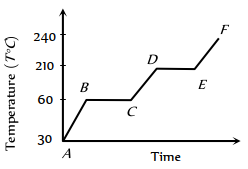
Answer(b) In the given graph $C D$ represents liquid state.
View full question & answer→MCQ 241 Mark
Water falls from a height of $210 \mathrm{~m}$. Assuming whole of energy due to fall is converted into heat the rise in temperature of water would be $(J=4.3$ Joule $/ \mathrm{cal})$
AnswerCorrect option: C. $0.49^{\circ} \mathrm{C}$
(c) $\Delta \theta=0.0023 h=0.0023 \times 210=0.483^{\circ} \mathrm{C} \approx 0.49^{\circ} \mathrm{C}$.
View full question & answer→MCQ 251 Mark
The coefficient of volumetric expansion of mercury is $18 \times 10 \%{ }^{\circ} \mathrm{C}$. A thermometer bulb has a volume $10 \mathrm{~m}$ and cross section of stem is $0.004 \mathrm{~cm}$. Assuming that bulb is filled with mercury at $0^{\circ} \mathrm{C}$ then the length of the mercury column at $100^{\circ} \mathrm{C}$ is
- A
$18.8 \mathrm{~mm}$
- B
$9.2 \mathrm{~mm}$
- C
$7.4 \mathrm{~cm}$
- ✓
$4.5 \mathrm{~cm}$
AnswerCorrect option: D. $4.5 \mathrm{~cm}$
$ V=V(1+\gamma \Delta \theta) \Rightarrow \text { Change in volume } $
$ V-V_0=\Delta V=A . \Delta l=V_0 \gamma \Delta \theta $
$ \Rightarrow \Delta I=\frac{V_0 \cdot \Delta \theta}{A}=\frac{10^{-6} \times 18 \times 10^{-5} \times(100-0)}{0.004 \times 10^{-4}} $
$ =45 \times 10^m \mathrm{~m}=4.5 \mathrm{~cm}$
View full question & answer→MCQ 261 Mark
The temperature of the sun is measured with
- A
- B
- ✓
- D
Vapour pressure thermometer
Answer(c) Pyrometer can measure temperature from $800^{\circ} \mathrm{C}$ to $6000^{\circ} \mathrm{C}$. Hence temperature of sun is measured with pyrometer.
View full question & answer→MCQ 271 Mark
Water has maximum density at
- A
$0^{\circ} \mathrm{C}$
- B
$32^{\circ} \mathrm{F}$
- C
$-4^{\circ} \mathrm{C}$
- ✓
$4^{\circ} \mathrm{C}$
AnswerCorrect option: D. $4^{\circ} \mathrm{C}$
(d) Water has maximum density at $4^{\circ} \mathrm{C}$.
View full question & answer→MCQ 281 Mark
During constant temperature, we feel colder on a day when the relative humidity will be
- ✓
$25 \%$
- B
$12.5 \%$
- C
$50 \%$
- D
$75 \%$
AnswerCorrect option: A. $25 \%$
(a) When the relative humidity is low (approx. $25\%$), the evaporation from our body is faster. Thus we feel colder.
View full question & answer→MCQ 291 Mark
Heat required to convert one gram of ice at $0^{\circ} \mathrm{C}$ into steam at$100^{\circ} \mathrm{C}$ is (given $L_{-}=536 \mathrm{cal} / \mathrm{gm}$ )
View full question & answer→MCQ 301 Mark
$5 \mathrm{~g}$ of ice at $0^{\circ} \mathrm{C}$ is dropped in a beaker containing $20 \mathrm{~g}$ of water at $40^{\circ} \mathrm{C}$. The final temperature will be
- A
$32^{\circ} \mathrm{C}$
- ✓
$16^{\circ} \mathrm{C}$
- C
$8^{\circ} \mathrm{C}$
- D
$24^{\circ} \mathrm{C}$
AnswerCorrect option: B. $16^{\circ} \mathrm{C}$
(b) For water and ice mixing $\theta_{\text {mix }}=\frac{m_W \theta_W-\frac{m_i L_i}{c_W}}{m_i+m_W}$$=\frac{20 \times 40-\frac{5 \times 80}{1}}{5+20}=16^{\circ} \mathrm{C}$
View full question & answer→MCQ 311 Mark
The volume of a gas at $20^{\circ} \mathrm{C}$ is $100 \mathrm{~cm}$ at normal pressure. If it is heated to $100^{\circ} \mathrm{C}$, its volume becomes $125 \mathrm{~cm}$ at the same pressure, then volume coefficient of the gas at normal pressure is
- A
$0.0015 /{ }^{\circ} \mathrm{C}$
- B
$0.0045 /{ }^{\circ} \mathrm{C}$
- C
$0.0025 /^{\circ} \mathrm{C}$
- ✓
$0.0033 /{ }^{\circ} \mathrm{C}$
AnswerCorrect option: D. $0.0033 /{ }^{\circ} \mathrm{C}$
(d) $\frac{V_1}{V_2}=\frac{1+\gamma t_1}{1+\gamma t_2} \Rightarrow \frac{100}{125}=\frac{1+\gamma \times 20}{1+\gamma \times 100} \Rightarrow \gamma=0.0033 /{ }^{\circ} \mathrm{C}$
View full question & answer→MCQ 321 Mark
The amount of work, which can be obtained by supplying $200 \mathrm{cal}$ of heat, is
- A
$840$ dyne
- B
$840 \mathrm{~W}$
- C
$840$ erg
- ✓
$840 \mathrm{~J}$
AnswerCorrect option: D. $840 \mathrm{~J}$
$W=J Q \Rightarrow W=4.2 \times 200=840 \mathrm{~J}$.
View full question & answer→MCQ 331 Mark
$1 \mathrm{~g}$ of a steam at $100^{\circ} \mathrm{C}$ melt how much ice at $0^{\circ} \mathrm{C}$ ? (Latent heat of ice $=80 \mathrm{cal} / \mathrm{gm}$ and latent heat of steam $=540 \mathrm{cal} / \mathrm{gm}$ )
- A
$1 \mathrm{gm}$
- B
$2 \mathrm{gm}$
- C
$4 \mathrm{gm}$
- ✓
$8 \mathrm{gm}$
AnswerCorrect option: D. $8 \mathrm{gm}$
Suppose $m \mathrm{gm}$ ice melted, then heat required for its melting $=m L=m \times 80 \mathrm{cal}$
Heat available with steam for being condensed and then brought to $0^{\circ} \mathrm{C}$
$=1 \times 540+1 \times 1 \times(100-0)=640 \mathrm{cal}$
$\Rightarrow$ Heat lost $=$ Heat taken$\Rightarrow 640=m \times 80 \Rightarrow m=8 \mathrm{gm}$
Short trick: You can remember that amount of steam $\left(m^{\prime}\right)$ at $100^{\circ} \mathrm{C}$ required to melt $m\mathrm{gm}$ ice at $0^{\circ} \mathrm{C}$ is $m^{\prime}=\frac{m}{8}$.
Here, $m=8 \times m^{\prime}=8 \times 1=8 \mathrm{gm}$
View full question & answer→MCQ 341 Mark
How many grams of a liquid of specific heat $0.2$ at a temperature $40^{\circ} \mathrm{C}$ must be mixed with $100 \mathrm{gm}$ of a liquid of specific heat of $0.5$ at a temperature $20^{\circ} \mathrm{C}$, so that the final temperature of the mixture becomes $32^{\circ} \mathrm{C}$
- A
$175 \mathrm{gm}$
- B
$300 \mathrm{~g}$
- C
$295 \mathrm{gm}$
- ✓
$375 g$
AnswerCorrect option: D. $375 g$
$ \text { Temperature of mixture } \theta=\frac{m_1 c_1 \theta_1+m_2 c_2 \theta_2}{m_1 c_1+m_2 \theta_2}$
$ \Rightarrow 32=\frac{m_1 \times 0.2 \times 40+100 \times 0.5 \times 20}{m_1 \times 0.2+100 \times 0.5} $
$\Rightarrow m_1=375 \mathrm{gm}$
View full question & answer→MCQ 351 Mark
Surface of the lake is at $2^{\circ} \mathrm{C}$. Find the temperature of the bottom of the lake
- A
$2^{\circ} \mathrm{C}$
- B
$3^{\circ} \mathrm{C}$
- ✓
$4^{\circ} \mathrm{C}$
- D
$1^{\circ} \mathrm{C}$
AnswerCorrect option: C. $4^{\circ} \mathrm{C}$
(c) The densest layer of water will be at bottom. The density of water is maximum at $4^{\circ} \mathrm{C}$. So the temperature ofbottom of lake will be $4^{\circ} \mathrm{C}$.
View full question & answer→MCQ 361 Mark
A uniform metal rod is used as a bar pendulum. If the room temperature rises by $10^{\circ} \mathrm{C}$, and the coefficient of linear expansion of the metal of the rod is $2 \times 10^{-}$per ${ }^{\circ} \mathrm{C}$, the period of the pendulum will have percentage increase of
- A
$-2 \times 10$
- B
$-1 \times 10$
- C
$2 \times 10$
- ✓
$1 \times 10$
AnswerCorrect option: D. $1 \times 10$
$1 \times 10$
View full question & answer→MCQ 371 Mark
$0.93$ watt-hour of energy is supplied to a block of ice weighing $10\ g m$. It is found that
AnswerCorrect option: C. The entire block just melts
Energy supplied $=0.93 \times 3600$ joules $=3348$ joules Heat required to melt $10 \mathrm{gms}$ of ice$=10 \times 80 \times 4.18=3344 \text { joules }$
Hence block of ice just melts.
View full question & answer→MCQ 381 Mark
A bullet moving with a uniform velocity $v$, stops suddenly after hitting the target and the whole mass melts be $m$, specific heat $S$, initial temperature $25^{\circ} \mathrm{C}$, melting point $475^{\circ} \mathrm{C}$ and the latent heat $L$. Then $v$ is given by
- A
$m L=m S(475-25)+\frac{1}{2} \cdot \frac{m v^2}{J}$
- ✓
$m S(475-25)+m L=\frac{m v^2}{2 J}$
- C
$m S(475-25)+m L=\frac{m v^2}{J}$
- D
$m S(475-25)-m L=\frac{m v^2}{2 J}$
AnswerCorrect option: B. $m S(475-25)+m L=\frac{m v^2}{2 J}$
Firstly the temperature of bullet rises up to melting point, then it melts. Hence according to $W=J Q$.
$ \Rightarrow \frac{1}{2} m v^2=J \cdot[m \cdot c \cdot \Delta \theta+m L]=J[m S(475-25)+m L]$
$ \Rightarrow m S(475-25)+m L=\frac{m v^2}{2 J}$
View full question & answer→MCQ 391 Mark
The $S l$ unit of mechanical equivalent of heat is
- ✓
Joule $\times$ Calorie
- B
- C
Calorie $\times$ Erg
- D
AnswerCorrect option: A. Joule $\times$ Calorie
(b) $J=\frac{W}{Q}=\frac{\text { Joule }}{\text { cal }}$
View full question & answer→MCQ 401 Mark
In a water-fall the water falls from a height of $100 \mathrm{~m}$. If the entire K.E. of water is converted into heat, the rise in temperature of water will be
- ✓
$0.23^{\circ} \mathrm{C}$
- B
$0.46^{\circ} \mathrm{C}$
- C
$2.3^{\circ} \mathrm{C}$
- D
$0.023^{\circ} \mathrm{C}$
AnswerCorrect option: A. $0.23^{\circ} \mathrm{C}$
(a) $\Delta \theta=0.0023 h=0.0023 \times 100=0.23^{\circ} \mathrm{C}$
View full question & answer→MCQ 411 Mark
Hailstone at $0^{\circ} \mathrm{C}$ falls from a height of $1 \mathrm{~km}$ on an insulating surface converting whole of its kinetic energy into heat. What part of it will melt $\left(g=10 \mathrm{~m} / \mathrm{s}^2\right)$
AnswerCorrect option: A. $\frac{1}{33}$
Suppose $m^{\prime} \mathrm{kg}$ ice melts out of $m \mathrm{~kg}$ then by using
$W=J Q \Rightarrow m g h=J\left(m^{\prime} L\right)$.
Hence fraction of ice melts $[=\frac{m^{\prime}}{m}=\frac{g h}{J L}=\frac{9.8 \times 1000}{4.18 \times 80}=\frac{1}{33}]$
View full question & answer→MCQ 421 Mark
In supplying 400 calories of heat to a system, the work done will be
Answer(b) $W=J Q=4.18 \times 400=1672$ joule
View full question & answer→MCQ 431 Mark
$4200 /$ of work is required for
- A
Increasing the temperature of $10 \mathrm{gm}$ of water through $10^{\circ} \mathrm{C}$
- ✓
Increasing the temperature of $100 \mathrm{gm}$ of water through $10^{\circ} \mathrm{C}$
- C
Increasing the temperature of $1 \mathrm{~kg}$ of water through $10^{\circ} \mathrm{C}$
- D
Increasing the temperature of $10 \mathrm{~kg}$ of water through $10^{\circ} \mathrm{C}$
AnswerCorrect option: B. Increasing the temperature of $100 \mathrm{gm}$ of water through $10^{\circ} \mathrm{C}$
(b) Work done to raise the temperature of $100 \mathrm{gm}$ water through $10^{\circ} \mathrm{C}$ is$W=J Q=4.2 \times\left(100 \times 10^{-3} \times 1000 \times 10\right)=4200 \mathrm{~J}$
View full question & answer→MCQ 441 Mark
At atmospheric pressure, the water boils at $100^{\circ} \mathrm{C}$. If pressure is reduced, it will boil at
Answer(b) When pressure decreases, boiling point also decreases.
View full question & answer→MCQ 451 Mark
Work done in converting one gram of ice at $-10^{\circ} \mathrm{C}$ into steam at $100^{\circ} \mathrm{C}$ is
- ✓
$3045 \mathrm{~J}$
- B
$6056 \mathrm{~J}$
- C
$721 \mathrm{~J}$
- D
$616 J$
AnswerCorrect option: A. $3045 \mathrm{~J}$
View full question & answer→MCQ 461 Mark
$300 \mathrm{gm}$ of water at $25^{\circ} \mathrm{C}$ is added to $100 \mathrm{gm}$ of ice at $0^{\circ} \mathrm{C}$. The final temperature of the mixture is
AnswerCorrect option: C. $-5^{\circ} \mathrm{C}$
View full question & answer→MCQ 471 Mark
A liquid boils when its vapour pressure equals
MCQ 481 Mark
The mechanical equivalent of heat $J$ is
View full question & answer→MCQ 491 Mark
The height of a waterfall is 84 metre. Assuming that the entire kinetic energy of falling water is converted into heat, the rise in temperature of the water will be$\left(g=9.8 \mathrm{~m} / \mathrm{s}^2, J=4.2 \text { joule } / \mathrm{cal}\right)$
- ✓
$0.196^{\circ} \mathrm{C}$
- B
$1.960^{\circ} \mathrm{C}$
- C
$0.96^{\circ} \mathrm{C}$
- D
$0.0196^{\circ} \mathrm{C}$
AnswerCorrect option: A. $0.196^{\circ} \mathrm{C}$
$ W=J Q \Rightarrow m g h=J(m . c . \Delta \theta) $
$ \Rightarrow \Delta \theta=\frac{g h}{J c}=0.0023 h=0.0023 \times 84=0.196^{\circ} \mathrm{C}$
View full question & answer→MCQ 501 Mark
5 litre of benzene weighs
- A
More in summer than in winter
- ✓
More in winter than in summer
- C
Equal in winter and summer
- D
AnswerCorrect option: B. More in winter than in summer
(b) Similar to previous question, benzene contracts in winter. So 5 litre of benzene will weigh more in winter than in summer.
View full question & answer→