MCQ 11 Mark
A string vibrates according to the equation $y=5 \sin \left(\frac{2 \pi x}{3}\right) \cos 20\ \pi t$, where $x$ and $y$ are in $\mathrm{cm}$ and $t$ in sec. The distance between two adjacent nodes is
- A
$3 \mathrm{~cm}$
- B
$4.5 \mathrm{~cm}$
- C
$6 \mathrm{~cm}$
- ✓
$1.5 \mathrm{~cm}$
AnswerCorrect option: D. $1.5 \mathrm{~cm}$
(d) $y=5 \sin \left(\frac{2 \pi x}{3}\right) \cos 20 \pi t$, comparing with equation
$y=2 a \sin \frac{2 \pi x}{\lambda} \cos \frac{2 \pi v t}{\lambda} \Rightarrow \lambda=3$,
distance between two adjacent nodes $=\lambda / 2=1.5 \mathrm{~cm}$.
View full question & answer→MCQ 21 Mark
The equation of a travelling wave is given by $y=0.5 \sin (20 x-400 t)$ where $x$ and $y$ are in meter and $t$ is in second. The velocity of the wave is
- A
$10 \mathrm{~m} / \mathrm{s}$
- ✓
$20 \mathrm{~m} / \mathrm{s}$
- C
$200 \mathrm{~m} / \mathrm{s}$
- D
$400 \mathrm{~m} / \mathrm{s}$
AnswerCorrect option: B. $20 \mathrm{~m} / \mathrm{s}$
(b) Given, $y=0.5 \sin (20 x-400 t)$
Comparing with $y=a \sin (\omega t-k x)$
Givesvelocity of wave $v=\frac{\omega}{k}=\frac{400}{20}=20 \mathrm{~m} / \mathrm{s}$.
View full question & answer→MCQ 31 Mark
A police car horn emits a sound at a frequency $240 \mathrm{~Hz}$ when the car is at rest. If the speed of the sound is $330 \mathrm{~m} / \mathrm{s}_{\llcorner}$the frequency heard by an observer who is approaching the car at a speed of $11 \mathrm{~m} / \mathrm{s}$, is :
- ✓
$248 \mathrm{~Hz}$
- B
$244 \mathrm{~Hz}$
- C
$240 \mathrm{~Hz}$
- D
$230 \mathrm{~Hz}$
AnswerCorrect option: A. $248 \mathrm{~Hz}$
(a) Frequency heard by the observer
$[n^{\prime}=n\left(\frac{v+v_0}{v}\right)=240\left(\frac{330+11}{330}\right)=248 \mathrm{~Hz} .$
View full question & answer→MCQ 41 Mark
Two waves represented by the following equations are travelling in the same medium $y_1=5 \sin 2 \pi(75 t-0.25 x)$, $y_2=10 \sin 2 \pi(150 t-0.50 x)$ The intensity ratio $I_1 / I_2$ of the two waves is
- A
$1: 2$
- ✓
$1: 4$
- C
$1: 8$
- D
$1: 16$
AnswerCorrect option: B. $1: 4$
(b) $\frac{I_1}{I_2}=\frac{a_1^2}{a_2^2} \Rightarrow \frac{I_1}{I_2}=\frac{25}{100}=\frac{1}{4}$
View full question & answer→MCQ 51 Mark
A source of sound of frequency $256 \mathrm{~Hz}$ is moving rapidly towards a wall with a velocity of $5 \mathrm{~m} / \mathrm{s}$. The speed of sound is $330 \mathrm{~m} / \mathrm{s}$. If the observer is between the wall and the source, then beats per second heard will be
- ✓
$7.8 \mathrm{~Hz}$
- B
$7.7 \mathrm{~Hz}$
- C
$3.9 \mathrm{~Hz}$
- D
AnswerCorrect option: A. $7.8 \mathrm{~Hz}$
View full question & answer→MCQ 61 Mark
A small source of sound moves on a circle as shown in the figure and an observer is standing on $O$. Let $n_1, n_2$ and $n_3$ be the frequencies heard when the source is at $A, B$ and $C$ respectively. Then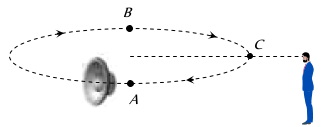
- A
$n_1>n_2>n_3$
- ✓
$n_2>n_3>n_1$
- C
$n_1=n_2>n_3$
- D
$n_2>n_1>n_3$
AnswerCorrect option: B. $n_2>n_3>n_1$
At point $A$, source is moving away from observer so apparent frequency $n_1n$ and point $C$ source is moving perpendicular to observer so $n_3=n$ Hence $n_2>n_3>n_1$
View full question & answer→MCQ 71 Mark
Two trains are moving towards each other at speeds of $20 \mathrm{~m} / \mathrm{s}$ and $15 \mathrm{~m} / \mathrm{s}$ relative to the ground. The first train sounds a whistle of frequency $600 \mathrm{~Hz}$. the frequency of the whistle heard by a passenger in the second train before the train meets is (the speed of sound in air is $340 \mathrm{~m} / \mathrm{s}$ )
- A
$600 \mathrm{~Hz}$
- B
$585 \mathrm{~Hz}$
- C
$645 \mathrm{~Hz}$
- ✓
$666 \mathrm{~Hz}$
AnswerCorrect option: D. $666 \mathrm{~Hz}$
View full question & answer→MCQ 81 Mark
An open pipe is suddenly closed at one end with the result that the frequency of third harmonic of the closed pipe is found to be higher by $100 \mathrm{~Hz}$, then the fundamental frequency of open pipe is:
- A
$480 \mathrm{~Hz}$
- B
$300 \mathrm{~Hz}$
- C
$240 \mathrm{~Hz}$
- ✓
$200 \mathrm{~Hz}$
AnswerCorrect option: D. $200 \mathrm{~Hz}$
(d) Fundamental frequency of open organ pipe $=\frac{v}{2 l}$
Frequency of third harmonic of closed pipe
$=\frac{3 v}{4 l}$$\therefore \frac{3 v}{4 l}=100+\frac{v}{2 l}$
$ \Rightarrow \frac{3 v}{4 l}-\frac{2 v}{4 l}=\frac{v}{4 l}=100$
$ \Rightarrow \frac{v}{2 l}=200 \mathrm{~Hz} \text {. }$
View full question & answer→MCQ 91 Mark
A wave equation which gives the displacement along $y-$ direction is given by $y=0.001 \sin (100 t+x)$ where $x$ and $y$ are in meterand $t$ is time in second. This represented a wave
- A
Of frequency $\frac{100}{\pi} \mathrm{Hz}$
- B
- C
Travelling with a velocity of $\frac{50}{\pi} m /s$ in the positive $X-$ direction
- ✓
Travelling with a velocity of $100 \mathrm{~m/s}$ in the negative $X-$ direction
AnswerCorrect option: D. Travelling with a velocity of $100 \mathrm{~m/s}$ in the negative $X-$ direction
Travelling with a velocity of $100 \mathrm{~m/s}$ in the negative $X-$ direction
View full question & answer→MCQ 101 Mark
What is the base frequency if a pipe gives notes of frequencies $425, 255$ and $595$ and decide whether it is closed at one end or open at both ends
- A
$17$ , closed
- ✓
$85$ , closed
- C
$17$, open
- D
$85$ , open
AnswerCorrect option: B. $85$ , closed
(b) Let the base frequency be $n$ for closed pipe then notes are $n, 3 n, 5 n \ldots .$.
$\therefore$ note $3 n=255 \Rightarrow n=85$, note $5 n=85 \times 5=425$
$note \ 7 n=7 \times 85=595$
View full question & answer→MCQ 111 Mark
An air column in a pipe, which is closed at one end, will be in resonance with a vibrating body of frequency $166 \mathrm{~Hz}$, if the length of the air column is
- A
$2.00 \mathrm{~m}$
- B
$1.50 \mathrm{~m}$
- C
$1.00 \mathrm{~m}$
- ✓
$0.50 \mathrm{~m}$
AnswerCorrect option: D. $0.50 \mathrm{~m}$
(d) For closed pipe $n_1=\frac{v}{4 l} \Rightarrow l=\frac{v}{4 n}=\frac{332}{4 \times 166}=0.5 \mathrm{~m}$
View full question & answer→MCQ 121 Mark
It is possible to hear beats from the two vibrating sources of frequency
- A
$100 \mathrm{~Hz}$ and $150 \mathrm{~Hz}$
- ✓
$20 \mathrm{~Hz}$ and $25 \mathrm{~Hz}$
- C
$400 \mathrm{~Hz}$ and $500 \mathrm{~Hz}$
- D
$1000 \mathrm{~Hz}$ and $1500 \mathrm{~Hz}$
AnswerCorrect option: B. $20 \mathrm{~Hz}$ and $25 \mathrm{~Hz}$
(b) For hearing beats, difference of frequencies should be approximately $10 \mathrm{~Hz}$.
View full question & answer→MCQ 131 Mark
A stretched string of length $l$, fixed at both ends can sustain stationary waves of wavelength $\lambda$, given by
AnswerCorrect option: C. $\lambda=\frac{2 l}{n}$
(c) $\lambda=\frac{2 l}{n} \quad(n=$ Number of loops $)$
View full question & answer→MCQ 141 Mark
A tuning fork vibrating with a sonometer having $20 \mathrm{~cm}$ wire produces 5 beats per second. The beat frequency does not change if the length of the wire is changed to $21 \mathrm{~cm}$. the frequency of the tuning fork (in Hertz) must be
AnswerLet the frequency of tunning fork be $N$As the frequency of vibration string $\propto \frac{1}{\text { lengthofstring }}$
For sonometer wire of length $20 \mathrm{~cm}$,frequency must be $(N+ 5)$ and that for the sonometer wire of length $21 \mathrm{~cm}$,the frequency must be $(N-5)$ as in each case the tunning fork produces $5$ beats/sec with so no meterwire
Hence $n_1 l_1=n_2 l_2 \Rightarrow(N+5) \times 20=(N-5) \times 21$
$\Rightarrow N=205\mathrm{~Hz} \text {. }$
View full question & answer→MCQ 151 Mark
A wire of density $9 \times 10 \mathrm{~kg} / \mathrm{m}$ is stretched between two clamps $1 \mathrm{~m}$ apart and is subjected to an extension of $4.9 \times 10 \mathrm{~m}$. The lowest frequency of transverse vibration in the wire is $\left(Y=9 \times 10^{-\mathrm{N}} / \mathrm{m}\right)$
- A
$40 \mathrm{~Hz}$
- ✓
$35 \mathrm{~Hz}$
- C
$30 \mathrm{~Hz}$
- D
$25 \mathrm{~Hz}$
AnswerCorrect option: B. $35 \mathrm{~Hz}$
(b) For wire if $M=$ mass, $\rho=$ density, $A=$ Area of cross section$V=$ volume, $l=$ length, $\Delta I=$ change in lengthThen mass per unit length
$m=\frac{M}{l}=\frac{A l \rho}{l}=A \rho$
And Young's modules of elasticity
$y=\frac{T / A}{\Delta l / l}$$\Rightarrow T=\frac{Y \Delta l A}{l}$.
Hence lowest frequency of vibration
$n=\frac{1}{2 l} \sqrt{\frac{T}{m}}=\frac{1}{2 l} \sqrt{\frac{y\left(\frac{\Delta l}{l}\right) A}{A \rho}}=\frac{1}{2 l} \sqrt{\frac{y \Delta l}{l \rho}} $
$\Rightarrow n=\frac{1}{2 \times 1} \sqrt{\frac{9 \times 10^{10} \times 4.9 \times 10^{-4}}{1 \times 9 \times 10^3}}=35 \mathrm{~Hz}$
View full question & answer→MCQ 161 Mark
The harmonics which are present in a pipe open at one end are
- ✓
- B
- C
Even as well as odd harmonics
- D
Answer(a) In closed pipe only odd harmonics are present
View full question & answer→MCQ 171 Mark
Two strings $X$ and $Y$ of a sitar produce a beat frequency $4 \mathrm{~Hz}$. When the tension of the string $Y$ is slightly increased the beat frequency is found to be $2 \mathrm{~Hz}$. If the frequency of $X$ is $300 \mathrm{~Hz}$, then the original frequency of $\gamma$ was
- ✓
$296 \mathrm{~Hz}$
- B
$298 \mathrm{~Hz}$
- C
$302 \mathrm{~Hz}$
- D
$304 \mathrm{~Hz}$
AnswerCorrect option: A. $296 \mathrm{~Hz}$
(a) $n_x=300 \mathrm{~Hz}, n_y=$ ?$x$ = beat frequency $=4 \mathrm{~Hz}$, which is decreasing $(4 \rightarrow 2)$after increasing the tension of the string $y$.Also tension of wire $y$ increasing so $n_y \uparrow(\because n \propto \sqrt{T})$Hence $n_x-n_y \uparrow=x \downarrow \longrightarrow$ Correct
$ n_y \uparrow n_x=x\downarrow \longrightarrow \text { Wrong }$
$\Rightarrow n_y=n_x-x=300-4=296 \mathrm{~Hz}$
View full question & answer→MCQ 181 Mark
A wavelength $0.60 \mathrm{~cm}$ is produced in air and it travels at a speed of $300 \mathrm{~ms}$. It will be an
Answer(c)$n=\frac{v}{\lambda}=\frac{300}{0.6 \times 10^{-2}} \mathrm{~Hz}=\frac{3}{6} \times 10^4 \mathrm{~Hz}=50,000 \mathrm{~Hz}$$\Rightarrow$ Wave is ultrasonic.
View full question & answer→MCQ 191 Mark
The wavelengths of two waves are $50$ and $51 \mathrm{~cm}$ respectively. If the temperature of the room is $20 ^{\circ} \mathrm{C}$, then what will be the number of beats produced per second by these waves, when the speed of sound at $0^{\circ} \mathrm{C}$ is $332\ \mathrm{~m} / \mathrm{sec}$
Answer(a)$v_0=332 \mathrm{~m} / \mathrm{s} \text {. Velocity sound at } t^{\circ} \mathrm{C} \text { is } v_t=\left(v_0+0.61 \mathrm{t}\right) $
$\Rightarrow v_{20}=v_0+0.61 \times 20=344.2 \mathrm{~m} / \mathrm{s} $
$\Rightarrow \Delta n=v_{20}\left(\frac{1}{\lambda_1}-\frac{1}{\lambda_2}\right)=344.2\left(\frac{100}{50}-\frac{100}{51}\right)=14$
View full question & answer→MCQ 201 Mark
At which temperature the speed of sound in hydrogen will be same as that of speed of sound in oxygen at $100\ ^{\circ}\mathrm{C}$
- A
$-148\ ^{\circ}\mathrm{C}$
- B
$-212\ ^{\circ}\mathrm{C}$
- C
$-317.5\ ^{\circ}\mathrm{C}$
- ✓
$-249.7\ ^{\circ}\mathrm{C}$
AnswerCorrect option: D. $-249.7\ ^{\circ}\mathrm{C}$
(d)$\text { Speed of sound in gases is } v=\sqrt{\frac{\gamma R T}{M}} \Rightarrow T \propto M $
$\text { (Because } v, \gamma \text {-constant}).$
Hence $\frac{T_{H_2}}{T_{O_2}}=\frac{M_{\mathrm{H}_2}}{M_{\mathrm{O}_2}}$
$\Rightarrow\frac{T_{\mathrm{H}_2}}{(273+100)}=\frac{2}{32} $
$\Rightarrow T_{\mathrm{H}_2}=23.2 \mathrm{~K}=-249.7\ ^{\circ} \mathrm{C}$
View full question & answer→MCQ 211 Mark
When a longitudinal wave propagates through a medium, the particles of the medium execute simple harmonic oscillations about their mean positions. These oscillations of a particle are characterised by an invariant
- A
- ✓
- C
Sum of kinetic energy and potential energy
- D
Difference between kinetic energy and potential energy
View full question & answer→MCQ 221 Mark
The equation of a transverse wave is given by $ y=100 \sin \pi(0.04 z-2 t) $ where $y$ and $z$ are in $\mathrm{cm}$ ant $t$ is in seconds. The frequency of the wave in $\mathrm{Hz}$ is
AnswerHere $\omega=2 \pi n=2 \pi \Rightarrow n=1$
View full question & answer→MCQ 231 Mark
The velocity of waves in a string fixed at both ends is $2 \mathrm{~m} / \mathrm{s}$. The string forms standing waves with nodes $5.0 \mathrm{~cm}$ apart. The frequency of vibration of the string in $\mathrm{Hz}$ is
Answer(c) Here $\frac{\lambda}{2}=5.0 \mathrm{~cm} \Rightarrow \lambda=10 \mathrm{~cm}$
Hence $n=\frac{v}{\lambda}=\frac{200}{10}=20 \mathrm{~Hz}$.
View full question & answer→MCQ 241 Mark
Mechanical waves on the surface of a liquid are
- A
- B
- C
- ✓
Both transverse and longitudinal
AnswerCorrect option: D. Both transverse and longitudinal
View full question & answer→MCQ 251 Mark
At nodes in stationary waves
- ✓
Change in pressure and density are maximum
- B
Change in pressure and density are minimum
- C
- D
AnswerCorrect option: A. Change in pressure and density are maximum
Change in pressure and density are maximum
View full question & answer→MCQ 261 Mark
A string fixed at both the ends is vibrating in two segments. The wavelength of the corresponding wave is
- A
$\frac{l}{4}$
- B
$\frac{l}{2}$
- ✓
$l$
- D
$2 \mathrm{I}$
View full question & answer→MCQ 271 Mark
Stationary waves of frequency $300 \mathrm{~Hz}$ are formed in a medium in which the velocity of sound is 1200 metre/sec. The distance between a node and the neighbouring antinode is
- ✓
$1 \mathrm{~m}$
- B
$2 \mathrm{~m}$
- C
$3 \mathrm{~m}$
- D
$4 \mathrm{~m}$
AnswerCorrect option: A. $1 \mathrm{~m}$
(a) Required distance $=\frac{\lambda}{4}=\frac{v / n}{4}=\frac{1200}{4 \times 300}=1 \mathrm{~m}$
View full question & answer→MCQ 281 Mark
What is the phase difference between two successive crests in the wave
- A
$\pi$
- B
$\pi / 2$
- ✓
$2 \pi$
- D
$4 \pi$
AnswerCorrect option: C. $2 \pi$
(c) Since distance between two consecutive crests is $\lambda$, so$\phi=\frac{2 \pi}{\lambda} \times \lambda=2 \pi .$
View full question & answer→MCQ 291 Mark
A string is rigidly tied at two ends and its equation of vibration is given by $y=\cos 2 \pi t \sin \sin \pi x$. Then minimum length of string is
- A
$1 \mathrm{~m}$
- ✓
$\frac{1}{2} m$
- C
$5 \mathrm{~m}$
- D
$2 \pi m$
AnswerCorrect option: B. $\frac{1}{2} m$
(b) Given equation of stationary wave is$y=\sin 2 \ \pi x \cos 2 \ \pi t$, comparing it with standard equation
$y=2 A \sin \frac{2 \pi x}{\lambda} \cos \frac{2 \pi x}{\lambda}$
We have $\frac{2 \pi x}{\lambda}=2 \pi x \Rightarrow \lambda=1 \mathrm{~m}$
Minimum distance of string (first mode) $L_{\min }=\frac{\lambda}{2}=\frac{1}{2} m$
View full question & answer→MCQ 301 Mark
- A
- B
X-rays radiation capacity
- ✓
- D
View full question & answer→MCQ 311 Mark
Maximum number of beats frequency heard by a human being is
Answer(a) Persistence of hearing is $10\ \mathrm{sec}$.
View full question & answer→MCQ 321 Mark
Which of the following do not require medium for transmission
Answer(b) EM waves do not requires medium for their propagation.
View full question & answer→MCQ 331 Mark
The nature of sound waves in gases is
MCQ 341 Mark
Progressive wave of sound is represented by $y=a \sin [400\ \pi t-\pi x / 6.85]$ where $x$ is in $m$ and $t$ is in sec. Frequency of the wave will be
- ✓
$200 \mathrm{~Hz}$
- B
$400 \mathrm{~Hz}$
- C
$500 \mathrm{~Hz}$
- D
$600 \mathrm{~Hz}$
AnswerCorrect option: A. $200 \mathrm{~Hz}$
(a) $n=\frac{\omega}{2 \pi}=\frac{400 \pi}{2 \pi}=200 \mathrm{~Hz} \quad$ (As $\left.\omega=400 \pi\right)$
View full question & answer→MCQ 351 Mark
If the tension of sonometer's wire increases four times then the fundamental frequency of the wire will increase by
- ✓
$2$ times
- B
$4$ times
- C
$1 / 2$ times
- D
AnswerCorrect option: A. $2$ times
$2$ times
View full question & answer→MCQ 361 Mark
The wave length of light in visible part $\left(\lambda_V\right)$ and for sound $\left(\lambda_S\right)$ are related as
- A
$\lambda_V<\lambda_S$
- ✓
$\lambda_S>\lambda_V$
- C
$\lambda_S=\lambda_V$
- D
AnswerCorrect option: B. $\lambda_S>\lambda_V$
View full question & answer→MCQ 371 Mark
At what temperature velocity of sound is double than that of at $0^{\circ} \mathrm{C}$
- A
$819 K$
- ✓
$819^{\circ} \mathrm{C}$
- C
$600^{\circ} \mathrm{C}$
- D
$600 K$
AnswerCorrect option: B. $819^{\circ} \mathrm{C}$
$v \propto \sqrt{T} \Rightarrow \frac{v_2}{v_1}=\sqrt{\frac{T_2}{T_1}} $
$\Rightarrow 2=\sqrt{\frac{T_2}{(273+0)}} $
$\Rightarrow T_2=273\times 4=1092\mathrm{~K}=819^{\circ}\mathrm{C}$
View full question & answer→MCQ 381 Mark
- A
Energy is uniformly distributed
- ✓
Energy is minimum at nodes and maximum at antinodes
- C
Energy is maximum at nodes and minimum at antinodes
- D
Alternating maximum and minimum energy producing at nodes and antinodes
AnswerCorrect option: B. Energy is minimum at nodes and maximum at antinodes
View full question & answer→MCQ 391 Mark
Energy is not carried by which of the following waves
Answer(a) Energy is not carried by stationary waves
View full question & answer→MCQ 401 Mark
Fundamental frequency of pipe is $100 \mathrm{~Hz}$ and other two frequencies are $300 \mathrm{~Hz}$ and $500 \mathrm{~Hz}$ then
- A
Pipe is open at both the ends
- B
Pipe is closed at both the ends
- ✓
One end open and another end is closed
- D
AnswerCorrect option: C. One end open and another end is closed
One end open and another end is closed
View full question & answer→MCQ 411 Mark
The displacement of the interfering light waves are $y_1=4 \sin \omega t$ and $y_2=3 \sin \left(\omega t+\frac{\pi}{2}\right)$. What is the amplitude of the resultant wave
Answer(a) Since $\phi=\frac{\pi}{2} \Rightarrow A=\sqrt{a_1^2+a_2^2}=\sqrt{(4)^2+(3)^2}=5$
View full question & answer→MCQ 421 Mark
Two sirens situated one kilometer apart are producing sound of frequency $330 \mathrm{~Hz}$. An observer starts moving from one siren to the other with a speed of $2 \mathrm{~m} / \mathrm{s}$. If the speed of sound be $330 \mathrm{~m} / \mathrm{s}$, what will be the beat frequency heard by the observer
View full question & answer→MCQ 431 Mark
Two waves are represented by $y_1=a \sin \left(\omega t+\frac{\pi}{6}\right)$ and $y_2=a \cos \omega t$. What will be their resultant amplitude
- ✓
$a$
- B
$\sqrt{2} a$
- C
$\sqrt{3} a$
- D
$2 a$
Answer(c) $A=\sqrt{\left(a_1^2+a_2^2+2 a_1 a_2 \cos \phi\right)}$Putting $a_1=a_2=a$ and $\phi=\frac{\pi}{3}$, we get $A=\sqrt{3} a$
View full question & answer→MCQ 441 Mark
At what speed should a source of sound move so that stationary observer finds the apparent frequency equal to half of the original frequency
- A
$\frac{v}{2}$
- B
$2 v$
- C
$\frac{v}{4}$
- ✓
$v$
Answer(d) Frequency is decreasing (becomes half), it means source is going away from the observes. In this case frequency observed by the observer is$n^{\prime}=n\left(\frac{v}{v+v_S}\right) \Rightarrow \frac{n}{2}=n\left(\frac{v}{v+v_S}\right) \Rightarrow v_S=v$
View full question & answer→MCQ 451 Mark
A student determines the velocity of sound with the help of a closed organ pipe. If the observed length for fundamental frequency is $24.7 \ m$, the length for third harmonic will be
- ✓
$74.1 \mathrm{~cm}$
- B
$72.7 \mathrm{~cm}$
- C
$75.4 \mathrm{~cm}$
- D
$73.1 \mathrm{~cm}$
AnswerCorrect option: A. $74.1 \mathrm{~cm}$
(a) $l_2=3 l_1=3 \times 24.7=74.1 \mathrm{~cm}$
View full question & answer→MCQ 461 Mark
Velocity of sound measured in hydrogen and oxygen gas at a given temperature will be in the ratio
- A
$1: 4$
- ✓
$4: 1$
- C
$2: 1$
- D
$1: 1$
AnswerCorrect option: B. $4: 1$
$v _{ h } \propto \frac{1}{m_{ h }} \text { and } v _{ o } \propto \frac{1}{m_{ o }}$
$\Rightarrow \frac{ v _{ h }}{ v _{ o }}=\sqrt{\frac{ m _0}{m_{ h }}} $
$\therefore \frac{ v _{ h }}{ v _{ o }}=\sqrt{\frac{16}{1}}$
$\therefore \frac{ v _{ h }}{ v _{ o }}=\frac{4}{1}$
View full question & answer→MCQ 471 Mark
To increase the frequency from $100 \mathrm{~Hz}$ to $400 \mathrm{~Hz}$ the tension in the string has to be changed by
- A
$4$ times
- ✓
$16$ times
- C
$20$ times
- D
AnswerCorrect option: B. $16$ times
$16$ times
View full question & answer→MCQ 481 Mark
If source and observer both are relatively at rest and if speed of sound is increased then frequency heard by observer will
Answer(d) No change in frequency.
View full question & answer→MCQ 491 Mark
Speed of sound at constant temperature depends on
Answer(d) Speed do sound, doesn't depend up on pressure and density medium.
View full question & answer→MCQ 501 Mark
Answer(b) Because sound waves in gases are longitudinal.
View full question & answer→