Questions

M.C.Q (1 Marks)

🎯

Test yourself on this topic

11 questions · timed · auto-graded

MCQ 11 Mark
In which of the following intervals is $y=x^2 e^{-x}$ increasing ?
  • A
    $(1,0)$
  • B
    $(2,0)$
  • C
    $(2,-\infty)$
  • D
    $(0,2)$
Answer
SELF
View full question & answer
MCQ 21 Mark
The minimum value of function $f(x)=2 \cos x+x$ in interval $\left[0, \frac{\pi}{2}\right]$ :
  • A
    2
  • B
    $\frac{\pi}{6}+\sqrt{3}$
  • $\frac{\pi}{2}$
  • D
    None of these
Answer
Correct option: C.
$\frac{\pi}{2}$
(C)$f(x)=2 \cos x+x \Rightarrow f^{\prime}(x)=-2 \sin x+1$
now, $f^{\prime}(x)=0 \Rightarrow-2 \sin x+1=0$
$\Rightarrow \quad \sin x=\frac{1}{2}=\sin \frac{\pi}{6} \Rightarrow x=\frac{\pi}{6}$
$\Rightarrow \quad x=\frac{\pi}{6} \in\left[0, \frac{\pi}{2}\right]$
$\therefore \quad f(0)=2+0=2, f\left(\frac{\pi}{6}\right)=2 \cos \frac{\pi}{6}+\frac{\pi}{6}$
$=2\left(\frac{\sqrt{3}}{2}\right)+\frac{\pi}{6}=\sqrt{3}+\frac{\pi}{6}$
and $\quad f\left(\frac{\pi}{2}\right)=0+\frac{\pi}{2}=\frac{\pi}{2}$
The minimum value of $f(x)$ is $\frac{\pi}{2}$ at $x=\frac{\pi}{2}$.
View full question & answer
MCQ 41 Mark
Find the absolute maximum value of $f(x)=4 x-\frac{1}{2} x^2$ in interval $\left[-2, \frac{9}{2}\right]$.
  • 8
  • B
    9
  • C
    6
  • D
    10
Answer
Correct option: A.
8
(A)Here $f(x)=4 x-\frac{1}{2} x^2$
$
\therefore \quad f^{\prime}(x)=4-x
$
now $f^{\prime}(x)=0 \Rightarrow 4-x=0 \Rightarrow x=4$
Thus, $\quad f(-2)=4(-2)-\frac{1}{2}(-2)^2=-8-2=-10$
$\begin{aligned}f(4) & =4(4)-\frac{1}{2}(4)^2=16-8=8 \\\text { and } \quad f\left(\frac{9}{2}\right) & =4\left(\frac{9}{2}\right)-\frac{1}{2}\left(\frac{9}{2}\right)^2=18-\frac{81}{8}=\frac{63}{8}\end{aligned}$
Hence absolute maximum value is 8 at $x=4$.
View full question & answer
MCQ 51 Mark
Function $f(x)=2 x^3-15 x^2+36 x+6$ is increasing in which of interval :
  • $(-\infty, 2) \cup(3, \infty)$
  • B
    $(-\infty, 2)$
  • C
    $(-\infty, 2] \cup[3, \infty)$
  • D
    $[3, \infty)$
Answer
Correct option: A.
$(-\infty, 2) \cup(3, \infty)$
(A)
$
\begin{aligned}
f(x) & =2 x^3-15 x^2+36 x+6 \\
f^{\prime}(x) & =6 x^2-30 x+36 \\
& =6\left(x^2-5 x+6\right)
\end{aligned}
$
$
=6(x-2)(x-3)
$
$f(x)$ is increasing if $f^{\prime}(x)>0$
$
\begin{array}{lc}
\Rightarrow & 6(x-2)(x-3)>0 \\
\Rightarrow & x \in(-\infty 2) \cup(3, \infty)
\end{array}
$
View full question & answer
MCQ 61 Mark
Function $y=x^2 e^{-x}$ is decreasing in which of interval :
  • A
    $(0,2)$
  • B
    $(2, \infty)$
  • C
    $(-\infty, 0)$
  • $(-\infty, 0) \cup(2, \infty)$
Answer
Correct option: D.
$(-\infty, 0) \cup(2, \infty)$
(D) Given $\quad y=f(x)=x^2 e^{-x}$$
\begin{aligned}
\therefore \quad f^{\prime}(x) & =x^2 e^{-x}(-1)+2 x e^{-x} \\
& =x e^{-x}(2-x)
\end{aligned}
$
now $e^{-x}>0 \quad \forall x \in R$
Hence $f(x)$ will be decreasing if$
\begin{aligned}
f^{\prime}(x)<0 \\
\Rightarrow x(2-x)<0 \\
\Rightarrow x(x-2)>0 \\
\Rightarrow &x \in(-\infty, 0) \cup(2, \infty)
\end{aligned}
$
View full question & answer
MCQ 71 Mark
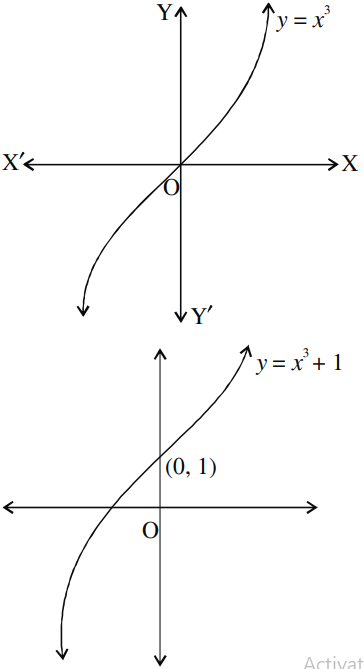
A function $f: R \rightarrow R$ is defined such that $f(x)=x^3$ +1 , then function :
  • A
    is not any maximum value
  • B
    is not any minimum value
  • C
    is maximum and minimum value
  • is neither maximum nor minimum value
Answer
Correct option: D.
is neither maximum nor minimum value
(D)
Image
It is clear from graph, function is neither maximum nor minimum value.
View full question & answer
MCQ 81 Mark
Maximum value of $=\left(\frac{1}{x}\right)^x$:
  • $e^{1 / e}$
  • B
    $e$
  • C
    $\left(\frac{1}{e}\right)^{1 / e}$
  • D
    $e^{\varepsilon}$
Answer
Correct option: A.
$e^{1 / e}$
(A)$y=\left(\frac{1}{x}\right)^x$
$\therefore \quad \log y=\log \left(\frac{1}{x}\right)^x=-x \log x$
$\therefore \quad \frac{1}{y} \frac{d y}{d x}=-x \frac{1}{x}-\log x=-(1+\log x)$
$\Rightarrow \quad \frac{d y}{d x}=-y(1+\log x)$
now $\frac{d y}{d x}=0 \Rightarrow 1+\log x=0$
$\Rightarrow \log x=-1 \Rightarrow x=e^{-1}=\frac{1}{e}$
hence maximum value $=\left(\frac{1}{1 / e}\right)^{1 / e}=e^{1 / e}$
View full question & answer
MCQ 91 Mark
If a particle is moving in a straight line. In $t$ time, it will cover $x$ distance according to $x=2 t^2-5 t+$ 1 then find the velocity after 5 sec .
  • 15
  • B
    20
  • C
    25
  • D
    26
Answer
Correct option: A.
15
(A)
$
\begin{aligned}
x & =2 t^2-5 t+1 \\
V & =\frac{d x}{d t}=4 t-5 \quad \therefore\left(\frac{d x}{d t}\right)_{t=5}=4 \times 5-5=15
\end{aligned}
$
Hence correct answer is (A).
View full question & answer
MCQ 101 Mark
A stone throw upward having speed equation $S =9.8 t-4.9 t^2$ where S in $m / s$. What will be the time to achieve maximum height ?
  • A
    2 sec
  • B
    1$1 / 2 sec$
  • 1 sec
  • D
    $1 / 2 sec$
Answer
Correct option: C.
1 sec
(C)
$
\begin{aligned}
S & =9.8 t-4.9 t^2 \\
\frac{d S}{d t} & =9.8-9.8 t
\end{aligned}
$
To achieve maximum height, final velocity will be zero.$
\begin{aligned}
0 & =9.8-9.8 t \\
t & =\frac{9.8}{9.8}=1 sec
\end{aligned}
$
Hence correct option is (C).
View full question & answer
MCQ 111 Mark
Speed equation of a particle is $S =t^2-4 t+5$, Find the time having zero speed.
  • A
    1 sec
  • 2 sec
  • C
    3 sec
  • D
    4 sec
Answer
Correct option: B.
2 sec
(B)
$
\begin{aligned}
S & =t^2-4 t+5 \\
\frac{d S}{d t} & =2 t-4
\end{aligned}
$
ATQ$
\Rightarrow 2 t-4=0 \Rightarrow t=2 sec
$
Hence, correct option is (B).
View full question & answer
