Question 1015 Marks
Evaluate the following intregals:
$\int\frac{1}{5-4\cos\text{x}}\ \text{dx}$
AnswerLet $\text{I}=\int\frac{1}{5-4\cos\text{x}}\ \text{dx}$
Putting $\cos\text{x}=\frac{1-\tan^2\frac{\text{x}}{2}}{1+\tan^2\frac{\text{x}}{2}}$
$=\text{I}=\int\frac{1}{5-4\Bigg(\frac{1-\tan^2\frac{\text{x}}{2}}{1+\tan^2\frac{\text{x}}{2}}\Bigg)}\ \text{dx}$
$=\int\frac{\Big(1+\tan^2\frac{\text{x}}{2}\Big)}{5\Big(1+\tan^2\frac{\text{x}}{2}\Big)-4+4\tan^2\frac{\text{x}}{2}}$
$=\int\frac{\sec^2\Big(\frac{\text{x}}{2}\Big)}{9\tan^2\frac{\text{x}}{2}+1}\ \text{dx}$
Let $\tan\big(\frac{\text{x}}{2}\big)=\text{t}$
$\Rightarrow\frac{1}{2}\sec^2\big(\frac{\text{x}}{2}\big)\text{dx}=\text{dt}$
$\Rightarrow\sec^2\big(\frac{\text{x}}{2}\big)\text{dx}=2\text{dt}$
$\therefore\text{I}=2\int\frac{\text{dt}}{9\text{t}^2+1}$
$=\frac{2}{9}\int\frac{\text{dt}}{\text{t}^2+\frac{1}{9}}$
$=\frac{2}{9}\int\frac{\text{dt}}{\text{t}^2+\big(\frac{1}{3}\big)^2}$
$=\frac{2}{9}\times3\tan^{-1}\bigg(\frac{\text{t}}{\frac{1}{3}}\bigg)+\text{C}$
$=\frac{2}{3}\tan^{-1}(3\text{t})+\text{C}$
$=\frac{2}{3}\tan^{-1}\big(3\tan\frac{\text{x}}{2}\big)+\text{C}$
View full question & answer→Question 1025 Marks
Evaluate the following integrals:$\int\frac{\text{x}+1}{\text{x}^2+\text{x}+3}\text{ dx}$
AnswerLet $\text{I}=\int\frac{\text{x}}{\text{x}^2+\text{x}+3}\text{ dx}$
Let $\text{x}=\lambda\frac{\text{d}}{\text{dx}}\big(\text{x}^2+\text{x}+3\big)+\mu$
$\text{x}+1=\lambda(2\text{x}+1)+\mu$
$\text{x}+1=(2\lambda)\text{x}+(\lambda+\mu)$
Comparing the coefficients of like powers of x,
$2\lambda=1$
$\Rightarrow\lambda=\frac{1}{2}$
$\lambda+\mu=1$
$\Rightarrow\Big(\frac{1}{2}\Big)+\mu=0$
$\mu=\frac{1}{2}$
So, $\text{I}=\int\frac{\frac{1}{2}(2\text{x}+1)+\frac{1}{2}}{\text{x}^2+\text{x}+3}\text{ dx}$
$\text{I}=\frac{1}{2}\int\frac{2\text{x}+1}{\text{x}^2+\text{x}+3}\text{ dx}+\frac{1}{2}\int\frac{1}{\text{x}^2+2\text{x}\big(\frac{1}{2}\big)+\big(\frac{1}{2}\big)^2-\big(\frac{1}{2}\big)^2+3}\text{ dx}$
$\text{I}=\frac{1}{2}\int\frac{2\text{x}+1}{\text{x}^2+\text{x}+3}\text{ dx}+\frac{1}{2}\int\frac{1}{\big(\text{x}+\frac{1}{2}\big)^2+\big(\frac{11}{4}\big)}\text{ dx}$
$\text{I}=\frac{1}{2}\int\frac{2\text{x}+1}{\text{x}^2+\text{x}+3}\text{ dx}+\frac{1}{2}\int\frac{1}{\big(\text{x}+\frac{1}{2}\big)^2+\big(\frac{\sqrt{11}}{2}\big)^2}\text{ dx}$
$\text{I}=\frac{1}{2}\log\big|\text{x}^2+\text{x}+3\big|+\frac{1}{2}\times\frac{1}{\Big(\frac{\sqrt{11}}{2}\Big)}\tan^{-1}\bigg(\frac{\text{x}+\frac{1}{2}}{\frac{\sqrt{11}}{2}}\bigg)+\text{C}$ $\Big[\text{Since }\int\frac{1}{\text{x}^2+\text{a}^2}\text{ dx}=\frac{1}{\text{a}}\tan^{-1}\Big(\frac{\text{x}}{\text{a}}\Big)+\text{C}\Big]$
$\text{I}=\frac{1}{2}\log\big|\text{x}^2+\text{x}+3\big|+\frac{1}{\sqrt{11}}\tan^{-1}\Big(\frac{2\text{x}+1}{\sqrt{11}}\Big)+\text{C}$
View full question & answer→Question 1035 Marks
Evaluate the following intregals:
$\int\frac{2\text{x}^2+7\text{x}-3}{\text{x}^2(2\text{x}+1)}\text{ dx}$
Answerwe have, $\text{I}=\int\frac{2\text{x}^2+7\text{x}-3}{\text{x}^2(2\text{x}+1)}\text{ dx}$ $\Rightarrow\int\frac{2\text{x}^2+7\text{x}-3}{\text{x}^2(2\text{x}+1)}=\frac{\text{A}}{\text{x}}+\frac{\text{B}}{\text{x}^2}+\frac{\text{C}}{2\text{x}+1}$ $\Rightarrow\int\frac{2\text{x}^2+7\text{x}-3}{\text{x}^2(2\text{x}+1)}=\frac{\text{A}(\text{x})(2\text{x}+1)+\text{B}(2\text{x}+1)+\text{Cx}^2}{\text{x}^2(2\text{x}+1)}$ $\Rightarrow2\text{x}^2+7\text{x}-3=\text{A}(2\text{x}^2+\text{x})+\text{B}(2\text{x}+1)+\text{Cx}^2$ $\Rightarrow2\text{x}^2+7\text{x}-3=(2\text{A}+\text{C})\text{x}^2+(\text{A}+2\text{})\text{x}+\text{B}$ Equating coefficient of like terms 2A + C = 2 ...(1) A + 2B = 7 ...(2) B = -3 ...(3) Solving (1), (2) and (3), we get A = 13 B = -3 C = -24$\therefore\frac{2\text{x}^2+7\text{x}-3}{\text{x}^2(2\text{x}+1)}=\frac{13}{\text{x}}-\frac{3}{\text{x}^2}-\frac{24}{2\text{x}+1}$
$\Rightarrow\text{I}=13\int\frac{\text{dx}}{\text{x}}-3\int\text{x}^{-2}\text{dx}-24\int\frac{\text{dx}}{2\text{x}+1}$
$=13\log|\text{x}|+\frac{3}{\text{x}}-24\frac{\log|2\text{x}+1|}{2}+\text{C}$
$=13\log|\text{x}|+\frac{3}{\text{x}}-12\log|2\text{x}-1|+\text{C}$
View full question & answer→Question 1045 Marks
Evaluvate the following intregals:
$\int\frac{5\text{x}+3}{\sqrt{\text{x}^2+4\text{x}+10}}\ \text{dx}$
AnswerLet $\text{I}=\int\frac{5\text{x}+3}{\sqrt{\text{x}^2+4\text{x}+10}}\ \text{dx}$
Consider,
$5\text{x}+3=\text{A}\frac{\text{d}}{\text{dx}}(\text{x}^2+4\text{x}+10)+\text{B}$
$\Rightarrow5\text{x}+3=\text{A}(2\text{x}+4)+\text{B}$
$\Rightarrow5\text{x}+3=(2\text{A})\text{x}+4\text{A}+\text{B}$
Equating coefficient of like terms
$2\text{A}=5$
$\Rightarrow\text{A}=\frac{5}{2}$
And
$4\text{A}+\text{B}=3$
$\Rightarrow4\times\frac{5}{2}+\text{B}=3$
$\Rightarrow\text{B}=-7$
$\therefore\text{I}=\frac{5}{2}\int\frac{(2\text{x}+4)\text{dx}}{\sqrt{\text{x}^2+4\text{x}+10}}-7\int\frac{\text{dx}}{\sqrt{\text{x}^2+4\text{x}+10}}$
$=\frac{5}{2}\int\frac{(2\text{x}+4)\text{dx}}{\sqrt{\text{x}^2+4\text{x}+10}}-7\int\frac{\text{dx}}{\sqrt{\text{x}^2+4\text{x}+4-4+10}}$
$=\frac{5}{2}\int\frac{(2\text{x}+4)\text{dx}}{\sqrt{\text{x}^2+4\text{x}+10}}-7\int\frac{\text{dx}}{\sqrt{(\text{x}+2})^2+(\sqrt{6})^2}$
Putting, $\text{x}^2+4\text{x}+10=\text{t}$
$\Rightarrow(2\text{x}+4)\text{dx}=\text{dt}$
$\text{I}=\frac{5}{2}\int\frac{\text{dt}}{\sqrt{\text{t}}}-7\log\big|(\text{x}+2)^2+6\big|+\text{C}$
$=\frac{5}{2}\int\text{t}^{-\frac{1}{2}}\text{dt}-7\log\big|\text{x}+2+\sqrt{\text{x}^2+4\text{x}+10}\big|+\text{C}$
$=\frac{5}{2}\times2\sqrt{\text{t}}-7\log\big|\text{x}+2+\sqrt{\text{x}^2+4\text{x}+10}\big|+\text{C}$
$=5\sqrt{\text{x}^2+4\text{x}+10}-7\log\big|\text{x}+2+\sqrt{\text{x}^2+4\text{x}+10}\big|+\text{C}$
View full question & answer→Question 1055 Marks
Evaluate the following integrals:$\int\frac{\text{x}^2}{\text{x}^2+7\text{x}+10}\text{ dx}$
AnswerLet $\text{I}=\int\frac{\text{x}^2}{\text{x}^2+7\text{x}+10}\text{ dx}$ $=\int\Big\{1-\frac{7\text{x}+10}{\text{x}^2+7\text{x}+10}\Big\}\text{dx}$ $=\text{x}-\int\frac{7\text{x}+10}{\text{x}^2+7\text{x}+10}\text{ dx}+\text{C}_1\ ....(1)$ $\text{I}_1=\int\frac{7\text{x}+10}{\text{x}^2+7\text{x}+10}\text{ dx}$ Let $7\text{x}+10=\lambda\frac{\text{d}}{\text{dx}}\big(\text{x}^2+7\text{x}+10\big)+\mu$ $=\lambda(2\text{x}+7)+\mu$ $7\text{x}+10=(2\lambda)\text{x}+7\lambda+\mu$Comparing the coefficients of like powers of x,
$7=2\lambda\Rightarrow\lambda=\frac{7}{2}$ $7\lambda+\mu=10\Rightarrow7\Big(\frac{7}{2}\Big)+\mu=10$ $\mu=-\frac{29}{2}$ So, $\text{I}_1=\int\frac{\frac{7}{2}(2\text{x}+7)-\frac{29}{2}}{\text{x}^2+7\text{x}+10}\text{ dx}$ $\text{I}_1=\frac{7}{2}\int\frac{(2\text{x}+7)}{\text{x}^2+7\text{x}+10}\text{ dx}-\frac{29}{2}\int\frac{1}{\text{x}^2-2\text{x}\big(\frac{7}{2}\big)+\big(\frac{7}{2}\big)^2-\big(\frac{7}{2}\big)^2+10}\text{ dx}$ $\text{I}_1=\frac{7}{2}\int\frac{2\text{x}+7}{\text{x}^2+7\text{x}+10}\text{ dx}-\frac{29}{2}\int\frac{1}{\big(\text{x}+\frac{7}{2}\big)^2-\big(\frac{3}{2}\big)^2}\text{ dx}$ $\text{I}_1=\frac{2}{7}\log\big|\text{x}^2+7\text{x}+10\big|-\frac{29}{2}\times\frac{1}{2\big(\frac{3}{2}\big)}\log\bigg|\frac{\text{x}+\frac{7}{2}-\frac{3}{2}}{\text{x}+\frac{7}{2}+\frac{3}{2}}\bigg|+\text{C}_2$ $\Big[\text{since},\int\frac{1}{\text{x}^2-\text{a}^2}\text{ dx}=\frac{1}{2\text{a}}\log\Big|\frac{\text{x}-\text{a}}{\text{x}+\text{a}}\Big|+\text{C}\Big]$ $\text{I}_1=\frac{7}{2}\log\big|\text{x}^2+7\text{x}+10\big|-\frac{29}{6}\log\Big|\frac{\text{x}+2}{\text{x}+5}\Big|+\text{C}_2\ ....(2)$ Using equation (1) and (2) $\text{I}=\text{x}-\frac{7}{2}\log\big|\text{x}^2+7\text{x}+10\big|+\frac{29}{6}\log\Big|\frac{\text{x}+2}{\text{x}+5}\Big|+\text{C}$
View full question & answer→Question 1065 Marks
Evaluate the follwing intregals:
$\int\frac{1}{\text{x}(\text{x}^4-1)}\ \text{dx}$
AnswerWe have,
$\text{I}=\int\frac{\text{dx}}{\text{x}(\text{x}^4-1)}$
$=\int\frac{\text{x}^3\text{dx}}{\text{x}^4(\text{x}^4-1)}$
Putting $\text{x}^4=\text{t}$
$\Rightarrow4\text{x}^3\text{dx}=\text{dt}$
$\Rightarrow\text{x}^3\text{dx}=\frac{\text{dt}}{4}$
$\therefore\text{I}=\frac{1}{4}\int\frac{\text{dt}}{\text{t}(\text{t}-1)}$
Let $\frac{1}{\text{t}(\text{t}-1)}=\frac{\text{A}}{\text{t}}+\frac{\text{B}}{\text{t}-1}$
$\rightarrow\frac{1}{\text{t}(\text{t}-1)}=\frac{\text{A}(\text{t}-1)+\text{B}\text{t}}{(\text{t}-1)}$
$\Rightarrow1=\text{A}(\text{t}-1)+\text{Bt}$
Putting t - 1 = 0
⇒ t = 1
$\therefore$ 1 = A × 0 + B (1)
⇒ B = 1
Putting t = 0
$\therefore$ 1 = A (0 - 1) + B × 0
⇒ A = -1
$\therefore$ $\text{I}=-\frac{1}{4}\int\frac{\text{dt}}{\text{t}}+\frac{1}{4}\int\frac{\text{dt}}{\text{t}-1}$
$=-\frac{1}{4}\log|\text{t}|+\frac{1}{4}\log|\text{t}-1|+\text{C}$
$=\frac{1}{4}\log\Big|\frac{\text{t}-1}{\text{t}}\Big|+\text{C}$
$=\frac{1}{4}\log\Big|\frac{\text{x}^2-1}{\text{x}^4}\Big|+\text{C}$
View full question & answer→Question 1075 Marks
Evaluate the following integrals:$\int\frac{2\text{x}-3}{\text{x}^2+6\text{x}+13}\text{ dx}$
AnswerLet $\text{I}=\int\frac{2\text{x}-3}{\text{x}^2+6\text{x}+13}\text{ dx}$
Let $2\text{x}-3=\lambda\frac{\text{d}}{\text{dx}}\big(\text{x}^2+6\text{x}+13\big)+\mu$
$=\lambda(2\text{x}+6)+\mu$
$2\text{x}-3=(2\lambda)\text{x}+(6\lambda+\mu)$
Comparing the coefficients of like powers of x,
$2\lambda=2\Rightarrow\lambda=1$
$6\lambda+\mu=-3\Rightarrow6(1)+\mu=-3$
$\mu=-9$
So, $\text{I}=\int\frac{1(2\text{x}+6)-9}{\text{x}^2+6\text{x}+13}\text{ dx}$
$\text{I}=\int\frac{2\text{x}+6}{\text{x}^2+6\text{x}+13}\text{ dx}-9\int\frac{1}{\text{x}^2+2\text{x}(3)+(3)^2-(3)^2+13}\text{ dx}$
$\text{I}=\int\frac{2\text{x}+6}{\text{x}^2+6\text{x}+13}\text{ dx}-9\int\frac{1}{(\text{x}+3)^2+(2)^2}\text{ dx}$
$\text{I}=\log\big|\text{x}^2+6\text{x}+13\big|-9\times\frac{1}{2}\tan^{-1}\Big(\frac{\text{x}+3}{2}\Big)+\text{C}$ $\Big[\text{Since }\int\frac{1}{\text{x}^2+\text{a}^2}\text{ dx}=\frac{1}{\text{a}}\tan^{-1}\Big(\frac{\text{x}}{\text{a}}\Big)+\text{C}\Big]$
$\text{I}=\log\big|\text{x}^2+6\text{x}+13\big|-\frac{9}{2}\tan^{-1}\Big(\frac{\text{x}+3}{2}\Big)+\text{C}$
View full question & answer→Question 1085 Marks
Evaluate the following integrals:$\int\frac{\text{x}}{\text{x}^2+3\text{x}+2}\text{ dx}$
AnswerLet $\text{I}=\int\frac{\text{x}}{\text{x}^2+3\text{x}+2}\text{ dx}$
Let $\text{x}=\lambda\frac{\text{d}}{\text{dx}}\big(\text{x}^2+3\text{x}+2\big)+\mu$
$=\lambda(2\text{x}+3)+\mu$
$\text{x}=(2\lambda)\text{x}+(3\lambda+\mu)$
Comparing the coefficients of like powers of x,
$2\lambda=1\Rightarrow\lambda=\frac{1}{2}$
$3\lambda+\mu=0\Rightarrow3\Big(\frac{1}{2}\Big)+\mu=0$
$\mu=-\frac{3}{2}$
So, $\text{I}=\int\frac{\frac{1}{2}(2\text{x}+3)-\frac{3}{2}}{\text{x}^2+3\text{x}+2}\text{ dx}$
$\text{I}=\frac{1}{2}\int\frac{2\text{x}+3}{\text{x}^2+3\text{x}+2}\text{ dx}-\frac{3}{2}\int\frac{1}{\text{x}^2+3\text{x}+2}\text{ dx}$
$\text{I}=\frac{1}{2}\int\frac{2\text{x}+3}{\text{x}^2+3\text{x}+2}\text{ dx}-\frac{3}{2}\int\frac{1}{\text{x}^2+2\text{x}\big(\frac{3}{2}\big)+\big(\frac{3}{2}\big)^2-\big(\frac{3}{2}\big)^2+2}\text{ dx}$
$\text{I}=\frac{1}{2}\int\frac{2\text{x}+3}{\text{x}^2+3\text{x}+2}\text{ dx}-\frac{3}{2}\int\frac{1}{\big(\text{x}+\frac{3}{2}\big)^2-\big(\frac{1}{2}\big)^2}\text{ dx}$
$\text{I}=\frac{1}{2}\log\big|\text{x}^2+3\text{x}+2\big|-\frac{3}{2}\times\frac{1}{2\big(\frac{1}{2}\big)}\log\Bigg|\frac{\text{x}+\frac{3}{2}-\frac{1}{2}}{\text{x}+\frac{3}{2}+\frac{1}{2}}\Bigg|+\text{C}$ $\Big[\text{Since }\int\frac{1}{\text{a}^2-\text{x}^2}\text{ dx}=\frac{1}{2\text{a}}\log\Big|\frac{\text{x}-\text{a}}{\text{x}+\text{a}}\Big|+\text{C}\Big]$
$\text{I}=\frac{1}{2}\log\big|\text{x}^2+3\text{x}+2\big|-\frac{3}{2}\log\Big|\frac{\text{x}+1}{\text{x}+2}\Big|+\text{C}$
View full question & answer→Question 1095 Marks
Evaluate the following intregals:
$\int\frac{\text{x}^3}{(\text{x}-1)(\text{x}-2)(\text{x}-3)}\ \text{dx}$
AnswerLet $\text{I}=\int\frac{\text{x}^3}{(\text{x}-1)(\text{x}-2)(\text{x}-3)}\ \text{dx}$
$=\int1+\frac{6\text{x}^2-9\text{x}+6}{(\text{x}-1)(\text{x}-2)(\text{x}-3)}\ \text{dx}$
Let $\frac{6\text{x}^2-9\text{x}+6}{(\text{x}-1)(\text{x}-2)(\text{x}-3)}=\frac{\text{A}}{\text{x}-1}+\frac{\text{B}}{\text{x}-2}+\frac{\text{C}}{\text{x}-3}$
$\text{x}\Rightarrow6\text{x}^2-11+6=\text{A}(\text{x}-2)(\text{x}-3)\\+\text{B}(\text{x}-1)(\text{x}-3)+\text{C}(\text{x}-1)(\text{x}-2)$
put x = 1
$\Rightarrow1=2\text{A}\Rightarrow\text{A}=\frac{1}{2}$
put x = 2
$\Rightarrow8=-\text{B}\Rightarrow\text{B}=-8$
put x = 3
$\Rightarrow27=2\text{C}\Rightarrow\text{C}=\frac{27}{2}$
Thus,
$\text{I}=\int\text{dx}+\frac{1}{2}\int\frac{\text{dx}}{\text{x}-1}-8\int\frac{\text{dx}}{\text{x}-2}+\frac{27}{2}\int\frac{\text{dx}}{\text{x}-3}$
$=\text{x}+\frac{1}{2}\log|\text{x}-1|-8\log|\text{x}-2|+\frac{27}{2}\log|\text{x}-3|+\text{C}$
Hence,
$\text{I}=\text{x}+\frac{1}{2}\log|\text{x}-1|-8\log|\text{x}-2|+\frac{27}{2}\log|\text{x}-3|+\text{C}$
View full question & answer→Question 1105 Marks
Evaluate the following integrals:
$\int \frac{\text{x}^2}{(\text{x}-1)\sqrt{\text{x}+2}}\text{ dx}$
AnswerWe have,
$\text{I}=\int \frac{\text{x}^2}{(\text{x}-1)\sqrt{\text{x}+2}}\text{ dx}$
Putting $\text{x}+2=\text{t}^2$
$\text{x}=\text{t}^2-2$
Diff both sides
$\text{dx}=2\text{t dt} $
$\text{I}=\int\frac{(\text{t}^2-2)^2}{(\text{t}^2-2-1)\text{t}}2\text{t dt}$
$=2\int\frac{(\text{t}^2-2)^2\text{dt}}{\text{t}^2-3}$
$=2\int\frac{(\text{t}^4-4\text{t}^2+4)}{\text{t}^2-3}\text{ dt}$
Dividing numerator by denominator, we get
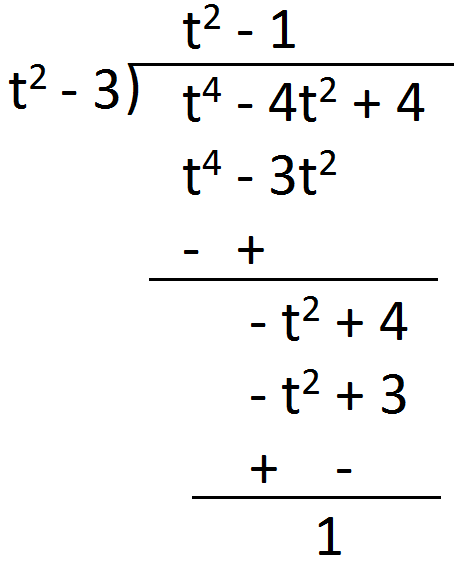
$\therefore\ \text{I}=2\int\Big(\text{t}^2-1+\frac{1}{\text{t}^2-3}\Big)\text{ dt}$
$=2\int\text{t}^2\text{ dt}-2\int\text{ dt}+2\int\frac{\text{dt}}{\text{t}^2-(\sqrt{3})^2}$
$=2\Big[\frac{\text{t}^3}{3}\Big]-2\text{t}+2\times\frac{1}{2\sqrt{3}}\log\Big|\frac{\text{t}-\sqrt{3}}{\text{t}+\sqrt{3}}\Big|+\text{C}$
$=\frac{2}{3}(\sqrt{\text{x}+2})^3-2\sqrt{\text{x}+2}+\frac{1}{\sqrt{3}}\log\bigg|\frac{\sqrt{\text{x}+2}-\sqrt{3}}{\sqrt{\text{x}+2}+\sqrt{3}}\bigg|+\text{C}$
$=\frac{2}{3}(\text{x}+2)^{\frac{3}{2}}-2\sqrt{\text{x}+2}+\frac{1}{\sqrt{3}}\log\bigg|\frac{\sqrt{\text{x}+2}-\sqrt{3}}{\sqrt{\text{x}+2}+\sqrt{3}}\bigg|+\text{C}$ View full question & answer→Question 1115 Marks
Evaluate the following intregals:
$\int\frac{\text{x}+2}{\sqrt{\text{x}^2+2\text{x}-1}}\text{dx}$
AnswerLet $\text{I}=\int\frac{\text{x}+2}{\sqrt{\text{x}^2+2\text{x}-1}}\text{dx}$
consider,
$\text{x}+2=\text{A}\frac{\text{d}}{\text{dx}}(\text{x}^2+2\text{x}-1)+\text{B}$
$\Rightarrow\text{x}+2=\text{A}(2\text{x}+2)+\text{B}$
$\Rightarrow\text{x}+2=(2\text{A})\text{x}+2\text{A}+\text{B}$
Equating coefficient of like terms.
$2\text{A}=1$
$\Rightarrow\text{A}=\frac{1}{2}$
And
$2\text{A}+\text{B}=2$
$\Rightarrow2\times\frac{1}{2}+\text{B}=2$
$\Rightarrow\text{B}=1$
Then,
$\text{I}=\int\frac{\big[\frac{1}{2}(2\text{x}+2)+1}{\sqrt{\text{x}^2+2\text{x}+1}}\text{dx}$
$=\frac{1}{2}\int\frac{(2\text{x}+2)\text{dx}}{\sqrt{\text{x}^2+2\text{x}+1}}+\int\frac{\text{dx}}{\sqrt{\text{x}^2+2\text{x}-1}}$
Let $\text{x}^2+2\text{x}-1=\text{t}$
$\Rightarrow(2\text{x}+2)\text{dx}=\text{dt}$
$\therefore\text{I}=\frac{1}{2}\int\frac{\text{dt}}{\sqrt{\text{t}}}+\int\frac{\text{dx}}{\sqrt{\text{x}^2+2\text{x}+1-2}}$
$=\frac{1}{2}\int\text{t}^{-\frac{1}{2}}\text{dt}+\int\frac{\text{dx}}{\sqrt{\text{x}^2+2\text{x}+1-2}}$
$=\frac{1}{2}\bigg[\frac{\text{t}^{\frac{1}{2}}+1}{-\frac{1}{2}+1}\bigg]+\int\frac{\text{dx}}{\sqrt{(\text {x}+1)^2-(\sqrt{2})^2}}$
$=\sqrt{\text{t}}+\log\Big|\text{x}+1+\sqrt{(\text{x}+1)^2-(\sqrt{2})^2}\Big|+\text{C}$
$=\sqrt{\text{x}^2+2\text{x}-1}+\log\big|\text{x}+1+\sqrt{\text{x}^2+2\text{x}-1}\big|+\text{C}$
View full question & answer→Question 1125 Marks
Evaluate the following integrals:
$\int(\text{x}=1)\sqrt{\text{x}^2-\text{x}+1}\text{dx}$
AnswerLet $\text{I}=\int(\text{x}=1)\sqrt{\text{x}^2-\text{x}+1}\text{dx}\ \dots(1)$
Let $\text{x}+1=\lambda\frac{\text{d}}{\text{dx}}(\text{x}^2-\text{x}+1)+\mu$
$=\lambda(2\text{x}-1)+\mu$
Equating similar terms, we get,
$2\lambda=1\ \Rightarrow\ \lambda=\frac{1}{2}$
$-\lambda+\mu=1$
$\Rightarrow\mu=1+\lambda=1+\frac{1}{2}=\frac{3}{2}$
$\therefore\ \mu=\frac{3}{2}$
So,
$\text{I}=\int\Big(\frac{1}{2}(2\text{x}-1)+\frac{3}{2}\Big)\sqrt{\text{x}^2-\text{x}+1}\text{dx}$
$=\frac{1}{2}\int(2\text{x}-1)\sqrt{\text{x}^2-\text{x}+1}\text{dx}+\frac{3}{2}\int\sqrt{\text{x}^2-\text{x}+1}\text{dx}$
Let $\text{x}^2-\text{x}+1=\text{t}$
$\Rightarrow(2\text{x}-1)\text{dx}=\text{dt}$
$=\frac{1}{2}\int\sqrt{\text{t}}\text{dt}+\frac{3}{2}\int\sqrt{\Big(\text{x}-\frac{1}{2}\Big)^2+\Big(\frac{\sqrt3}{2}\Big)^2}\text{dx}$
$=\frac{1}{2}\frac{\text{t}^{\frac{3}{2}}}{\frac{3}{2}}+\frac{3}{2}\begin{Bmatrix}\frac{\big(\text{x}-\frac{1}{2}\big)}{2}\sqrt{\text{x}^2-\text{x} +1}\\+\frac{3}{8}\log\Big|\Big(\text{x}-\frac{1}{2}\Big)+\sqrt{\text{x}^2-\text{x}+1}\Big|\end{Bmatrix}$
$\Rightarrow\text{I}=\frac{1}{3}\text{t}^{\frac{3}{2}}+\frac{3}{8}(2\text{x}-1)\sqrt{\text{x}^2-\text{x}+1}+\frac{9}{16}\\\times\log\Big|\Big(\text{x}-\frac{1}{2}\Big)+\sqrt{\text{x}^2-\text{x}+1}\Big|+\text{C}$
Hence,
$\Rightarrow\text{I}=\frac{1}{3}(\text{x}^2-\text{x}+1)^{\frac{3}{2}}+\frac{3}{8}(2\text{x}-1)\sqrt{\text{x}^2-\text{x}+1}+\frac{9}{16}\\\times\log\Big|\Big(\text{x}-\frac{1}{2}\Big)+\sqrt{\text{x}^2-\text{x}+1}\Big|+\text{C}$
View full question & answer→Question 1135 Marks
Evaluate the following integrals:$\int\frac{\text{ax}^3+\text{bx}}{\text{x}^4+\text{c}^2}\text{ dx}$
AnswerLet $\text{I}=\int\frac{\text{ax}^3+\text{bx}}{\text{x}^4+\text{c}^2}\text{ dx}$ Let $\text{ax}^3+\text{bx}=\lambda\frac{\text{d}}{\text{dx}}\big(\text{x}^4+\text{c}^2\big)+\mu$ $\text{ax}^3+\text{bx}=\lambda\big(4\text{x}^3\big)+\mu$ Comparing the coefficients of like powers of x, $4\lambda=\text{a}\Rightarrow\lambda=\frac{\text{a}}{4}$ $\mu=0\Rightarrow\mu=0$ So, $\text{I}=\int\frac{\frac{\text{a}}{4}(4\text{x}^3)+\text{bx}}{\text{x}^4+\text{c}^2}\text{ dx}$ $\text{I}=\frac{\text{a}}{4}\int\frac{4\text{x}^3}{\text{x}^4+\text{c}^2}\text{ dx}+\text{b}\int\frac{\text{x}}{(\text{x}^2)^2+\text{c}^2}\text{ dx}$ $\text{I}=\frac{\text{a}}{4}\int\frac{4\text{x}^3}{\text{x}^4+\text{c}^2}\text{ dx}+\frac{\text{b}}{2}\int\frac{2\text{x}}{(\text{x}^2)^2+\text{c}^2}\text{ dx}$ $\text{I}=\frac{\text{a}}{4}\log\big|\text{x}^4+\text{c}^2\big|+\frac{\text{b}}{2}\text{I}_1\ ....(1)$Now,
$\text{I}_1=\int\frac{2\text{x}}{(\text{x}^2)^2+\text{c}^2}\text{ dx}$ Put $\text{x}^2=\text{t}$ $\Rightarrow2\text{x}\text{ dx}=\text{dt}$ $\text{I}_1=\int\frac{1}{(\text{t})^2+\text{c}^2}\text{ dx}$ $\text{I}_1=\frac{1}{\text{c}}\tan^{-1}\Big(\frac{\text{t}}{\text{c}}\Big)+\text{C}_1\ ....(2)$ Using equation (2) in equation (1), $\text{I}=\frac{\text{a}}{4}\log\big|\text{x}^4+\text{c}^4\big|+\frac{\text{b}}{2\text{c}}\tan^{-1}\Big(\frac{\text{x}^2}{\text{c}}\Big)+\text{K}$ K = Integration constant.
View full question & answer→Question 1145 Marks
Evaluate the following integrals:
$\int\frac{\log\big(1+\frac{1}{\text{x}}\big)}{\text{x}(1+\text{x})}\text{dx}$
AnswerLet I $=\int\frac{\log\big(1+\frac{1}{\text{x}}\big)}{\text{x}(1+\text{x})}\text{dx}\ .....(1)$
Let $\log\Big(1+\frac{1}{\text{x}}\Big)=\text{t}$ then,
$\text{d}\Big[\log\Big(1+\frac{1}{\text{x}}\Big)\Big]=\text{dt}$
$\Rightarrow\frac{1}{1+\frac{1}{\text{x}}}\times\frac{-1}{\text{x}^2}\text{dx}=\text{dt}$
$\Rightarrow\frac{1}{\frac{\text{x}+1}{\text{x}}}\times\frac{-1}{\text{x}^2}\text{dx}=\text{dt}$
$\Rightarrow\frac{-\text{x}}{\text{x}^2(\text{x}+1)}\text{dx}=-\text{dt}$
$\Rightarrow\frac{\text{dx}}{\text{x}(\text{x}+1)}=-\text{dt}$
Putting $\log\Big(1+\frac{1}{\text{x}}\Big)=\text{t}$ and $\frac{\text{dx}}{\text{x}(\text{x}+1)}=-\text{dt}$ in equation (1), we get
$\text{I}=\int\text{tx}-\text{dt}$
$=-\frac{\text{t}^2}{2}+\text{C}$
$=-\frac{1}{2}\Big[\log\Big(1+\frac{1}{\text{x}}\Big)\Big]^2+\text{C}$
$\therefore\text{I}=-\frac{1}{2}\Big[\log\Big(1+\frac{1}{\text{x}}\Big)\Big]^2+\text{C}$
View full question & answer→Question 1155 Marks
Evaluate the following integrals:
$\int\frac{\text{dx}}{(\text{x}^2+1)(\text{x}^2+4)}$
AnswerLet $\frac{1}{(\text{x}^2+1)(\text{x}^2+4)}=\frac{\text{Ax}+\text{B}}{(\text{x}^2+1)}+\frac{\text{Cx}+\text{D}}{\text{x}^2+4}$
$\Rightarrow1=(\text{Ax}+\text{B})(\text{x}^2+4)+(\text{Cx}+\text{D})(\text{x}^2+1)$
$=(\text{A}+\text{C})\text{x}^3+(\text{B}+\text{D})\text{x}^2+(4\text{A}+\text{C})\text{x}+4\text{B}+\text{D}$
Equating similar terms, we get,
A + C = 0, B + D = 0, 4A + C = 0, 4B + D = 1
Solving, we get, $\text{A}=0,\text{B}=\frac{1}{3},\text{C}=0,\text{D}=-\frac{1}{3}$
Thus,
$\text{I}=\int\frac{\frac{1}{3}\text{dx}}{(\text{x}^2+1)}-\int\frac{\frac{1}{3}\text{dx}}{(\text{x}^2+4)}$
$=\frac{1}{3}\tan^{-1}\text{x}-\frac{1}{6}\tan^{-1}\Big(\frac{\text{x}}{2}\Big)+\text{C}$ $\big[\because\int\frac{\text{dx}}{\text{x}^2+\text{a}^2}=\frac{1}{\text{a}}\tan^{-1}\frac{\text{x}}{\text{a}}\big]$
$\therefore\text{I}=\frac{1}{3}\tan^{-1}\Big(\frac{\text{x}}{2}\Big)+\text{C}$
View full question & answer→Question 1165 Marks
Evaluate the following intregals:
$\int\frac{2\text{x}-3}{(\text{x}^2-1)(2\text{x}-3)}\ \text{dx}$
Answer$\int\frac{2\text{x}-3}{(\text{x}^2-1)(2\text{x}-3)}\ \text{dx}$
$=\int\frac{(2\text{x}-3)}{(\text{x}-1)(\text{x}+1)(2\text{x}+3)}\ \text{dx}$
Let $\int\frac{(2\text{x}-3)}{(\text{x}-1)(\text{x}+1)(2\text{x}+3)}=\frac{\text{A}}{\text{x}-1}+\frac{\text{B}}{\text{x}+1}+\frac{\text{C}}{2\text{x}+ 3}$
$\Rightarrow\int\frac{(2\text{x}-3)}{(\text{x}-1)(\text{x}+1)(2\text{x}+3)}=\frac{\text{A}(\text{x}+1)(2\text{x}+3)+\text{B}(\text{x}+1)(2\text {x}-3)+\text{C}(\text{x}^2-1)}{(\text{x}-1))(\text{x}+1)(2\text{X}+3)}$
$\Rightarrow2\text{x}-3=\text{A}(\text{x}+1)(2\text{x}+3)\\+\text{B}(\text{x}-1)(2\text{x}+3)+\text{C}(\text{x}+1)(\text{x}-1)\ ...(1)$
Putting x + 1 = 0 or x = -1 in eq (1)
⇒ -2 - 3 = B (-1 -1) (-2 + 3)
⇒ -5 = B (-2) (1)
$\Rightarrow\text{B}=\frac{5}{2}$
Putting x - 1 = 0 or x = 1 in eq (1)
⇒ 2 - 3 = A (1 + 1) (2 + 3)
⇒ -1 = A (2) (5)
$\Rightarrow\text{A}=\frac{-1}{10}$
Putting 2x + 3 = 0 or $\text{x}=\frac{-3}{2}$ in eq (1)
$\Rightarrow2\times-\frac{3}{2}-3=\text{A}\times0+\text{B}\times0+\text{C}\Big(-\frac{3}{2}+1\Big)\Big(\frac{-3}{2}-1\Big)$
$\Rightarrow-6=\text{C}\Big(-\frac{1}{2}\Big)\Big(\frac{-5}{2}\Big)$
$\Rightarrow\text{C}=-\frac{24}{5}$
$\therefore\frac{2\text{x}-3}{(\text{x}-1)(\text{X}+1)(2\text{X}+3)}=\frac{-1}{10(\text{x}-1)}+\frac{5}{2(\text{x}+1)}-\frac{24}{5(2\text{x}+3)}$
$\Rightarrow\int\frac{(2\text{x}-3)}{(\text{x}-1)(\text{x}+1)(2\text{x}+3)}\ \text{dx}=\frac{-1}{10}\int\frac{1}{\text{x}-1}\text{dx}\\+\frac{5}{2}\int\frac{1}{\text{x}+1}\text{dx}-\frac{24}{5}\int\frac{1}{2\text{X}+3}\ \text{dx}$
$=\frac{-1}{10}\ln|\text{x}-1|+\frac{5}{2}\ln|\text{x}+1|-\frac{24}{5}\ln\frac{|2\text{x}+3|}{3}+\text{C}$
$=-\frac{1}{10}\ln|\text{x}-1|+\frac{5}{2}\ln|\text{x}+1|-\frac{12}{5}\ln|2\text{x}+3|+\text{C}$
View full question & answer→Question 1175 Marks
Evaluate the following integrals:
$\int\frac{1}{\text{x}(\text{x}^6+1)}\text{dx}$
AnswerLet $\text{I}=\int\frac{1}{\text{x}(\text{x}^6+1)}\text{dx}$
$=\int\frac{\text{x}^5}{\text{x}^6(\text{x}^6+1)}\text{dx}$
Let $\text{x}^6=\text{t}$
$\Rightarrow6\text{x}^5\text{dx = dt}$
$\Rightarrow\text{x}^5\text{dx}=\frac{\text{dt}}{6}$
$\text{I}=\frac{1}{6}\int\frac{\text{dt}}{\text{t}(\text{t}+1)}$
$=\frac{1}{6}\int\frac{\text{dt}}{\text{t}^2+\text{t}}$
$=\frac{1}{6}\int\frac{\text{dt}}{\text{t}^2+2\text{t}\big(\frac{1}{2}\big)+\big(\frac{1}{2}\big)^2-\big(\frac{1}{2}\big)^2}$
$=\frac{1}{6}\int\frac{\text{dt}}{\big(\text{t}+\frac{1}{2}\big)^2-\big(\frac{1}{2}\big)^2}$
Let $\text{t}+\frac{1}{2}=\text{u}$
$\Rightarrow\text{dt = du}$
$\text{I}=\frac{1}{6}\int\frac{\text{du}}{\text{u}^2-\big(\frac{1}{2}\big)^2}$
$=\frac{1}{6}\times\frac{1}{2\big(\frac{1}{2}\big)}\log\Bigg|\frac{\text{u}-\frac{1}{2}}{\text{u}+\frac{1}{2}}\Bigg|+\text{C}$ $\bigg[\text{Since}\int\frac{1}{\text{x}^2-\text{a}^2}\text{dx}=\frac{1}{2\text{a}}\log\Big|\frac{\text{x}-\text{a}}{\text{x}+\text{a}}\Big|+\text{C}\bigg]$
$\text{I}=\frac{1}{6}\log\Bigg|\frac{\text{t}+\frac{1}{2}-\frac{1}{2}}{\text{t}+\frac{1}{2}+\frac{1}{2}}\Bigg|+\text{C}$
$\text{I}=\frac{1}{6}\log\bigg|\frac{\text{x}^6}{\text{x}^6+1}\bigg|+\text{C}$
View full question & answer→Question 1185 Marks
Evaluate the following intregals:
$\int\frac{1}{1-\sin\text{x}+\cos\text{x}}\ \text{dx}$
AnswerLet $\text{I}=\int\frac{1}{1-\sin\text{x}+\cos\text{x}}\ \text{dx}$
Putting $\sin\text{x}=\frac{2\tan\frac{\text{x}}{2}}{1+\tan^2\frac{\text{x}}{2}},\cos\text{x}=\frac{1-\tan^2\frac{\text{x}}{2}}{1+\tan^2\frac{\text{x}}{2}}$
$\text{I}=\int\frac{1}{1-\frac{2\tan\frac{\text{x}}{2}}{1+\tan^2\frac{\text{x}}{2}}+\frac{1-\tan^2\frac{\text{x}}{2}}{1+\tan^2\frac{\text{x}}{2}}}$
$=\int\frac{1+\tan^2\frac{\text{x}}{2}}{1+\tan^2\frac{\text{x}}{2}-2\tan\frac{\text{x}}{2}+1-\tan^2\frac{\text{x}}{2}}\ \text{dx}$
$=\int\frac{\sec^2\frac{\text{x}}{2}}{2-2\tan\frac{\text{x}}{2}}\ \text{dx}$
Let $\tan\frac{\text{x}}{2}=\text{t}$
$\frac{1}{2}\sec^2\frac{\text{x}}{2}\text{dx}=\text{dt}$
$=\frac{2}{2}\int\frac{\text{dt}}{1-\text{t}}$
$=-\log|1-\text{t}|+\text{C}$
$\text{I}=-\log\big|1-\tan\frac{\text{x}}{2}\big|+\text{C}$
View full question & answer→Question 1195 Marks
Evaluate the following intregals:
$\int\frac{\text{x}^2+\text{x}+1}{(\text{x}^2+1)(\text{x}+2)}\text{ dx}$
AnswerLet $\text{I}=\int\frac{\text{x}^2+\text{x}+1}{(\text{x}^2+1)(\text{x}+2)}\text{ dx}$
We express
$\frac{\text{x}^2+\text{x}+1}{(\text{x}^2+1)(\text{x}+2)}=\frac{\text{A}}{\text{x}+2}+\frac{\text{Bx}+\text{C}}{\text{x}^2+1}$
$\Rightarrow\text{x}^2+\text{x}+1=\text{A}(\text{x}^2+1)+(\text{Bx}+\text{C})(\text{x}+2)$
Equating the coefficient of $x^2$, x and constant, we get
$1=\text{A}+\text{B}\text{ and }1=2\text{B}+\text{C}\text{ and }1=\text{A}+2\text{C}$
$\text{or}\text{ A } =\frac{3}{5}\text{ and }\text{B}=\frac{2}{5}\text{ and }\text{C}=\frac{1}{5}$
$ \therefore\text{I}=\int\bigg(\frac{\frac{3}{5}}{\text{x}+2}+\frac{\frac{2}{5}\text{x}+\frac{1}{5}}{\text{x}^2+1}\bigg)\text{dx}$
$=\frac{3}{5}\int\frac{1}{\text{x}+2}\ \text{dx}+\frac{2}{5}\int\frac{\text{x}}{\text{x}+1}\ \text{dx}+\frac{1}{5}\int\frac{1}{\text{x}^2+1}\ \text{dx}$
$=\frac{3}{5}\text{I}_1+\frac{2}{5}\text{I}_2+\frac{1}{5}\text{I}_3\ \dots(1)$
Let x + 2 = u
On Differentiating both sides, we get
$\text{dx}=\text{du}$
$\text{I}_1=\int\frac{1}{\text{u}}\text{du}$
$=\log|\text{u}|+\text{C}_1$
$=\log|\text{x}+2|+\text{C}_1\ \dots(2)$
And, $\text{I}_2=\int\frac{\text{x}}{\text{x}+1}\text{ dx}$
Let $(\text{x}^2+1)=\text{u}$
On differentiating both sides, we get
$2\text{x}\ \text{dx}=\text{du}$
$\therefore\text{I}_2=\frac{1}{2}\int\frac{1}{\text{u}}\text{ du}$
$=\frac{1}{2}\log|\text{u}|+\text{C}_2$
$=\frac{1}{2}\log|\text{x}^2+1|+\text{C}_2\ \dots(3)$
And $\text{I}_3=\int\frac{1}{\text{x}^2+1}\ \text{dx}$
$=\tan^{-1}\text{x}+\text{C}_3\ \dots(4)$
From (1), (2), (3) and (4) we get
$\therefore\text{I}=\frac{3}{5}(\log|\text{x}+2|+\text{C}_1)+\frac{2}{5}(\frac{1}{2}\log|\text{x}^2+1|+\text{C}_2)\\+\frac{1}{5}\tan^{-1}\text{x}+\text{C}$
$=\frac{3}{5}\log|\text{x}+2|+\frac{1}{5}\log|\text{x}^2+1|+\frac{1}{5}\tan^{-1}\text{x}+\text{C}$
Hence, $\int\frac{\text{x}^2+\text{x}+1}{(\text{x}^2+1)(\text{x}+2)}\ \text{dx}=\frac{3}{5}\log|\text{x}+2|+\frac{1}{5}\tan^{-1}\text{x}+\text{C}$
View full question & answer→Question 1205 Marks
Evaluate the following integrals:
$\int\frac{\text{x}}{3\text{x}^4-18\text{x}^2+11}\text{dx}$
Answer$\int\frac{\text{x dx}}{3\text{x}^4-18\text{x}^2+11}$
Let $\text{x}^2=\text{t}$
$\Rightarrow2\text{x}\text{ dx = dt}$
$\Rightarrow\text{x dx}=\frac{\text{dt}}{2}$
Now, $\int\frac{\text{x dx}}{3\text{x}^4-18\text{x}^2+11}$
$=\frac{1}2{}\int\frac{\text{dt}}{3\text{t}^2-18\text{t}+11}$
$=\frac{1}{3\times2}\int\frac{\text{dt}}{\text{t}^2-6\text{t}+\frac{11}{3}}$
$=\frac{1}{6}\int\frac{\text{dt}}{\text{t}^2-6\text{t}+9-9+\frac{11}{3}}$
$=\frac{1}{6}\int\frac{\text{dt}}{(\text{t}-3)^2-\frac{16}{3}}$
$=\frac{1}{6}\int\frac{\text{dt}}{(\text{t}-3)^2-\Big(\frac{4}{\sqrt{3}}\Big)^2}$
$=\frac{1}{6}\times\frac{1}{2\times\frac{4}{\sqrt{3}}}\log\Bigg|\frac{\text{t}-3-\frac{4}{\sqrt{3}}}{\text{t}-3+\frac{4}{\sqrt{3}}}\Bigg|+\text{C}$
$=\frac{\sqrt{3}}{48}\log\Bigg|\frac{\text{x}^2-3-\frac{4}{\sqrt{3}}}{\text{x}^2-3+\frac{4}{\sqrt{3}}}\Bigg|+\text{C}$
View full question & answer→Question 1215 Marks
Evaluvate the following intregals:
$\int\frac{8\cot\text{x}+1}{3\cot\text{x}+2}\ \text{dx}$
AnswerLet $\text{I}=\int\Big(\frac{8\cot\text{x}+1}{3\cot\text{x}+2}\Big)\ \text{dx}$$=\int\bigg(\frac{8\frac{\cos\text{x}}{\sin\text{x}}+1}{\frac{3\cos\text{x}}{\sin\text{x}}+2}\bigg)\text{dx}$
$=\int\Big(\frac{8\cos\text{x}+\sin\text{x}}{3\cos\text{x}+2\sin\text{x}}\Big)\text{dx}$
Now, Let $8\cos\text{x}+\sin\text{x}=\text{A}(3\cos\text{x}+2\sin\text{x})+\text{B}(-3\sin\text{x}+2\cos\text{x})\ \dots(1)$
$\Rightarrow8\cos\text{x}+\sin\text{x}+\sin\text{x}=3\text{A}\cos\text{x}+2\text{A}\sin\text{x}-3\text{B}\sin\text{x}+2\text{B}\cos\text{x}$
$\Rightarrow8\cos\text{x}+\sin\text{x}-(3\text{A}+2\text{B})\cos\text{x}+(2\text{A}-3\text{B})\sin\text{x}$
Equating the coefficient of like terms we get,
$2\text{A}-3\text{B}=1\ \dots(2)$
$3\text{A}+2\text{B}=8\ \dots(3)$
Solving eq (2) and eq (3) we get,
$\text{A}=2,\text{B}=1$
Thus, by substracting the value of A and B in eq (1) we get,
$\text{I}=\int\Big[\frac{2(3\cos\text{x}+2\sin\text{x})+1(-3\sin\text{x}+2\cos\text{x})}{(3\cos\text{x}+2\sin\text{x})}\Big]\text{dx}$
$=2\int\Big(\frac{3\cos\text{x}+2\sin\text{x}}{3\cos\text{x}+2\sin\text{x}}\Big)\text{dx}+\int\Big(\frac{-3\sin\text{x}+2\cos\text{x}}{3\cos\text{x}+2\sin\text{x}}\Big)\text{dx}$
$=2\int\text{dx}+\int\Big(\frac{-3\sin\text{x}+2\cos\text{x}}{3\cos\text{x}+2\sin\text{x}}\Big)\text{dx}$
Putting $3\cos\text{x}+2\sin\text{x}=\text{t}$
$\Rightarrow(-3\sin\text{x}+2\cos\text{x})\text{dx}=\text{dt}$
$\therefore\text{I}=2\int\text{dx}+\int\frac{1}{\text{t}}\text{dt}$
$=2\text{x}+\ln|\text{t}|+\text{C}$
$=2\text{x}+\ln|3\cos\text{x}+2\sin\text{x}|+\text{C}$
View full question & answer→Question 1225 Marks
$\int\frac{3\text{x}+5}{\sqrt{7\text{x}+9}}\text{dx}$
Answer$\text{Let I}=\int\Big(\frac{3\text{x}+5}{\sqrt{7\text{x}+9}}\Big)\text{dx}$
$\text{Putting}\ 7\text{x}+9=\text{t}$
$\Rightarrow\text{x}=\frac{\text{t}-9}{7}\ \&\ 7\text{dx}=\text{dt}$
$\Rightarrow\text{dx}=\frac{\text{dt}}{7}$
$\therefore\text{I}=\int\Bigg(\frac{3\big(\frac{\text{t}-9}{7}\big)+5}{\sqrt{\text{t}}}\Bigg)\text{dt}$
$=\int\Big(\frac{3}{7}\frac{\text{t}}{\sqrt{\text{t}}}-\frac{27}{7\sqrt{\text{t}}}+\frac{5}{\sqrt{\text{t}}}\Big)\frac{\text{dt}}{7}$
$=\frac{3}{7\times7}\int\text{t}^\frac{1}{2}\text{dt}-\frac{27}{7\times7}\int\text{t}^{-\frac{1}{2}}\text{dt}+\frac{5}{7}\int^{-\frac{1}{2}}\text{dt}$
$=\frac{3}{7\times7}\bigg[\frac{\text{t}^{\frac{1}{2}+1}}{\frac{1}{2}+1}\bigg]-\frac{27}{7\times7}\bigg[\frac{\text{t}^{-\frac{1}{2}+1}}{-\frac{1}{2}+1}\bigg]+\frac{5}{7}\bigg[\frac{\text{t}^{-\frac{1}{2}+1}}{-\frac{1}{2}+1}\bigg]+\text{C}$
$=\frac{2}{7\times7}\text{t}^\frac{3}{2}-\frac{27}{7\times7}2\text{t}^\frac{1}{2}+\frac{10\sqrt{t}}{7}+\text{C}$
$=\frac{2}{7\times7}(7\text{x}+9)^\frac{3}{2}-\frac{54}{7\times7}(7\text{x}+9)^\frac{1}{2}+\frac{10}{7}\sqrt{7\text{x}+9}+\text{C}$ $[\because\text{t}=7\text{x}+9]$
$=\frac{2}{7\times7}(7\text{x}+9)^\frac{3}{2}+\Big(10-\frac{54}{7}\Big)\frac{\sqrt{7\text{x}+9}}{7}+\text{C}$
$=\frac{2}{7\times7}(7\text{x}+9)^\frac{3}{2}+\Big(\frac{70-54}{7}\Big)\frac{\sqrt{7\text{x}+9}}{7}+\text{C}$
$=\frac{2}{7\times7}(7\text{x}+9)^\frac{3}{2}+\frac{16}{7\times7}\frac{\sqrt{7\text{x}+9}}{7}+\text{C}$
$=\frac{2}{7\times7}\Big[(7\text{x}+9)^\frac{1}{2}[7\text{x}+9+8]\Big]+\text{C}$
$=\frac{2}{49}\Big[(7\text{x}+9)^\frac{1}{2}[7\text{x}+17]\Big]+\text{C}$
View full question & answer→Question 1235 Marks
Evaluate the following integrals:$\int\frac{\text{x}^2\tan^{-1}\text{x}}{1+\text{x}^2}\text{dx}$
AnswerLet $\text{I}=\int\Big(\frac{\text{x}^2\tan^{-1}\text{x}}{1+\text{x}^2}\Big)\text{dx}$
$=\int\Big(\frac{\text{x}^2+1-1}{\text{x}^2+1}\Big)\tan^{-1}\text{x dx}$
$=\int\Big(1-\frac{1}{\text{x}^2+1}\Big)\tan^{-1}\text{x dx}$
$=\int1.\tan^{-1}\text{x dx}-\int\frac{\tan^{-1}\text{x}}{\text{x}^2+1}\text{dx}$
$=\Big[\tan^{-1}\text{x}\int1\text{dx}-\int\Big\{\frac{\text{d}}{\text{dx}}\big(\tan^{-1}\text{x}\big)\int1\text{dx}\Big\}\text{dx}\Big]-\int\frac{\tan^{-1}\text{x}}{\text{x}^2+1}\text{dx}$
$=\Big[\tan^{-1}\text{x}\times\text{x}-\int\frac{\text{x}}{1+\text{x}^2}\text{dx}\Big]-\int\frac{\tan^{-1}\text{x}}{\text{x}^2+1}\text{dx}$
Putting $\text{x}^2+1=\text{t}$ in the first integral and $\tan^{-1}\text{x}=\text{p}$ in the second integral
$\Rightarrow2\text{x dx = dt} $ and $\frac{1}{1+\text{x}^2}\text{dx = dp}$
$\Rightarrow\text{x dx}=\frac{\text{dt}}{2}$ and $\frac{1}{1+\text{x}^2}\text{dx = dp}$
$\therefore \text{I}=\tan^{-1}\text{x.x}-\frac{1}{2}\int\frac{\text{dt}}{\text{t}}-\int\text{p.dp}$
$=\text{x}\tan^{-1}\text{x}-\frac{1}{2}\ln|\text{t}|-\frac{\text{P}^2}{2}+\text{C}$
$=\text{x}\tan^{-1}\text{x}-\frac{1}{2}\ln|1+\text{x}^2|-\frac{(\tan^{-1}\text{x})^2}{2}+\text{C}$ $[\therefore \text{t}=\text{x}^2+1\text{ and}\text{ p}=\tan^{-1}\text{x}]$
View full question & answer→Question 1245 Marks
Evaluate the following integrals:
$\int\frac{\sin^3\text{x}}{\sqrt{\cos\text{x}}}\text{dx}$
AnswerLet I $=\int\frac{\sin^3\text{x}}{\sqrt{\cos\text{x}}}\text{dx}$$\therefore\text{I}=\int\frac{\sin^2\text{x}\sin\text{x}}{\sqrt{\cos\text{x}}}\text{dx}$
$\Rightarrow\text{I}=\int\frac{(1-\cos^2\text{x})}{\sqrt{\cos\text{x}}}\sin\text{x dx}\ ...(1)$
Let $\cos\text{x}=\text{t}$ then, $\text{d}(\cos\text{x})=\text{dt}$
$\Rightarrow-\sin\text{x dx}=\text{dt}$
$\Rightarrow\sin\text{x dx}=-\text{dt}$
Putting $\cos\text{x}=\text{t}$ and $\sin\text{x dx}=-\text{dt}$ in equation (1), we get
$\text{I}=\int\frac{(1-\text{t}^2)}{\sqrt{\text{t}}}\times-\text{dt}$
$=\int\frac{\text{t}^2-1}{\sqrt{\text{t}}}\text{dt}$
$=\int\Bigg(\frac{\text{t}^2}{\text{t}^\frac{1}{2}}-\frac{1}{\text{t}^\frac{1}{2}}\Bigg)\text{dt}$
$=\int\Big(\text{t}^{2-\frac{1}{2}}-\text{t}^\frac{-1}{2}\Big)\text{dt}$
$=\int\Big(\text{t}^\frac{3}{2}-\text{t}^{\frac{-1}{2}}\Big)\text{dt}$
$=\frac{2}{5}\text{t}^\frac{5}{2}-2\text{t}^\frac{1}{2}+\text{C}$
$\therefore\text{I}=\frac{2}{5}\cos^\frac{5}{2}\text{x}-2\cos^\frac{1}{2}\text{x}+\text{C}$
$\therefore\text{I}=\frac{2}{5}\cos^\frac{5}{2}\text{x}-2\sqrt{\cos\text{x}}+\text{C}$
View full question & answer→Question 1255 Marks
Evaluate the following integrals:$\int\frac{\text{x}^2(\text{x}^4+4)}{\text{x}^2+4}\text{ dx}$
AnswerLet $\text{I}=\int\frac{\text{x}^2(\text{x}^4+4)}{\text{x}^2+4}\text{ dx}$
$=\int\frac{\text{x}^6+4\text{x}^2}{(\text{x}^2+4)}\text{ dx}$
$=\int\Big[\text{x}^4-4\text{x}^2+20-\frac{80}{\text{x}^2+4}\Big]\text{dx}$
$\text{I}=\frac{\text{x}^5}{5}-\frac{4\text{x}^3}{3}+20\text{x}-80\int\frac{1}{\text{x}^2+4}\text{ dx}+\text{C}_1\ ....(1)$
Let $\text{I}_1=\int\frac{1}{\text{x}^2+4}\text{ dx}$
$\text{I}_1=\int\frac{1}{\text{x}^2+(2)^2}\text{ dx}$
$\text{I}_1=\frac{1}{2}\tan^{-1}\Big(\frac{\text{x}}{2}\Big)+\text{C}_2\ ....(2)$ $\Big[\text{Since},\int\frac{1}{\text{x}^2+\text{a}^2}\text{ dx}=\frac{1}{\text{a}}\tan^{-1}\Big(\frac{\text{x}}{\text{a}}\Big)+\text{C}\Big]$
Using equation (1) and (2)
$\text{I}=\frac{\text{x}^5}{5}-\frac{4\text{x}^3}{3}+20\text{x}-\frac{80}{2}\tan^{-1}\Big(\frac{\text{x}}{2}\Big)+\text{C}$
$\text{I}=\frac{\text{x}^5}{5}-\frac{4\text{x}^3}{3}+20\text{x}-40\tan^{-1}\Big(\frac{\text{x}}{2}\Big)+\text{C}$
View full question & answer→Question 1265 Marks
Evaluate the following intregals:
$\int\frac{\text{x}^2+1}{(2\text{x}+1)(\text{x}^2-1)}\text{ dx}$
AnswerWe have,$\text{I}=\int\frac{\text{x}^2+1}{(2\text{x}+1)(\text{x}^2-1)}$
$\text{I}=\int\frac{(\text{x}^2+1)\text{dx}}{(2\text{x}+1)(\text{x}^2-1)(\text{x}+1)}$
Let $\text{I}=\int\frac{(\text{x}^2+1)}{(2\text{x}+1)(\text{x}^2-1)(\text{x}+1)}=\frac{\text{A}}{2\text{x}+1}+\frac{\text{B}}{\text{x}-1}+\frac{\text{C}}{\text{x}+1}$
$\Rightarrow\int\frac{(\text{x}^2+1)}{(2\text{x}+1)(\text{x}^2-1)(\text{x}+1)}=\frac{\text{A}(\text{x}^2-1)+\text{B}(2\text{x}+1)(\text{x}+1)+\text{C}(2\text{x}+1)(\text{x}-1)}{(2\text{x}-1)(\text{x}-1)(\text{x}+1)}$
$\Rightarrow\text{x}^2+1=\text{A}(\text{x}^2-1)+\text{B}(2\text{x}+1)(\text{x}+1)\\+\text{C}(2\text{x}+1)(\text{x}-1)$
Putting x - 1 = 0
⇒ x = 1
1 + 1 = A × 0 + B × 0 + C (-2 + 1) (-1 - 1)
⇒ 2 = B (3) (2)
$\Rightarrow\text{B}=\frac{1}{3}$
Putting x + 1 = 0
⇒ x = -1
1 + 1 = A × 0 + B (-2 + 1)(-1 - 1)
⇒ 2 = C (-1) (-2)
⇒ C = 1
Putting 2x + 1 = 0
$\Rightarrow\text{x}=-\frac{1}{2}$
$\Big(-\frac{1}{2}\Big)^2+1=\text{A}\Big(\frac{1}{4}-1\Big)$
$\Rightarrow\frac{1}{4}+1=\text{A}\Big(-\frac{3}{4}\Big)$
$\Rightarrow\frac{5}{4}=\text{A}\Big(-\frac{3}{4}\Big)$
$\text{A}=-\frac{5}{3}$
$\therefore\text{I}=-\frac{5}{3}\int\frac{\text{dx}}{2\text{x}+1}+\frac{1}{3}\int\frac{\text{dx}}{\text{x}-1}+\int\frac{\text{dx}}{\text{x}+1}$
$=-\frac{5}{3}\times\frac{\log|2\text{x}+1|}{2}+\frac{1}{3}\log|\text{x}-1|+\log|\text{x}+1|+\text{C}$
$=-\frac{5}{6}\log|2\text{x}-1|+\frac{1}{3}\log|\text{x}-1|+\log|\text{x}+1|+\text{C}$
View full question & answer→Question 1275 Marks
Evaluate the following intregals:$\int\frac{1}{3+2\cos^2\text{x}}\text{ dx}$
AnswerLet $\text{I}=\int\frac{1}{3+2\cos^2\text{x}}\text{ dx}$
Dividing numerator and denominator by $\cos^2\text{x}$
$\text{I}=\int\frac{\frac{1}{\cos^2\text{x}}}{\frac{3}{\cos^2\text{x}}+\frac{2\cos^2\text{x}}{\cos^2\text{x}}}$
$=\int\frac{\sec^2\text{x}}{2\sec^2\text{x}+2}\ \text{dx}$
$=\int\frac{\sec^2\text{x}}{3(1+\tan^2\text{x})+2}\ \text{dx}$
$=\int\frac{\sec^2\text{x}}{3+3\tan^2\text{x}+2}\text{ dx}$
$=\int\frac{\sec^2\text{x}}{5+3\tan^2\text{x}}\ \text{dx}$
Let $\sqrt{3}\tan\text{x}=\text{t}$
$\sqrt{3}\sec^2\text{x}\text{ dx}=\text{dt}$
$\text{I}=\frac{1}{\sqrt{3}}\int\frac{\text{dt}}{(\sqrt{5})^2+\text{t}^2}$
$=\frac{1}{\sqrt{3}+\sqrt{5}}\tan^{-1}\Big(\frac{\text{t}}{\sqrt{5}}\Big)+\text{C}$
$\text{I}=\frac{1}{\sqrt{15}}\tan^{-1}\Big(\frac{\sqrt{3}\tan\text{x}}{\sqrt{5}}\Big)+\text{C}$
View full question & answer→Question 1285 Marks
Evaluate the following integrals:
$\int\frac{\text{x}^2+1}{\text{x}^4-\text{x}^2+1}\ \text{dx}$
Answerlet $\text{I}=\int\frac{\text{x}^2+1}{\text{x}^4-\text{x}^2+1}\ \text{dx}$
Dividing numerator and denominator bt $x^2$
$\therefore\text{I}=\frac{\Big(1+\frac{1}{\text{x}^2}\Big)}{\text{x}^2-1+\frac{1}{\text{x}^2}}\ \text{dx}$
$=\int\frac{\Big(1+\frac{1}{\text{x}^2}\Big)\text{dx}}{\Big(\text{x}-\frac{1}{\text{x}}\Big)^2+1}$
let $\Big(\text{x}-\frac{1}{\text{x}^2}\Big)\text{dx}=\text{dt}$
$\Rightarrow\text{I}=\int\frac{\text{dt}}{\text{t}^2+1}$
$=\tan^{-1}\text{t}+\text{C}$
$\therefore\text{I}=\tan^{-1}\Big(\frac{\text{x}^2-1}{\text{x}}\Big)+\text{C}$
View full question & answer→Question 1295 Marks
Evaluate the following integrals:
$\int\frac{\text{x}^2+1}{\text{x}^2+7\text{x}^2+1}\ \text{dx}$
AnswerWe have,
$\text{I}=\int\Big(\frac{\text{x}^2+1}{\text{x}^4+7\text{x}^2+1}\Big)\text{dx}$
Dividing numerator and denominator by $x^2$
$\text{I}=\int\Bigg(\frac{1+\frac{1}{\text{x}^2}}{\text{x}^2+7+\frac{1}{\text{x}^2}}\Bigg)\text{dx}$
$=\int\frac{\Big(1+\frac{1}{\text{x}^2}\Big)\text{dx}}{\text{x}^2+\frac{1}{\text{x}^2}-2+9}$
$\Rightarrow\int\frac{\Big(1+\frac{1}{\text{x}^2}\Big)\text{dx}}{\Big(\text{x}-\frac{1}{\text{x}^2}\Big)^2+3^2}$
Putting $\text{x}-\frac{1}{\text{x}}=\text{t}$
$\Rightarrow\Big(1+\frac{1}{\text{x}^2}\Big)\text{dx}=\text{dt}$
$\therefore\text{I}=\int\frac{\text{dt}}{\text{t}^2+3^2}$
$=\frac{1}{3}\tan^{-1}\Big(\frac{\text{t}}{3}\Big)+\text{C}$
$=\frac{1}{3}\tan^{-1}\Big(\frac{\text{x}-\frac{1}{\text{x}}}{3}\Big)+\text{C}$
$=\frac{1}{3}\tan^{-1}\Big(\frac{\text{x}^2-1}{3\text{x}}\Big)+\text{C}$
View full question & answer→Question 1305 Marks
Evaluate the following integrals:
$\int\frac{1}{(\text{x}^2+2\text{x}+10)^2}\text{ dx}$
AnswerLet $\int\frac{1}{(\text{x}^2+2\text{x}+10)^2}\text{ dx}$
$=\int\frac{1}{\big[(\text{x}+1)^2+3^2\big]}\text{ dx}$
Let $\text{x}+1=3\tan\theta$
On differentiating both sides, we get
$\text{dx}=3\sec^2\theta\text{ d}\theta$
$\therefore\ \text{I}=\int\frac{1}{\big[3^2\tan^2\theta+3^2\big]^2}3\sec^2\theta\text{ d}\theta$
$=\frac{1}{27}\int\frac{\sec^2\theta}{\sec^4\theta}\text{ d}\theta$
$=\frac{1}{27}\int\frac{1}{\sec^2\theta}\text{ d}\theta$
$=\frac{1}{27}\int\cos^2\theta\text{ d}\theta$
$=\frac{1}{54}\int(1+\cos2\theta)\text{d}\theta$
$=\frac{1}{54}\Big(\theta+\frac{\sin2\theta}{2}\Big)+\text{ C}$
$=\frac{1}{54}\Big(\theta+\frac{\tan\theta}{1+\tan^2\theta}\Big)+\text{C}$
$=\frac{1}{54}\begin{pmatrix}\tan^{-1}\frac{\text{x}+1}{3}+\frac{\tan\Big(\tan^{-1}\frac{\text{x}+1}{3}\Big)}{1+\tan^{2}\Big(\tan^{-1}\frac{\text{x}+1}{3}\Big)}\end{pmatrix}+\text{C}$
$=\frac{1}{54}\begin{pmatrix}\tan^{-1}\frac{\text{x}+1}{3}+\frac{\frac{\text{x}+1}{3}}{1+\Big(\frac{\text{x}+1}{3}\Big)^2}\end{pmatrix}+\text{C}$
$=\frac{1}{54}\Bigg(\tan^{-1}\frac{\text{x}+1}{3}+\frac{\frac{\text{x}+1}{3}}{\frac{\text{x}^2+2\text{x}+10}{9}}\Bigg)+\text{C}$
$=\frac{1}{54}\bigg(\tan^{-1}\frac{\text{x}+1}{3}+\frac{3(\text{x}+1)}{\text{x}^2+2\text{x}+10}\bigg)+\text{C}$
View full question & answer→Question 1315 Marks
Evaluate the following integrals:
$\int\frac{\cos^5\text{x}}{\sin\text{x}}\text{ dx}$
Answer$\int\frac{\cos^5\text{x}}{\sin\text{x}}\text{ dx}$ $=\int\frac{\cos^4\text{x}\cos\text{x}}{\sin\text{x}}\text{ dx}$ $=\int\frac{(\cos^2\text{x})^2\cos\text{x}}{\sin\text{x}}\text{ dx}$ $=\int\frac{(1-\sin^2\text{x})^2\times\cos\text{x}}{\sin\text{x}}\text{ dx}$ $=\int\frac{(1-\sin^4\text{x}-2\sin^2\text{x})}{\sin\text{x}}\cos\text{x}\text{ dx}$Let $\sin\text{x}=\text{t}$
$\Rightarrow\cos\text{x}\text{ dx}=\text{dt}$
Now, $\int\frac{(1-\sin^4\text{x}-2\sin^2\text{x})}{\sin\text{x}}\cos\text{x}\text{ dx}$
$=\int\frac{(1+\text{t}^4-2\text{t}^2)}{\text{t}}\text{ dt}$
$=\int\Big(\frac{1}{\text{t}}+\text{t}^3-2\text{t}\Big)\text{dt}$
$=\log|\text{t}|+\frac{\text{t}^4}{4}-\frac{2\text{t}^2}{2}+\text{C}$
$=\log|\text{t}|+\frac{\text{t}^4}{4}-\text{t}^2+\text{C}$
$=\log|\sin\text{x}|+\frac{\sin^4\text{x}}{4}-\sin^2\text{x}+\text{C}$
View full question & answer→Question 1325 Marks
Evaluate the following integrals:$\int(\text{x}+1)\text{e}^{\text{x}}\log(\text{xe}^{\text{x}})\text{dx}$
Answer$\int(\text{x}+1)\text{e}^{\text{x}}.\log(\text{xe}^{\text{x}})\text{dx}$ Let $\text{x e}^{\text{x}}=\text{t}$ $\Rightarrow\big(\text{x.e}^{\text{x}}+1.\text{e}^{\text{x}}\big)\text{dx=dt}$ $\therefore\int(\text{x}+1)\text{e}^{\text{x}}.\log(\text{x e}^\text{x})\text{dx}=\int1.\log (\text{t})\text{dt}$ $=\log\text{t}\int1\text{dt}-\int\big\{\frac{\text{d}}{\text{dt}}(\log\text{t)}-\int1\text{dt}\Big\}\text{dt}$ $=\log(\text{t})\times\text{t}-\int\frac{1}{\text{t}}\times\text{t dt}$ $=\text{t}\log(\text{t})-\text{t}+\text{C} \dots(1)$Substituting the value of t in eq (1)
$\Rightarrow\int(\text{x}+1)\text{e}^{\text{x}}.\log(\text{x e}^{\text{x}})\text{dx} = (\text{x e}^{\text{x}}).\log(\text{x e}^{\text{x}})-\text{x e}^{\text{x}}+\text{C}$ $=\text{x e}^{\text{x}}\Big\{\log(\text{x e}^{\text{x}})-1\Big\}+\text{C}$
View full question & answer→Question 1335 Marks
$\int\text{x}^2\sqrt{\text{x}+2}\text{ dx}$
Answer$\int\text{x}^2\sqrt{\text{x}+2}\text{ dx}$
Let $\text{x}+2=\text{t}$
$\Rightarrow\text{x}=\text{t}-2$
$\Rightarrow\text{dx}=\text{dt}$
Now, $\int\text{x}^2\sqrt{\text{x}+2}\text{ dx}$
$=\int(\text{t}-2)^2\sqrt{\text{t}}\text{ dt}$
$=\int(4^2-4\text{t}+4)\text{t}^\frac{1}{2}\text{dt}$
$=\int\Big(\text{t}^{2+\frac{1}{2}}-4\text{t}^{1+\frac{1}{2}}+4\text{t}^{\frac{1}{2}}\Big)\text{dt}$
$=\int\Big(\text{t}^{\frac{5}{2}}-4\text{t}^{\frac{3}{2}}+4\text{t}^{\frac{1}{2}}\Big)\text{dt}$
$=\Bigg[\frac{\text{t}^{\frac{5}{2}+1}}{\frac{5}{2}+1}\Bigg]-4\Bigg[\frac{\text{t}^{\frac{3}{2}+1}}{\frac{3}{2}+1}\Bigg]+4\Bigg[\frac{\text{t}^{\frac{1}{2}+1}}{\frac{1}{2}+1}\Bigg]+\text{c}$
$=\frac{2}{7}\text{t}^{\frac{7}{2}}-\frac{8}{5}\text{t}^{\frac{5}{2}}+\frac{8}{3}\text{t}^{\frac{3}{2}}+\text{C}$
$=\frac{2}{7}(\text{x}+2)^\frac{7}{3}-\frac{8}{5}(\text{x}+2)^\frac{5}{2}+\frac{8}{3}(\text{x}+2)^\frac{3}{2}+\text{C}$
View full question & answer→Question 1345 Marks
Evalute the following integrals:
$\int\frac{\sin2\text{x}}{\text{a}^2+\text{b}^2\sin^2\text{x}}\text{dx}$
AnswerLet $\int\frac{\sin2\text{x}}{\text{a}^2+\text{b}^2\sin^2\text{x}}\text{dx}\ .....(\text{i})$
Let $\text{a}^2+\text{b}^2\sin^2\text{x}=\text{t}$ then,
$\text{d}\big(\text{a}^2+\text{b}^2\sin^2\text{x}\big)=\text{dt}$
$=\text{b}^2(2\sin\text{x}\cos\text{x})\text{dx}=\text{dt}$
$\Rightarrow\text{dx}=\frac{\text{dt}}{\text{b}^2(2\sin\text{x}\cos\text{x})}$
$=\frac{\text{dt}}{\text{b}^2\sin2\text{x}}$
Putting $\text{a}^2+\text{b}^2\sin^2\text{x}=\text{t}$ and $\text{dx}=\frac{\text{dt}}{\text{b}^2\sin2\text{x}}$ in equation (i), we get,
$\text{I}=\int\frac{\sin2\text{x}}{\text{t}}\times\frac{\text{dt}}{\text{b}^2\sin2\text{x}}$
$=\frac{1}{\text{b}^2}\int\frac{\text{dt}}{\text{t}}$
$=\frac{1}{\text{b}^2}\log|\text{t}|+\text{C}$
$=\frac{1}{\text{b}^2}\log|\text{a}^2+\text{b}^2\sin^2\text{x}|+\text{C}$
$\Rightarrow\text{I}=\frac{1}{\text{b}^2}\log|\text{a}^2+\text{b}^2\sin^2\text{x}|+\text{C}$
View full question & answer→Question 1355 Marks
Evaluate the following integrals:
$\int(\text{e}^{\log\text{x}}+\sin\text{x})\cos\text{x dx}$
AnswerLet $\text{I}=\int(\text{e}^{\log\text{x}}+\sin\text{x})\cos\text{x dx}$
$=\int(\text{x}+\sin\text{x})\cos\text{x dx}$
$=\int\text{x}\cos\text{x dx}+\int\sin\text{x}\cos\text{x dx}$
$=\big[\text{x}\int\cos\text{x dx}-\int(1\int\cos\text{x dx})\text{dx}\big]+\frac{1}{2}\int\sin2\text{x dx}$
$=\big[\text{x}\sin\text{x}-\int\sin\text{x dx}\big]+\frac{1}{2}\Big(-\frac{\cos2\text{x}}{2}\Big)+\text{C}$
$\text{I}=\text{x}\sin\text{x}+\cos\text{x}-\frac{1}{4}\cos2\text{x}+\text{C}$
$\text{I}=\text{x}\sin\text{x}+\cos\text{x}-\frac{1}{4}\big[1-2\sin^2\text{x}\big]+\text{C}$
$\text{I}=\text{x}\sin\text{x}+\cos\text{x}-\frac{1}{4}+\frac{1}{2}\sin^2\text{x}+\text{C}$
$\text{I}=\text{x}\sin\text{x}+\cos\text{x}+\frac{1}{2}\sin^2\text{x}+\text{C}-\frac{1}{4}$
$\text{I}=\text{x}\sin\text{x}+\cos\text{x}+\frac{1}{2}\sin^2\text{x}+\text{k},$ where $\text{k}=\text{C}-\frac{1}{4}$
View full question & answer→Question 1365 Marks
Evaluate the following integrals:
$\int\sin^5\text{x}\text{ dx}$
AnswerLet $\text{I}=\int\sin^5\text{x}\text{ dx}$ Then
$\text{I}=\int\sin^3\text{x }\sin^2\text{x}\text{ dx}$
$=\int\sin^3\text{x}(1-\cos^2\text{x})\text{ dx} $
$=\int\big(\sin^3\text{x}-\sin^3\text{x}\cos^2\text{x}\big)\text{ dx}$
$=\int\big[\sin\text{x}(1-\cos^2\text{x})-\sin^3\text{x}\cos^2\text{x}\big]\text{dx}$
$=\int\big(\sin\text{x}-\sin\text{x}\cos^2\text{x}-\sin^3\text{x}\cos^2\text{x}\big)\text{dx}$
$\text{I}=\int\sin\text{x}\text{ dx}-\int\sin\text{x}\cos^2\text{x}\text{ dx}-\int\sin^3\text{x}\cos^2\text{x}\text{dx}$
Putting $\cos\text{x}=\text{t}$ and $-\sin\text{x}\text{ dx}=\text{dt}$ is $2^{nd}$ and $3^{rd}$ integrals, we get
$\text{I}=\int\sin\text{x}\text{ dx}-\int\text{t}^2(-\text{dt})+\int\sin^2\text{x}\text{t}^2\text{ dt}$
$=\int\sin\text{x}\text{ dx}+\int\text{t}^2\text{dt}+\int\big(1-\cos^2\text{x}\big)\text{t}^2\text{dt}$
$=\int\sin\text{x}\text{ dx}+\int\text{t}^2\text{dt}+\int(1-\text{t}^2)\text{t}^2\text{dt}$
$=-\cos\text{x}+\frac{\text{t}^3}{3}+\frac{\text{t}^3}{3}-\frac{\text{t}^5}{5}+\text{C}$
$=-\cos\text{x}+\frac{2}{3}\text{t}^3-\frac{1}{5}\text{t}^5+\text{C}$
$=-\cos\text{x}+\frac{2}{3}(\cos^3\text{x})-\frac{1}{5}\big(\cos^5\text{x})+\text{C}$
$\therefore\ \text{I}=-\big[\cos\text{x}-\frac{2}{3}\cos^3\text{x}+\frac{1}{5}\cos^5\text{x}\big]+\text{C}$
View full question & answer→Question 1375 Marks
Evaluate the follwing intregals:
$\int\frac{\text{x}^2}{(\text{x}-1)(\text{x}^2+1)}\ \text{dx}$
Answer$\text{I}=\int\frac{\text{x}^2}{(\text{x}-1)(\text{x}^2+1)}\ \text{dx}$
$\frac{\text{x}^2}{(\text{x}-1)^2(\text{x}^2+1)}=\frac{\text{A}}{(\text{x}-1)}+\frac{\text{Bx}+\text{C}}{\text{x}^2+1}$
$=\frac{\text{A}(\text{x}^2+1)+(\text{Bx}+\text{C})(\text{x}-1)}{(\text{x}-1)(\text{x}^2+1)}$
$\Rightarrow\frac{\text{x}^2}{(\text{x}+1)(\text{x}^2+1)}=\frac{(\text{A}+\text{B})\text{x}^2+(\text{C}-\text{B})\text{x}+(\text{A}-\text{C})}{(\text{x}-1)(\text{x}^2+1)}$
Comapairing coefficient, we get
$\text{A}+\text{B}=\text{C}=\frac{1}{2}$
$\therefore\text{I}=\frac{1}{2}\int\frac{1}{(\text{x}-1)\ \text{dx}}+\frac{1}{2}\int\frac{\text{x}}{\text{x}^2+1}\ \text{dx}+\frac{1}{2}\int\frac{1}{\text{x}^2+1}\ \text{dx}$
$=\frac{1}{2}\ln|\text{x}-1|+\frac{1}{4}\ln|\text{x}^2+1|+\frac{1}{2}\tan^{-1}\text{(x)}+\text{C}$
View full question & answer→Question 1385 Marks
Evaluate the following integral:
$\int\frac{1}{\sqrt{(2-\text{x})^2-1}}\text{ dx}$
Answer$\int\frac{1}{\sqrt{(2-\text{x})^2-1}}\text{ dx}$
Let $2-\text{x}=\text{t}$
$-\text{dx}=\text{dt}$
$\text{dx}=-\text{dt}$
Now, $\int\frac{1}{\sqrt{(2-\text{x})^2-1}}\text{ dx}$
$=\int\frac{-\text{dt}}{\sqrt{\text{t}^2-1}}$
$=-\log\big|\text{t}+\sqrt{\text{t}^2-1}\big|+\text{C}$
$=-\log\big|(2-\text{x})+\sqrt{(2-\text{x})^2-1}\big|+\text{C}$
View full question & answer→Question 1395 Marks
Evalute the following integrals:
$\int\frac{\sin2\text{x}}{\text{a}\cos^2\text{x}+\text{b}\sin^2\text{x}}\text{dx}$
AnswerLet $\text{I}=\int\frac{\sin2\text{x}}{\text{a}\cos^2\text{x}+\text{b}\sin^2\text{x}}\text{dx}$ $=\int\frac{\sin2\text{x}}{\text{a}(1-\sin^2\text{x})+\text{b}\sin^2\text{x}}\text{dx}$ $=\int\frac{\sin2\text{x}}{(\text{b}-\text{a})\sin^2\text{x}+\text{a}}\text{dx}$ Putting $\sin^2\text{x}=\text{t}$ $\Rightarrow2\sin\text{x}\cos\text{x}=\frac{\text{dt}}{\text{dx}}$ $\Rightarrow\sin2\text{x}=\frac{\text{dt}}{\text{dx}}$ $\Rightarrow\sin2\text{x }\text{dx}=\text{dt}$ $\therefore\text{I}=\int\frac{1}{(\text{b}-\text{a})\text{t}+\text{a}}\text{dt}$ $=\frac{1}{(\text{b}-\text{a})}\text{ln}|(\text{b}-\text{a})\text{t}+\text{a}|+\text{C}$ $\Big[\because\int\frac{1}{\text{ax}+\text{b}}\text{dx}=\frac{1}{\text{a}}\text{In}|\text{ax}+\text{b}|+\text{C}\Big]$ $=\frac{1}{(\text{b}-\text{a})}\text{ln}|(\text{b}-\text{a})\sin^2\text{x}+\text{a}|+\text{C}\ \big[\because\text{t}=\sin^2\text{x}\big]$ $=\frac{1}{(\text{b}-\text{a})}\text{ln}\big|\text{b}\sin^2\text{x}+\text{a}(1-\sin^2\text{x})\big|+\text{C}$$=\frac{1}{(\text{b}-\text{a})}\text{ln}\big|\text{b}\sin^2\text{x}+\text{a}\cos^2\text{x}\big|+\text{C}$
View full question & answer→Question 1405 Marks
Evalute the following integrals:
$\int\frac{\text{cosec x}}{\log\tan\frac{\text{x}}{2}}\text{dx}$
AnswerLet $\int\frac{\text{cosec x}}{\log\tan\frac{\text{x}}{2}}\text{dx}\ .....(\text{i})$
Let $\log\tan\frac{\text{x}}{2}=\text{t}$ then,
$\text{d}\Big[\log\tan\frac{\text{x}}{2}\Big]=\text{dt}$
$\Rightarrow\text{cosec x dx}=\text{dt}$
$\Rightarrow\text{dx}=\frac{\text{dt}}{\text{cosec x}}$
Putting $\log\tan\frac{\text{x}}{2}=\text{t}$ and $\text{dx}=\frac{\text{dt}}{\text{cosec x}}$ in equation (i), we get
$\text{I}=\int\frac{\text{cosec x}}{\text{t}}\times\frac{\text{dt}}{\text{cosec x}}$
$=\int\frac{\text{dt}}{\text{t}}$
$=\log|\text{t}|+\text{C}$
$=\log\Big|\log\tan\frac{\text{x}}{2}\Big|+\text{C}$
$\therefore\text{I}=\log\Big|\log\tan\frac{\text{x}}{2}\Big|+\text{C}$
View full question & answer→Question 1415 Marks
Evaluate the following integrals:
$\int\text{x}\Big(\frac{\sec2\text{x}-1}{\sec2\text{x}+1}\Big)\text{dx}$
AnswerLet $\text{I}=\int\text{x}\Big(\frac{\sec2\text{x}-1}{\sec2\text{x}+1}\Big)\text{dx}$
$=\int\text{x}\Big(\frac{1-\cos2\text{x}}{1+\cos2\text{x}}\Big)\text{dx}$
$=\int\text{x}\Big(\frac{\sec^2\text{x}}{\cos^2\text{x}}\Big)\text{dx}$
$=\int\text{x}\tan^2\text{x dx}$
$=\int\text{x}(\sec^2\text{x}-1)\text{dx}$
$=\int\text{x}\sec^2\text{x dx}-\int\text{dx}$
$=\big[\text{x}\int\sec^2\text{x dx}-\int(1\int\sec^2\text{x dx})\text{dx}\big]-\frac{\text{x}^2}{2}$
$=\text{x}\tan\text{x}-\int\tan\text{x dx}-\frac{\text{x}^2}{2}$
$\text{I}=\text{x}\tan\text{x}-\log\sec\text{x}-\frac{\text{x}^2}{2}+\text{C}$
View full question & answer→Question 1425 Marks
Evaluate the following integrals:
$\int4\text{x}^3\sqrt{5-\text{x}^2}\text{ dx}$
Answer$\int4\text{x}^3\sqrt{5-\text{x}^2}\text{ dx}$
$=4\int\text{x}^2\times\text{x}\sqrt{5-\text{x}^2}\text{ dx}$
Let $5-\text{x}^2=\text{t}$
$\Rightarrow\text{x}^2=5-\text{t}$
$\Rightarrow2\text{x}=-\frac{\text{dt}}{\text{dx}}$
$\Rightarrow\text{x dx}=-\frac{\text{dt}}{2}$
Now, $4\int\text{x}^2\times\text{x}\sqrt{5-\text{x}^2}\text{ dx}$
$=\frac{4}{-2}\int(5-\text{x})\sqrt{\text{t}}\text{ dt}$
$=-2\int5\text{t}^{\frac{1}{2}}+2\int\text{t}^{\frac{3}{2}}\text{ dt}$
$=-10\Bigg[\frac{\text{t}^{\frac{1}{2}+1}}{\frac{1}{2}+1}\Bigg]+2\Bigg[\frac{\text{t}^{\frac{3}{2}+1}}{\frac{3}{2}+1}\Bigg]+\text{C}$
$=-\frac{20}{3}\text{t}^{\frac{3}{2}}+\frac{4}{5}\text{t}^{\frac{5}{2}}+\text{C}$
$=-\frac{20}{3}\big(5-\text{x}^2\big)^{\frac{3}{2}}+\frac{4}{5}\big(5-\text{x}^2\big)^{\frac{5}{2}}+\text{C}$
View full question & answer→Question 1435 Marks
$\int\frac{2\text{x}-1}{(\text{x}-1)^2}\text{ dx}$
Answer$\int\Big[\frac{2\text{x}-1}{(\text{x}-1)^2}\text{ dx}\Big]$
Let $\text{x}-1=\text{t}$
$\Rightarrow\text{x}=1+\text{t}$
$\Rightarrow1=\frac{\text{dt}}{\text{dx}}$
Now, $\int\Big[\frac{2\text{x}-1}{(\text{x}-1)^2}\text{ dx}\Big]$
$=\int\Big[\frac{2(\text{t}+1)-\text{t}}{\text{t}^2}\Big]\text{dt}$
$=\int\Big(\frac{2\text{t}+1}{\text{t}^2}\Big)\text{dt}$
$=2\int\frac{\text{dt}}{\text{t}}+\int\text{t}^{-2}\text{dt}$
$=2\log|\text{t}|+\frac{\text{t}^{-2+1}}{-2+1}+\text{C}$
$=2\log(\text{x}-1)-\frac{1}{\text{x}-1}+\text{C}$
View full question & answer→Question 1445 Marks
$\int\frac{\text{x}}{\sqrt{\text{x}+4}}\text{dx}$
Answer$\int\frac{\text{x}}{\sqrt{\text{x}+4}}\text{dx}$
$=\int\Big(\frac{\text{x}+4-4}{\sqrt{\text{x}+4}}\Big)\text{dx}$
$=\int\Big(\sqrt{\text{x}+4}-\frac{4}{\sqrt{\text{x}+4}}\Big)\text{dx}$
$=\int(\text{x}+4)^\frac{1}{2}\text{dx}-4\int(\text{x}+4)^{-\frac{1}{2}}\text{dx}$
$=\frac{(\text{x}+4)^{\frac{1}{2}+1}}{\frac{1}{2}+1}-4\frac{[\text{x}+4]^{-\frac{1}{2}+1}}{-\frac{1}{2}+1}+\text{C}$
$=\frac{2}{3}(\text{x}+4)^\frac{3}{2}-8(\text{x}+4)^\frac{1}{2}+\text{C}$
$=(\text{x}+4)^\frac{1}{2}\Big[\frac{2}{3}(\text{x}+4)-8\Big]+\text{C}$
$=(\text{x}+4)^\frac{1}{2}\Big[\frac{2\text{x}+8-24}{3}\Big]+\text{C}$
$=(\text{x}+4)^\frac{1}{2}\Big[\frac{2\text{x}-16}{3}\Big]+\text{C}$
$=\frac{2}{3}(\text{x}-8)\sqrt{\text{x}+4}+\text{C}$
View full question & answer→Question 1455 Marks
Evaluate the following integrals:$\int\text{e}^{\text{x}}\frac{1+\text{x}}{(2+\text{x})^2}\text{dx}$
AnswerLet $\text{I}=\int\text{e}^{\text{x}}\frac{1+\text{x}}{(2+\text{x})^2}\text{dx}$
$=\int\text{e}^{\text{x}}\Big(\frac{\text{x}+2-1}{(2+\text{x})^2}\Big)\text{dx}$
$=\int\text{e}^{\text{x}}\bigg\{\frac{1}{\text{x}+2}-\frac{1}{(\text{x}+2)^2}\bigg\}\text{dx}$
$=\int\text{e}^{\text{x}}\frac{1}{\text{x}+2}\text{dx}-\int\text{e}^{\text{x}}\frac{1}{(\text{x}+2)^2}\text{dx}$
Integrating by parts
$=\text{e}^{\text{x}}\frac{1}{\text{x}+2}-\int\text{e}^{\text{x}}\Big(\frac{\text{d}}{\text{dx}}\Big(\frac{1}{\text{x}+2}\Big)\Big)\text{dx}-\int\text{e}^{\text{x}}\frac{1}{(\text{x}+2)^2}\text{dx}$
$=\text{e}^{\text{x}}\frac{1}{\text{x}+2}+\int\text{e}^{\text{x}}\frac{1}{(\text{x}+2)^2}\text{dx}-\int\text{e}^{\text{x}}\frac{1}{(\text{x}+2)^2}\text{dx}$
$=\frac{\text{e}^{\text{x}}}{\text{x}+2}+\text{C}$
View full question & answer→Question 1465 Marks
Evaluate the following integrals:
$\int\frac{\sqrt{\tan\text{x}}}{\sin\text{x}\cos\text{x}}\text{dx}$
Answer$\int\frac{\sqrt{\tan\text{x}}}{\sin\text{x}\cos\text{x}}\text{dx}$
$=\int\frac{\sqrt{\tan\text{x}}}{\frac{\sin\text{x}}{\cos\text{x}}\times\cos^2\text{x}}\text{dx}$
$=\int\frac{\sqrt{\tan\text{x}}}{\tan\text{x}}\times\sec^2\text{x dx}$
$=\int\frac{1}{\sqrt{\tan\text{x}}}\times\sec^2\text{x dx}$
$=\int(\tan\text{x})^{-\frac{1}{2}}\sec^2\text{x dx}$
$\text{Let }\tan\text{x}=t$
$\Rightarrow\sec^2\text{x}=\frac{\text{dt}}{\text{dx}}$
$\Rightarrow\sec^2\text{x dx}=\text{dt}$
$\text{Now,}\int(\tan\text{x})^{-\frac{1}{2}}\sec^2\text{x dx}$
$=\int\text{t}^{{-\frac{1}{2}}}\text{dt}$
$=\Bigg[\frac{-{\frac{1}{2}+1}}{-\frac{1}{2}+1}\Bigg]+\text{C}$
$=2\sqrt{\text{t}}+\text{C}$
$=2\sqrt{\tan\text{x}}+\text{C}$
View full question & answer→Question 1475 Marks
Evaluate the following intregals:
$\int\frac{1}{\text{x}[6(\log\text{x})^2+7\log\text{x}+2]}\ \text{dx}$
AnswerLet $\text{I}=\int\frac{\text{dx}}{\text{x}[6(\log\text{x})^2+7\log\text{x}+2]}$ $=\int\frac{1}{\text{x}(2\log\text{x}+1)(3\log\text{x}+2)}\text{ dx}$ Now,Let $\frac{1}{\text{x}(2\log\text{x}+1)(3\log\text{x}+2)}=\frac{\text{A}}{\text{x}(2\log\text{x}+1)}+\frac{\text{B}}{\text{x}(3\log\text{x}+2)}$
$\Rightarrow1=\text{A}(3\log\text{x}+2)+\text{B}(2\log\text{x}+1)$ Put $\text{x}=10^{-\frac12{}{}}$ $\Rightarrow1=\frac{1}{2}\text{A}\Rightarrow\text{A}=2$ $-\frac{2}{3}$ Put $\text{x}=10)^{-\frac23}$ $\Rightarrow1=-\frac{1}{3}\text{B}\Rightarrow\text{B}=-3$ $\therefore\text{I}=\int\frac{2\text{dx}}{\text{x}(2\log\text{x}+1)}-\int\frac{3\text{dx}}{\text{x}(3\log\text{x}+2)}$ $=\log|2\log\text{x}+1|-\log|3\log\text{x}+2|\text{C}$ $\therefore\text{I}=\log\Big|\frac{2\log\text{x}+1}{3\log\text{x}+2}\Big|+\text{C}$
View full question & answer→Question 1485 Marks
Evaluate the following integrals:
$\int\sin^7\text{x}\text{ dx}$
AnswerLet $\text{I}=\int\sin^7\text{x}\text{ dx}$ Then
$\text{I}=\int\sin^6\text{x }\sin\text{x}\text{ dx}$
$=\int\big(\sin^2\text{x}\big)^3\sin\text{x}\text{ dx}$
$=\int\big(1-\cos^2\text{x}\big)^3\sin\text{x}\text{ dx}$
$=\int\big(1-\cos^6\text{x}+3\cos^4\text{x}-3\cos^2\text{x}\big)\sin\text{x}\text{ dx}$
$\text{I}=\int\sin\text{x}\text{ dx}-\int\cos^6\text{x }\sin\text{x}\text{ dx}+3\int\cos^4\text{x }\sin\text{x}\text{ dx}-3\int\cos^2\text{x }\sin\text{x}\text{ dx}$
Putting $\cos\text{x}=\text{t}$ and $-\sin\text{x}\text{dx}=\text{dt}$ in $2^{nd}, 3^{rd}$ and $4^{th}$ integral we get
$\text{I}=\int\sin\text{x}\text{ dx}-\int\text{t}^6(-\text{dt})+3\int\text{t}^4(-\text{dt})-3\int\text{t}^2(-\text{dt})$
$=-\cos\text{x}+\frac{\text{t}^7}{7}-\frac{3}{5}\text{t}^5+\frac{3}{3}\text{t}^3+\text{C}$
$=-\cos\text{x}+\frac{\cos^7\text{x}}{7}-\frac{3}{5}\cos^5\text{x}+\cos^3\text{x}+\text{C}$
$\therefore\ \text{I}=-\cos\text{x}+\cos^3\text{x}-\frac{3}{5}\cos^5\text{x}+\frac{1}{7}\cos^7\text{x}+\text{C}$
View full question & answer→Question 1495 Marks
Evaluate the following integrals:$\int(\log\text{x})^2\cdot\text{x dx}$
AnswerLet $\text{I}=\int(\log\text{x})^2\text{x dx}$
Using integration by parts,
$=(\log\text{x})^2\int\text{x dx }-\int\Big(2(\log\text{x})\Big(\frac{1}{\text{x}}\Big)\int\text{x dx}\Big)\text{dx}$
$=\frac{\text{x}^2}{2}(\log\text{x})^2-2\int(\log\text{x})\Big(\frac{1}{\text{x}}\Big)\Big(\frac{\text{x}^2}{2}\Big)\text{dx}$
$=\frac{\text{x}^2}{2}(\log\text{x})^2-\int\text{x}(\log\text{x})\text{dx}$
$=\frac{\text{x}^2}{2}(\log\text{x})^2-\Big[\log\text{x}\int\text{x dx}-\int\Big(\frac{1}{\text{x}}\int\text{x dx}\Big)\text{dx}\Big]$
$=\frac{\text{x}^2}{2}(\log\text{x})^2-\Big[\frac{\text{x}^2}{2}\log\text{x}-\int\Big(\frac{1}{\text{x}}\times\frac{\text{x}^2}{2}\Big)\text{dx}\Big]$
$=\frac{\text{x}^2}{2}(\log\text{x})^2-\frac{\text{x}^2}{2}\log\text{x}+\frac{1}{2}\int\text{x dx}$
$=\frac{\text{x}^2}{2}(\log\text{x})^2-\frac{\text{x}^2}{2}\log\text{x}+\frac{1}{4}\text{x}^2+\text{C}$
$\text{I}=\frac{\text{x}^2}{2}\Big[(\log\text{x})^2-\log\text{x}+\frac{1}{2}\Big]+\text{C}$
View full question & answer→Question 1505 Marks
Evaluate the following integrals:
$\int\frac{\text{x}}{\sqrt{\text{x}^2+\text{a}^2}+\sqrt{\text{x}^2-\text{a}^2}}\text{ dx}$
Answer$\int\frac{\text{x}}{\sqrt{\text{x}^2+\text{a}^2}+\sqrt{\text{x}^2-\text{a}^2}}\text{ dx}$ Let $\text{x}^2=\text{t}$ $\Rightarrow2\text{x}=\frac{\text{dt}}{\text{dx}}$ $\Rightarrow\text{x dx}=\frac{\text{dt}}{2}$ Now, $\int\frac{\text{x}}{\sqrt{\text{x}^2+\text{a}^2}+\sqrt{\text{x}^2-\text{a}^2}}\text{ dx}$$=\frac{1}{2}\int\frac{\text{dt}}{\sqrt{\text{t}+\text{a}^2}+\sqrt{\text{t}-\text{a}^2}}$
$=\frac{1}{2}\int\frac{\text{dt}}{\Big(\sqrt{\text{t}+\text{a}^2}+\sqrt{\text{t}-\text{a}^2}\Big)}\times\frac{\Big(\sqrt{\text{t}+\text{a}^2}-\sqrt{\text{t}-\text{a}^2}\Big)}{\Big(\sqrt{\text{t}+\text{a}^2}-\sqrt{\text{t}-\text{a}^2}\Big)}$
$=\frac{1}{2}\int\frac{\Big(\sqrt{\text{t}+\text{a}^2}-\sqrt{\text{t}-\text{a}^2}\Big)}{(\text{t}+\text{a}^2)-(\text{t}-\text{a}^2)}\text{ dt}$
$=\frac{1}{4\text{a}^2}\int\Big(\text{t}+\text{a}^2\Big)^{\frac12}\text{dt}-\frac{1}{4\text{a}^2}\big(\text{t}-\text{a}^2\big)^{\frac12}\text{dt}$
$=\frac{1}{4\text{a}^2}\begin{bmatrix}\frac{\big(\text{t}+\text{a}^2\big)^{\frac12+1}}{\frac{1}2+1}\end{bmatrix}-\frac{1}{4\text{a}^2}\begin{bmatrix}\frac{\big(\text{t}-\text{a}^2\big)^{\frac12+1}}{\frac12+1}\end{bmatrix}+\text{C}$
$=\frac{1}{6\text{a}^2}\begin{bmatrix}(\text{t}+\text{a}^2)^{\frac{3}{2}}-(\text{t}-\text{a}^2)^{\frac32}\end{bmatrix}+\text{C}$
$=\frac{1}{6\text{a}^2}\begin{bmatrix}(\text{x}^2+\text{a}^2)^{\frac32}-(\text{x}^2-\text{a}^2)^{\frac32}\end{bmatrix}+\text{C}$
View full question & answer→