Questions

M.C.Q (1 Marks)

🎯

Test yourself on this topic

18 questions · timed · auto-graded

MCQ 11 Mark
The cartesian equation of a line is given by $\frac{2 x-1}{\sqrt{3}}=\frac{y+2}{2}=\frac{z-3}{3}$The direction cosines of the line is
  • A
    $\frac{\sqrt{3}}{\sqrt{55}}, \frac{-4}{\sqrt{55}}, \frac{6}{\sqrt{55}}$
  • B
    $\frac{3}{\sqrt{55}}, \frac{4}{\sqrt{55}}, \frac{6}{\sqrt{55}}$
  • $\frac{\sqrt{3}}{\sqrt{55}}, \frac{4}{\sqrt{55}}, \frac{6}{\sqrt{55}}$
  • D
    $\frac{-3}{\sqrt{55}}, \frac{4}{\sqrt{55}}, \frac{6}{\sqrt{55}}$
Answer
Correct option: C.
$\frac{\sqrt{3}}{\sqrt{55}}, \frac{4}{\sqrt{55}}, \frac{6}{\sqrt{55}}$
Rewrite the given line as
$r \frac{2\left(x-\frac{1}{2}\right)}{\sqrt{3}}=\frac{y+2}{2}=\frac{z-3}{3}$
$\text { or } \frac{x-\frac{1}{2}}{\sqrt{3}}=\frac{y+2}{4}=\frac{z-3}{6}$
$\therefore$ DR's of line are $\sqrt{3}, 4$ and $6$
Therefore, direction cosines are:
$\frac{\sqrt{3}}{\sqrt{(\sqrt{3})^2+4^2+6^2}}, \frac{4}{\sqrt{(\sqrt{3})^2+4^2+6^2}}, \frac{6}{\sqrt{(\sqrt{3})^2+4^2+6^2}}$ or $\frac{\sqrt{3}}{\sqrt{55}}, \frac{4}{\sqrt{55}}, \frac{6}{\sqrt{55}}$
View full question & answer
MCQ 21 Mark
If $y =\tan ^{-1} \frac{\cos x}{1+\sin x}$ then $\frac{d y}{d x}= ?$
  • A
    $\frac{1}{2}$
  • B
    $1$
  • C
    $0$
  • $\frac{-1}{2}$
Answer
Correct option: D.
$\frac{-1}{2}$
Given that $y=\tan ^{-1}\left(\frac{\cos x}{1+\sin x}\right)$
Using $\cos x=\cos ^2 \frac{x}{2}-\sin ^2 \frac{x}{2}, \sin x=2 \sin \frac{x}{2} \cos \frac{x}{2}$ and $\cos ^2 \theta+\sin ^2 \theta=1$
Therefore,
$y=\tan ^{-1}\left(\frac{\cos ^2 \frac{x}{2}-\sin ^2 \frac{x}{2}}{\cos ^2 \frac{x}{2}+\sin ^2 \frac{x}{2}+2 \sin \frac{x}{2} \cos \frac{x}{2}}\right)=\tan ^{-1}\left(\frac{\left(\cos \frac{x}{2}-\sin \frac{x}{2}\right)\left(\cos \frac{x}{2}+\sin \frac{x}{2}\right)}{\left(\cos \frac{x}{2}+\sin \frac{x}{2}\right)^2}\right)$
$\Rightarrow y =\tan ^{-1} \frac{\cos \frac{x}{2}-\sin \frac{x}{2}}{\cos \frac{x}{2}+\sin \frac{x}{2}}$
Dividing by $\cos \frac{x}{2}$ in numerator and denominator, we get
$y=\tan ^{-1} \frac{1-\tan \frac{x}{2}}{1+\tan \frac{x}{2}}$
Using $\tan \left(\frac{\pi}{4}-x\right)=\frac{1-\tan x}{1+\tan x}$, we obtain
$y=\tan ^{-1} \tan \left(\frac{\pi}{4}-\frac{x}{2}\right)$
$=\frac{\pi}{4}-\frac{x}{2}$
Differentiating with respect to $x$, we
$\frac{d y}{d x}=-\frac{1}{2}$
View full question & answer
MCQ 31 Mark
If $|\vec{a} \times \vec{b}|=4,|\vec{a} \cdot \vec{b}|=2$, then $|\vec{a}|^2|\vec{b}|^2=$
  • A
    $2$
  • $20$
  • C
    $8$
  • D
    $6$
Answer
Correct option: B.
$20$
We know that
$(\vec{a} \cdot \vec{b})^2+(\vec{a} \times \vec{b})^2=|\vec{a}|^2|\vec{b}|^2$
$|\vec{a}|^2 \cdot|\vec{b}|^2=2^2+4^4$
$|\vec{a}|^2 \cdot|\vec{b}|^2=20$
View full question & answer
MCQ 41 Mark
Degree of the differential equation $\sin x+\cos \left(\frac{d y}{d x}\right)=y^2$ is
  • A
    2
  • no defined
  • C
    $0$
  • D
    1
Answer
Correct option: B.
no defined
(b) not defined
Explanation: not defined
View full question & answer
MCQ 51 Mark
If $A$ and $B$ are independent events such that $P ( A )=\frac{1}{5}, P ( A \cup B )=\frac{7}{10}$, then what is $P (\bar{B})$ equal to?
  • $\frac{3}{8}$
  • B
    $\frac{7}{9}$
  • C
    $\frac{3}{7}$
  • D
    $\frac{2}{7}$
Answer
Correct option: A.
$\frac{3}{8}$
Given that,
$P ( A )=\frac{1}{5}, P ( A \cup B )=\frac{7}{10}$
Also, A and B are independent events,
$\therefore P ( A \cap B )= P ( A ) \cdot P ( B )$
$\Rightarrow P ( A )+ P ( B )- P ( A \cup B )= P ( A ) \cdot P ( B )$
$\Rightarrow \frac{1}{5}+ P ( B )-\frac{7}{10}=\frac{1}{5} \times P ( B )$
$\Rightarrow P ( B )-\frac{P(B)}{5}=\frac{7}{10}-\frac{1}{5}=\frac{5}{10}$
$\Rightarrow \frac{4 P(B)}{5}=\frac{1}{2}$
$\Rightarrow P ( B )=\frac{5}{8}$
$\therefore P(\bar{B})=1- P ( B )=1-\frac{5}{8}=\frac{3}{8}$
View full question & answer
MCQ 61 Mark
If $A=\left|\begin{array}{ccc}1 & 0 & 0 \\ 1 & 1 & 2 \\ 3 & -1 & 9\end{array}\right|$, then the value of $\operatorname{det}(\operatorname{Adj}(\operatorname{Adj} A))$ equals
  • $14641$
  • B
    $121$
  • C
    $11$
  • D
    $1331$
Answer
Correct option: A.
$14641$
We know that, for a square matrix of order $n,$ if $|A| \neq 0$
$\operatorname{Adj}(\operatorname{Adj} A)=|A|^{n-2} A\ (\because n=3)$
$\therefore \operatorname{Adj}(\operatorname{Adj} A)=|A|^{3-2} A\ (\because n=3)$
$=| A | A$
$\therefore\left|\operatorname{Adj}(\operatorname{Adj} A )=\left|| A | A \|=| A |^3 \operatorname{det} A\right| A \right|^4$
$=11^4=14641$
View full question & answer
MCQ 71 Mark
The vector in the direction of the vector $\hat{i}-2 \hat{j}+2 \hat{k}$ that has magnitude 9 is
  • A
    $\hat{i}-2 \hat{j}+2 \hat{k}$
  • $3(\hat{i}-2 \hat{j}+2 \hat{k})$
  • C
    $9(\hat{i}-2 \hat{j}+2 \hat{k})$
  • D
    $\frac{\hat{i}-2 \hat{j}+2 \hat{k}}{3}$
Answer
Correct option: B.
$3(\hat{i}-2 \hat{j}+2 \hat{k})$
(b) $3(\hat{i}-2 \hat{j}+2 \hat{k})$
Explanation: Let $\vec{a}=\hat{i}-2 \hat{j}+2 \hat{k}$
Unit vector in the direction of a vector a
$=\frac{\vec{a}}{|\vec{a}|}=\frac{\hat{i}-2 \hat{j}+2 \hat{k}}{\sqrt{1^2+2^2+2^2}}=\frac{i-2 \hat{j}+2 \hat{k}}{3}$
∴ Vector in the direction of a with magnitude 9
$=9 \cdot \frac{i-2 j+2 k}{3}=3(i-2 j+2 k)$.
View full question & answer
MCQ 81 Mark
Objective function of an LPP is
  • a function to be optimized
  • B
    a function between the variables
  • C
    a constraint
  • D
    a relation between the variables
Answer
Correct option: A.
a function to be optimized
(a) a function to be optimized
Explanation:a function to be optimized
The objective function of a linear programming problem is either to be maximized or minimized i.e. objective function is to be optimized.
View full question & answer
MCQ 91 Mark
If $\left[\begin{array}{lll}x & -5 & -1\end{array}\right]\left[\begin{array}{lll}1 & 0 & 2 \\ 0 & 2 & 1 \\ 2 & 0 & 3\end{array}\right]\left[\begin{array}{l}x \\ 4 \\ 1\end{array}\right]=0$, then the value of $x$ is
  • A
    $\pm 6 \sqrt{5}$
  • B
    $5 \sqrt{5}$
  • $\pm 4 \sqrt{3}$
  • D
    $\pm 3 \sqrt{5}$
Answer
Correct option: C.
$\pm 4 \sqrt{3}$
Given, $\left[\begin{array}{lll}x & -5 & -1\end{array}\right]\left[\begin{array}{lll}1 & 0 & 2 \\ 0 & 2 & 1 \\ 2 & 0 & 3\end{array}\right]\left[\begin{array}{l}x \\ 4 \\ 1\end{array}\right]=0$
$\Rightarrow x \times 1+(-5) \times 0+(-1) \times 2 x \times 0+(-5) \times 2+(-1) \times 0$
$x \times 2+(-5) \times 1+(-1) \times 3]\left[\begin{array}{l}x \\ 4 \\ 1\end{array}\right]=0$
$\Rightarrow\left[\begin{array}{lll}x-2 -10 2 x-8\end{array}\right]\left[\begin{array}{l}x \\ 4 \\ 1\end{array}\right]=0$
$\Rightarrow[( x -2) \times x +(-10) \times 4+(2 x -8) \times 1]=0$
$\Rightarrow x ^2-2 x -40+2 x -8=0$
$\Rightarrow x ^2=48$
$\Rightarrow x= \pm \sqrt{48}= \pm 4 \sqrt{3}$
View full question & answer
MCQ 101 Mark
$\int_0^{\pi / 2} \frac{\cos x}{(2+\sin x)(1+\sin x)} d x$ equals
  • A
    $\log \left(\frac{3}{4}\right)$
  • B
    $\log \left(\frac{3}{2}\right)$
  • $\log \left(\frac{4}{3}\right)$
  • D
    $\log \left(\frac{2}{3}\right)$
Answer
Correct option: C.
$\log \left(\frac{4}{3}\right)$
Let $I=\int_0^{\frac{\pi}{2}} \frac{\cos x}{(2+\sin x)(1+\sin x)} d x$
Let $\sin x = t$ then $\cos x dx = dt$
When $x =0, t =0 x =\frac{\pi}{2}, t =1$
Therefore the integral becomes
$I=\int_0^1 \frac{d t}{(2+t)(1+t)}$
$=\int_0^1\left[\frac{-1}{2+t}+\frac{1}{1+t}\right] d t$
$=[-\log (2+t)+\log (1+t)]_0^1$
$=[\log (1+t)-\log (2+t)]_0^1$
$=\log 2-\log 3-\log 1+\log 2$
$=\log \frac{4}{3}$
View full question & answer
MCQ 111 Mark
The domain of the function $\cos ^{-1}(2 x-1)$ is
  • A
    $[0, \pi]$
  • B
    $[-1,1]$
  • $[0,1]$
  • D
    $(-1,0)$
Answer
Correct option: C.
$[0,1]$
We have $f(x)=\cos ^{-1}(2 x-1)$
Since, $-1 \leq 2 x-1 \leq 1$
$\Rightarrow 0 \leq 2 x \leq 2$
$\Rightarrow 0 \leq x \leq 1$
$\therefore x \in[0,1]$
View full question & answer
MCQ 121 Mark
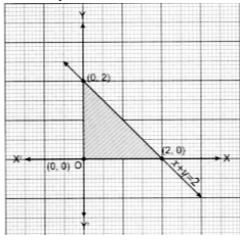
By graphical method solution of $\ce{LLP}$ maximize $z = x + y$ subject to $x+y \leq 2 x ; y \geq 0$ obtained at
  • at infinite number of points
  • B
    only two points
  • C
    only one point
  • D
    at definite number of points
Answer
Correct option: A.
at infinite number of points
Image
Feasible region is shaded region with corner points $(0, 0), (2, 0)$ and $(0, 2)$
$Z(0, 0) = 0$
$ Z (2,0)=2 \longleftarrow \text { maximise }$
$Z (0,2)=2 \longleftarrow \text { maximise }$
$Z _{\max }=2$ obtained at $(2,0)$ and $(0,2)$
so is obtained at any point on line segment joining $(2,0)$ and $(0,2)$.
View full question & answer
MCQ 131 Mark
The order of the differential equation of all circles of given radius a is:
  • A
    4
  • B
    1
  • 2
  • D
    3
Answer
Correct option: C.
2
(c) 2
Explanation: Let the equation of given family be $(x-h)^2+(y-k)^2=a^2$. It has two arbitrary constants $h$ and $k$. Therefore, the order of the given differential equation will be 2 .
View full question & answer
MCQ 141 Mark
Find the equation of the line which passes through the point $(1, 2, 3)$ and is parallel to the vector $3 \hat{i}+2 \hat{j}-2 \hat{k}$
  • $\begin{array}{l}\vec{r}=\hat{i}+2 \hat{j}+3 \hat{k}+\lambda(3 \hat{i}+2 \hat{j}-2 \hat{k} .) \lambda \in R\end{array}$
  • B
    $\begin{array}{l}\vec{r}=\widehat{2 i}+2 \hat{j}+3 \hat{k}+\lambda(3 \hat{i}+2 \hat{j}-2 \hat{k} .) \lambda \in R\end{array}$
  • C
    $\begin{array}{l}\vec{r}=4 \hat{i}+2 \hat{j}+3 \hat{k}+\lambda(3 \hat{i}+2 \hat{j}-2 \hat{k} .) \lambda \in R\end{array}$
  • D
    $\begin{array}{l}\vec{r}=3 \hat{i}+2 \hat{j}+3 \hat{k}+\lambda(3 \hat{i}+2 \hat{j}-2 \hat{k}) \lambda \in R\end{array}$
Answer
Correct option: A.
$\begin{array}{l}\vec{r}=\hat{i}+2 \hat{j}+3 \hat{k}+\lambda(3 \hat{i}+2 \hat{j}-2 \hat{k} .) \lambda \in R\end{array}$
The equation of the line which passes through the point $(1, 2, 3)$ and is parallel to the vector
$3 \hat{i}+2 \hat{j}-2 \hat{k}$, let vector $\vec{a}=\hat{i}+\hat{j}+\hat{k}$ and vector $\vec{b}=3 \hat{i}+2 \hat{j}-2 \hat{k}$
the equation of line is:
$\vec{a}+\lambda \vec{b}=(\hat{i}+\hat{j}+\hat{k})+\lambda(3 \hat{i}+2 \hat{j}-2 \hat{k})$
View full question & answer
MCQ 151 Mark
Let $f ( x )=[ x ]^2+\sqrt{x}$, where $[\bullet]$ and $[\bullet]$ respectively denotes the greatest integer and fractional part functions, then
  • A
    f(x) is continuous and differentiable at x = 0
  • B
    $f ( x )$ is non differentiable $\forall x \in Z$
  • $f ( x )$ is discontinuous $\forall x \in Z -\{1\}$
  • D
    $f(x)$ is continuous at all integral points
Answer
Correct option: C.
$f ( x )$ is discontinuous $\forall x \in Z -\{1\}$
(c) $f(x)$ is discontinuous $\forall x \in Z-\{1\}$
Explanation:$f ( x )$ is discontinuous $\forall x \in Z -\{1\}$
View full question & answer
MCQ 161 Mark
If A and B are invertible matrices, then which of the following is not correct?
  • A
    $(A B)^{-1}=B^{-1} A^{-1}$
  • $(A+B)^{-1}=B^{-1}+A^{-1}$
  • C
    $\operatorname{det}( A )^{-1}=[\operatorname{det}( A )]^{-1}$
  • D
    $\operatorname{adj} A =| A | \cdot A ^{-1}$
Answer
Correct option: B.
$(A+B)^{-1}=B^{-1}+A^{-1}$
(b) $( A + B )^{-1}= B ^{-1}+ A ^{-1}$
Explanation: Since, A and B are invertible matrices.
$(AB)^{-1}=B^{-1} A^{-1} \ldots(i)$
We know that, $A ^{-1}=\frac{1}{|A|}(\operatorname{adj} A )$
$\Rightarrow \operatorname{adj} A =| A | \cdot A ^{-1} \ldots( ii )$
Also, $\operatorname{det}(A)^{-1}=[\operatorname{det}(A)]^{-1}$
$\Rightarrow \operatorname{det}( A )^{-1}=\frac{1}{\mid \operatorname{det}(A)]}$
$\Rightarrow \operatorname{det}( A ) \cdot \operatorname{det}( A )^{-1}=1 \ldots$ (iii)
Which is true,
So, only option d is incorrect.
View full question & answer
MCQ 171 Mark
If the matrix $A=\left[\begin{array}{cc}3-2 x & x+1 \\ 2 & 4\end{array}\right]$ is singular then $x =?$
  • $1$
  • B
    $0$
  • C
    $-1$
  • D
    $-2$
Answer
Correct option: A.
$1$
When a given matrix is singular then the given matrix determinant is $0.$
$|A|=0$
Given, $A=\left(\begin{array}{cc}3-2 x & x+1 \\ 2 & 4\end{array}\right)$
$|A|=0$
$4(3-2 x)-2(x+1)=0$
$12-8 x-2 x-2=0$
$10-10 x=0$
$10(1-x)=0$
$x=1$
View full question & answer
MCQ 181 Mark
Let $A=\left[\begin{array}{lll}a & 0 & 0 \\ 0 & a & 0 \\ 0 & 0 & a\end{array}\right]$, then $A^{ n }$ is equal to
  • A
    $\left[\begin{array}{lll}a^n & 0 & 0 \\ 0 & a & 0 \\ 0 & 0 & a\end{array}\right]$
  • B
    $\left[\begin{array}{ccc}n a & 0 & 0 \\ 0 & n a & 0 \\ 0 & 0 & n a\end{array}\right]$
  • $\left[\begin{array}{lll}a^n & 0 & 0 \\ 0 & a^n & 0 \\ 0 & 0 & a^n\end{array}\right]$
  • D
    $\left[\begin{array}{lll}a^n & 0 & 0 \\ 0 & a^n & 0 \\ 0 & 0 & a\end{array}\right]$
Answer
Correct option: C.
$\left[\begin{array}{lll}a^n & 0 & 0 \\ 0 & a^n & 0 \\ 0 & 0 & a^n\end{array}\right]$
(c) $\left[\begin{array}{lll}a^n & 0 & 0 \\ 0 & a^n & 0 \\ 0 & 0 & a^n\end{array}\right]$
Explanation: A $=\left[\begin{array}{lll}a & 0 & 0 \\ 0 & a & 0 \\ 0 & 0 & a\end{array}\right]$
$A ^{ n }=\left[\begin{array}{lll}a & 0 & 0 \\ 0 & a & 0 \\ 0 & 0 & a\end{array}\right] \times\left[\begin{array}{lll}a & 0 & 0 \\ 0 & a & 0 \\ 0 & 0 & a\end{array}\right] \times\left[\begin{array}{lll}a & 0 & 0 \\ 0 & a & 0 \\ 0 & 0 & a\end{array}\right] \times\left[\begin{array}{lll}a & 0 & 0 \\ 0 & a & 0 \\ 0 & 0 & a\end{array}\right] \ldots\{$ n times, (where $\left.n \in N )\right\}$
$A ^{ n }=\left[\begin{array}{ccc}a^n & 0 & 0 \\ 0 & a^n & 0 \\ 0 & 0 & a^n\end{array}\right]$
View full question & answer
M.C.Q (1 Marks) - Mathematics STD 12 Science Questions - Vidyadip