Questions

3 Marks Question

🎯

Test yourself on this topic

9 questions · timed · auto-graded

Question 13 Marks
If $x=a \sin 2 t(1+\cos 2 t)$ and $y=b \cos 2 t(1-\cos 2 t)$, then find $\frac{d y}{d x}$ at $t=\frac{\pi}{4}$.
Answer
We know that, $x=a \sin 2 t(1+\cos 2 t)$ and $y=b \cos 2 t(1-\cos 2 t)$
$\Rightarrow \frac{d y}{d t}= a [-2 \sin 2 t \sin 2 t +2 \cos 2 t (1+\cos 2 t )] \ldots$ (I)
and $\frac{d x}{d t}= b [2 \sin 2 t \cos 2 t -2 \sin 2 t (1-\cos 2 t )] \ldots( ii )$
$\therefore \frac{d y}{d x}=\frac{d y}{d t} \times \frac{d t}{d x}=\frac{b[2 \sin 2 t \cos 2 t-2 \sin 2 t(1-\cos 2 t)]}{a\left[-2 \sin ^2 2 t+2 \cos 2 t(1+\cos 2 t)\right]}$. [Using (i) and (ii)]
$\left.\Rightarrow \frac{d y}{d x}\right]_{\text {at } t=\pi / 4}=\frac{b\left[2 \sin \frac{\pi}{2} \cos \frac{\pi}{2}-2 \sin \frac{\pi}{2}\left(1-\cos \frac{\pi}{2}\right)\right]}{a\left[-2 \sin ^2\left(\frac{\pi}{2}\right)+2 \cos \frac{\pi}{2}\left(1+\cos \frac{\pi}{2}\right)\right]}=\frac{b}{a} \cdot \frac{(0-1)}{(-1-0)}=\frac{b}{a}$
View full question & answer
Question 23 Marks
Solve the following $\text{LPP}$ by graphical method:
Minimize $Z = 20x + 10y$
Subject to $x+2 y \leq 40 , 3 x+y \geq 30 , 4 x+3 y \geq 60$ and $ x, y \geq 0$
Answer
Converting the given inequations into equations, we obtain the following equations:
$x+2 y=40,3 x+y=30,4 x+3 y=60, x=0$ and $y=0$
Region represented by $x+2 y \leq 40$ :
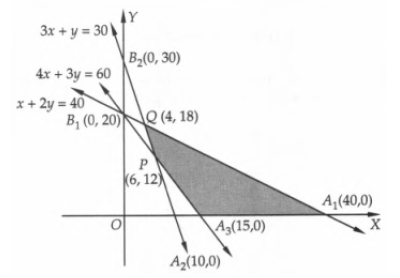
The line $x+2 y=40$ meets the coordinate axes at $A_1(40,0)$ and $B_1(0,20)$ respectively. Join these points to obtain the line $x+2 y$=40
Clearly, $(0,0)$ satisfies the inequation $x+2 y \leq 40$. So, the region in $x y$-plane that contains the origin represents the solution set of the given inequation.
Region represented by $3 x+y \geq 30$ :
The line $3 x+y=30$ meets $x$ and $y$ axes at $A_2(10,0)$ and $B_2(0,30)$ respectively. Join these points to obtain this line.
We find that the point $O(0,0)$ does not satisfy the inequation $3 x+y \geq 30$.
So, that region in $xy-$plane which does not contain the origin is the solution set of this inequation.
Region represented by $x \geq 0, y \geq 0$ :
Clearly, the region represented by the non-negativity restrictions $x \geq 0$ and $y \geq 0$ is the first quadrant in $xy-$plane.
The shaded region $A _3 A_1 QP$ in a figure represents the common region of the regions represented by the above inequations.
This region represents the feasible region of the given $\text{LPP}.$
Image
The coordinates of the corner points of the shaded feasible region are $A_3(15,0), A_1(40,0), Q(4,18)$ and $P(6,12)$ These points
have been obtained by solving the equations of the corresponding intersecting lines, simultaneously.
The values of the objective function at these points are given in the following table
Point $(x, y)$ Value of the objective function $z = 20x + 10y$
$A_3(15, 0)$ $Z = 20 x 15 + 10 x 0 = 300$
$A_1(40, 0)$ $Z = 20 x 40 + 10 x 0 = 800$
$P(6,12)$ $Z = 20 x 4 + 0 x 18 = 260$
$P(6,12)$ $Z = 20 x 6 + 10 x 12 = 240$
 Out of these values of $Z,$ the minimum value is $240$ which is attained at point $P (6,12).$ Hence$, x = 6 y = 12$ the optimal solution of the given $\text{LPP}$ and the optimal value of $Z$ is $240$.
View full question & answer
Question 33 Marks
Show that the solution set of the linear constraints is empty $x-2 y \geq 0,2 x-y \leq-2, x \geq 0$ and $y \geq 0$
Answer
Here, it is given that the equations
$x-2 y \geq 0 \ldots \ldots \text { (i) }$
$2 x-y \leq-2 \ldots \ldots . \text { (ii) }$
$x \geq 0 \ldots(iii)$
$y \geq 0 \ldots . .(iv)$
and $x=2$
$\Rightarrow 2-2 y=0=y=1$
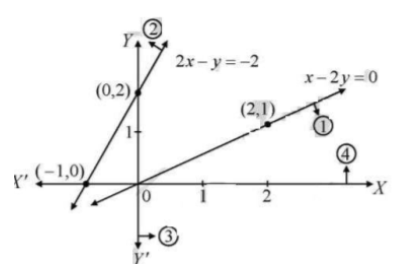
$(0,0)$ and $(2,1)$ are on the line $(v)$
$(0,1)$ is not on this line and it lies in the half
plane of $(i)$ which is not true The line corresponding to $(ii)$ is
$2 x-y=-2 \ldots \ldots( vi )$
on the line $(vi)$ put $x=0$
$\Rightarrow 0-y=-2$
$\Rightarrow y=2$
and $y =0$
$\Rightarrow2 x-0=-2$
$\Rightarrow x=-1$
The inequation $x > 0$ represents the closed half$-$plane on the right of the $y-$axis.
The inequation $y > 0$ represent the closed half$-$plane above the $x-$axis
The graph of the given system is the intersection of half$-$planes of the inequation
The intersection of half$-$planes is empty
The solution set of the given inequation is empty. This is the required solution
Image
View full question & answer
Question 43 Marks
Solve : $\frac{d y}{d x}+\frac{y}{x}=\cos x +\frac{\sin x}{x}$
Answer
We have, $\frac{d y}{d x}+\left(\frac{1}{x}\right) y=\cos x+\frac{\sin x}{x} \ldots$
This is a linear differential equation of the form
$\frac{d y}{d x}+ Py = Q$, where $P =\frac{1}{x}$ and $Q =\cos x +\frac{\sin x}{x}$
$\therefore I. F=e^{\int P d x}=e^{\int \frac{1}{x} d x}=e^{\log x}=x$
Multiplying both sides of $(i)$ by $I.F. = x,$
we get $x \frac{d y}{d x}+y=x \cos x+\sin x$
Integrating both sides with respect to $x,$ we get
$y x=\int(x \cos x+\sin x) d x+C\left[\right.$ Using: $y=( I.F. )=\int Q( I.F. \left.) d x+C\right]$
$\Rightarrow xy =\int \underset{I}{x} \cos xdx +\int \sin x dx + C$
$\Rightarrow x y=x \sin x-\int \sin x d x+\int \sin x d x+C [$Integrating $1^{st}$ integral by parts$]$
$\Rightarrow x y=x \sin x+C$
$\Rightarrow y=\sin x+\frac{C}{x}$
View full question & answer
Question 53 Marks
Find the particular solution of the differential equation $\left(1+ y ^2\right)+\left( x -e^{\tan ^{-1} y}\right) \frac{d y}{d x}=0$ given that y = 0 when x =1
Answer
Given differential equation can be written as
$\frac{d x}{d y}+\frac{x}{1+y^2}=\frac{e^{\tan ^{-1} y}}{1+y^2}$
L.F $=e^{\int \frac{d y}{1+y^2}}=e^{\tan ^{-1} y}$
Solution is given by
$x e^{\tan ^{-1} y}=\int \frac{e^{\tan ^{-1} y}}{1+y^2} \times e^{\tan ^{-1} y} d y=\int \frac{e^{2 \tan ^{-1} y}}{1+y^2} d y$
or $x e^{\tan ^{-1} y}=\frac{e^{2 \tan ^{-1} y}}{2}+ c$
when $x =1, y =0$ or $c =\frac{1}{2}$
$\therefore$ Solution is given by $x e^{\tan ^{-1} y}=\frac{1}{2} e^{2 \tan ^{-1} y}+\frac{1}{2}$
or $x=\frac{1}{2}\left(e^{\tan -1} y+e^{-\tan ^{-1} y}\right)$
View full question & answer
Question 63 Marks
Find $\int \frac{\sqrt{x}}{\sqrt{a^3-x^3}} d x$.
Answer
Given $I=\int \frac{\sqrt{x}}{\sqrt{a^3-x^3}} d x=\int \frac{\sqrt{x}}{\sqrt{\left(a^{3 / 2}\right)^2-\left(x^{3 / 2}\right)^2}} d x$
$\text { Let, } x^{3 / 2}=a^{3 / 2} t$
$\Rightarrow \frac{3}{2} x^{1 / 2} d x=a^{3 / 2} d t$
$\Rightarrow \sqrt{x} d x=\frac{2}{3} a^{3 / 2} d t$
$\therefore I=\int \frac{\frac{2}{3} a^{3 / 2}}{\sqrt{\left(a^{3 / 2}\right)^2-\left(a^{3 / 2} t\right)^2}} d t$
$=\frac{2}{3} a^{3 / 2} \int \frac{d t}{a^{3 / 2} \sqrt{1-t^2}}$
$=\frac{2}{3} \int \frac{d t}{\sqrt{1-t^2}}=\frac{2}{3} \sin ^{-1}\left(\frac{t}{1}\right)+C$
$\left[\because \int \frac{d x}{a^2-x^2}=\sin ^{-1}\left(\frac{x}{a}\right)+c\right]$
$=\frac{2}{3} \sin ^{-1}\left(\frac{x^{3 / 2}}{a^{3 / 2}}\right)+C \left[\text { put } t=\frac{x^{3 / 2}}{a^{3 / 2}}\right]$
$=\frac{2}{3} \sin ^{-1}\left(\sqrt{\frac{x^3}{a^3}}\right)+C$
View full question & answer
Question 73 Marks
Evaluate: $\int_0^{1 / \sqrt{2}} \frac{\sin ^{-1} x}{\left(1-x^2\right)^{3 / 2}} d x$
Answer
Let $\sin ^{-1} x=\theta$ or, $x=\sin \theta$.
Then, $d x=d(\sin \theta)=\cos \theta d \theta$
Now, $ x=0$
$\Rightarrow \sin \theta=0$
$\Rightarrow \theta=0$ and $x=\frac{1}{\sqrt{2}}$
$\Rightarrow \sin \theta=\frac{1}{\sqrt{2}}$
$\Rightarrow \theta=\frac{\pi}{4}$
$\therefore I=\int_0^{1 / \sqrt{2}} \frac{\sin ^{-1} x}{\left(1-x^2\right)^{3 / 2}} d x$
$\Rightarrow I=\int_0^{\pi / 4} \frac{\theta}{\cos ^3 \theta} \cos \theta d \theta$
$=\int_0^{\pi / 4} \theta \sec ^2 \theta d \theta$
Now using integratio by parts.
$\Rightarrow I=\left[\theta \tan \theta \right]_0^{\pi / 4}+[\log \cos \theta]_0^{\pi / 4}$
$=\frac{\pi}{4}+\left\{\log \left(\frac{1}{\sqrt{2}}\right)-\log 1\right\}$
$=\frac{\pi}{4}-\frac{1}{2} \log 2$
View full question & answer
Question 83 Marks
Bag I contains $3$ white and $4$ black balls, while Bag $II$ contains $5$ white and $3$ black balls. One ball is transferred at random from Bag $I$ to Bag $II$ and then a ball is drawn at random from Bag $II.$ The ball so drawn is found to be white. Find the probability that the transferred ball is also white.
Answer
Let $E_{1:}$ Transferred ball is white
$E_2:$ Transferred ball is black
$A:$ white ball is found
$\text { Here, } P \left( E _1\right)=\frac{3}{7}, P \left( E _2\right)=\frac{4}{7}$
$P \left( A / E _1\right)=\frac{6}{9}, P \left( A / E _2\right)=\frac{5}{9}$
Using Baye's theorem
$P\left(E_1 / A\right)=\frac{P\left(E_1\right) \cdot P\left(A / E_1\right)}{P\left(E_1\right) \cdot P\left(A / E_1\right)+P\left(E_2\right) \cdot P\left(A / E_2\right)}$
$=\frac{\frac{3}{7} \times \frac{6}{9}}{\frac{3}{7} \times \frac{6}{9}+\frac{4}{7} \times \frac{5}{9}}$
$=\frac{18}{18+20}=\frac{9}{19}$
View full question & answer
Question 93 Marks
Evaluate: $\int \frac{x+2}{\sqrt{x^2+2 x+3}}$
Answer
Let $I =\int \frac{x+2}{\sqrt{x^2+2 x+3}}$
$x +2=A \frac{d}{d z}\left[ x ^2+2 x +3\right]+ B$
$\Rightarrow x +2=2 Ax +2 A+ B$
Comparing the coefficients,
we have, $2A = 1$ and $2A + B = 2$
$\Rightarrow A =\frac{1}{2}$
Substituting the value of $A$ in $2 A+B=2$,
we have, $2 \times \frac{1}{2}+B=2$
$\Rightarrow 1+B=2$
$\Rightarrow B=2-1$
$\Rightarrow B=1$
Thus we have, $x +2=\frac{1}{2}[2 x+2]+1$
Hence, using values of $A,$ and $B,$ we have
$I=\int \frac{x+2}{\sqrt{x^2+2 x+3}} d x$
$\left.=\int \frac{\left[\frac{1}{2}[2 x+2]+1\right]}{\sqrt{x^2+2 x+3}}\right] d x$
$=\int \frac{\left[\frac{1}{2}[2 x+2]\right]}{\sqrt{x^2+2 x+3}} d x+\int \frac{d x}{\sqrt{x^2+2 x+3}}$
$=\frac{1}{2} \int \frac{[2 x+2]}{\sqrt{x^2+2 x+3}} d x+\int \frac{d x}{\sqrt{x^2+2 x+3}}$
Substituting $t = x ^2+2 x +3$ and $dt =2 x +2$
in the first integrand,
we have, $I =\frac{1}{2} \int \frac{d t}{\sqrt{t}}+\int \frac{d x}{\sqrt{x^2+2 x+3}}$
$=\frac{1}{2} \times 2 \sqrt{t}+\int \frac{d x}{\sqrt{x^2+2 x+1+2}}+C$
$=\sqrt{t}+\int \frac{d x}{\sqrt{(x+1)^2+(\sqrt{2})^2}}+c$
$ I =\sqrt{x^2+2 x+3}+\log \left[| x +1|+\sqrt{(x+1)^2+(\sqrt{2})^2}\right]+C$
$\Rightarrow I =\sqrt{x^2+2 x+3}+\log \left[| x +1| \sqrt{x^2+2 x+3}\right]+ c $
View full question & answer
3 Marks Question - Mathematics STD 12 Science Questions - Vidyadip