Questions · Page 4 of 5

[1 Marks Each] M.C.Q.

MCQ 1511 Mark
Which one of the following is an example of a physical change?
  • A
    Burning of match-stick.
  • B
    Growth in plant.
  • C
    Decaying of food substances.
  • Tearing of paper.
Answer
Correct option: D.
Tearing of paper.
Tearing of paper.
View full question & answer
MCQ 1521 Mark
Why is the rusting of iron termed as a chemical change?
  • A
    It is a temporary change.
  • B
    It can be cleaned and the original substance can be recovered.
  • C
    It is a slow reaction.
  • A new substance is formed.
Answer
Correct option: D.
A new substance is formed.
Iron reacts chemically with the oxygen and water vapour present in the air and forms a new product.
View full question & answer
MCQ 1531 Mark
Directions: Read the passage $(s)$ given below and answer the questions that follow Passage. For changing milk into curd we add a small quantity of curd into milk. The milk is stirred and is set aside for a few hours at a warm place. In a few hours the milk changes into curd. The change of milk into curd is a:
  • A
    Physical change.
  • Chemical change.
  • C
    Periodic change.
  • D
    None of the above.
Answer
Correct option: B.
Chemical change.

It is a chemical change because a new substance has been formed.

View full question & answer
MCQ 1541 Mark
Which one is a periodic change?
  • A
    Earth-quake.
  • B
    Formation of rainbow in sky.
  • Occurrence of tides in seas.
  • D
    None of these.
Answer
Correct option: C.
Occurrence of tides in seas.
Low and high tides appear periodically, so it is a periodic change.
View full question & answer
MCQ 1551 Mark
Metal rim is fixed to the wooden cart wheel by:
  • Heating metal rim.
  • B
    Heating wooden wheel.
  • C
    Cooling metal rim.
  • D
    Cooling wooden wheel.
Answer
Correct option: A.
Heating metal rim.
On heating metal ring expands and fits around the wheel.
View full question & answer
MCQ 1561 Mark
In which one of the following kinds of changes no new substance are formed?
  • Physical changes.
  • B
    Chemical changes.
  • C
    Irreversible changes.
  • D
    All of these.
Answer
Correct option: A.
Physical changes.
Physical changes.
View full question & answer
MCQ 1571 Mark
Swati classified a few changes occurring around us as shown in the table.
S.No.
Changes
Type
$1.$
Sharpening of pencil.
Physical, reversible.
$2.$
Evaporation of water.
Physical, irreversible.
$3.$
Opening of a bud.
Chemical irreversible.
$4.$
Rusting of iron.
Chemical reversible.
Which of the changes is/ are classified correctly$?$
  • A
    $2$ and $3$ only.
  • B
    $3$ and $4$ only.
  • C
    $1$ and $4$ only.
  • $3$ only.
Answer
Correct option: D.
$3$ only.
Opening of a bud is a chemical and irreversible process.
View full question & answer
MCQ 1581 Mark
Spilled water on the table when evaporates, the process involves:
  • A
    Releasing of heat.
  • Absorption of heat.
  • C
    Both $(a)$ and $(b).$
  • D
    Either $(a)$ or $(b).$
Answer
Correct option: B.
Absorption of heat.
Absorption of heat.
View full question & answer
MCQ 1591 Mark
The melting of gold is a physical change because:
  • A
    Melted gold is still gold but in different form.
  • B
    No new substance is formed in it.
  • C
    On cooling melted gold returns back to its original state.
  • All the above.
Answer
Correct option: D.
All the above.
All the above.
View full question & answer
MCQ 1601 Mark
Direction: Match Column-$I$ with column-$II$ and select the correct answer using the codes given below the column.
S.No. Column-$I$ S. No. Column-$II$
$A.$ Formation of day and night. $(p)$ Chemical change.
$B.$ Ripening of a mango. $(q)$ Physical change.
$C.$ Dissolving of sugar in water. $(r)$ Periodic change.
$D.$ Occurrence of rainbow. $(s)$ Non-periodic change.
  • A
    $A\rightarrow (p), B\rightarrow (r), C\rightarrow (q), D\rightarrow (s)$
  • B
    $A\rightarrow (q), B\rightarrow (r), C\rightarrow (p), D\rightarrow (r)$
  • C
    $A\rightarrow (r), B\rightarrow (q), C\rightarrow (s), D\rightarrow (p)$
  • $A\rightarrow (r), B\rightarrow (p), C\rightarrow (q), D\rightarrow (s)$
Answer
Correct option: D.
$A\rightarrow (r), B\rightarrow (p), C\rightarrow (q), D\rightarrow (s)$
View full question & answer
MCQ 1611 Mark
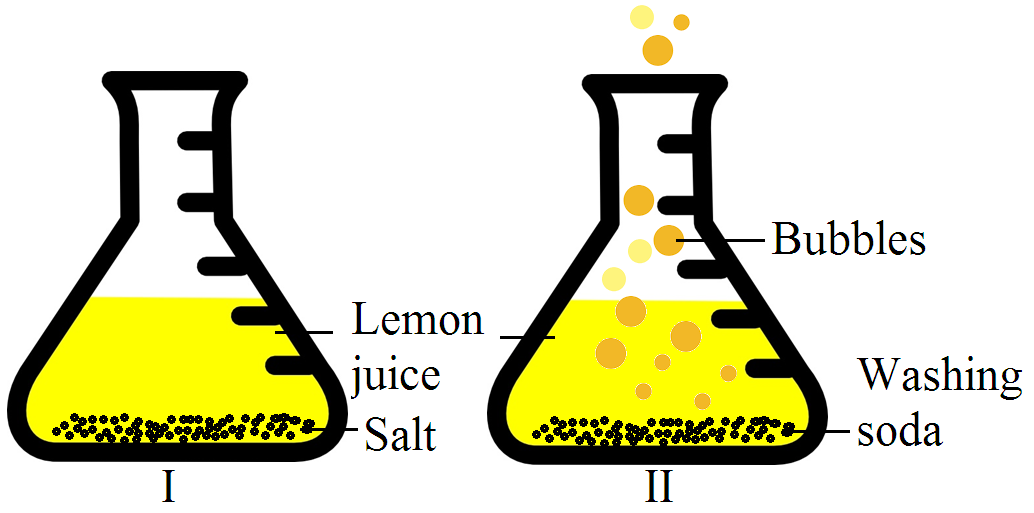
Sudha took lemon juice in two flasks. She put salt in flask $I$ and washing soda in flask $II.$ She observed lots of bubbles in flask $II$ but nothing in flask $I.$ What could be the reason for this$?$
  • A
    In flask $I,$ a chemical change takes place.
  • In flask $II,$ a chemical change takes place and bubbles of carbon dioxide are seen.
  • C
    In flask $II,$ a physical change takes place producing lots of bubbles.
  • D
    In flask $I,$ salt reacts with lemon juice and forms a new compound.
Answer
Correct option: B.
In flask $II,$ a chemical change takes place and bubbles of carbon dioxide are seen.

Lemon juice (acid) reacts with washing soda (base) and liberates carbon dioxide gas i.e., a new substance is formed. Thus, it is a chemical change. Whereas, addition of salt in lemon juice is a physical change as only salt gets dissolved in lemon juice, no chemical reaction takes place.

View full question & answer
MCQ 1621 Mark
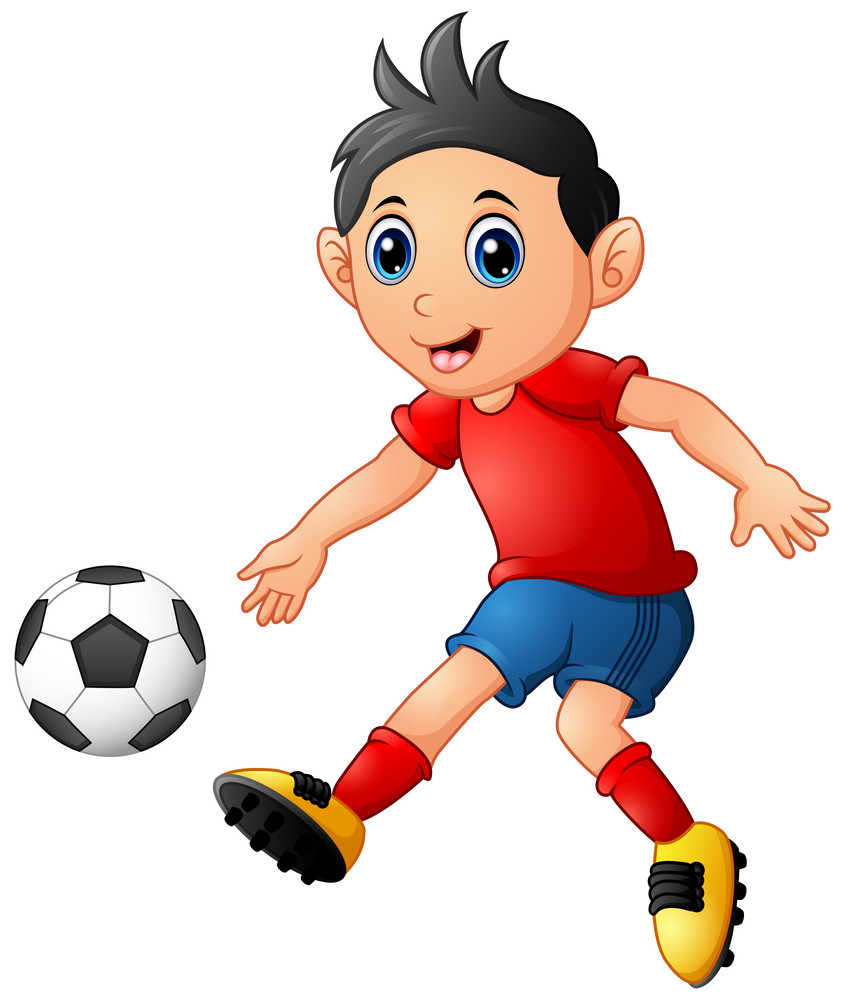
In the given figure, a boy is kicking a football.

What type of change is this?
  • A
    Exothermic.
  • B
    Endothermic.
  • Physical.
  • D
    Chemical.
Answer
Correct option: C.
Physical.

It is a physical change. There is change only in the position of the ball. Neither composition nor properties undergo any change.

View full question & answer
MCQ 1631 Mark
Directions: Read the following two statements carefully and choose the correct option.
  1. Rusting of iron is a chemical change.
  2. The change of liquid water to ice on cooling is a reversible change.
  • A
    Statement $(i)$ is correct while statement $(ii)$ is in correct.
  • B
    Statement $(ii)$ is correct while statement $(i)$ is incorrect.
  • C
    Both statements are correct.
  • Both statements are incorrect.
Answer
Correct option: D.
Both statements are incorrect.
View full question & answer
MCQ 1641 Mark
Direction: Read the following three statements carefully and choose the correct option.
  1. Turning off of a bulb is a irreversible change.
  2. When the leaves of the touch-me-not plant is touched, they close. This is an reversible change.
  3. Ripening of fruits is a reversible change as we can get unriped fruit from riped one.
  • Statements $(i)$ and $(iii)$ are in correct but $(ii)$ is correct.
  • B
    Statements $(i)$ and $(ii)$ are in correct but $(iii)$ is correct.
  • C
    All three statements are correct.
  • D
    All three statements are in correct.
Answer
Correct option: A.
Statements $(i)$ and $(iii)$ are in correct but $(ii)$ is correct.
View full question & answer
MCQ 1651 Mark
When water with sugar is stirred with a spoon, sugar is dissolved faster. Why does this happen?
  • A
    The spoon acts as a catalyst.
  • B
    On stirring, the temperature increases.
  • Stirring increases the rate of interaction.
  • D
    The attraction between the molecules of sugar increases.
Answer
Correct option: C.
Stirring increases the rate of interaction.
Stirring helps to increase the interaction between sugar molecules and water molecules which causes sugar molecule in the solid to break from each other.
View full question & answer
MCQ 1661 Mark
On lowering the temperature, a liquid turns into a solid. What is this process called?
  • A
    Condensation.
  • B
    Melting.
  • Freezing.
  • D
    Sublimation.
Answer
Correct option: C.
Freezing.

On decreasing the temperature, a liquid turns into a solid. This is called freezing.

View full question & answer
MCQ 1671 Mark
Softening of iron on heating is:
  1. Reversible change.
  2. Chemical change.
  3. Physical change.
  4. Irreversible change.
Which of the following is correct for the above statement?
  • $i$ and $iii.$
  • B
    $ii$ and $iii.$
  • C
    $i$ and $iv.$
  • D
    $iii$ and $iv.$
Answer
Correct option: A.
$i$ and $iii.$
View full question & answer
MCQ 1681 Mark
Pick the change that can be reversed from the following:
  • A
    Cutting of trees
  • Melting of ghee
  • C
    Burning of candle
  • D
    Blooming of flower
Answer
Correct option: B.
Melting of ghee
Melting of ghee is a reversible change because on melting, ghee turns into liquid form and after cooling it returns back to its original form.
View full question & answer
MCQ 1691 Mark
Direction: Read the passage $(s)$ given below and answer the questions that follow Passage For changing milk into curd we add a small quantity of curd into milk. The milk is stirred and is set aside for a few hours at a warm place. In a few hours the milk changes into curd. Chemical changes are generally:
  • A
    Reversible change.
  • Irreversible change.
  • C
    Periodic change.
  • D
    None of these.
Answer
Correct option: B.
Irreversible change.
Chemical changes are generally irreversible as we cannot get back the starting substances from new product formed.
View full question & answer
MCQ 1701 Mark
Which of the following statements is true of the changes when a mixture of iron powder and sulphur powder are heated?
  • Iron and sulphur are called the reactants.
  • B
    Iron and sulphur form a solution.
  • C
    Iron and sulphur can be easily separated after the reaction.
  • D
    A new product is formed which has all the properties of iron and sulphur.
Answer
Correct option: A.
Iron and sulphur are called the reactants.
The substances iron and sulphur which react to produce a new product are called reactants.
View full question & answer
MCQ 1711 Mark
Cutting a metal sticks into small pieces is which one of the following kind of change?
  • Physical change.
  • B
    Chemical change.
  • C
    Biochemical change.
  • D
    All of these.
Answer
Correct option: A.
Physical change.
Physical change.
View full question & answer
MCQ 1721 Mark
Which of the following is not true about a chemical change?
  • A
    It involves reactants and products.
  • B
    It is an irreversible change.
  • C
    Energy changes take place in it.
  • The reactants can be retrieved by physical methods.
Answer
Correct option: D.
The reactants can be retrieved by physical methods.
In a chemical change, the reactants cannot be retrieved by physical methods.
View full question & answer
MCQ 1731 Mark
Direction: Read the passages given below and answer the questions that follow Passage.

What is the term used to describe the phase change as a liquid becomes a solid?
  • A
    Evaporation.
  • B
    Condensation.
  • Freezing.
  • D
    None of the above.
Answer
Correct option: C.
Freezing.
Conversion of liquid to solid for example water to ice is called freezing.
View full question & answer
MCQ 1741 Mark
Physical changes are usually:
  • A
    Periodic changes.
  • A change in state of matter.
  • C
    Fast changes.
  • D
    A change in composition.
Answer
Correct option: B.
A change in state of matter.
Physical changes are usually a change in state of matter. For example, Evaporation is a physical change in which liquid changes into gaseous form.
View full question & answer
MCQ 1751 Mark
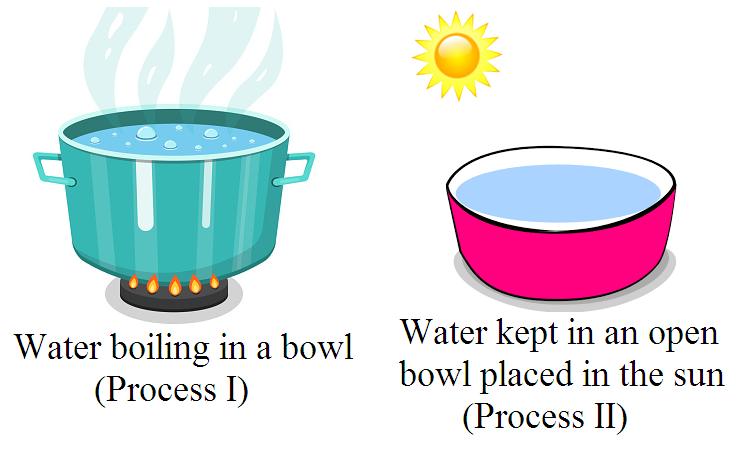
Observe the given processes $1$ and $2$ carefully.

Which of the following statements are correct$?$
  1. Bubbles are formed in process $1$ while no bubble formation takes place in process $2.$
  2. Process $1$ is slow while process $2$ is fast.
  3. Process $1$ occurs at $100^\circ C$ only while process $2$ can occur at any temperature.
  • A
    $I$ and $II$ only.
  • B
    $II$ and $III$ only.
  • $I$ and $III$ only.
  • D
    All of these.
Answer
Correct option: C.
$I$ and $III$ only.
Process $1$ is boiling which is a fast process while process $2$ is evaporation which is a slow process.
View full question & answer
MCQ 1761 Mark
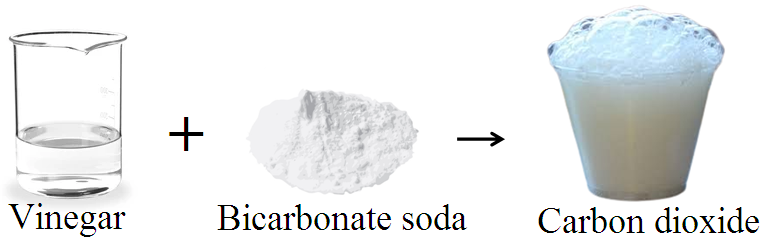
The picture given below represents a chemical process.

On the basis of given figure choose the correct option.
  • A
    Reactant $\rightarrow $ Bicarbonate of soda, Product $\rightarrow $ Vinegar.
  • B
    Reactant $\rightarrow $ Vinegar, Product $\rightarrow $ Carbon dioxide.
  • C
    Reactant $\rightarrow $ Vinegar, Product $\rightarrow $ Bicarbonate of soda and carbon dioxide.
  • Reactant $\rightarrow $ Vinegar, Bicarbonate of soda, product $\rightarrow $ Carbon dioxide.
Answer
Correct option: D.
Reactant $\rightarrow $ Vinegar, Bicarbonate of soda, product $\rightarrow $ Carbon dioxide.

In this process reactants are vinegar and bicarbonate of soda which on reaction gives product carbon dioxide.

View full question & answer
MCQ 1771 Mark
Which of the following are reversible changes:
  • A
    Breaking a toy.
  • B
    Melting of ice cream.
  • C
    Changing shape of cloth by folding it.
  • $(B)$ and $(C)$ both
Answer
Correct option: D.
$(B)$ and $(C)$ both
View full question & answer
MCQ 1781 Mark
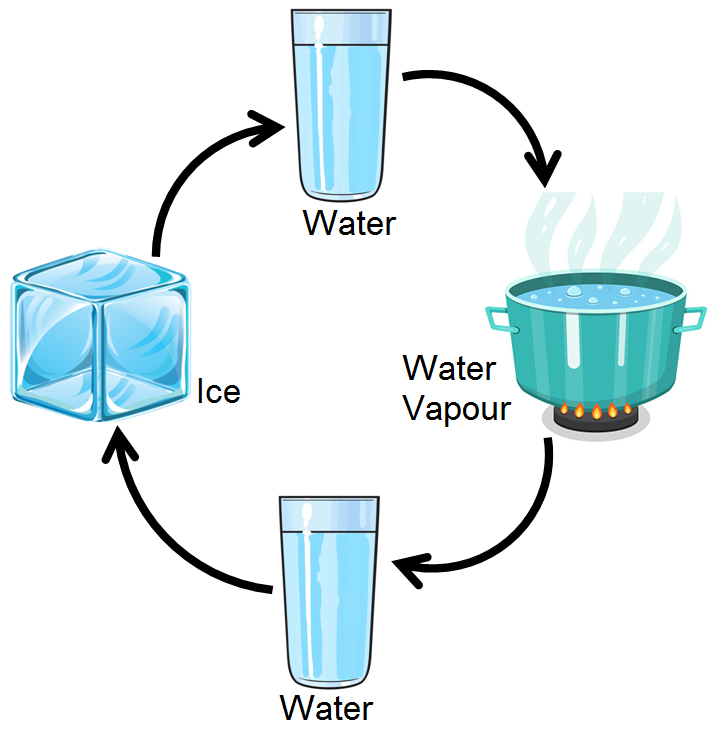
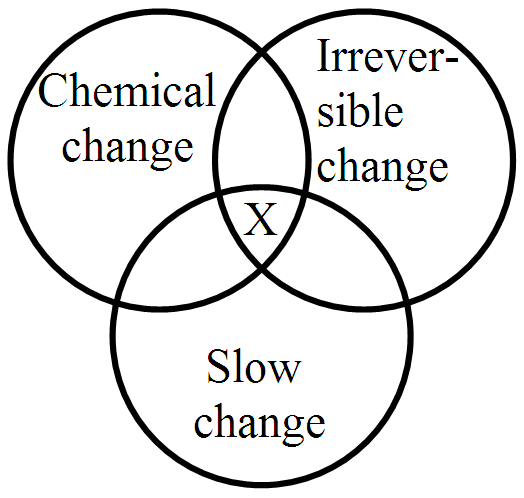
Study the given Venn diagram carefully.

The centre point $X$ represents:
  • A
    Burning of paper.
  • B
    Dissolving salt in water.
  • Boiling of an egg.
  • D
    Bursting of a balloon.
Answer
Correct option: C.
Boiling of an egg.

 Boiling of an egg is a chemical, irreversible and slow change.

View full question & answer
MCQ 1791 Mark
Direction: The questions in this segment consists of two statements, one labelled as 'Assertion $A$' and the other labelled as 'Reason $R$'. You are to examine these two statements carefully and decide if the Assertion $A $ and Reason $R$ are individually true and if so, whether the reason is a correct explanation of the assertion. Select your answers to these items using codes given below.
Assertion $A$: Respiration is an exothermic process.
Reason $R$: In an exothermic process heat is evolved.
  • A
    Both $A$ and $R$ are true and $R$ is the correct explanation of $A.$
  • Both $A$ and $R$ are true but $R$ is not the correct explanation of $A.$
  • C
    $A$ is true but $R$ is false.
  • D
    $A$ is false but $R$ is true.
Answer
Correct option: B.
Both $A$ and $R$ are true but $R$ is not the correct explanation of $A.$
View full question & answer
MCQ 1801 Mark
Peeled and unpeeled banana doesn't look same Does that means peeling banana is a chemical change?
  • No, we just separated skin of banana and there is no change in is composition.
  • B
    Yes, through peeling a new product is formed.
  • C
    Yes, both chemical and physical change happen here.
  • D
    No, neither chemical nor physical change happen here.
Answer
Correct option: A.
No, we just separated skin of banana and there is no change in is composition.
Peeling of banana is a physical change. As we just separated skin of banana. Composition of banana remains the same.
View full question & answer
MCQ 1811 Mark
Ramesh wants to buy a clay pot. For which he went to a potter. Ramesh asked potter to make Z pot of his desired design, shape and size. Will potter be able to do this? This is an example of which kind of change?
  • Yes, physical change.
  • B
    Yes, chemical change.
  • C
    No, physical change.
  • D
    No, chemical change.
Answer
Correct option: A.
Yes, physical change.
Yes, This is a physical change as clay can be converted into different shapes and this does not result in change in its composition.
View full question & answer
MCQ 1821 Mark
Choose the incorrect statement.
  • A
    The heating of sugar is a permanent change.
  • B
    Sugar decomposes to form charcoal.
  • The crystallization of sugar is a chemical change.
  • D
    The powdering of sugar is a physical change.
Answer
Correct option: C.
The crystallization of sugar is a chemical change.
The crystallization of sugar is a physical change.
View full question & answer
MCQ 1831 Mark
The change of bud to flower is a/ an:
  • A
    Physical change.
  • B
    Reversible change.
  • Irreversible change.
  • D
    None of these.
Answer
Correct option: C.
Irreversible change.
The change of bud to flower is an irreversible change as blooming flower cannot be changed into buds.
View full question & answer
MCQ 1841 Mark
Directions: Read the passages given below and answer the questions that follow Passage Copper statues exposed to carbon dioxide and water in the air become coated with patina. The patina is not copper, it is not carbon dioxide, and not water. It is a new substance formed by the reaction of these chemicals with one another. The appearance of patina on copper statues when these are exposed to moist air is which type of change?
  • A
    Physical change.
  • Chemical change.
  • C
    Periodic change.
  • D
    Non-periodic change.
Answer
Correct option: B.
Chemical change.
It is a chemical change because in it a new substance is formed.
View full question & answer
MCQ 1851 Mark
Which is an example of a physical change?
  • A
    Metal rusting.
  • B
    Silver tarnishing.
  • Water boiling.
  • D
    Paper burning.
Answer
Correct option: C.
Water boiling.
Water boiling.
View full question & answer
MCQ 1861 Mark
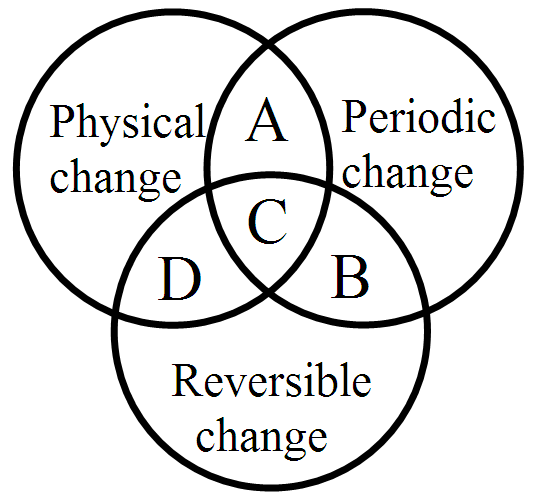
Direction: Read the passages given below and answer the questions that follow Passage.

Which of the following represents $'D':$
  • A
    Making tea.
  • B
    Burning of sulphur.
  • Dissolving salt in water.
  • D
    Burning of coal.
Answer
Correct option: C.
Dissolving salt in water.
It is a physical change and salt can be obtained from salt water solution by evaporation and hence it is a reversible change.
View full question & answer
MCQ 1871 Mark
In which of the following cases is heat energy released?
  1. When ice melts.
  2. When water freezes to ice.
  3. When water vapour condenses into liquid water.
  4. When water evaporate into water vapours.
  • A
    $A, B$ and $C.$
  • B
    $B, C $ and $D.$
  • $B$ and $C.$
  • D
    All of these.
Answer
Correct option: C.
$B$ and $C.$

Heat energy is released when water freezes to ice and when water vapour condenses into liquid water. While in melting of ice and evaporation of water heat is absorbed.

View full question & answer
MCQ 1881 Mark
Why is earthquake considered a non-periodic change?
  • Its occurrence is possible at any time.
  • B
    It occurs rarely at some places.
  • C
    It occurs only in certain quake prone areas.
  • D
    None of above.
Answer
Correct option: A.
Its occurrence is possible at any time.
View full question & answer
MCQ 1891 Mark
Rusting of iron is an example of:
  • Slow change.
  • B
    Fast change.
  • C
    Reversible change.
  • D
    Physical change.
Answer
Correct option: A.
Slow change.
Rusting of iron is a slow change.
View full question & answer
MCQ 1901 Mark
Which of these changes does a burning match stick undergo?
  1. Endothermic reaction.
  2. Exothermic reaction.
  3. Chemical change.
  • A
    Only $(i)$ and $(ii)$
  • Only $(ii)$ and $(iii)$
  • C
    Only $(i)$ and $(iii)$
  • D
    $(i), (ii)$ and $(iii)$
Answer
Correct option: B.
Only $(ii)$ and $(iii)$

 Heat is evolved when a match stick is burnt as it has undergone a chemical change.

View full question & answer
MCQ 1911 Mark
Evaporation is:
  • A
    Physical change.
  • B
    Temporary change.
  • C
    A change in state of matter.
  • All the above.
Answer
Correct option: D.
All the above.
The change of liquid to gaseous state on heating is evaporation.
View full question & answer
MCQ 1921 Mark
If two substances interact to produce a change, they will do:
  • A
    So under any condition.
  • B
    Only if they are not in close contact with each other.
  • C
    Under any temperature.
  • Under the right conditions.
Answer
Correct option: D.
Under the right conditions.
Changes generally occur when two or more things interact with each other under the right conditions.
View full question & answer
MCQ 1931 Mark
What kind of change is the dissolving of sugar in water?
  • A
    Periodic change.
  • Reversible change.
  • C
    Irreversible change.
  • D
    Chemical change.
Answer
Correct option: B.
Reversible change.
We can get back both sugar and water by simple distillation. So, it is a reversible change.
View full question & answer
MCQ 1941 Mark
When cold water is poured over the hot iron rim in a wooden wheel:
  • A
    It expands.
  • It contracts.
  • C
    It remains same.
  • D
    All the above.
Answer
Correct option: B.
It contracts.
It contracts.
View full question & answer
MCQ 1951 Mark
Which among the following is an irreversible change?
  • A
    Ageing of man.
  • B
    Making cheese from milk.
  • C
    Burning of incense stick.
  • All the above.
Answer
Correct option: D.
All the above.
All the above.
View full question & answer
MCQ 1961 Mark
A substance present in plants which itself does not undergo any change but helps in changing water and carbon dioxide into food:
  • A
    Flower.
  • B
    Bud.
  • C
    Leaf.
  • Chlorophyll.
Answer
Correct option: D.
Chlorophyll.
Chlorophyll.
View full question & answer
MCQ 1971 Mark
The burning of magnesium in air is accompanied by production of heat and light. This can be classified as:
  • A
    Physical and exothermic change.
  • Chemical and exothermic change.
  • C
    Physical and endothermic change.
  • D
    Chemical and endothermic change.
Answer
Correct option: B.
Chemical and exothermic change.
Since new substance (i.e. magnesium oxide) is formed when magnesium is burnt in air so it is a chemical change. Since heat is produced so it is an exothermic change.
View full question & answer
MCQ 1981 Mark
Which of the following is a chemical change?
  • The burning of magnesium wire.
  • B
    The heating of an iron rod.
  • C
    The heating of water.
  • D
    The dissolving of salt in water.
Answer
Correct option: A.
The burning of magnesium wire.
The burning of magnesium wire is a chemical change.
View full question & answer
MCQ 1991 Mark
Identify a change that is not man-made and is irreversible:
  • A
    The burning of paper.
  • B
    The stretching of a spring by a suspended weight.
  • Soil erosion due to floods.
  • D
    The boiling of an egg.
Answer
Correct option: C.
Soil erosion due to floods.
Soil erosion due to floods is not man-made. It is a natural and an irreversible change.
View full question & answer
MCQ 2001 Mark
A periodic change is a change:
  • A
    That get repeated many a times in our life.
  • That get repeated after a certain definite interval.
  • C
    That never get repeated.
  • D
    All the above.
Answer
Correct option: B.
That get repeated after a certain definite interval.
View full question & answer