Questions

Answer The Following Questions In Short.[2 Marks Each]

🎯

Test yourself on this topic

23 questions · timed · auto-graded

Question 12 Marks
Give some examples of physical and chemical changes.
Answer
Examples of physical changes:Tearing of sheet of paper into pieces, melting of ice, change of water into steam, breaking of glass tumbler, glowing of electric bulb, dissolution of sugar or salt in water.
Examples of chemical changes:
Burning of paper, wood, candle, etc., formation of curd from milk, cooking of food, rusting of iron and mixing of vinegar with baking soda, electrolysis of water.
View full question & answer
Question 22 Marks
Conversion of ice into water and water into ice is an example of change which can be reversed. Give four more examples where you can say that the changes can be reversed.
Answer
Changes that can be reversed are called reversible changes. Some examples are as follows:
  1. Melting of wax.
  2. Folding of a paper.
  3. Knitting of a sweater.
  4. Inflating of a tyre.
View full question & answer
Question 32 Marks
Classify the following changes in as many ways as you can:
  1. Breaking of a brick with a hammer.
  2. Beating of heart.
  3. Germination of a seed.
  4. Burning of an incense-stick (agarbatti).
  5. Occurrence of solar eclipse.
Answer
  1. Physical change, irreversible change.
  2. Periodic change, irreversible change.
  3. Irreversible change,
  4. Irreversible change, chemical change.
  5. Irreversible change.
View full question & answer
Question 42 Marks
Paheli had bought a new bottle of pickle from the market. She tried to open the metal cap to taste it but could not do so. She then took a bowl of hot water and immersed the upper end of the bottle in it for five minutes. She could easily open the bottle now. Can you give the reason for this?
Answer
She can easily open the bottle because of expansion of metal cap (increase in size) due to heating.
Note: When a metal object is heated, it increases in size and when the hot object is cooled, it decreases in size and comes back to the original size.
View full question & answer
Question 52 Marks
What are reversible and irreversible changes?
Answer
Reversible and irreversible changes:
Reversible changes: The changes which can be brought back to its original form are known as reversible changes. For example, melting of wax and stretching of a rubber band.
Irreversible changes: The changes in which the matter cannot be brought back to its original state are known as irreversible changes. For example, burning of paper changes it into ash and smoke. Paper cannot be obtained back from ash and smoke.
View full question & answer
Question 62 Marks
Explain the term ‘solute’ and ‘solvent’ with an example.
Answer
Solute is the substance that is dissolved in the solvent to form a solution. For example, in a sugar solution, sugar is the solute and water is the solvent.
View full question & answer
Question 72 Marks
What kind of change is the formation of clouds?
Answer
It is a physical change. Water after evaporation goes into the air, and form clouds by condensation process, so the water get back to the earth by precipitation.
View full question & answer
Question 82 Marks
Activity.
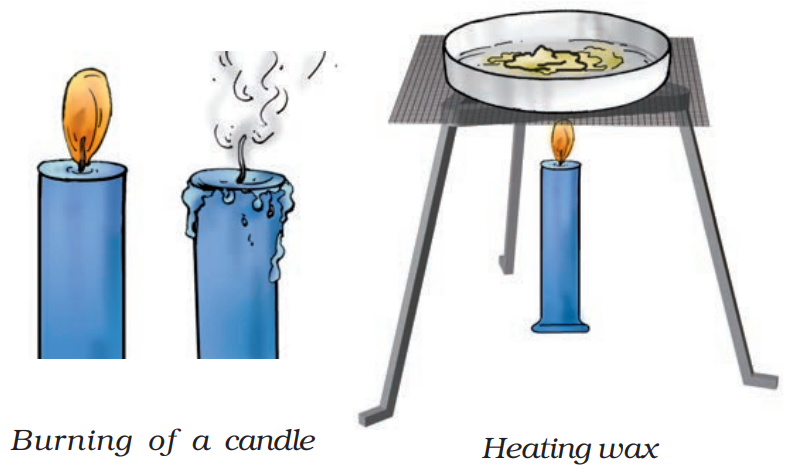
Take a small candle and measure its length with a scale. Now, fix it at a suitable place and light it. Let it burn for some time. Now blow out the candle and measure its length again.
Can the change in the length of the candle be reversed? If we were to take some wax in a pan and heat it, can this change be reversed?
Answer
Its length will be reduced.

No, the change in the length of the candle cannot be reversed. Yes, on heating the wax in a pan, its change into liquid form can be reversed.
View full question & answer
Question 92 Marks
A bag of cement lying in the open gets wet due to rain during the night. The next day the sun shines brightly. Do you think the changes, which have occurred in the cement, could be reversed?
Answer
In this case, the changes cannot be reversed. This is because the cement that hardens up after getting wet cannot be obtained back.
View full question & answer
Question 102 Marks
Explain how a metal rim slightly smaller than a wooden wheel can be fixed on it.
Answer
The metal rim is always made slightly smaller than the wooden wheel. The metal rim is heated; on heating, the rim expands and fits onto the wheel. Cold water is then poured over the rim. Due to cooling, rim contracts and fits tightly over the wheel.
View full question & answer
Question 112 Marks
Write two examples of changes which can be reversed.
Answer
  1. Drying the wet clothes.
  2. Liquid water into water vapour.
View full question & answer
Question 122 Marks
Differentiate between slow and fast change.
Answer
S. No.
Slow Change
Fast Change
$(i)$
The change that takes place in long period of time.
The change that takes place in short period of time.
$(ii)$
Examples: curdling of milk germination of seed etc.
Examples: Burning of paper, bursting of cracker, etc.
View full question & answer
Question 132 Marks
Energy is needed for a change. Give two examples to support this statement.
Answer
  1. When ice is kept outside the freezer, it melts.
  2. When alcohol is put on the back of palm, it evaporates.
View full question & answer
Question 142 Marks
Tearing of paper is said to be a change that cannot be reversed. What about paper recycling?
Answer
We can get the paper on paper recycling but it is not the same original paper that we get. The colour and texture of the paper change.
View full question & answer
Question 152 Marks
Define physical and chemical changes. Give examples.
Answer
Physical change: Physical change is a temporary change in which chemical composition of the substance does not change and no new substance is formed.
During a physical change, only the physical properties of a substance change.
It is a reversible change. For example, melting of ice, during this change, the water changes from its solid form to liquid form. It can be solidified again.The water remains water in both the cases.
Chemical change: A chemical change is a permanent change in which not .
only the physical properties but chemical properties also change. It is an irreversible change. For example, formation of curd from milk, rusting of iron, etc.
View full question & answer
Question 162 Marks
Some changes are listed in the following table. For each change, write in the blank column, whether the change can be reversed or not.
S.No
Change
Can be reversed (Yes/ No)
$(i)$
Sawing of a piece of wood
-
$(ii)$
Melting of ice candy
-
$(iii)$
Dissolving sugar in water
-
$(iv)$
Cooking food
-
$(v)$
Ripening of a mango
-
$(vi)$
Souring of milk
-
Answer
S.No
Change
Can be reversed (Yes/ No)
$(i)$
Sawing of a piece of wood
$No$
$(ii)$
Melting of ice candy
Yes
$(iii)$
Dissolving sugar in water
Yes
$(iv)$
Cooking food
$No$
$(v)$
Ripening of a mango
$No$
$(vi)$
Souring of milk
$No$
View full question & answer
Question 172 Marks
How does curd set? Is this change reversible?
Answer
A small quantity of curd is added to warm milk. The milk is stirred and is set aside undisturbed for a few hours at a warm place. In a few hours, the milk changes into curd.
Curd formed from milk cannot be changed into milk again. So, this is an irreversible change.
View full question & answer
Question 182 Marks
How the iron blade is fixed into a wooden handle in tools used to dig the soil?
Answer
Iron blade of tools has a ring in which the wooden handle is fixed. Normally the ring is slightly smaller in size than wooden handle. To fix handle ring is heated and it expands. Now handle easily fits into the ring. When ring cools down it contracts and fits into handle.
View full question & answer
Question 192 Marks
Change of a bud into a flower is a change which cannot be reversed. Give four more such example.
Answer
Changes that cannot be reversed are called irreversible changes. Some examples are as follows:
  1. Milk into curd.
  2. Burning of wood.
  3. Ripening of fruits.
  4. Digestion of food.
View full question & answer
Question 202 Marks
A piece of iron is heated till it becomes red-hot. It then becomes soft and is beaten to a desired shape. What kind of changes are observed in this process–reversible or irreversible?
Answer
The softening of iron on heating to red hot stage is a reversible change. And when the hot iron is cooled, it becomes hard again.
View full question & answer
Question 212 Marks
Most physical changes are reversible. Give reasons with two examples.
Answer
  • Melting of ice: During this change, the water changes from its solid form to liquid form. It can be solidified again. The water remains water in both cases, hence reversible.
  • Glowing of an electric bulb: During this change, electricity is passed through the tungston filament which becomes white hot and glows, but when the switch is off, the filament returns to its original shape and condition, hence totally reversible.
View full question & answer
Question 222 Marks
How is metal rim fixed on a wooden wheel of a cart? How is the changes made in that metal?
Answer
Metal rim is made slightly smaller than the wooden wheel. On heating rim expands and fits into wheel. Cold water is then poured over rim, which contracts and fits tightly onto the wheel.
View full question & answer
Question 232 Marks
Give some examples of changes which take place on their own.
Answer
Many changes are taking place around us on their own. For example:
  1. Ripening of crops in the fields.
  2. Leaves fall from trees.
  3. Flowers bloom and then wither away.
  4. Growing of hair and nail.
View full question & answer