Questions

[3 Marks Each] QUE-ANS

Take a timed test

14 questions · self-marked practice — reveal the answer and mark yourself.

Question 13 Marks
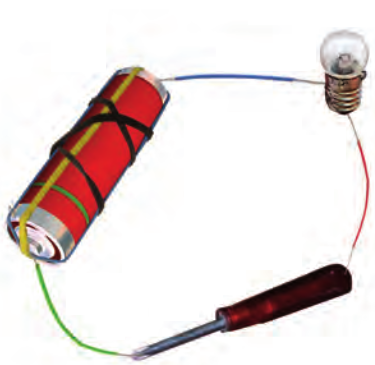
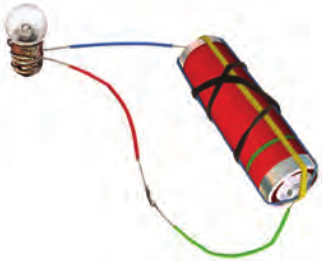
Explain why the bulb would not glow in the arrangement shown in Fig.
Answer
An electric current cannot pass through objects such as plastic scales, tester holders, etc., because these objects are bad conductors of electricity.
From the given figure, it can be observed that one terminal of the bulb is connected to a tester holder. A current will not flow through the circuit.
Hence, the bulb would not glow.
View full question & answer
Question 23 Marks
Why should an electrician use rubber gloves while repairing an electric switch at your home? Explain.
Answer
An electric switch is an electrical appliance. It conducts electricity through its internal parts. When its internal parts are touched with naked hands, then it may cause an electric shock. Therefore, it should be touched with rubber gloves in hand because rubber cannot conduct electricity.
Hence, electricians wear rubber gloves while repairing a switch or any other electrical appliance.
View full question & answer
Question 33 Marks
Using the "conduction tester" on an object it was found that the bulb begins to glow. Is that object a conductor or an insulator? Explain.
Answer
When the two free ends of a conductor tester are touched with an object, then the bulb of the tester would glow if the object conducts electricity. However, the bulb would not glow if the object does not conduct electricity. Since the bulb glows when the tester is touched with the object, the object must conduct electricity.
Hence, the object is a conductor.
View full question & answer
Question 43 Marks
What is the difference between conductor and an insulator? Explain with examples.
Answer
Materials that allow electric current to pass through them are called conductors.
For example: Iron, copper etc. Metals are good conductors. Materials that do not allow electric current to pass through them are called insulators.
For example: Rubber, plastic etc.
View full question & answer
Question 53 Marks
What is the purpose of using an electric switch? Name some electrical gadgets that have switches built into them.
Answer
A switch is an electric device that is used to complete or break an electric circuit. If the switch is $‘ON’$, then a current can flow through the circuit. However, if the switch is $‘OFF’$, then the current cannot flow through the circuit. Electrical appliances such as table fans, electric lamps, washing machines, juicers and mixers, $TV$, radio, etc. have switches built into them.
View full question & answer
Question 63 Marks
Would the bulb glow in the circuit shown in Fig.?
Answer
The bulb will not glow. This is because the two terminals of the cell are connected to the single terminal of the bulb. This is equivalent to the bulb not being connected in the circuit at all. The two terminals of the battery should be connected to the two terminals.
Of the cell.
View full question & answer
Question 73 Marks
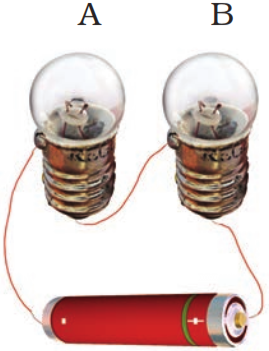
Paheli connected two bulbs to a cell as shown in Fig.

She found that filament of bulb $B$ is broken. Will the bulb $A$ glow in this circuit? Give reason.
Answer
No, the bulb $A$ will not glow in the circuit because the filament of the bulb $8$ is broken and the current will not pass through it, i.e. the circuit is broken or incomplete. Therefore, the current will not flow in the whole circuit.
View full question & answer
Question 83 Marks
Using a conduction tester, select conductors and insulators from the following. Note your observations in a table as follows:
Pin, notebook, chalk, duster, pen, comb, key, rubber, nail, paper.
Answer
S. No.
Thing
Bulb glows or not
Circuit situation
Object is conductor/ insulator
$1.$
Pin
Bulb glows.
Circuit is complete.
Conductor
$2.$
Notebook
Bulb doesn’t glow.
Circuit is not complete.
Insulator
$3.$
Chalk
Bulb doesn’t glow.
Circuit is not complete.
Insulator
$4.$
Duster
Bulb doesn’t glow.
Circuit is not complete.
Insulator
$5.$
Pen
Bulb doesn’t glow.
Circuit is not complete.
Insulator
$6.$
Comb
Bulb doesn’t glow.
Circuit is not complete.
Insulator
$7.$
Key
Bulb glows.
Circuit is complete.
Conductor
$8.$
Rubber
Bulb doesn’t glow.
Circuit is not complete.
Insulator
$9.$
Nail
Bulb glows.
Circuit is complete.
Conductor
$10.$
Paper
Bulb doesn’t glow.
Circuit is not complete.
Insulator
View full question & answer
Question 93 Marks
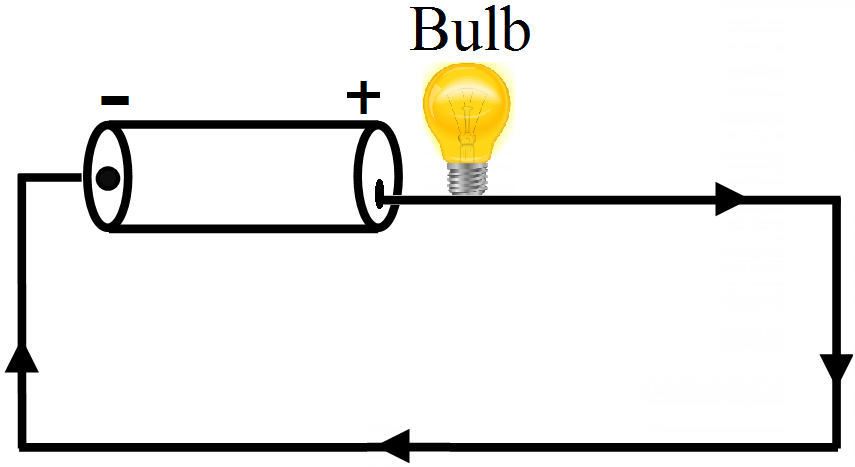
Boojho has a cell and a single piece of connecting wire. Without cutting the wire in two, will he be able to make the bulb glow? Explain with the help of a circuit diagram.
Answer
Yes, this can be done by arranging the circuit as given below:
In this arrangement, one terminal of the bulb should be connected directly to the positive (say) terminal of the cell and the other terminal of the bulb should be connected to the negative terminal of the cell using the given piece of connecting wire.
View full question & answer
Question 103 Marks
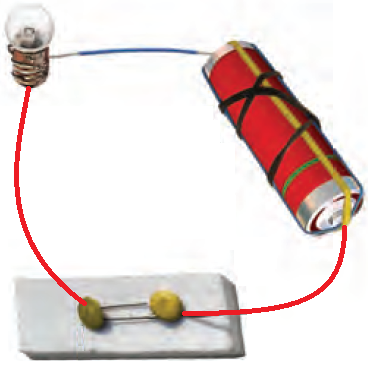
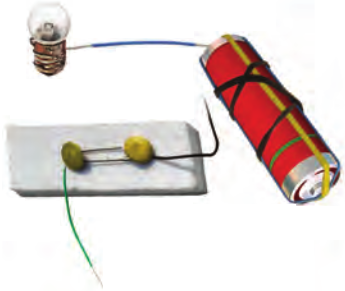
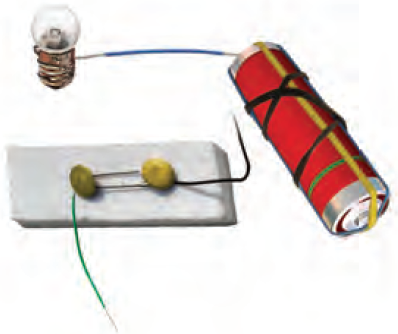
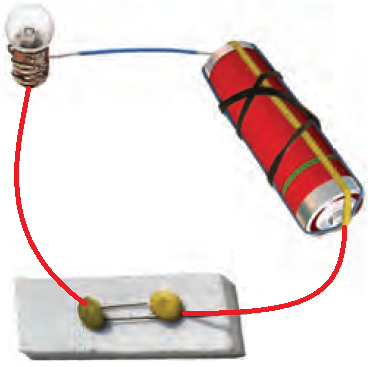
Complete the drawing shown in Fig. to indicate where the free ends of the two wires should be joined to make the bulb glow.
Answer
The given circuit is not complete. To complete the circuit, the positive terminal of the cell should be connected to one end of the switch, and the other terminal of the bulb should be connected to the other end of the switch. The closed circuit is shown in the following figure:
View full question & answer
Question 113 Marks
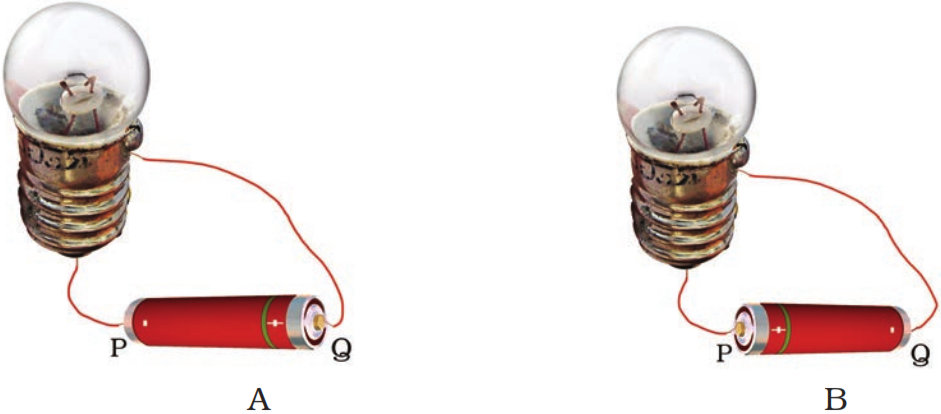
Fig. $A$ and $B$, show a bulb connected to a cell in two different ways.
  1. What will be the direction of the current through the bulb in both the cases. $(Q$ to $P$ or $P$ to $Q)$
  2. Will the bulb glow in both the cases?
  3. Does the brightness of the glowing bulb depend on the direction of current through it?
Answer
  1. The direction of current will be from $0$ to $P$ in $A$ and direction of current will be from $P$ to $Q$ in $B$. This is because the direction of current is always from positive terminal to negative terminal of the cell or battery. This is the conventional direction of flow of current in the circuit.
  2. Yes, the bulb will glow in both the cases because for the bulb to glow, we just need to complete the circuit.
  3. No, the brightness of the bulb never depends upon the direction of current passing through it.
View full question & answer
Question 123 Marks
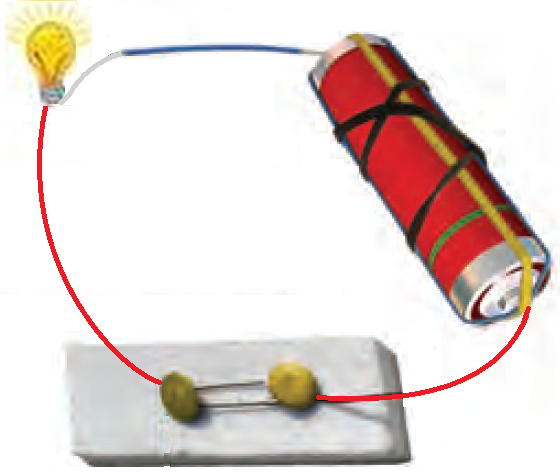
Would the bulb glow after completing the circuit shown in Fig. if instead of safety pin we use an eraser?
Answer
Erasers are bad conductors of electricity. They do not conduct electricity. The circuit becomes an open circuit.
Hence, the bulb will not glow if a safety pin is replaced with an eraser.
View full question & answer
Question 133 Marks
Activity.
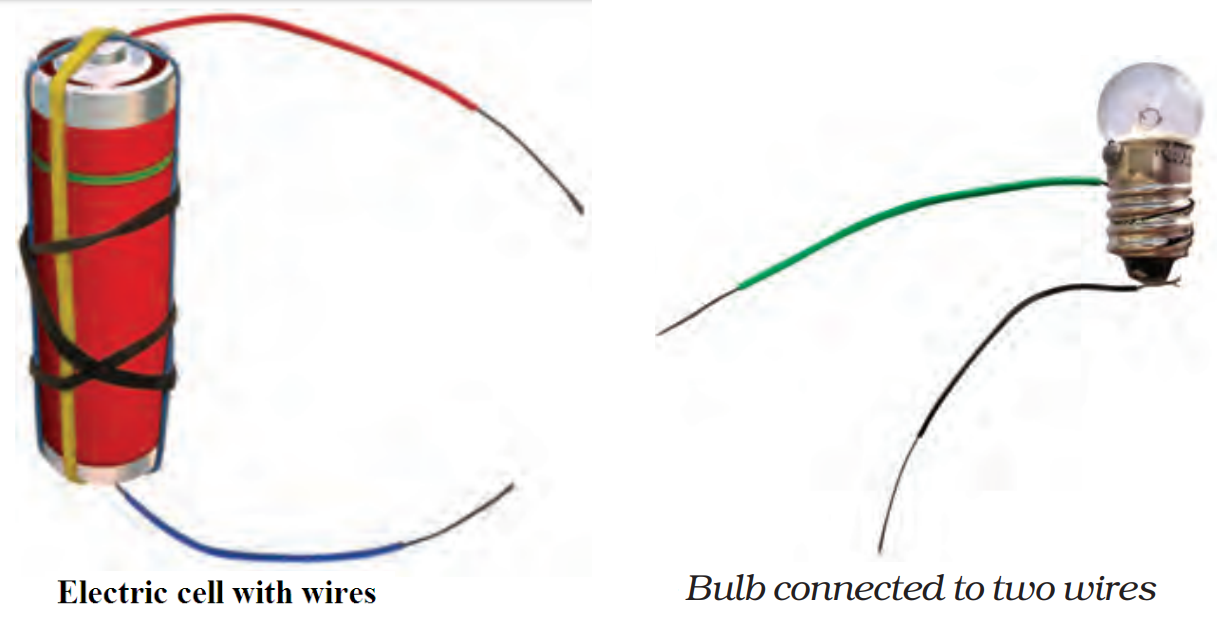
Take four lengths of electric wire with differently coloured plastic coverings. Remove a little of the plastic covering from each length of wire at the ends. This would expose the metal wires at the ends of each length. Fix the exposed parts of two wires to the cell and the other two of the bulb as shown in Fig. $(A)$ and Fig. $(B).$

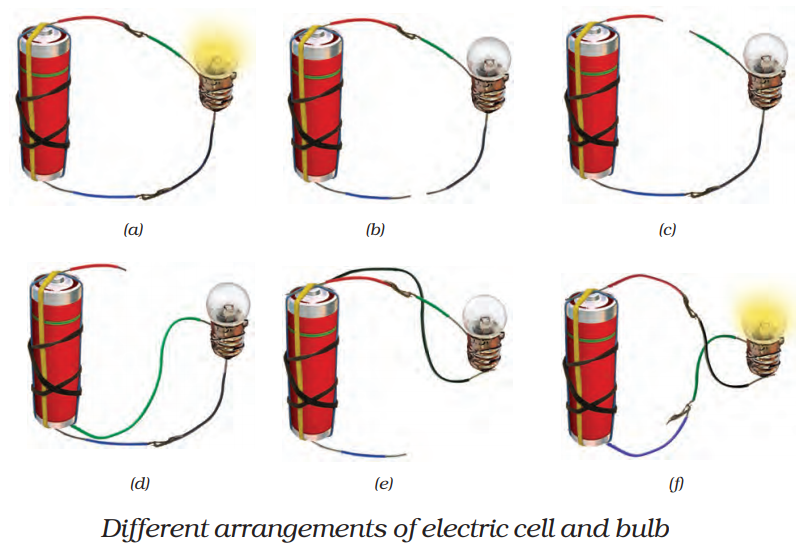
You can stick the wires to the bulb with the tape used by electricians. Use rubber bands or tape to fix the wires to the cell.Now, connect the wires fixed to the bulb with those attached to the cell in six different ways as have been shown in Fig. $C$ $[(a)$ to $(f)].$
For each arrangement, find out whether the bulb glows or not. Write “Yes’ or ‘No’ for each arrangement in your notebook.
Now, carefully look at the arrangements in which the bulb glows. Compare these with those in which the bulb does not glow.

Can you find the reason for the difference?
Answer
Figure
Bulb lights up/Bulb does not light up
Reasons
$(a)$
Bulb lights up
Wires from the cell are connected with two terminals of the bulb
$(b)$
Bulb does not light up
One of the wires is connected with terminal, while other wire is left free
$(c)$
Bulb does not light up
Two different wires are not connected properly
$(d)$
Bulb does not light up
One wire is not connected with one terminal, bulb connected to one terminal of the cell
$(e)$
Bulb does not light up
Wire is not connected with one terminal, bulb connected to one terminal of the cell
$(f)$
Bulb lights up
Both the wires from the cell are connected with two terminals of the bulb (by changing the position of wire).
View full question & answer
Question 143 Marks
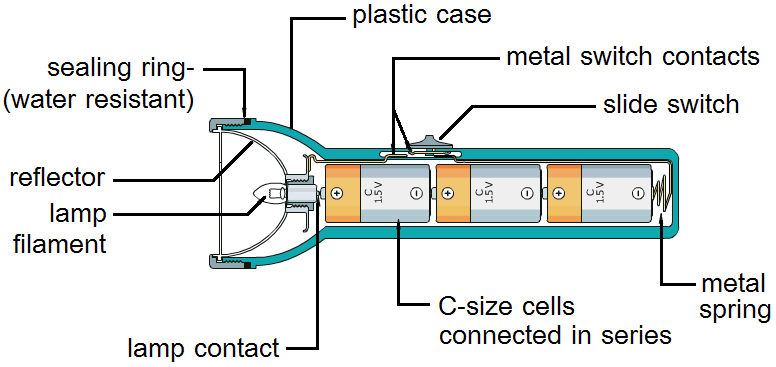
A torch requires $3$ cells. Show the arrangement of the cells, with a diagram, inside the torch so that the bulb glows.
Answer
The arrangement of bulb should be such that the positive terminal of a battery touches the base of the bulb. When switched $ON$, the bulb will glow.
View full question & answer