Questions

[3 Marks Each] QUE-ANS

🎯

Test yourself on this topic

10 questions · timed · auto-graded

Question 13 Marks
A bar magnet is cut into two pieces $A$ and $B$, from the middle, as shown in Fig.
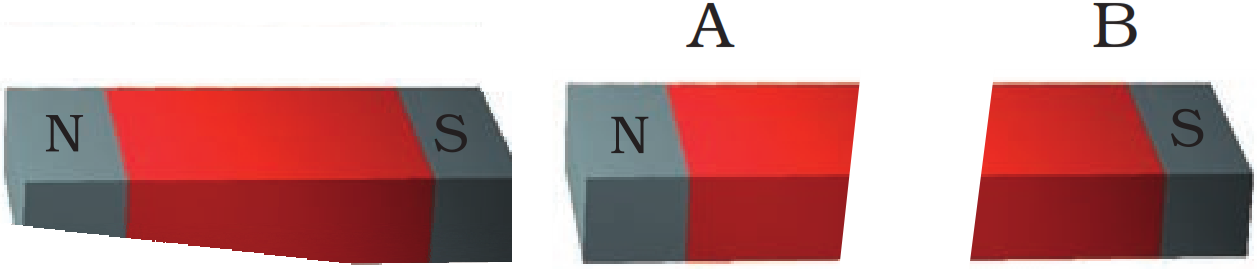
Will the two pieces act as individual magnets? Mark the poles of these two pieces. Suggest an activity to verify your answer.
Answer


Yes, the two pieces will work as individual magnets because a monopole (single pole) of magnet never exists.
Activity
  1. Place the magnet, so formed $(A$ and $B)$ on the table.
  2. Bring the North pole of both magnets towards each other, they will be repelled.
  3. Bring the North and South poles of both magnets towards each other, they will attract.
This proves that the two pieces will act as individual magnets having attraction and repulsion properties.
View full question & answer
Question 23 Marks
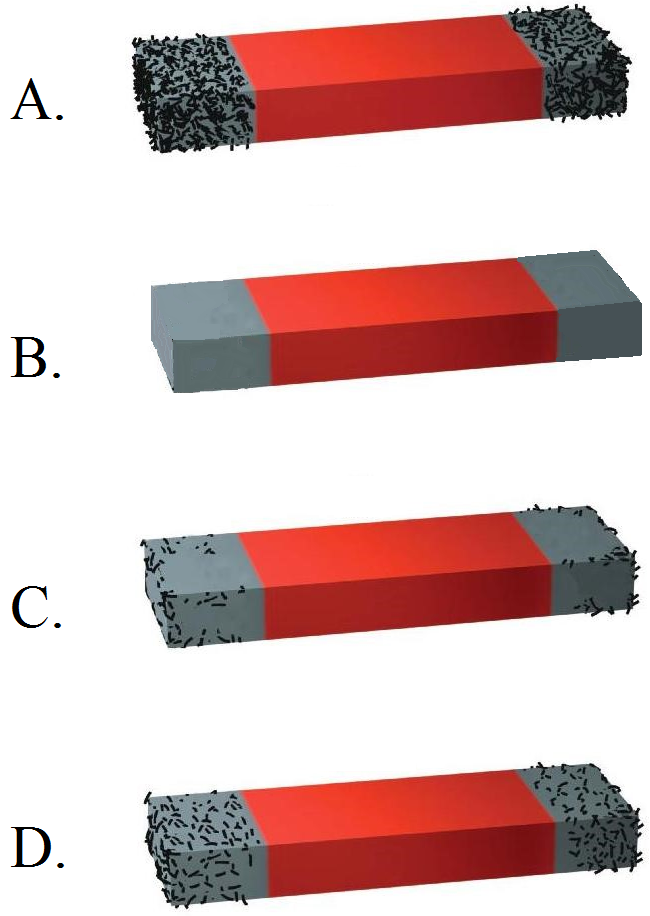
Four identical iron bars were dipped in a heap of iron filings one by one. The figures given below show the amount of iron filings sticking to each of them.
  1. Which of the iron bars is likely to be the strongest magnet?
  2. Which of the iron bars is not a magnet? Justify your answer.
Answer
  1. $A$
  2. $B$ because there are no iron filings sticking to it.
View full question & answer
Question 33 Marks
How is a compass used to find directions?
Answer
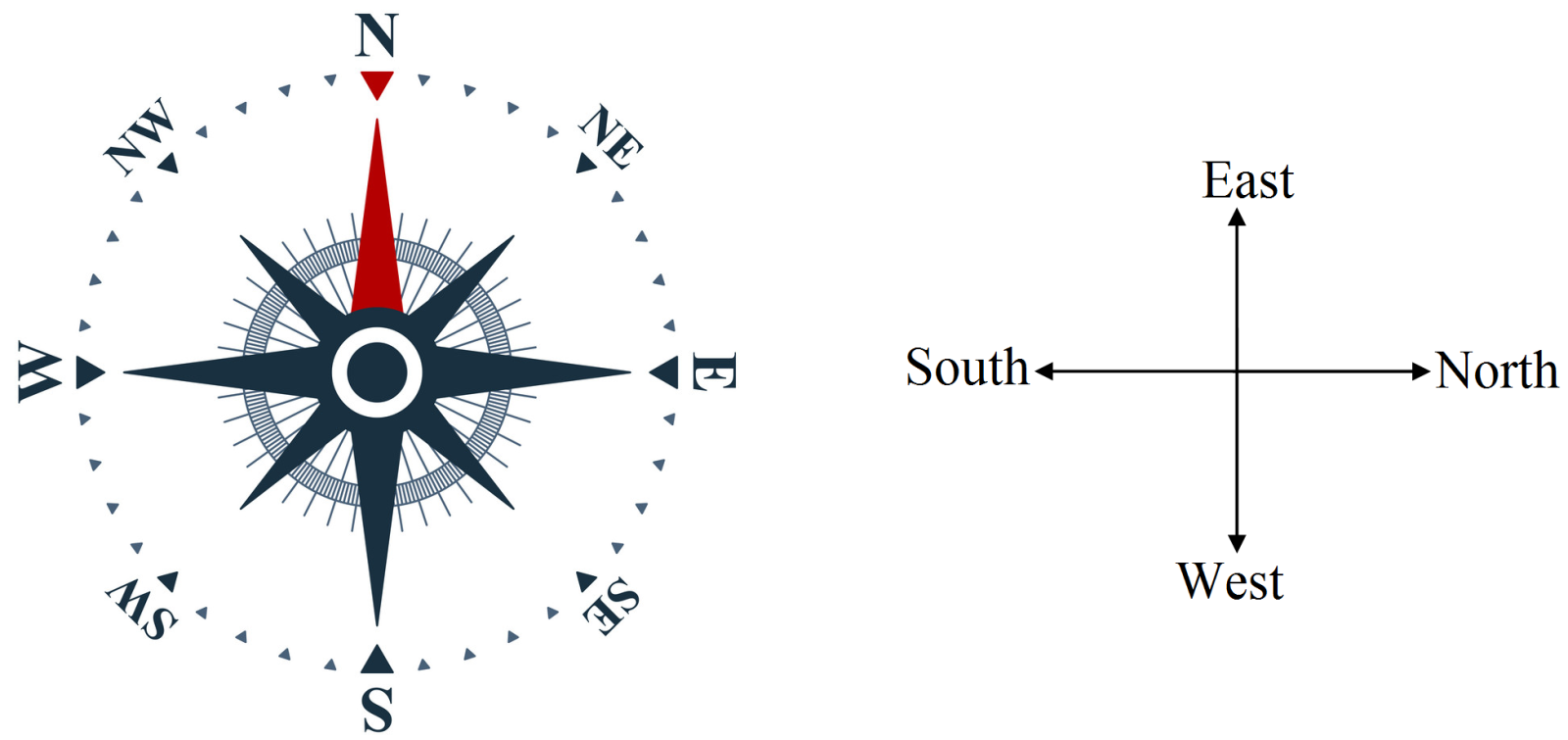
A compass always points towards the North-South direction. The red arrow of the compass needle indicates its north pole. The arrow always points in the North direction (as shown in the given figure).

If we know the North direction, then we can find all the other three directions at that place. If North is towards the front, then South would be towards the back, East towards the right of North, and West towards the left of North.
View full question & answer
Question 43 Marks
Boojho kept a magnet close to an ordinary iron bar. He observed that the iron bar attracts a pin as shown in Fig.

What inference could he draw from this observation? Explain.
Answer
When we place any iron bar near a bar magnet, the magnetic properties are induced in it and it acts like a magnet. The small objects like pin, iron filings can be attracted by it. But when we remove the bar magnet kept near it, it again becomes an iron bar and does not attract the small iron objects.
View full question & answer
Question 53 Marks
You are provided with two identical metal bars. One out of the two is a magnet. Suggest two ways to identify the magnet.
Answer
The two ways to identify the magnet are:
  1. Suspend the metal bars having their levels horizontal with a thread one by one. Let the metal bar come to rest. Now, if we move it by pushing it slowly in any direction, then it will return to the same direction. This means that it is a magnet otherwise it is simply an iron bar.
  2. Take some iron filings and move the iron bars over these iron filings one by one. If iron filings are attracted very strongly at poles, then it is a magnet and if they are not attracted, then it is simply an iron bar.
View full question & answer
Question 63 Marks
How can you show that unlike poles attract each other while like poles repel each other?
Answer
Suspend a magnet on a stand with the help of a string. Now it rests in $N-S$ directions. Take another magnet which has been marked $N-S$ on it and bring $N$-pole of this magnet near the $N$-pole of the suspended magnet. You will find that the suspended magnet rotates and moves away showing that like poles repel each other. The same can be repeated by bringing south-pole of one magnet near south-pole of suspended magnet.
Now you must have found that during the above experiment, south-pole comes towards north-pole and vice versa. It can be repeated by bringing south-pole near a north-pole and north-pole near south-pole of suspended magnet. You will find that unlike poles attract each other.
View full question & answer
Question 73 Marks
Write any three properties of a magnet?
Answer
  1. Magnet has two poles north and South Pole.
  2. Same poles of two magnets repel each other.
  3. Opposite poles of two magnets attract each other.
View full question & answer
Question 83 Marks
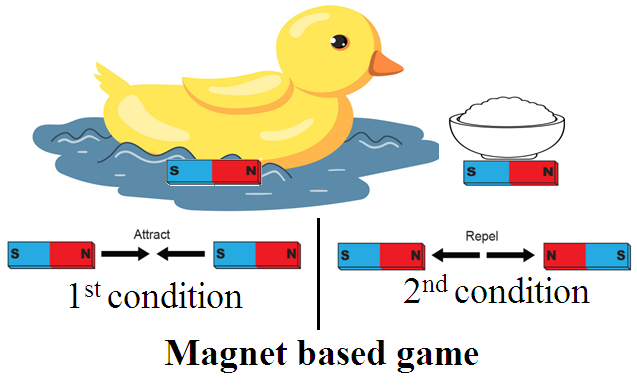
Bhawana witnessed an interesting game at the fair. A duck was floating in a tub. When a plate containing some grains of rice was brought close to the duck, the duck moved towards the plate. But, when a plate containing some pebbles was brought close to the duck, it moved away from the plate. Explain how this could have been possible.
Answer
This game is based on the plate containing rice which may have magnet attached to its bottom. The magnet is fitted in such a way that its north-pole points towards rice grains, while south-pole indicates towards pebbles. A magnet (bar magnet) may also be fitted in the bottom of the duck, where south-pole points towards mouth and north-pole towards tail of the duck.
When the rice portion of the plate is brought closer to the duck, the duck moves towards rice grains because unlike poles of two magnets attract each other. In second situation, same (like) poles repel each other. So the duck moves away.
View full question & answer
Question 93 Marks
What is the difference between magnetic and non-magnetic material? Give examples.
Answer
The materials which get attracted towards a magnet are magnetic materials.
For example: Iron, cobalt etc. Materials which are not attracted towards a magnet are non-magnetic materials.
For example: Plastic, glass etc.
View full question & answer
Question 103 Marks
A bar magnet has no markings to indicate its poles. How would you find out near which end is its north pole locataed?
Answer
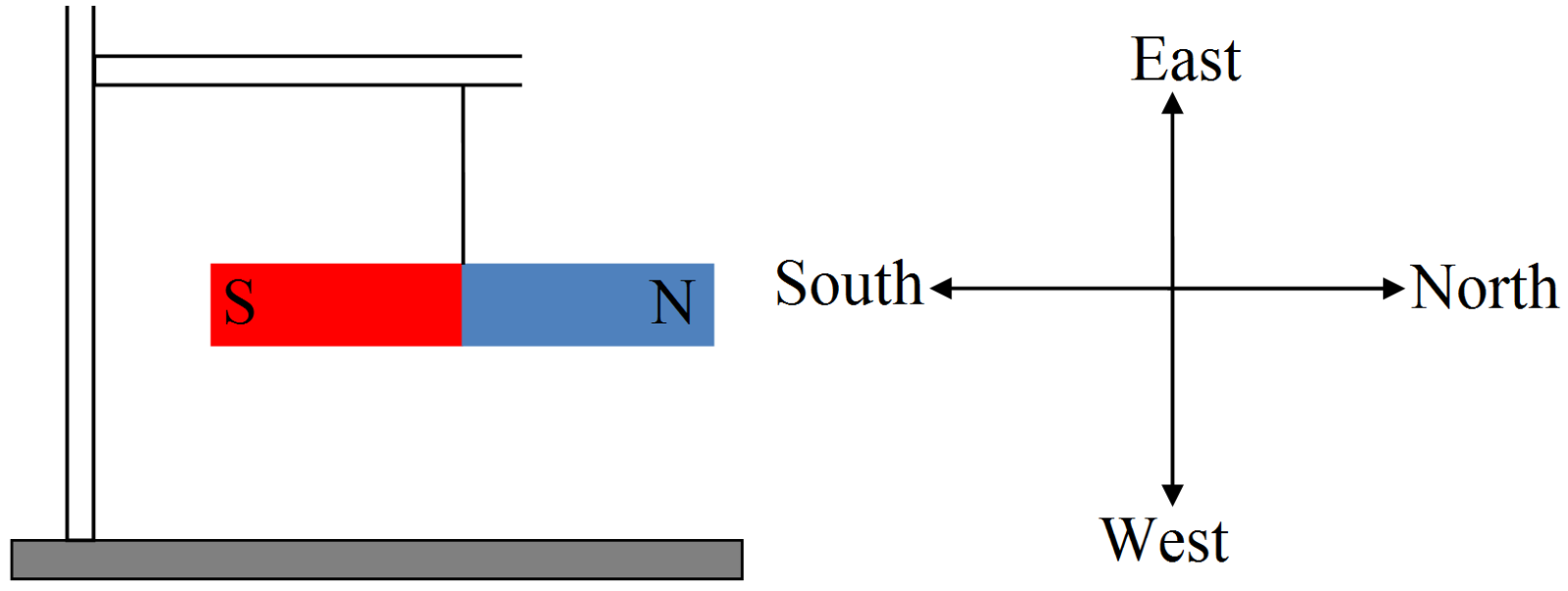
A freely suspended bar magnet always comes to rest in the North-South direction. The north facing end of the magnet is its north pole, and the south facing end is its south pole (as shown in the given figure).

Hence, the unknown poles of a bar magnet can be marked by suspending it freely by a string.
View full question & answer