Question types

Oceans and Continents question types

154 questions across 11 question groups — pick any mix to generate a Social Studies paper with step-by-step answer keys.

154
Questions
11
Question groups
5
Question types
Sample Questions

Oceans and Continents questions

One sample from each question group in this chapter. Select any group above to see the full set with answer keys.
Q 2M.C.Q1 Mark
Continents are also surrounded by water, but because they are so large, they are not considered
  • A
    islands
  • B
    plains
  • C
    desert
  • D
    plateau
View full solution
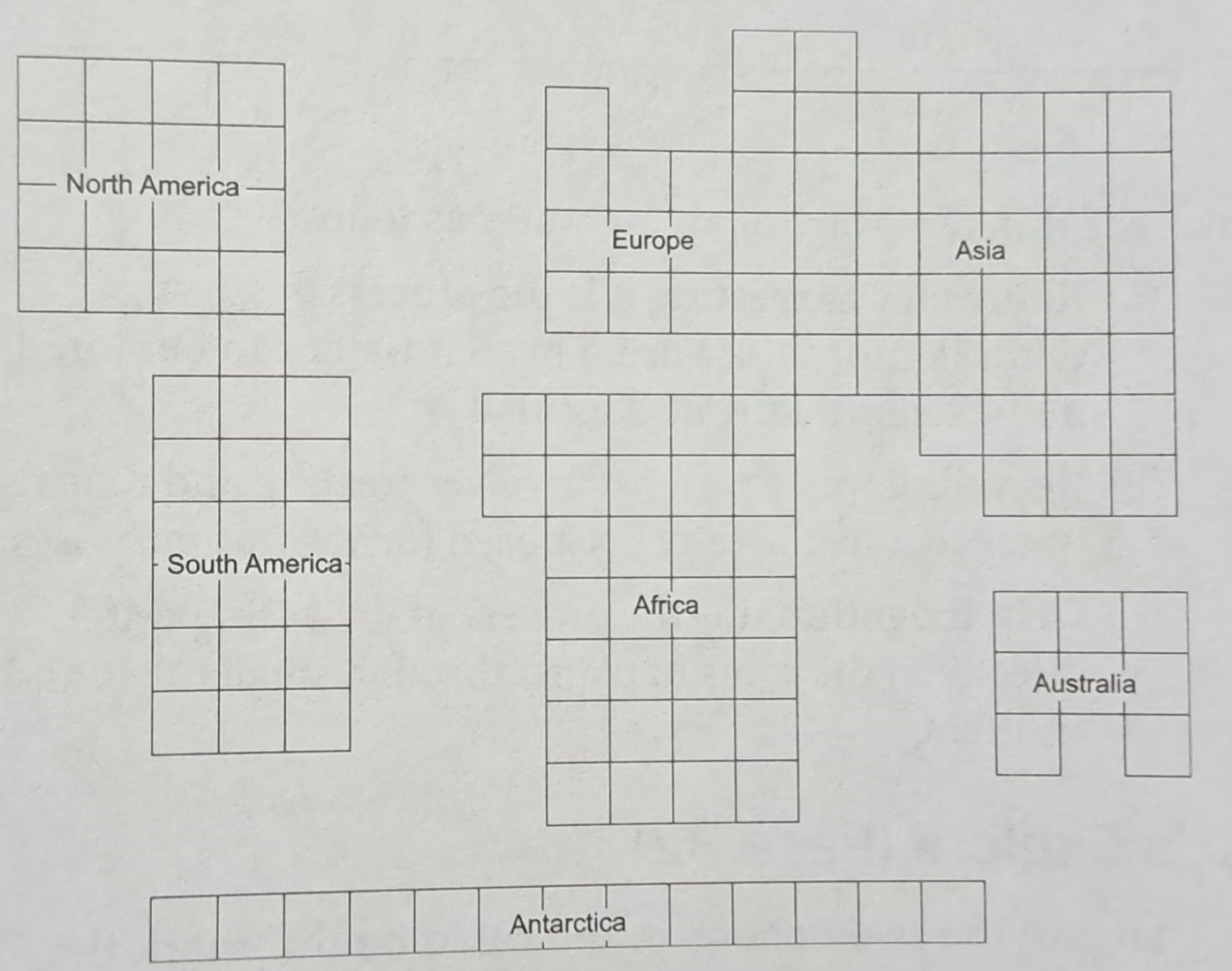
Re-colour the diagram by having a single colour for Europe and Asia and rename the result as 'Eurasia'. Compare its size with the continent of South America.
View full solution
Research and present a case study on the Andaman and Nicobar Islands, focusing on their geographical features, biodiversity, and the impact of the 2004 tsunami.
View full solution
Create a detailed diary entry from the perspective of an explorer navigating the oceans during the Age of Exploration. Describe the challenges and discoveries made during the journey.
View full solution
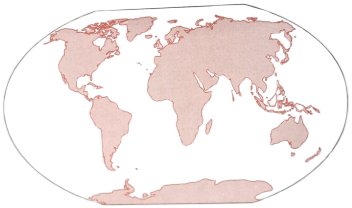
Let us draw – Without looking at the maps in this chapter, draw the continents free hand on a sheet of paper and colour them. Then compare your drawing with the map of oceans and continents in the chapter.
View full solution
Read the paragraph given and answer the following questions.
Oceans and continents are vital parts of the environment and affect most aspects of our lives, even if we do not notice it. We have mentioned that oceans send rain to the continents; this is part of the Earth’s water cycle, which you will further study in science.
Without oceans, for instance, there would be no rainfall! The Earth would be a desert. Moreover, more than half of the world’s oxygen is produced by the oceans’ flora, which is why they are called ‘the planet’s lung’s. The oceans, therefore, play a crucial role in regulating the climate and sustaining life on Earth.
Oceans have deeply impacted humanity in many other ways. From early times, people have used oceans and seas to migrate to other regions, to trade in all kinds of goods, to conduct military campaigns, and as a source of food through fishing. Oceans have also nourished the cultures of coastal people all over the worid. Almost all of them have tales and legends about the sea, sea gods and goddesses, sea monsters and treasures from the sea the oceans’ dangers but also their blessings.

(i) How do oceans contribute to the Earth’s water cycle, and what would happen to the Earth without oceans ?
(ii) What is the significance of the flora in the oceans concerning the Earth’s oxygen supply ?
(iii) How have oceans historically impacted human activities and civilisations ?
View full solution
Locate the five oceans in the table below, mark the hemisphere or hemispheres they belong to.
 Northern HemisphereSouthern Hemisphere
Pacific Ocean  
Atlantic Ocean  
Indian Ocean  
Southern Ocean  
Arctic Ocean  
View full solution
Read the passage given below and answer the following questions.
They are large masses of clouds. Such clouds bring rain to the continents; for instance, the monsoon rains we in India expect every summer originate in the ocean-without such rains, our agriculture and all life will suffer. But oceans often aiso give rise to stormsviolent events with extreme rainfall or very strong winds, such as cyclones, which can cause widespread damage to coastal regions of the world. A tsunami is another natural disaster that originates in the ocean. It is a huge and powerful wave generally caused by a strong earthquake or a volcanic eruption at the bottom of the ocean. Tsunamis can travel thousands of kilometres and submerge coastal areas, causing widespread damage.

(i) What natural phenomenon originating in the ocean is essential for agriculture in India dúring the summer ?
(a) Cyclones
(b) Tsunamis
(c) Monsoon rains
(d) Volcanic eruptions

(ii) How do large masses of clouds formed over oceans contribute to agriculture in regions like India ?
(a) By creating high-pressure systems
(b) By enhancing photosynthesis directly
(c) By providing essential rainfall during the monsoon season
(d) By reducing soil erosion

(iii) Why are monsoon rains important for India ?
(a) They bring strong winds
(b) They originate from the ocean
(c) They are essential for agriculture and life
(d) They cause cyclones

(iv) Cyclones are characterised by which of the following features ?
(a) Very strong winds and heavy rainfall
(b) Mila breezes and light rain
(c) Extremely low temperatures
(d) Gentle waves and calm weather
View full solution
The solid portion of the earth is called the lithosphere. It comprises the rocks of the earth’s crust and the thin layers of soil that contain nutrient elements which sustain organisms. There are two main divisions of the earth’s surface. The large landmasses are known as the continents and the huge water bodies are called the ocean basins. All the oceans of the world are connected with one another. The level of seawater remains the same everywhere. Elevation of land is measured from the level of the sea, which is taken as zero. The highest mountain peak Mt. Everest is 8,848m above the sea level. The greatest depth of 11,022 m is recorded at Mariana Trench in the Pacific Ocean. There are seven major continents. These are separated by large water bodies. These continents are – Asia, Europe, Africa, North America, South America, Australia and Antarctica. Asia is the largest continent. It covers about one-third of the total land area of the earth. The continent lies in the Eastern Hemisphere. The Tropic of Cancer passes through this continent. Asia is separated from Europe by the Ural mountains on the west. The combined landmass of Europe and Asia is called the Eurasia (Europe + Asia). Europe is much smaller than Asia. The continent lies to the west of Asia. The Arctic Circle passes through it.
It is bound by water bodies on three sides. Look at the map of the world and locate it. Africa is the second largest continent after Asia. The Equator or 0° latitude runs almost through the middle of the continent. A large part of Africa lies in the Northern Hemisphere. It is the only continent through which the Tropic of Cancer, the Equator and the Tropic of Capricorn pass. The Sahara Desert, the world’s largest hot desert, is located in Africa. The continent is bound on all sides by oceans and seas. The world’s longest river, the Nile, flows through Africa. North America is the third largest continent in the world. It is linked to South America by a very narrow strip of land called the Isthmus of Panama. The continent lies completely in the Northern and Western Hemisphere. Three oceans surround this continent. The Andes, world’s longest mountain range, runs through its length from north to south. South America has the world’s largest river, the Amazon. Australia is the smallest continent that lies entirely in the Southern Hemisphere. It is surrounded on all sides by the oceans and seas. It is called an island continent. Antarctica, completely in the Southern Hemisphere, is a huge continent. The South Pole lies almost at the centre of this continent. As it is located in the South Polar Region, it is permanently covered with thick ice sheets. There are no permanent human settlements. Many countries have research stations in Antarctica. India also has research stations there. These are named as Maitri and Dakshin Gangotri.
Q.1. Which domain has solid portion on the earth?
(a) Lithosphere $\quad$ (b) Atmosphere $\quad$ (c) Hydrosphere $\quad$ (d) All of these
Q.2. Where is Mariana Trench located?
(a) Atlantic ocean $\quad$$\quad$ (b) Pacific ocean
(c) Indian ocean $\quad$$\quad$ (d) None of these
Q.3. The combined landmass of which continent is known as Eurasia?
(a) Europe - Asia $\quad$$\quad$(b) Europe + Antarctica
(c) Asia + North America$\quad$$\quad$ (d) Africa + Europe
Q.4. The Sahara Desert, the world’s largest hot desert, is located in:
(a) Africa $\quad$ (b) Europe $\quad$ (c) Australia $\quad$ (d) Asia
View full solution
The earth is called the blue planet. More than 71% of the earth is covered with water and 29% is with land. Hydrosphere consistS of water ¡n all its forms. As running water in oceans and rivers and in lakes, ice in glaciers1 underground water and the water vapour in atmosphereø all comprise the hydrosphere. More than 97% of the Earth1s water is found in the oceans and is too salty for human use. A large proportion of the rest of the water is in the form of ice sheets and glaciers or under the ground and a very small percentage is available as fresh water for human use. Hence, despite being a ‘blue planet’ we face a shortage of water!! Oceans— Oceans are the major part of hydr0SPh They are all interconnected. The ocean waters are always moving. The three chief movements of ocean waters are the waves, the tides and the ocean currents. The five major oceans are the pacific Ocean, the Atlantic Ocean, the Indian Ocean, the Southern Ocean and the Arctic Ocean, in order of their size.
The Pacific Ocean is the largest ocean. It is spread over one third of the earth. Mariana Trench, the deepest part of the earth, lies in the Pacific Ocean. The Pacific Ocean is almost circular in shape. Asia, Australia North and South America surround it. It is flanked by the North and South America on the western side, and Europe and Africa on the eastern side. The Atlantic Ocean is the second-largest ocean in the world. It is ‘S’ shaped and is highly indented. This irregular and indented coastline provides an ideal location for natural harbours and ports. From the point of view of commerce, it is the busiest Ocean. The Indian Ocean is the only ocean named after a country, that is, India. The shape of the ocean is almost triangular. In the north, it is bound by Asia, in the west by Africa and in the east by Australia. The Southern Ocean encircles the continent of Antarctica and extends northward to 60 degrees south latitude. The Arctic Ocean is located within the Arctic Circle and surrounds the North Pole. It is connected with the Pacific Ocean by a narrow stretch of shallow water known as the Bering Strait. It is bound by northern coasts of North America and Eurasia.
Q.1. What percentage of earth’s covered with water?
(a) 29% $\quad$ (b) 71% $\quad$ (c) 30% $\quad$ (d) 100%
Q.2. What are the chief movements of ocean?
(a) The waves $\quad$ (b) The tides $\quad$ (c) The ocean currents $\quad$ (d) All of these
Q.3. Which is the largest ocean?
(a) Atlantic ocean $\quad$ (b) Pacific ocean $\quad$ c) Indian ocean $\quad$ (d) Arctic ocean
Q.4. Which is the ‘S’ shaped ocean?
(a) Indian ocean $\quad$ (b) Pacific ocean $\quad$ (c) Arctic ocean $\quad$ (d) Atlantic ocean
View full solution

Column A

Column B

(1) First scientific base station

(i) Arctic

(2) The largest island in the world

(ii) Gulf

(3) On 26 December 2004

(iii) Greenland

(4) Smallest ocean

(iv) ‘Dakshin Gangotri’

(5) A part of the sea nearly surrounded with land

(v) Powerful Tsunami

View full solution
Column AColumn B
(1) The Blue Planet(a) The largest ocean
(2) Pacific Ocean(b) Caused by underwater earthquakes or volcanic eruptions
(3) Sam noh Varunah(c) Earth’s nickname due to its appearance from space
(4) Tsunami(d) The coldest continent
(5) Antarctica(e) Indian Navy's motto invoking a deity associated with oceans
View full solution
List IList II
A. Oceans1. The plant life is found in the oceans.
B. Continents2. The large continuous expanse of land on Earth.
C. Water cycle3.The process by which watercirculates between the Earth’soceans, atmosphere and land.
D. Marine flora4. Large bodies of saltwater cover most of the Earth’s surface.
E. Marine fauna5. Animal life is found in the oceans.
View full solution
Column AColumn B
1. Maitri(a) Surrounded by water on all sides
2.Australia(b) Caused by Earthquake or Volcanic eruption at the bottom of the ocean
3. Islands(c) Scientific base station
4. Algae(d) Smallest continent
5.Tsunami(e) Flora
View full solution
Assertion: The animal life of a particular region or period of time is called Fauna. Reason: The plant life of a particular region or period of time is called Flora.
  • A
    Both Assertion (A) and Reason (R) are true, and Reason (R) is the correct explanation of Assertion (A).
  • B
    Both Assertion (A) and Reason (R) are true, but Reason (R) is not the correct explanation of Assertion (A).
  • C
    Assertion (A) is true, but Reason (R) is false.
  • D
    Assertion (A) is false, but Reason (R) is true.
View full solution
Assertion: A tsunami is a natural disaster that originates in the desert.
Reason: Tsunamis can travel thousands of kilometres and submerge coastal areas, causing widespread damage.
  • A
    Both Assertion (A) and Reason (R) are true, and Reason (R) is the correct explanation of Assertion (A).
  • B
    Both Assertion (A) and Reason (R) are true, but Reason (R) is not the correct explanation of Assertion (A).
  • C
    Assertion (A) is true, but Reason (R) is false.
  • D
    Assertion (A) is false, but Reason (R) is true.
View full solution
Assertion: North America and South America are generally considered to be two continents.
Reason: But if seen as a single landmass, they can also be considered as one.
  • A
    Both Assertion (A) and Reason (R) are true, and Reason (R) is the correct explanation of Assertion (A).
  • B
    Both Assertion (A) and Reason (R) are true, but Reason (R) is not the correct explanation of Assertion (A).
  • C
    Assertion (A) is true, but Reason (R) is false.
  • D
    Assertion (A) is false, but Reason (R) is true.
View full solution
Assertion: Oceans support all kinds of marine life and play a critical role in the world climate.
Reason: Oceans are now seriously affected by human activity and need our collective protection.
  • A
    Both Assertion (A) and Reason (R) are true, and Reason (R) is the correct explanation of Assertion (A).
  • B
    Both Assertion (A) and Reason (R) are true, but Reason (R) is not the correct explanation of Assertion (A).
  • C
    Assertion (A) is true, but Reason (R) is false.
  • D
    Assertion (A) is false, but Reason (R) is true.
View full solution
Assertion (A): The 2004 tsunami caused widespread damage in the Indian Ocean region.
Reason (R): The tsunami was triggered by a volcanic eruption.
  • A
    Both (A) and (R) are true and (R) is the correct explanation of (A).
  • B
    Both (A) and (R) are true but (R) is not the correct explanation of (A).
  • (A) is correct but (R) is wrong.
  • D
    (A) is wrong but (R) is correct.

Answer: C.

View full solution

Generate a Oceans and Continents paper free

Pick question groups from the list above, set marks and difficulty, and export a branded PDF with step-by-step answer keys. First 3 chapters free — no signup.

Download App