Question types

Unity in Diversity, or ‘Many in the One’ question types

144 questions across 9 question groups — pick any mix to generate a Social Studies paper with step-by-step answer keys.

144
Questions
9
Question groups
5
Question types
Sample Questions

Unity in Diversity, or ‘Many in the One’ questions

One sample from each question group in this chapter. Select any group above to see the full set with answer keys.

Q 1M.C.Q1 Mark
Which of the following are types of silk saris?
(i) Banarasi
(ii) Kanjivaram
(iii) Khadi
(iv) Kota Doria
  • (i) and (ii)
  • B
    (i) and (iii)
  • C
    (ii) and (iv)
  • D
    All of these

Answer: A.

View full solution
Q 2M.C.Q1 Mark
Which statement best describes the sari?
(I) It is a uniform dress style worn by all Indian women.
(ii) It has multiple variations and ways of draping across regions.
(iii) It is no longer worn in modern India.
(iv) It is exclusively made from silk.
  • A
    Only (i) and (ii)
  • Only (ii)
  • C
    Only (iii)
  • D
    Only (iv)

Answer: B.

View full solution
Q 3M.C.Q1 Mark
What is a notable characteristic of Indian festivals?
  • A
    They are celebrated in the same way across the country.
  • B
    They are limited to only one religion.
  • They vary by region but often occur around the same time.
  • D
    They are all celebrated in October.

Answer: C.

View full solution
Q 4M.C.Q1 Mark
According to KS Singh, which heroes are mentioned as visiting various regions of India in folklore?
  • The Pandavas
  • B
    The Ten Avatars
  • C
    The Chakravartins
  • D
    The Asuras

Answer: A.

View full solution
Q 5M.C.Q1 Mark
Which common festival is celebrated across India on 14th January?
  • A
    Diwali
  • B
    Holi
  • Makar Sankranti
  • D
    Eid

Answer: C.

View full solution
What is your favourite festival and how is it celebrated in your region? Do you know whether it is celebrated in any other part of India, maybe under a different name?
View full solution
As a class activity, make a list of ingredients (grains, spices, etc) that are used in your home. Take any one vegetable and think of the number of different dishes you can prepare with it.
View full solution
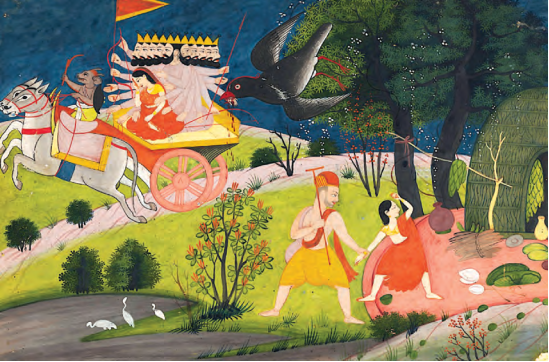
Discuss in class the following quotation by India’s first prime minister, Jawaharlal Nehru, when he travelled to many parts of India before Independence.
“Everywhere I found a cultural background which had exerted a powerful influence on their lives. The old epics of India, the Ramayana and the Mahabharata and other books, in popular translations and paraphrases, were widely known among the masses, and every incident and story and moral in them was engraved on the popular mind and gave a richness and content to it. Illiterate villagers would know hundreds of verses by heart and their conversation would be full of references to them or to some story with a moral, enshrined in some old classic.”
View full solution
Is there any ancient story that you have seen being depicted through a form of art? It could be a sculpture, a painting, a dance performance, a movie. Discuss with your classmates.
View full solution
Read the National Anthem and its translation in the preliminary pages of this textbook. Where do you see the diversity? And where is the unity? Write two or three paragraphs on this.
View full solution
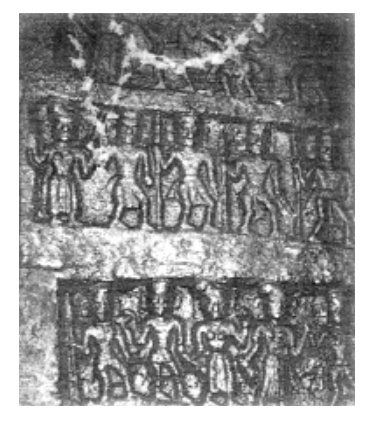
Look at the picture of a carved stone and answer the following questions.
Image
(a) Whom do these five figures shown in the picture represent ?
(b) In which part of India was this carved stone found ?
(c) How is this carved stone related to the tribal culture of that area ?
(d) What conclusion did the anthropologist K.S. Singh draw from such carved stones and the folklores ?
View full solution

 Column A

Column B

(a) Silk

(i) A natural fibre to make soft clothes.

(b) Leather

(ii) A luxurious fabric used for elegant clothing.

(c) Jute

(iii) A material used for making warm winter clothes and shoes.

(d) Cotton

(iv) A natural fibre used for making bags and other accessories.

View full solution
Column AColumn B
1. Panchatantra(a) Directed the ‘People of India’ project
2. Vincent Smith(b) Anthropological Survey of India
3. People of india project(c) Silk sari
4. K.S. Singh(d) 2,200 years old
5. Muga(e) British historian
View full solution
Assertion (A) The National Anthem of Indla represents the unity of the nation.
Reason (R) The National Anthem mentions different regions and states of India, showcasing diversity.
  • Both A and R are true and R is the correct explanation of A
  • B
    Both A and R are true, but R is not the correct explanation of A
  • C
    A is false, but R is true
  • D
    A is true, but R is false

Answer: A.

View full solution
Assertion (A) The diversity in Indian festivals reflects the country’s varied cultural practices.
Reason (R) Many festivals share similar themes but are celebrated differently in different regions.
  • Both A and R are true and R is the correct explanation of A
  • B
    Both A and R are true, but R is not the correct explanation of A
  • C
    A is false, but R is true
  • D
    A is true, but R is false

Answer: A.

View full solution
Assertion (A) Folk versions of the Mahabharata are found in many Indian states.
Reason (R) These folk versions have been preserved by various communities, including tribal ones.
  • Both A and R are true and R is the correct explanation of A
  • B
    Both A and R are true, but R is not the correct explanation of A
  • C
    A is false, but R is true
  • D
    A is true, but R is false

Answer: A.

View full solution
Assertion (A) The concept of ‘unity in diversity’ means that despite differences, there is a common bond.
Reason (R) India’s historical and cultural diversity is unified by a shared sense of identity and values.
  • Both A and R are true and R is the correct explanation of A
  • B
    Both A and R are true, but R is not the correct explanation of A
  • C
    A is false, but R is true
  • D
    A is true, but R is false

Answer: A.

View full solution
Assertion (A) Many Indians are considered migrants because they do not live near their birthplace.
Reason (R) Migration in India is solely due to economic reasons.
  • A
    Both A and R are true and R is the correct explanation of A
  • B
    Both A and R are true, but R is not the correct explanation of A
  • A is false, but R is true
  • D
    A is true, but R is false

Answer: C.

View full solution

Generate a Unity in Diversity, or ‘Many in the One’ paper free

Pick question groups from the list above, set marks and difficulty, and export a branded PDF with step-by-step answer keys. First 3 chapters free — no signup.

Download App