Question 12 Marks
A vehicle covers a distance of $43.2\ km$ in $2.4$ litres of petrol. How much distance will it cover in one litre of petrol?
AnswerDistance covered in $2.4$ litres of petrol $= 43.2\ km$
$\therefore$ Distance trvelled in $1$ litre of petrol $= 43.2$ $\div$ $2.4$
= $\frac{43.2}{2.4}$ $km$
= $\frac{432}{24}$ $km$
= $\frac{18}{1}$ $km$ $= 18\ km$
View full question & answer→Question 22 Marks
Find: $0.5$ $\div$ $1000$
AnswerWe have,
$0.5$ $\div$ $1000$
$=\frac{0.5}{1000} =\frac{5}{1000 \times 10} =\frac{5}{10000} $ $= 0.0005$
Note that whenever any decimal number is divided by $10, 100$ or $1000$ then the decimal point of that number will be shifted towards the left side as many as there are zeros in the number.
View full question & answer→Question 32 Marks
Find: $128.9$ $\div$ $1000$
AnswerWe have,
$128.9$ $\div$ $1000$
$=\frac{128.9}{1000} =\frac{1289}{1000 \times 10} = \frac{1289}{10000}$ $= 0.1289$
Note that whenever any decimal number is divided by $10, 100$ or $1000$ then the decimal point of that number will be shifted towards the left side as many as there are zeros in the number.
View full question & answer→Question 42 Marks
Find: $38.53$ $\div$ $1000$
AnswerWe have,
$38.53$ $\div$ $1000$
= $\frac{38.53}{1000}$ = $\frac{3853}{1000 \times 100}$ = $\frac{3853}{100000}$ $= 0.03853$
Note that whenever any decimal number is divided by $10, 100$ or $1000$ then the decimal point of that number will be shifted towards the left side as many as there are zeros in the number.
View full question & answer→Question 52 Marks
Find: $26.3$ $\div$ $1000$
AnswerWe have,
$26.3$ $\div$ $1000$
= $\frac{26.3}{1000}$ = $\frac{263}{1000 \times 10}$ = $\frac{263}{10000}$ $= 0.0263$
Note that whenever any decimal number is divided by $10, 100$ or $1000$ then the decimal point of that number will be shifted towards the left side as many as there are zeros in the number
View full question & answer→Question 62 Marks
Find: $7.9$ $\div$ $1000$
AnswerWe have,
$7.9$ $\div$ $1000$
= $\frac{7.9}{1000}$ = $\frac{79}{1000 \times 10}$ = $\frac{79}{10000}$ $=0.0079$
Note that whenever any decimal number is divided by $10, 100$ or $1000$ then the decimal point of that number will be shifted towards the left side as many as there are zeros in the number.
View full question & answer→Question 72 Marks
Find: $98.53$ $\div$ $100$
AnswerWe have,
$98.53$ $\div$ $100$
= $\frac{98.53}{100}$ = $\frac{98.53}{100}$ = $\frac{9853}{100 \times 100}$ = $\frac{9853}{10000}$ $= 0.9853$
Note that whenever any decimal number is divided by $10, 100$ or $1000$ then the decimal point of that number will be shifted towards the left side as many as there are zeros in the number.
View full question & answer→Question 82 Marks
Find: $23.6$ $\div$ $100$
AnswerWe have,
$23.6$ $\div$ $100$
= $\frac{23.6}{100}$ = $\frac{236}{100 \times 10}$ = $\frac{236}{1000}$ $= 0.236$
Note that whenever any decimal number is divided by $10, 100$ or $1000$ then the decimal point of that number will be shifted towards the left side as many as there are zeros in the number
View full question & answer→Question 92 Marks
Find: $432.6$ $\div$ $100$
AnswerWe have,
$432.6$ $\div$ $100$
= $\frac{432.6}{100}$ = $\frac{4326}{100 \times 10}$ = $\frac{4326}{1000}$ = 4.326
Note that whenever any decimal number is divided by $10, 100$ or $1000$ then the decimal point of that number will be shifted towards the left side as many as there are zeros in the number.
View full question & answer→Question 102 Marks
Find: $0.78 \div 100$
AnswerWe have,
$0.78 \div 100$
$= \frac{0.78}{100} = \frac{78}{100 \times 100} = \frac{78}{10000} = 0.0078$
Note that whenever any decimal number is divided by $10, 100$ or $1000$ then the decimal point of that number will be shifted towards the left side as many as there are zeros in the number.
View full question & answer→Question 112 Marks
Find: $0.3 \div 100$
AnswerWe have,
$0.3 \div 100$
$= \frac{0.3}{100} = \frac{3}{100 \times 10} = \frac{3}{1000} = 0.003$
Note that whenever any decimal number is divided by $10, 100$ or $1000$ then the decimal point of that number will be shifted towards the left side as many as there are zeros in the number.
View full question & answer→Question 122 Marks
Find: $3.97 \div 10$
AnswerWe have,
$3.97 \div 10$
$= \frac{3.97}{10} = \frac{397}{10 \times 100} = \frac{397}{1000} = 0.397$
Note that whenever any decimal number is divided by $10, 100$ or $1000$ then the decimal point of that number will be shifted towards the left side as many as there are zeros in the number
View full question & answer→Question 132 Marks
Find: $0.56 \div 10$
AnswerWe have,
$0.56 \div 10$
$= \frac{0.56}{10} = \frac{56}{10 \times 100} = \frac{56}{1000} = 0.056$
Note that whenever any decimal number is divided by $10, 100$ or $1000$ then the decimal point of that number will be shifted towards the left side as many as there are zeros in the number
View full question & answer→Question 142 Marks
Find: $272.23 \div 10$
AnswerWe have,
$272.23 \div 10$
$= \frac{272.23}{10} = \frac{27223}{10 \times 100} = \frac{27223}{1000} = 27.223$
Note that whenever any decimal number is divided by $10, 100$ or $1000$ then the decimal point of that number will be shifted towards the left side as many as there are zeros in the number
View full question & answer→Question 152 Marks
Find: $33.1 \div 10$
AnswerWe have,
$33.1 \div 10$
$= \frac{33.1}{10} = \frac{331}{10 \times 10} = \frac{331}{100} = 3.31$
Whenever any decimal number is divided by $10, 100$ or $1000$ then the decimal point of that number will be shifted towards the left side as many as there are zeros in the number.
View full question & answer→Question 162 Marks
Find the area of rectangle whose length is $5.7 \ cm$ and breadth is $3 \ cm.$
AnswerLength of a rectangle $= 5.7 \ cm$
Breadth of a rectangle $= 3 \ cm$
Area of rectangle = Length $ \times $ breadth
$ = 5.7\ cm \times 3\ cm$
$= 17.1 sq. \ cm.$
Therefore the area of rectangle is $17.1 sq. \ cm.$
View full question & answer→Question 172 Marks
Find the reciprocal of the fraction.Classify the reciprocal as proper fraction, improper fraction and whole number: $\frac{1}{11}$
AnswerWe have,
$\frac{1}{11}$
Reciprocal of $\frac{1}{11}=\frac{11}{1}$= 11
Hence,
It is a whole number.
View full question & answer→Question 182 Marks
Classify the reciprocal as proper fraction, improper fraction and whole number: $\frac{1}{8}$
AnswerWe have,
$\frac{1}{8}$
Reciprocal of $\frac{1}{8}=\frac{8}{1}$ = 8
Hence,
It is a whole number.
View full question & answer→Question 192 Marks
Find the reciprocal of the fraction.Classify the reciprocal as proper fraction, improper fraction and whole number: $\frac{12}{7}$
AnswerWe have,
$\frac{12}{7}$
Reciprocal of $\frac{12}{7}=\frac{7}{12}$
Here, the numerator is less than the denominator.
Hence,
It is a proper fraction.
View full question & answer→Question 202 Marks
Find the reciprocal of the fraction.Classify the reciprocals as proper fractions, improper fractions and whole numbers $\frac{6}{5}$
AnswerWe have,
$\frac{6}{5}$
Reciprocal of $\frac{6}{5}=\frac{5}{6}$
Here, the numerator is less than the denominator.
Hence,
It is a proper fraction.
View full question & answer→Question 212 Marks
Find the reciprocal of the fraction. Classify the reciprocals as proper fractions, improper fractions and whole numbers $\frac{9}{7}$.
AnswerWe have,
$\frac{9}{7}$
Reciprocal of = $\frac{9}{7}=\frac{7}{9}$
Numerator is less than the denominator.
Hence,
It is a proper fraction.
View full question & answer→Question 222 Marks
Find the reciprocal of the fraction.Classify the reciprocal as proper fraction, improper fraction and whole number: $\frac{5}{8}$
AnswerWe have,
$\frac{5}{8}$
Reciprocal of $\frac{5}{8}=\frac{8}{5}$
The numerator is greater than the denominator.
Hence,
It is an improper fraction.
View full question & answer→Question 232 Marks
Find the reciprocal of the fraction.Classify the reciprocal as proper fraction, improper fractions and whole numbers: $\frac{3}{7}$
AnswerWe have,
$\frac{3}{7}$
We know that,
Reciprocal of $\frac{3}{7}=\frac{7}{3}$
Hence,
It is a improper fraction
View full question & answer→Question 242 Marks
Lipika reads a book for $1 \frac{3}{4}$ hours every day. She reads the entire book in 6 days. How many hours in all were required by her to read the book?
AnswerHours in all required by Lipika to read the book
= $1 \frac{3}{4} \times 6=\frac{7}{4} \times 6=\frac{7 \times 6}{4}=\frac{42}{4}$
= $\frac{42 \div 2}{4 \div 2}=\frac{21}{2}=10 \frac{1}{2}$ hours.
View full question & answer→Question 252 Marks
Saili plants $4$ saplings, in a row, in her garden. The distance between two adjacent saplings is $\frac{3}{4}$ m. Find the distance between the first and the last sapling.
AnswerThe distance between the first and the last sapling
= $\frac{3}{4} \times 4=\frac{3 \times 4}{4}=\frac{12}{4}=\frac{12 \div 4}{4 \div 4}=\frac{3}{1} = 3m$
View full question & answer→Question 262 Marks
Which is greater:$\frac{2}{7}$ of $\frac{3}{4}$ or$\frac{3}{5}$ of $\frac{5}{8}$
Answer$\frac{2}{7}$ of $\frac{3}{4}=\frac{2}{7} \times \frac{3}{4}=\frac{2 \times 3}{7 \times 4}=\frac{6}{28}=\frac{6 \div 2}{28 \div 2}=\frac{3}{14}$
$\frac{3}{5}$ of $\frac{5}{8}=\frac{3}{5} \times \frac{5}{8}=\frac{3 \times 5}{5 \times 8}=\frac{15}{40}=\frac{15 \div 5}{40 \div 5}=\frac{3}{8}$
$LCM (14, 8) = 56$
$\frac{3}{14}=\frac{3 \times 4}{14 \times 4}=\frac{12}{56}$
$\frac{3}{8}=\frac{3 \times 7}{8 \times 7}=\frac{21}{56}$
$\because 21 > 12$
$\therefore$ $\frac{21}{56}>\frac{12}{56}$
$\therefore$ $\frac{3}{8}>\frac{3}{14}$
$\therefore$ $\frac{3}{5}$ of $\frac{5}{8}$ > $\frac{2}{7}$ of $\frac{3}{4}$
View full question & answer→Question 272 Marks
Find: $\frac{1}{7}$ of $(a). \frac{2}{9} \ (b). \frac{6}{5} \ (c). \frac{3}{10}$
AnswerHere,
$a. \frac{1}{7}$ of $\frac{2}{9}$
$=\frac{1}{7} \times \frac{2}{9}$
$=\frac{2}{63}$
$b. \frac{1}{7}$ of $\frac{6}{5}$
$=\frac{1}{7} \times \frac{6}{5} $
$=\frac{6}{35}$
$c. \frac{1}{7}$ of $\frac{3}{10}$
$=\frac{1}{7} \times \frac{3}{10} $
$=\frac{3}{70}$
View full question & answer→Question 282 Marks
Find:$\frac{1}{4}$ of $(a) \frac{1}{4} \ (b) \frac{3}{5} \ (c) \frac{4}{3}$
Answer$a. \frac{1}{4}$ of $\frac{1}{4}$
$=\frac{1}{4} \times \frac{1}{4}$
$=\frac{1}{16}$
$b. \frac{1}{4}$ of $\frac{3}{5}$
$=\frac{1}{4} \times \frac{3}{5}$
$=\frac{3}{20}$
$c. \frac{1}{4}$ of $\frac{4}{5}$
$=\frac{1}{4} \times \frac{4}{5} $
$= \frac{1}{5}$
View full question & answer→Question 292 Marks
Find: $\frac{5}{8}$ of $(i). 3 \frac{5}{6} \ (ii). 9 \frac{2}{3}$
Answer$i. \frac{5}{8}$ of $3 \frac{5}{6}$
$=\frac{5}{8}$ of $\frac{23}{6}$
$=\frac{5}{8} \times \frac{23}{6}$
$=\frac{5 \times 23}{8 \times 6}$
$=\frac{115}{48}$
$=2 \frac{19}{48}$
$ii. \frac{5}{8}$ of $9\frac{2}{3}$
$=\frac{5}{8}$ of $\frac{29}{3}$
$=\frac{5}{8} \times \frac{29}{3}$
$=\frac{5 \times 29}{8 \times 3}$
$=\frac{145}{24}$
$=6 \frac{1}{24}$
View full question & answer→Question 302 Marks
Find: $\frac{1}{2}$ of $(i). 2 \frac{3}{4} \ (ii). 4 \frac{2}{9}$
Answer$i. \frac{1}{2}$ of $2 \frac{3}{4}$
$=\frac{1}{2} \times 2 \frac{3}{4}$
$=\frac{1}{2} \times \frac{11}{4}$
$=\frac{1 \times 11}{2 \times 4}$
$=\frac{11}{8}$
$=1 \frac{3}{8}$
$ii. \frac{1}{2}$ of $4 \frac{2}{9}$
$=\frac{1}{2}$ of $\frac{38}{9}$
$=\frac{1}{2} \times \frac{38}{9}$
$=\frac{1 \times 38}{2 \times 9}$
$=\frac{38}{18}$
$=\frac{38 \div 2}{18 \div 2}$
$=\frac{19}{9}$
$=2 \frac{1}{9}$
View full question & answer→Question 312 Marks
Find $\frac{4}{5}$ of $(i). 20 \ (ii). 35$
Answer$i. \frac{4}{5}$ of $20 = \frac{4}{5} \times 20=\frac{4 \times 20}{5}=\frac{80}{5}= 16$
$ii. \frac{4}{5}$ of $35 = \frac{4}{5} \times 35=\frac{4 \times 35}{5}=\frac{140}{5} = 28$
View full question & answer→Question 322 Marks
Find $\frac{3}{4}$ of $(i). 16 \ (ii). 36$
Answer$i. \frac{3}{4}$ of $16 = \frac{3}{4} \times 16=\frac{3 \times 16}{4}=\frac{48}{4}= 12$
$ii. \frac{3}{4}$ of $36 = \frac{3}{4} \times 36=\frac{3 \times 36}{4}=\frac{108}{4} = 27$
View full question & answer→Question 332 Marks
Find $\frac{2}{3}$ of $(i). 18 \ (ii). 27$
Answer$i. \frac{2}{3}$ of $18 = \frac{2}{3} \times 18=\frac{2 \times 18}{3}=\frac{36}{3}= 12$
$ii. \frac{2}{3}$ of $27 = \frac{2}{3} \times 27=\frac{2}{3} \times 27=\frac{2 \times 27}{3}=\frac{54}{3}= 18$
View full question & answer→Question 342 Marks
Find $\frac{1}{2}$ of $(i). 24 \ (ii). 46$
Answer$i. \frac{1}{2}$ of $24 = \frac{1}{2} \times 24=\frac{1 \times 24}{2}=\frac{24}{2}=12$
$ii. \frac{1}{2}$ of $46 = \frac{1}{2} \times 46=\frac{1 \times 46}{2}=\frac{46}{2}=23$
View full question & answer→Question 352 Marks
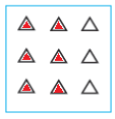
Shade $\frac{2}{3}$ of the triangles in box:

AnswerThere are in all nine triangles in the box.
And,
We have to shade $2/3$ of these triangles.
Since,
$9 \times \frac{2}{3} = 6$
Therefore,
We have to shade $6$ triangles
View full question & answer→Question 362 Marks
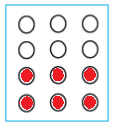
Shade $\frac{1}{2}$ of the circles in box:

AnswerThere are in all twelve circles in the box.
And,
We have to shade $1/2$ of these circles.
Since,
$12 \times \frac{1}{2} = 6$
Therefore,
We have to shade $6$ circles
View full question & answer→Question 372 Marks
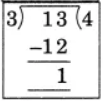
Multiply and reduce to lowest form and convert into a mixed fraction: $13 \times \frac{1}{3}$
Answer$13 \times \frac{1}{3}$
$=\frac{13}{3}=4 \frac{1}{3}$
View full question & answer→Question 382 Marks
Multiply and reduce to lowest form and convert into a mixed fraction: $20 \times \frac{4}{5}$
Answer$20 \times \frac{4}{5}$
= $\frac {80}{5}$ = 16
View full question & answer→Question 392 Marks
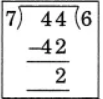
Multiply and reduce to lowest form and convert into a mixed fraction: $11 \times \frac{4}{7}$
Answer$11 \times \frac{4}{7}$
$=\frac{44}{7}=6 \frac{2}{7}$
View full question & answer→Question 402 Marks
Multiply and reduce to lowest form and convert into a mixed fraction: $\frac{5}{2} \times 6$
Answer$\frac{5}{2} \times 6$
= $\frac {30}{2}$ = 15
View full question & answer→Question 412 Marks
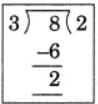
Multiply and reduce to lowest form and convert into a mixed fraction: $\frac{2}{3} \times 4$
Answer$\frac{2}{3} \times 4$
$=\frac{8}{3}=2 \frac{2}{3}$
View full question & answer→Question 422 Marks
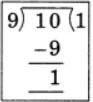
Multiply and reduce to lowest form and convert into a mixed fraction: $5 \times \frac{2}{9}$
Answer$5 \times \frac{2}{9}$
$=\frac{10}{9}=1 \frac{1}{9}$
View full question & answer→Question 432 Marks
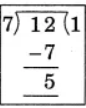
Multiply and reduce to lowest form and convert into a mixed fraction: $2 \times \frac{6}{7}$
Answer$2 \times \frac{6}{7}$
$=\frac{12}{7}=1 \frac{5}{7}$
View full question & answer→Question 442 Marks
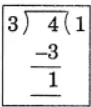
Multiply and reduce to lowest form and convert into a mixed fraction: $4 \times \frac{1}{3}$
Answer$4 \times \frac{1}{3}$
$=\frac{4}{3}=1 \frac{1}{3}$
View full question & answer→Question 452 Marks
Multiply and reduce to lowest form and convert into a mixed fraction: $15 \times \frac{3}{5}$
Answer$15 \times \frac{3}{5}$
= $\frac {45}{5}$ = 9
View full question & answer→Question 462 Marks
Multiply and reduce to lowest form and convert into a mixed fraction: $7 \times \frac{3}{5}$
Answer$7 \times \frac{3}{5}$
$=\frac{21}{5}=4 \frac{1}{5}$
View full question & answer→Question 472 Marks
Each side of a regular polygon is $2.5 \ cm$ in length. The perimeter of the polygon is $12.5 \ cm$. Find the number of sides of the polygon.
AnswerIn a regular polygon, the lengths of all its sides are equal. Perimeter is the sum of the lengths of its sides $= 12.5 \ cm$
Length of each side $= 2.5 \ cm$
$\therefore $ The number of sides of the regular polygon $ = \frac{{12.5}}{{2.5}} = \frac{{125}}{{25}} = 5$
View full question & answer→Question 482 Marks
Sushant reads $\frac{1}{3}$ part of a book in $1$ hour. How much part of the book will he read in $2 \frac{1}{5}$ hours?
AnswerGiven :
The part of the book read by Sushant in $1$ hour $=\frac{1}{3}$
Therefore, the part of the book read by him in $2 \frac{1}{5}$ hours = $2 \frac{1}{5} \times \frac{1}{3}$
$=\frac{11}{5} \times \frac{1}{3}=\frac{11 \times 1}{5 \times 3}=\frac{11}{15}$
View full question & answer→Question 492 Marks
In a class of $40$ students $\frac{1}{5}$ of the total number of students like to study English, $\frac{2}{5}$ of the total number like to study Mathematics and the remaining students like to study Science
$i.$ How many students like to study English?
$ii.$ How many students like to study Mathematics?
$iii.$ What fraction of the total number of students like to study Science?
AnswerHere we shall proceed as follows:
The Total number of students in the class $= 40$
$i.$ Of these $\frac{1}{5}$ of the total number of students like to study English.
Thus, the number of students who like to study English $=\frac{1}{5}$ of $40 \frac{1}{5} \times 40 = 8$
$ii.$ Of these $\frac{2}{5}$ of the total number of students like to study Mathematics.
Thus, the number of students who like to study Mathematics $=\frac{2}{5}$ of $40 = \frac{2}{5} \times 40 = 16$
$iii.$ The number of students who like English and Mathematics $= 8 + 16 = 24$.
Thus, the number of students who like Science $= 40 - 24 = 16$
Thus, the required fraction is $\frac{16}{40}$
View full question & answer→