MCQ 1511 Mark
Reciprocal of the fraction $\frac{2}{3}$ is:
- A
$2$
- B
$3$
- C
$\frac{2}{3}$
- ✓
$\frac{3}{2}$
AnswerCorrect option: D. $\frac{3}{2}$
The reciprocal of a non$-$zero frcation is obtained by interchanging its numerator and denominator.
Hence, the reciprocal of $\frac{2}{3}$ is $\frac{3}{2}$
View full question & answer→MCQ 1521 Mark
Improper fraction of $ \text{12}\frac{1}{6}$ is:
- A
$ \frac{72}{6}$
- ✓
$ \frac{73}{6}$
- C
$ \frac{108}{6}$
- D
$ \frac{85}{6}$
AnswerCorrect option: B. $ \frac{73}{6}$
$\frac{\text{WN}\times\text{D}+\text{N}}{\text{D}}$
$ \frac{12\times6+1}{6} $
$=\frac{72+1}{6} $
$=\frac{73}{6}$
View full question & answer→MCQ 1531 Mark
In an improper fraction, the numerator is always $..........$ the denominator.
AnswerA improper fraction is a fraction in which the numerator is greater than the denominator $,E.g \ \frac{7}{9}$
View full question & answer→MCQ 1541 Mark
A ribbon of length $5\frac{1}{4}\text{m}$ is cut into small pieces each of length $\frac{3}{4}\text{m}$ Number of pieces will be:
Answer Number of pieces
$=\frac{\text{Total length of ribbon}}{\text{Length of one piece}}=\frac{\big(5\frac{1}{4}\big)}{\big(\frac{3}{4}\big)}$
$=\Bigg(\frac{\frac{(5\times4)+1}{4}}{\frac{3}{4}}\Bigg)=\bigg(\frac{\frac{21}{4}}{\frac{3}{4}}\bigg)$
$=\frac{21}{4}\times\frac{4}{3}=7$
$\big[\because\text{reciprocal of}\ \frac{3}{4}=\frac{4}{3}\big]$
View full question & answer→MCQ 1551 Mark
Mark $(\checkmark)$ against the correct answer in the following:
Which one of the following is the correct statement?
- A
$\frac{2}{3}<\frac{3}{5}<\frac{14}{15}$
- ✓
$\frac{3}{5}<\frac{2}{3}<\frac{14}{15}$
- C
$\frac{14}{15}<\frac{3}{5}<\frac{2}{3}$
- D
AnswerCorrect option: B. $\frac{3}{5}<\frac{2}{3}<\frac{14}{15}$
The correct statement will be
$\frac{2}{3},\frac{3}{5},\frac{14}{15}$
$=\frac{10,9,14}{15}$
$LCM$ of $3, 5, 15, = 15$
or $\frac{3}{5}<\frac{2}{3}<\frac{14}{15}$
View full question & answer→MCQ 1561 Mark
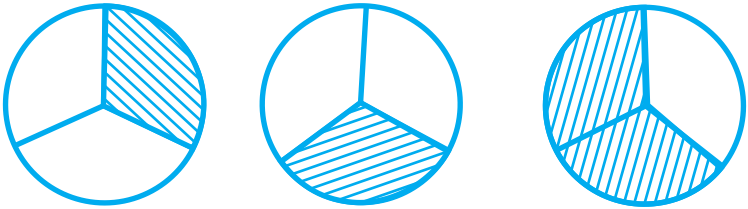
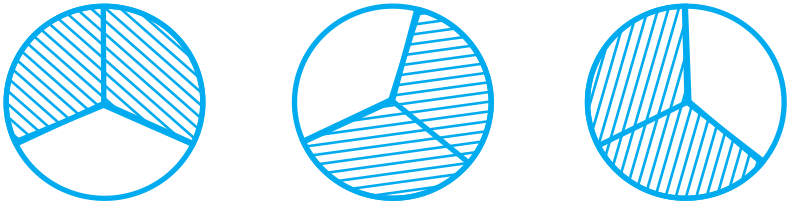
Pictorial representation of $3\times\frac{2}{3}$ is:
Answer$3\times\frac{2}{3}$ means $3$ times the two-third part of anything.
$\therefore$ Option $(b)$ is correct.
View full question & answer→MCQ 1571 Mark
Mark $(\checkmark)$ against the correct answer in the following:
What should be subtracted from $.1$ to get $.04?$
AnswerCorrect option: B. $0.06$
We have
$0.1 - x = 0.04$
$\Rightarrow x = 0.1 - 0.04$
Converting the given decimals into like decimals, we get
$0.10$ and $0.04$
Thus, required number $= (0.10 - 0.04) = 0.06$
Hence, 0.06 should be subtracted from $0.1$ to get $0.04$
View full question & answer→MCQ 1581 Mark
Which is the smallest of the following fractions$?$
- A
$\frac{4}{9}$
- B
$\frac{2}{5}$
- C
$\frac{3}{7}$
- ✓
$\frac{1}{4}$
AnswerCorrect option: D. $\frac{1}{4}$
Consider the fractions $\frac{4}{9},\frac{2}{5}$ and $\frac{1}{4}$
$LCM$ of $4, 5, 7$ and $9 = 1260$
Firstly, convert the fractions into equivalent fractions with denominator $1260$
$\Rightarrow\frac{4}{9}=\frac{4\times140}{9\times140}=\frac{560}{1260}$
$\Rightarrow\frac{2}{5}=\frac{2\times252}{5\times252}=\frac{504}{1260}$
$\Rightarrow\frac{3}{7}=\frac{3\times180}{7\times180}=\frac{540}{1260}$
$\Rightarrow\frac{1}{4}=\frac{1\times315}{4\times315}=\frac{315}{1260}$
Now,
$315<504<540<560$
$\therefore\ \frac{315}{1260}<\frac{504}{1260}<\frac{540}{1260}<\frac{560}{1260}$
$\Rightarrow\frac{1}{4}<\frac{2}{5}<\frac{3}{7}<\frac{4}{9}$
Thus, the smallest fraction is $\frac{1}{4}$
View full question & answer→MCQ 1591 Mark
Which of the following fractions is greater than $\frac{3}{4}$ and less than $\frac{5}{6}?$
- A
$\frac{2}{3}$
- B
$\frac{1}{2}$
- ✓
$\frac{4}{5}$
- D
$\frac{9}{10}$
AnswerCorrect option: C. $\frac{4}{5}$
Consider the fractions $\frac{3}{4},\frac{5}{6},\frac{2}{3},\frac{1}{2},\frac{4}{5}$ and $\frac{9}{10}$
$LCM$ of $2, 3, 4, 5, 6$ and $10 = 60$
Firstly, convert the fractions into equivalent fractions with denominator $60$
$\Rightarrow\frac{3}{4}=\frac{3\times15}{4\times15}=\frac{45}{60}$
$\Rightarrow\frac{5}{6}=\frac{5\times10}{6\times10}=\frac{50}{60}$
$\Rightarrow\frac{2}{3}=\frac{2\times20}{3\times20}=\frac{40}{60}$
$\Rightarrow\frac{1}{2}=\frac{1\times30}{2\times30}=\frac{30}{60}$
$\Rightarrow\frac{4}{5}=\frac{4\times12}{5\times12}=\frac{48}{60}$
$\Rightarrow\frac{9}{10}=\frac{9\times6}{10\times6}=\frac{54}{60}$
Now,
$30<40<45<48<50<54$
$\therefore\ \frac{30}{60}<\frac{40}{60}<\frac{45}{60}<\frac{48}{60}<\frac{50}{60}<\frac{54}{60}$
$\Rightarrow\frac{1}{2}<\frac{2}{3}<\frac{3}{4}<\frac{4}{5}<\frac{5}{6}<\frac{9}{10}$
Thus, the fraction $\frac{4}{5}$ is greater than $\frac{3}{4}$ and less than $\frac{5}{6}$
View full question & answer→MCQ 1601 Mark
Mixed fraction for $ \frac{39}{12}$ is
- A
$ \text{3}\frac{1}{12}$
- B
$ \text{3}\frac{2}{12}$
- ✓
$ \text{3}\frac{3}{12}$
- D
$ \text{2}\frac{14}{12}$
AnswerCorrect option: C. $ \text{3}\frac{3}{12}$
To convert an improper fraction to a mixed fraction,
we divide the numerator by the denominator,
then write down the whole number answer.
Finally we write down any remainder above the denominator.
$39÷12=3$ leaving remainder $3$
The answer will be, $3$ whole $3/12.$
View full question & answer→MCQ 1611 Mark
In the number $0.257,$ which of the following does the digit $7$ represent$?$
AnswerCorrect option: C. $ 7\times\frac{1}{1000}$
The number $0.257$ can be represented as $0.2 + 0.05 + 0.007 .$
Therefore we can see that digit $7$ represents
$ 0.007=7\times\frac{1}{1000}$
View full question & answer→MCQ 1621 Mark
What should be added to $5.09$ to get $5.5?$
- ✓
$0.41$
- B
$0.59$
- C
$0.49$
- D
$0.95$
AnswerCorrect option: A. $0.41$
The decimal number which should be added to $5.09$ to get $5.5$ is obtained by subtracting $5.09$ from $5.5$
Converting the given decimals to like decimals, we have $5.09$ and $5.50$
Now,
$= 5.50 - 5.09$
$= 0.41$
$\therefore$ Required decimal $= 5.50 - 5.09 = 0.41$
Thus, $0.41$ must be added to $5.09$ to get $5.5$
View full question & answer→MCQ 1631 Mark
One packet of biscuits requires $2\frac{1}{2}$ cups of flour and $1\frac{2}{3}$cups of sugar. Estimated total quantity of both ingredients used in $10$ such packets of biscuits will be.
AnswerCorrect option: C. Between $40$ cups and $50$ cups.
Total quantity of both ingredients in one packet of biscuits
$=$ Quantity of flour $+$ Quantity of sugar
$=2\frac{1}{2}\ \text{cups}+1\frac{2}{3}\text{cups}$
$=\frac{(2\times2)+1}{2}+\frac{(1\times3)+2}{3}$
$-\frac{4+1}{2}+\frac{3+2}{3}$
$=\frac{5}{2}+\frac{5}{3}$
$=\frac{5\times3+2\times5}{6}$ $\big[\because\ \text{LCM of 2 and 3 = 6}\big]$
$=\frac{15+10}{6}$
$=\frac{25}{6}$
$\therefore$ Total quantity of both ingredients used in $10$ packets
$= 10\ ×$ Total quantity of ingredients in one packet
$=10\times\frac{25}{6}=\frac{250}{6}$
Since, $\frac{250}{6}$ lies between $40$ and $50.$
View full question & answer→MCQ 1641 Mark
By what number $9\frac{4}{5}$ be multiplied to get $42?$
- ✓
$\frac{30}{7}$
- B
$\frac{7}{30}$
- C
$4\frac{1}{7}$
- D
$4\frac{3}{7}$
AnswerCorrect option: A. $\frac{30}{7}$
Product of two numbers $= 42$
One of the numbers $=9\frac{4}{5}=\frac{49}{5}$
$\therefore$ Other number = Product of two numbers $\div$ One of the numbers
$=42\div\frac{49}{5}$
$=\frac{42}{1}\times\frac{5}{49}$
$=\frac{6\times5}{1\times7}$
$=\frac{30}{7}$
View full question & answer→MCQ 1651 Mark
$0.3 \times 0.3 \times 0.3 =$
AnswerCorrect option: C. $0.027$
We have,
$3 \times 3 \times 3 = 27$
The sum of the decimal places in the given decimals is $1 + 1 + 1 = 3$
So, the product must contain 3 places of decimals.
$\therefore 0.3 \times 0.3 \times 0.3 = 0.027$
View full question & answer→MCQ 1661 Mark
$2\frac{3}{5}\div\frac{5}{7}=$
- A
$\frac{13}{7}$
- B
$\frac{13}{25}$
- ✓
$\frac{91}{25}$
- D
$\frac{25}{91}$
AnswerCorrect option: C. $\frac{91}{25}$
$2\frac{3}{5}\div\frac{5}{7}$
$=\frac{13}{5}\div\frac{5}{7}$
$=\frac{13}{5}\times\frac{7}{5}$
$=\frac{13\times7}{5\times5}$
$=\frac{91}{25}$
View full question & answer→MCQ 1671 Mark
The difference of place value of $6$ in the number $626.235$ is
- A
$496$
- B
$606$
- ✓
$594$
- D
$60.6$
Answer$626.235$
There are two $6s$ in this number, one at Hundreds place and other at Ones place.
$ \Rightarrow$ Place values of $ 6=6\times100$ and $ 6\times1$
Difference $= 600 - 6 = 594$
View full question & answer→MCQ 1681 Mark
Which of the following statements is $\text{CORRECT}?$
- A
$14$ tenths $4$ thousandths $= 0.144$
- B
$2$ tenths $13$ hundredths $= 0.213$
- C
$4$ hundredths $2$ tenths $= 0.024$
- ✓
$7$ tenths $17$ hundredths $= 0.87$
AnswerCorrect option: D. $7$ tenths $17$ hundredths $= 0.87$
Let us check with all options:
$a. 14$ tenths $4$ thousandths $= \frac{14}{10}+\frac{4}{1000} =\text{1.4} + \text{0.004}=\text{1.404.}$
$b. 2$ tenths $13$ hundredths $= \frac{2}{10}+\frac{13}{100}= \text{0.33}.$
$c. 4$ hundredths $2$ tenths $ =\frac{4}{100}+\frac{2}{10}= \text{0.24}.$
$d. 7$ tenths $17$ hundredths $= \frac{7}{10}+\frac{17}{100}= \text{0.87.}$
View full question & answer→MCQ 1691 Mark
Convert into decimals $ \frac{4}{10}+\frac{2}{1000}=\ .........$
- A
$40.2$
- B
$402$
- ✓
$0.402$
- D
$4.02$
AnswerCorrect option: C. $0.402$
$=\frac{4}{10}+\frac{2}{1000}=0.4 + 0.002=0.402$
View full question & answer→MCQ 1701 Mark
A terminating decimal is:
AnswerAccording to the definition of rational number, The decimal expansion of a rational number always either terminates after a finite number of digit or begins to repeat the same finite sequence of digits over and over.
View full question & answer→MCQ 1711 Mark
Mixed fraction of $ \frac{39}{12}$ is
- A
$ \text{3}\frac{1}{12}$
- B
$ \text{3}\frac{2}{12} $
- ✓
$ \text{3}\frac{3}{12}$
- D
$ \text{2}\frac{14}{12}$
AnswerCorrect option: C. $ \text{3}\frac{3}{12}$
A Mixed Fraction is a whole number and a proper fraction combined. Divide the numerator by the denominator. Write down the whole number answerThen write down any remainder above the denominator. $ \frac{39}{12}=\frac{36}{12}+\frac{3}{12}=\text{3 +}\frac{3}{12}=\text{3}\frac{3}{12} $
View full question & answer→MCQ 1721 Mark
Mark $(\checkmark)$ against the correct answer in the following:
Which of the following is correct?
- A
$\frac{2}{3}<\frac{3}{5}<\frac{11}{15}$
- ✓
$\frac{3}{5}<\frac{2}{3}<\frac{11}{15}$
- C
$\frac{11}{15}<\frac{3}{5}<\frac{2}{3}$
- D
$\frac{3}{5}<\frac{11}{15}<\frac{2}{3}$
AnswerCorrect option: B. $\frac{3}{5}<\frac{2}{3}<\frac{11}{15}$
The given fractions are $\frac{2}{3},\frac{3}{5}$ and $=\frac{11}{15}$
$[LCM$ of $5, 3$ and $15 = 15]$
Now, we have:
$\frac{3}{5}\times\frac{3}{3}=\frac{9}{15},\frac{2\times5}{3\times5}$
$=\frac{10}{15}$ and $\frac{11}{15}$
Clearly,
$\frac{9}{15}<\frac{10}{15}<\frac{11}{15}$
$\therefore\frac{3}{5}<\frac{2}{3}<\frac{11}{15}$
View full question & answer→MCQ 1731 Mark
The ascending arrangement of $\frac{2}{3},\frac{6}{7},\frac{13}{21}$ is:
- A
$\frac{6}{7},\frac{2}{3},\frac{13}{21}$
- ✓
$\frac{13}{21},\frac{2}{3},\frac{6}{7}$
- C
$\frac{6}{7},\frac{13}{21},\frac{2}{3}$
- D
$\frac{2}{3},\frac{6}{7},\frac{13}{21}$
AnswerCorrect option: B. $\frac{13}{21},\frac{2}{3},\frac{6}{7}$
Given, $\frac{2}{3},\frac{6}{7},\frac{13}{21}$
$LCM$ of $(3, 7, 21) = 21$
$\therefore\frac{2}{3}=\frac{2}{3}\times\frac{7}{7}=\frac{14}{21}$
$\frac{6}{7}=\frac{6}{7}\times\frac{3}{3}=\frac{18}{21}$
and $\frac{13}{21}=\frac{13}{21}$
Now, compare $\frac{14}{21},\frac{18}{21}\text{and}\frac{13}{21}$
$\text{So},\frac{13}{21}<\frac{14}{21}<\frac{18}{21}$
Hence, $\frac{13}{21}<\frac{2}{2}<\frac{96}{7}$ (ascending order)
Note with same denominators, fraction with larger numerator is greater.
View full question & answer→MCQ 1741 Mark
$0.25 \times 0.8 =$
- A
$0.02$
- ✓
$0.2$
- C
$0.002$
- D
$2$
AnswerIn order to find the product, we first multiply $8$ by $25$
We have, $25 \times 8 = 200$
Now, $0.25$ has $2$ decimal places and $0.8$ has $1$ decimal place.
The sum of the decimal places is $2 + 1 = 3$
So, the product must contain $3$ places of decimals.
$\therefore\ 0.25\times0.8$
$=0.200$
$=0.2$
View full question & answer→MCQ 1751 Mark
Which one of the following is true$?$
- A
$\frac{1}{2}<\frac{9}{13}<\frac{3}{4}<\frac{12}{17}$
- B
$\frac{3}{4}<\frac{9}{13}<\frac{1}{2}<\frac{12}{17}$
- C
$\frac{1}{2}<\frac{3}{4}<\frac{9}{13}<\frac{12}{17}$
- ✓
$\frac{1}{2}<\frac{9}{13}<\frac{12}{17}<\frac{3}{4}$
AnswerCorrect option: D. $\frac{1}{2}<\frac{9}{13}<\frac{12}{17}<\frac{3}{4}$
Consider the fractions $\frac{1}{2},\frac{9}{13},\frac{3}{4}$ and $\frac{12}{17}$
$LCM$ of $2, 4, 13$ and $17 = 884$
Firstly, convert the fractions into equivalent fractions with denominator $884$
$\Rightarrow\frac{1}{2}=\frac{1\times442}{2\times442}=\frac{442}{884}$
$\Rightarrow\frac{9}{13}=\frac{9\times68}{13\times68}=\frac{612}{884}$
$\Rightarrow\frac{3}{4}=\frac{3\times221}{4\times221}=\frac{663}{884}$
$\Rightarrow\frac{12}{17}=\frac{12\times52}{17\times52}=\frac{624}{884}$
Now,
$442<612<624<663$
$\therefore\ \frac{442}{884}<\frac{612}{884}<\frac{624}{884}<\frac{663}{884}$
$\frac{1}{2}<\frac{9}{13}<\frac{12}{17}<\frac{3}{4}$
View full question & answer→MCQ 1761 Mark
Mark $(\checkmark)$ against the correct answer in the following:
$70\ g = ?$
- A
$0.7\ kg$
- ✓
$0.07\ kg$
- C
$0.007\ kg$
- D
AnswerCorrect option: B. $0.07\ kg$
$70\text{g}=\frac{70}{1000}0.07\text{g}$
View full question & answer→MCQ 1771 Mark
When $0.48$ is written in the simplest from of its terms, the sum of its numerator and denominator is:
Answer$=0.48$
$=\frac{48}{100}$
$=\frac{48\div4}{100\div4} (HCF$ of $48$ and $100 = 4)$
$=\frac{12}{25}$
Here,
Numberator $= 12$
Denominator $= 25$
$\therefore$ Sum of the numerator and denominator $= 12 + 25 = 37$
View full question & answer→MCQ 1781 Mark
$4 + 4.4 + 44.4 + 4.04 + 444 =$
- ✓
$500.88$
- B
$577.2$
- C
$495.22$
- D
$472.88$
AnswerCorrect option: A. $500.88$
$500.88$
View full question & answer→MCQ 1791 Mark
$0.34$ can be represented as
- ✓
$ \frac{34}{100}$
- B
$ \frac{34}{1000}$
- C
$ \frac{34}{10}$
- D
AnswerCorrect option: A. $ \frac{34}{100}$
View full question & answer→MCQ 1801 Mark
Mark $(\checkmark)$ against the correct answer in the following:
$0.06 = ?$
- A
$\frac{3}{5}$
- ✓
$\frac{3}{50}$
- C
$\frac{3}{500}$
- D
AnswerCorrect option: B. $\frac{3}{50}$
$0.06=\frac{06}{100}=\frac{3}{50}$
View full question & answer→MCQ 1811 Mark
State $T$ for true and $F$ for false.
$(i).$ Every rational number can be expressed with a positive numerator.
$(ii). \frac{3}{11}$ cannot be represented as a non$-$terminating repeating decimal.
$(iii).$ If $ \frac{\text{p}}{\text{q}}$ and $\frac{\text{r}}{\text{s}}$ are two terminating decimals, then $ \frac{\text{p}}{\text{q}}\times\frac{\text{r}}{\text{s}}$ is also a terminating decimal.
$(iv).$ If $\frac{\text{p}}{\text{q}}$ is non$-$terminating repeating decimal and $\frac{\text{r}}{\text{s}}$ is a terminating decimal, then $\Big(\frac{\text{p}}{\text{q}}\div\frac{\text{r}}{\text{s}}\Big)$ is a terminating decimal.
- A
$\ce{F, F, F, T}$
- B
$\ce{F, T, F, T}$
- ✓
$\ce{T, F, T, F}$
- D
$\ce{T, F, F, T}$
AnswerCorrect option: C. $\ce{T, F, T, F}$
$1.$ Every number can be represented by positive integer. For example $ =\frac{5}{(-7)}=\frac{-5}{7}$
$2. \frac{3}{11}$ can be represented as terminating repeating decimal as $0.27$
$3.$ Let two terminating decimals by $ \frac{3}{12}$ and $ \frac{4}{12}$ then $ \frac{3}{12}\times\frac{4}{12}$ is also terminating decimal.
$4.$ Let, $ \frac{3}{12}$ and $ \frac{1}{3}$ then $ \frac{3}{12}\times\frac{1}{3}=\frac{1}{12}$ is a also non$-$terminating decimal.
View full question & answer→MCQ 1821 Mark
Which of the following is improper fraction?
- A
$ \frac{1}{3}$
- ✓
$ \frac{4}{3}$
- C
$ \frac{3}{5}$
- D
AnswerCorrect option: B. $ \frac{4}{3}$
A fraction in which the numerator is greater than the denominator is called an improper fraction.
View full question & answer→MCQ 1831 Mark
Find the value of :$ \frac{(0.0036)(2.8)}{(0.04)(0.1)(0.003)}$
- ✓
$840.0$
- B
$84.0$
- C
$8.4$
- D
$0.84$
AnswerCorrect option: A. $840.0$
The given expression can be simplified as follows:
$ \frac{(0.0036)(2.8)}{(0.04)(0.1)(0.003)}$
$ =\frac{0.0036\times2.8}{0.04\times0.1 \times 0.003}=$
$ \frac{0.01008}{0.000012}=840$
Hence, the value of $ \frac{(0.0036)(2.8)}{(0.04)(0.1)(0.003)}$ is $ 840$
View full question & answer→MCQ 1841 Mark
The fraction $\frac{84}{98}$ in its lowest terms is:
- A
$\frac{42}{49}$
- B
$\frac{12}{14}$
- ✓
$\frac{6}{7}$
- D
$\frac{3}{7}$
AnswerCorrect option: C. $\frac{6}{7}$
Factors of $84: 1, 2, 3, 4, 6, 7, 12, 14, 21, 28, 42, 84$
Factors of $98: 1, 2, 7, 14, 49, 98$
Common factors of $84$ and $98: 1, 2, 14$
$\therefore HCF$ of $84$ and $98 = 14$
Now,
$\frac{84}{98}=\frac{84\div14}{98\div14}=\frac{6}{7} ($Dividing numerator and senominator by the $HCF$ of $84$ and $98$ i.e., $14)$
View full question & answer→MCQ 1851 Mark
$75.57\div0.01=$
- ✓
$7557$
- B
$0.7557$
- C
$755.7$
- D
$7.557$
AnswerCorrect option: A. $7557$
$=75.57\div0.01$
$=\frac{75.57}{0.01}$
$=\frac{75.57\times100}{0.01\times100} ($Multiply numerator and denominator by $100$ to convert the divisor$)$
$=\frac{7557}{1}$
$=7557$
View full question & answer→MCQ 1861 Mark
Mark $(\checkmark)$ against the correct answer in the following: Which of the following statements is true?
- A
$\frac{9}{16}=\frac{13}{24}$
- B
$\frac{9}{16}<\frac{13}{24}$
- ✓
$\frac{9}{16}>\frac{13}{24}$
- D
AnswerCorrect option: C. $\frac{9}{16}>\frac{13}{24}$
$\frac{9}{16}=\frac{13}{24}$
$\Rightarrow9\times24 < 13\times16$
$\Rightarrow216=208,$ which is not true.
$\frac{9}{16} < \frac{13}{24}$
$\Rightarrow9\times24 > 13\times16$
$\Rightarrow216 > 208$ Which is true.
View full question & answer→MCQ 1871 Mark
$4\frac{1}{3}-2\frac{1}{3}=$
- A
$2\frac{1}{3}$
- ✓
$2$
- C
$3\frac{1}{3}$
- D
$\frac{1}{2}$
Answer$=4\frac{1}{3}-2\frac{1}{3}$
$=\frac{13}{3}-\frac{7}{3}$
$=\frac{13-7}{3}$
$=\frac{6}{3}$
$=2$
View full question & answer→MCQ 1881 Mark
In improper fraction the numerator is always $........$ the denominator
AnswerIn an improper fraction, the numerator is always greater than the denominator. Hence, the answer is greater than.
View full question & answer→MCQ 1891 Mark
The product of $0.03 \times 0.9$ is:
- A
$2.7$
- B
$0.27$
- ✓
$0.027$
- D
$0.0027$
AnswerCorrect option: C. $0.027$
Given, $0.03 × 0.9$
Here, $3 × 9 = 27$
Sum of the decimal places to the right of the decimal point is $0.03$ and $0.09$ is $3$
So, $0.03 × 0.9 = 0.027$
View full question & answer→MCQ 1901 Mark
Which of the following is not an improper fraction$?$
- A
$ \frac{4}{3}$
- B
$ \frac{3}{2}$
- C
$ \frac{5}{3}$
- ✓
$ \frac{7}{11}$
AnswerCorrect option: D. $ \frac{7}{11}$
In improper fractions, the Numerator is always greater than the denominator. In $ \frac{7}{11},$ the numerator $7$ is smaller than the denominator $11.$
Therefore, $ \frac{7}{11}$ is not an improper fraction.
View full question & answer→MCQ 1911 Mark
$5\ km\ 5\ m = ?$
- A
$5.5\ km$
- B
$5.05\ km$
- ✓
$5.005\ km$
- D
$5.0005\ km$
AnswerCorrect option: C. $5.005\ km$
We know that,
$1\text{m}=\frac{1}{1000}\text{km}$
Now,
$5\text{km 5m}=5\text{km}+5\text{m}$
$=5\text{km}+\frac{5}{1000}\text{km}$
$=5\text{km}+0.005\text{km}$
$=5.005\text{km}$
$\therefore\ 5\text{km 5m}$
$=5.005\text{km}$
View full question & answer→MCQ 1921 Mark
The smallest fraction which should be subtracted from the sum of $ \text{1}\frac{3}{4}, \text{2}\frac{1}{2}, \text{5}\frac{7}{12}, \text{3}\frac{1}{3},$ and $ \text{2}\frac{1}{4}$ to make the result a whole number, is $.......$
- ✓
$ \frac{5}{12}$
- B
$ \frac{7}{12}$
- C
$ \frac{1}{2}$
- D
${7}$
AnswerCorrect option: A. $ \frac{5}{12}$
$ \Rightarrow\text{1}\frac{3}{4} + \text{2}\frac{1}{2} +\text{5}\frac{7}{12}+ \text{3}\frac{1}{3}+ \text{2}\frac{1}{4}$
$= \frac{7}{4} + \frac{5}{2} + \frac{67}{12} + \frac{10}{3} + \frac{9}{4}$
$ =\frac{21+30+67+ 40 + 27 }{12}$
$ =\frac{185}{12}$
$= \text{5}\frac{5}{12}$
$ \therefore$ The smallest fraction which should be subtracted from the sum of $ \text{1}\frac{3}{4}, \text{2}\frac{1}{2}, \text{5}\frac{7}{12}, \text{3}\frac{1}{3}$ and $ \text{2}\frac{1}{4}$ to make the result a whole number is $ \frac{5}{12}$.
View full question & answer→MCQ 1931 Mark
$ \text{1}\frac{3}{4}$ is a which type of fraction?
Answer$ \text{1}\frac{3}{4}$ is a mixed fraction.
View full question & answer→MCQ 1941 Mark
$0.012\div1.5=?$
AnswerCorrect option: C. $0.008$
$=0.012\div1.5$
$=\frac{0.012}{1.5}$
$=\frac{0.012\times10}{1.5\times10}($ Multiply the numberator and denominator by $10$ to convert the divison$)$
$=\frac{0.12}{15}$
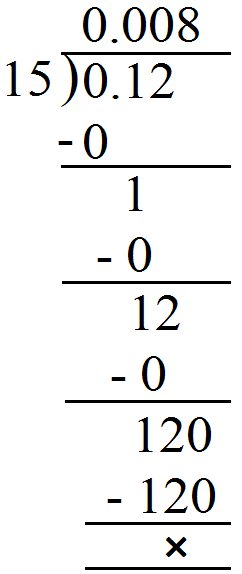
$\therefore\ 0.012\div1.5=0.008$
View full question & answer→MCQ 1951 Mark
What is $6050.287$ rounded to the nearest tenths$?$
- A
$6050$
- B
$6100$
- C
$6050.29$
- ✓
$6050.3$
AnswerCorrect option: D. $6050.3$
To round to the nearest tenth, write down the number with a decimal point, and find the tenths place directly to the right of the decimal. Then, to the right of the tenths place, look at the number in the hundredths place. In $6050.287$ the number in the hundredths is $2.$
So, $6050.287$ rounded to the nearest tenths will be $6050.3$
View full question & answer→MCQ 1961 Mark
Which of the following fraction is an irreducible (or in its lowest terms)?
- A
$\frac{91}{104}$
- B
$\frac{105}{112}$
- C
$\frac{51}{85}$
- ✓
$\frac{43}{83}$
AnswerCorrect option: D. $\frac{43}{83}$
We know that a fraction is irreducible (or is in its lowest terms) if the $HCF$ of its numerator and denominator is $1.$
Consider the fraction $\frac{91}{104}$
$HCF$ of $91$ and $104=13\neq1$
So, the fraction $\frac{91}{104}$ is reducible.
Consider the fraction $\frac{105}{112}$
$HCF$ of $105$ and $112=7\neq1$
So, the fraction $\frac{105}{112}$ is reducible.
Consider the fraction $\frac{51}{85}$
$HCF$ of $51$ and $85=17\neq1$
So, the fraction $\frac{51}{85}$ is reducible.
Now,
Consider the fraction $\frac{43}{83}$
$HCF$ of $43$ and $83 = 1$
So, the fraction $\frac{43}{83}$ is irreducible (or is in its lowest terms).
View full question & answer→MCQ 1971 Mark
Convert $0.55$ in to a fraction.
- ✓
$ \frac{11}{20}$
- B
$ \frac{2}{9}$
- C
$ \frac{3}{9}$
- D
$ \frac{4}{9}$
AnswerCorrect option: A. $ \frac{11}{20}$
$ 0.55=\frac{55}{100}=\frac{11}{20}$
View full question & answer→MCQ 1981 Mark
$ \text{10}\frac{2}{10}=\ .......$
- A
$100.2$
- B
$10.10$
- ✓
$10.2$
- D
$102.10$
AnswerCorrect option: C. $10.2$
$ \text{10}\frac{2}{10} ⇒\text{10}\frac{2}{10}=\frac{102}{10}=10.2$
View full question & answer→MCQ 1991 Mark
Mark $(\checkmark)$ against the correct answer in the following:
$2\ km\ 5\ m = ?$
- A
$2.5\ km$
- B
$2.05\ km$
- ✓
$2.005\ km$
- D
$2.0005\ km$
AnswerCorrect option: C. $2.005\ km$
$2\text{km }5\text{m}=2\frac{5}{1000}\text{km}=2.005\text{km}$
View full question & answer→MCQ 2001 Mark
Convert $ \frac{7}{4}$ into mixed fraction.
- ✓
$ \text{1}\frac{3}{4}$
- B
$ \text{2}\frac{3}{4}$
- C
$ \text{6}\frac{3}{4}$
- D
AnswerCorrect option: A. $ \text{1}\frac{3}{4}$
$ \frac{7}{4} = \text{1}\frac{3}{4}$
View full question & answer→